Greyhound racing's second century: the betting economy behind a shrinking sport
Greyhound racing evolved from a mass spectator attraction into a supply chain for bookmakers' screens. An AskSpinner analysis of British betting and welfare data, commercial disclosures and contrasting legal systems examines what now sustains the industry—and who pays for dogs when racing contracts or ends.
 19 Min Read
Overview
- Britain's modern track-racing centenary conceals a change of customer: the paying crowd is no longer the only market; bookmakers buy scheduled racing content.
- UKGC data show British betting-shop greyhound stakes fell 11.8% in 2025–26; remote greyhound stakes also declined, rather than fully replacing that loss.
- GBGB's lower long-run injury count partly accompanies fewer runs; racecourse euthanasia rose in 2025.
- Commercial media-rights payments, voluntary welfare contributions and public subsidy are different revenue streams, not interchangeable “levies”.
- A country-by-country status check sets out where greyhound racing has been banned, is awaiting commencement, has been reversed, or continues under a government phase-out target.
Greyhound racing is not simply a declining spectator sport awaiting a decision about animal welfare. It is also a content-production business whose customers include bookmakers, broadcasters and betting platforms. That second business helps explain why a race can remain commercially useful even when few people are watching from the stands.
It also creates the industry's central financial dilemma. If welfare is funded partly by betting, a reduction in betting can weaken the money available to protect dogs. But expanding the racing product to generate more money is not, by itself, proof of better welfare. The relevant questions are how much money reaches care, how risks are measured, and whether retirement obligations survive the loss of a track's commercial contract.
This report combines an original extraction of the Gambling Commission's latest channel-level betting tables with GBGB's injury and retirement series, company disclosures and a comparative legal review. It is not a new report of a nationwide British ban. AskSpinner's related account of Britain's divergent prohibition laws covers that immediate legislative story.
1. From coursing to an urban night out
Modern stadium racing developed from an older tradition of dogs pursuing hares, but the mechanical lure transformed the activity into a repeatable track event. GBGB's centenary history dates Britain's first modern race to July 24, 1926, at Belle Vue in Manchester. The historical distinction matters: the industry's centenary concerns this stadium format, not the origin of the greyhound breed or all forms of coursing.
Historian Keith Laybourn's research on greyhound racing and working-class leisure describes an American-derived model, urban accessibility, evening entertainment and relatively inexpensive admission. His account puts official-track attendance at about 38 million visits in 1936. These are admissions, not distinct people, and historical series covering official tracks should not be mixed with estimates including independent meetings.
The economic attraction was not only speed. A stadium could package races, a betting market, food and social entertainment into an evening close to industrial neighbourhoods. Owners and trainers supplied the animals; operators monetised both the gathering and the gambling associated with it.
The postwar decline did not have a single cause. Laybourn records taxation pressures and a movement of betting away from the course. Britain's legal betting-shop era, beginning in 1961, made a visit to the track less necessary to place a wager. His historical account traces this shift; it does not establish that every subsequent closure had the same cause. Changes in leisure, property economics and individual venue costs cannot be reduced to one national explanation.
The pivotal development was that off-course betting could remove customers from the terraces while creating a different customer for the races themselves.
2. BAGS: racing commissioned for the betting shop
The clearest description comes not from a campaign leaflet but from the competition regulator's record of a February 2016 hearing with BAGS.
BAGS—the Bookmakers' Afternoon Greyhound Services—told the Competition and Markets Authority that it was a not-for-profit company founded in 1967. It established schedules, contracted with tracks to stage meetings and sold media rights to SIS for transmission to licensed betting offices. It said it normally broadcast about 30,000 races annually at that time, compared with fewer than 15,000 roughly fifteen years earlier. Those are dated statements to an inquiry, not a count of today's British races.
One detail exposes the model. BAGS said it tended to pay more for morning and afternoon meetings because they were organised specifically for broadcast and media-rights fees were “almost their only source of revenue”. It also described adapting evening meetings around summer horse racing and taking bookmaker feedback into account when renewing contracts.
The race meeting had become a commissioned input to another business. A bookmaker needed scheduled, bettable events during trading hours; a track could sell that supply even without a large gate. This is the economic meaning of “betting-shop racing”. It does not mean that every meeting lacks spectators, or that racing is virtual: real dogs, track staff and veterinary obligations remain behind the screen.
Nor should BAGS be treated as the current universal legal counterparty. It describes a historical model; today's rights arrangements must be checked against contemporary providers and contracts.
3. The screen business: SIS, ARC and Entain
An ARC announcement dated March 19, 2021 documented an Entain–Arena Racing joint venture for greyhound media rights scheduled to operate from January 2024 through December 2029. The arrangement would license content to Entain and other domestic and international betting operators. Its original track list included bookmaker-owned venues as well as ARC and independent venues.
The structure can put a bookmaker on more than one side of the transaction: an operator can sell bets to customers while a related business owns tracks or participates in the commercialisation of their pictures. That is vertical integration, not proof of race manipulation or unlawful conduct.
In a May 2024 scheduling announcement, SIS and Premier Greyhound Racing described coordination of race times. SIS identified long-term supply agreements with bet365, William Hill, Paddy Power and Betfred across British and Irish retail and digital channels. The publication demonstrates that scheduling is part of the product sold to bookmakers, not merely an internal sporting calendar.
The May 2024 announcement's ownership numbers are historical. A statement that the partners owned a certain share of the tracks in 2024 cannot be pasted into a 2026 ownership census after closures and replacements. GBGB's racecourse page, checked for this report, says there are 16 licensed stadia. That is GBGB's published licensed-network count, not a count of every independent track, training venue or active media contract in the United Kingdom.
Commercial rights payments buy a service and access to content. They must be distinguished from the separate welfare contribution discussed below. The disclosures reviewed here do not reveal the entire industry's current rights revenue, individual track margins or all contract prices. They cannot support a precise claim about the proportion of each track's revenue that comes from broadcasting today.
4. What the latest betting data actually show
The Gambling Commission's September 2026 industry statistics, covering April 2025–March 2026, provide a firmer test than descriptions of an online boom. AskSpinner extracted the “Dogs” columns from the accompanying workbook. The latest year is marked provisional; prior years can be revised.
British greyhound betting by reported channel
Channel | 2023–24 turnover | 2024–25 turnover | 2025–26 turnover | 2025–26 GGY |
|---|---|---|---|---|
Off-course counter, non-remote | £792.1m | £672.7m | £593.4m | £112.1m |
Remote betting, Dogs category | £640.6m | £601.3m | £583.6m | £71.5m |
On-course betting, non-remote | £10.4m | £15.4m | £10.7m | £0.8m |
Pool betting, non-remote | £15.2m | £15.8m | £18.2m | £6.0m |
Source: UKGC Industry Statistics September 2026 workbook, tables 6a, 10b, 6b and 6c respectively. Money is nominal GBP, rounded to one decimal million; comparisons use unrounded cells. The categories are retained as reported rather than re-labelled as one universal “handle”.
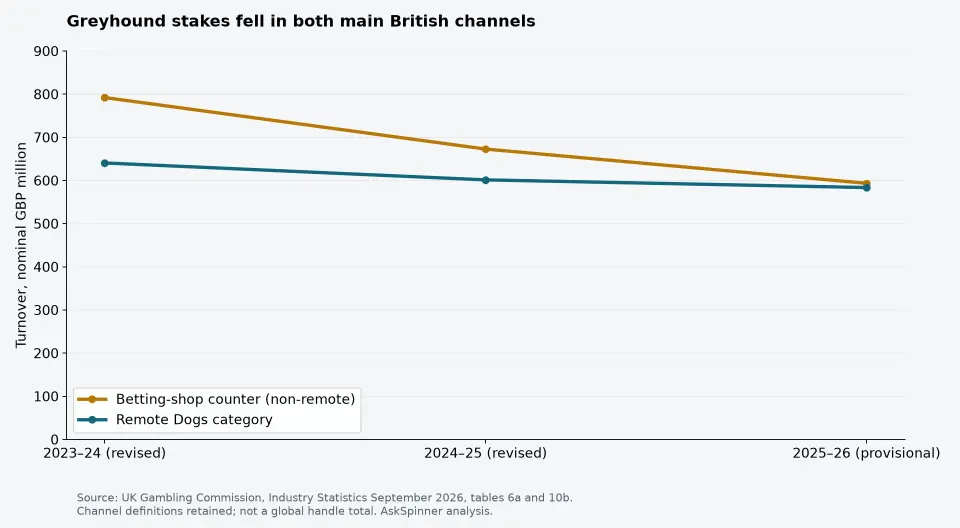
Counter stakes fell 11.8% in the latest year and 25.1% against 2023–24. Remote Dogs turnover fell 2.9% year on year. These are AskSpinner calculations from those tables. Online distribution remains substantial, but this interval does not show online growth offsetting the retail loss.
Turnover is money staked, not bookmaker profit and not revenue received by tracks. GGY is the regulator's gambling-yield measure, not operating profit after rights fees, taxes, staff and other costs. In the counter category, GGY was about 18.9% of turnover in 2025–26, calculated from the same cells; this observed aggregate ratio is not a promised return, a universal odds margin or an individual bettor's expected result.
Remote exchange turnover also requires care: the workbook's remote breakdown reports no exchange stakes in its overall turnover field while reporting exchange GGY separately. Adding commercial turnover claims or matched exchange stakes from another source could therefore create incompatible totals. This report keeps channels visible rather than presenting a supposedly comprehensive worldwide betting figure.
The wider retail distribution network is shrinking too. UKGC reports 5,617 British betting shops at March 2026, down from 5,825 a year earlier. Those are all betting shops, not greyhound-only premises. They show a distribution pressure, not a direct measure of greyhound audiences.
5. A separate money stream: the voluntary BGRF contribution
The British Greyhound Racing Fund requests a contribution of 0.6% of greyhound betting turnover under the current industry agreement. Matched or exchange betting uses a different calculation. The arrangement is voluntary: it is not a tax on every pound staked anywhere in the world, and it is not 0.6% of bookmakers' profits.
The fund's 2024–25 chairman's statement reports £6.75 million in income, compared with £7.3 million in the previous year. It says contributions are collected six months in arrears, making a direct comparison with a different UKGC reporting year misleading. The statement says grants focus almost entirely on welfare or welfare-related matters and describes GBGB seeking higher contributions or a statutory levy.
The same statement identifies an uncomfortable production problem: the chairman argues that too many meetings and short fields weaken the betting product. Those are the fund chairman's commercial assessments, not an independent estimate of the optimal number of races or dogs.
The dependency runs in a loop. Tracks need revenue to pay for operations; owners and trainers need a viable racing programme; welfare needs funding even for dogs that no longer race. If a funding mechanism depends on current betting turnover, a commercial contraction can reduce its receipts while the stock of retired dogs still requires care. That is a structural exposure, not evidence that a particular charity or regulator is presently insolvent.
A statutory racing-welfare levy could make payment compulsory and more predictable. It would not automatically settle how much is needed, who controls spending or what happens after racing ends. It is also distinct from Britain's statutory levy for preventing and treating gambling harms.
6. Welfare: fewer injuries do not answer every question
GBGB publishes an injury and retirement dataset for 2018–2025. The figures are industry-regulator data; the document says Barnes Roffe Advisory performed certain verification procedures under an agreed-upon-procedures engagement. That wording should not be inflated into a comprehensive independent welfare audit.
GBGB measure | 2018 | 2024 | 2025 |
|---|---|---|---|
Dog runs | 426,139 | 355,682 | 330,836 |
Recorded injuries | 4,963 | 3,809 | 3,648 |
Injuries / runs, published rate | 1.16% | 1.07% | 1.10% |
Euthanasia at racecourse | 242 | 123 | 161 |
Total deaths in the death table | 932 | 386 | 406 |
Total retirements in retirement table | 6,773 | 5,795 | 5,186 |
Source: GBGB 2018–2025 injury/retirement PDF. “Total deaths” includes categories outside racecourse euthanasia; it must not be presented as dogs killed by racing injuries. Runs are appearances, not races or unique dogs.
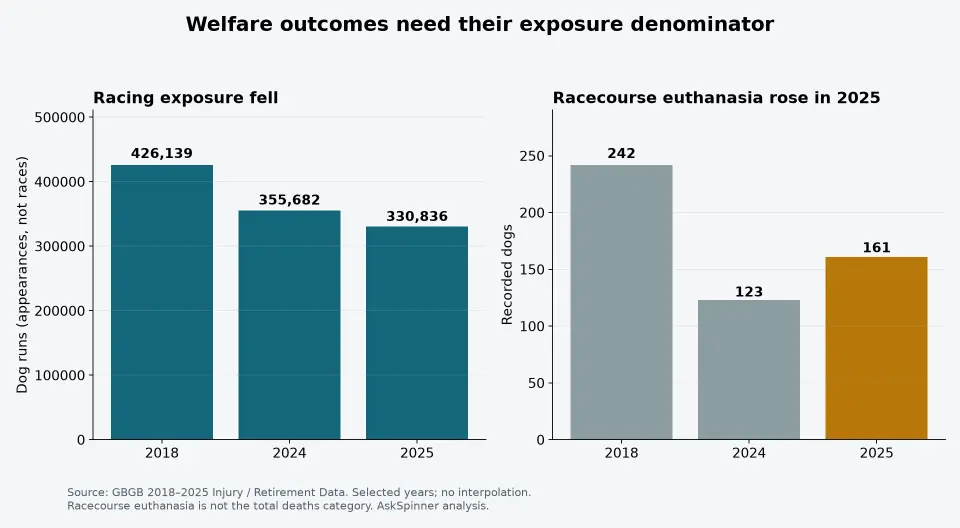
From 2018 to 2025, runs declined 22.4% and recorded injuries 26.5%, calculated from GBGB's figures. There is a genuine fall in the injury count, but less racing exposure accounts for part of it. The published injury rate also fell over that longer interval, while rising slightly between 2024 and 2025.
More importantly, racecourse euthanasia increased from 123 to 161 in the latest year—an increase of 30.9%, calculated from the published counts. The rounded rate rose from 0.03% to 0.05%. The long-term comparison with 2018 looks better; the latest annual movement looks worse. Neither observation cancels the other.
The dataset records 406 total deaths in 2025, including 161 racecourse euthanasias, 93 sudden deaths and 74 non-racecourse euthanasias on veterinary advice. It also records 35 dogs designated unsuitable for homing and two euthanised in the treatment-cost category. These categories are not all evidence of the same cause of death, and the table is not a lifetime census of every dog ever bred for racing.
Retirement has its own measurement trap. Of 5,186 retirements in 2025, 3,532 were classified Greyhound Trust/charity, 882 retained by owner/trainer, 582 rehomed by owner/trainer, 179 breeding and 11 other. Entering a charity is not the same event as entering a permanent domestic home. An intake statistic cannot by itself measure time spent waiting or lifelong outcomes.
GBGB's June 2026 release argues that regulation has delivered substantial improvements and says its welfare strategy remains funded and within budget. It describes a £420 retirement bond, funded jointly by owner and GBGB and passed to an approved homing centre. A contribution at transfer is not proof that all lifetime care costs are covered.
The policy argument is therefore not simply whether a small percentage sounds acceptable. It is whether avoidable harm can be reduced sufficiently, whether welfare is tracked before and after the racing career, and whether obligations remain enforceable when commercial demand disappears.
7. Britain: a layered regulator, not one national legal answer
GBGB is the sport's governing and regulatory body, not the Gambling Commission and not a government department. Betting regulation and animal-welfare regulation address different activities.
In England, the Welfare of Racing Greyhounds Regulations 2010 establish a track-operator licensing framework. Regulation 3 provides an exemption from the local-authority licensing requirement where an accredited regulatory body supervises the track and requires compliance with the licensing conditions. The schedule covers veterinary attendance and facilities, kennels, identification and records, including injuries. This is not a statutory guarantee that no dog will be injured, nor a reason to assume a non-GBGB venue faces no welfare law.
The current British comparison is more precise than “the UK is banning racing”:
Jurisdiction | Position checked November 8, 2026 | What still matters |
|---|---|---|
Wales | Prohibition Act 2026, asc 11, Royal Assent April 27 | Section 6 requires commencement between April 1, 2027 and April 1, 2030. The window is not an automatic 2027 start plus a grace period. |
Scotland | Greyhound Racing (Offences) Act 2026, asp 15, Royal Assent May 14 | Main offences require ministerial commencement. The October 7 government-published review said they had not commenced; the current legislation record remains prospective for those provisions. |
England | Lisa Smart's Greyhound Racing Bill, a private member's presentation bill | A proposal to prohibit racing, not an enacted ban. Its existence must not be substituted for the present licensing framework. |
Wales regulates organising races and use of venues, with the definition extending to timing or training around a track after a mechanical lure. Scotland's statutory track definition centres on oval tracks and can be expanded by ministers. These differences affect coverage; neither text is simply a ban on placing a bet wherever the race occurs.
8. Where greyhound racing is banned: country-by-country status
There is no single “greyhound racing ban.” Some places have ended commercial racing by statute or by letting a concession expire; some have enacted a prohibition that is not yet in force; some announced a shutdown and later reversed it; others have only a bill or a government target. The table below is a status check against official texts as of November 11, 2026. It is not a complete global inventory. Betting on a race run somewhere else can also be treated differently from staging a race at home.
| Jurisdiction | Status checked November 11, 2026 | Primary source |
|---|---|---|
| Wales | The Prohibition of Greyhound Racing (Wales) Act 2026 has received Royal Assent (April 27), but the main prohibition is not yet in force. Section 6 requires Welsh ministers to bring the remaining provisions into force on a day no sooner than April 1, 2027 and no later than April 1, 2030. | Prohibition of Greyhound Racing (Wales) Act 2026, asc 11 |
| Scotland | The Greyhound Racing (Offences) (Scotland) Act 2026 was passed on March 18 and received Royal Assent on May 14. The main offence, enforcement and penalty provisions still require commencement by Scottish ministers. The legislation record checked for this update continues to mark those provisions as not in force. | Greyhound Racing (Offences) (Scotland) Act 2026, asp 15 |
| England | Lisa Smart’s Greyhound Racing Bill is a private member’s presentation bill to prohibit racing in England. It is not law. First reading was on September 1, 2026; a second reading is listed for March 19, 2027, a date Parliament itself flags as possibly provisional. | Greyhound Racing Bill (UK Parliament, bill 4282); stages |
| New Zealand | The Racing Industry (Closure of Greyhound Racing Industry) Amendment Act 2026 (2026 No 12) received assent on April 9, 2026. The closure provisions in Part 2 came into force on August 1, 2026. | Amendment Act 2026 No 12; Department of Internal Affairs, Racing Policy |
| Florida, United States | The United States has no nationwide federal ban located for this check; status is set by the states. Florida’s Constitution, Article X, section 32, prohibits, after December 31, 2020, a licensed gaming or pari-mutuel operator from racing greyhounds or other dogs in connection with a wager in the state, and prohibits persons in the state from wagering on the outcome of a live dog race occurring in the state. That is not a ban on betting on out-of-state races, and it is not a finding that every other U.S. state has ended racing. | Fla. Const. art. X, § 32 |
| Australian Capital Territory | Greyhound racing and trialling in the ACT have been prohibited from April 30, 2018. Section 18A of the Animal Welfare Act 1992 makes it an offence to conduct or facilitate a greyhound race in the ACT, or to allow a greyhound kept by the person to take part in one, including a trial, training race or speed test. | Animal Welfare Act 1992, s 18A (current republication); commencement via the Domestic Animals (Racing Greyhounds) Amendment Act 2017 and the Racing (Greyhounds) Amendment Act 2017 |
| New South Wales | New South Wales passed the Greyhound Racing Prohibition Act 2016 (assent August 26, 2016). That Act was repealed by Schedule 8(a) of the Greyhound Racing Act 2017, with effect from July 3, 2017. The industry continues under the 2017 Act. A later ban proposal listed on the legislation record is a bill, not an enacted prohibition. | Greyhound Racing Prohibition Act 2016 No 36 (repealed); Greyhound Racing Act 2017 No 13; Greyhound Racing Bill 2017 (assented) |
| Tasmania | On August 10, 2025 the Tasmanian government announced it would phase out greyhound racing by June 30, 2029. A phase-out bill was introduced on November 6, 2025, and a draft transition plan was released on September 21, 2026. That is a government target and a bill process, not an already-completed statutory ban, and this update does not treat the 2029 date as having the force of an enacted commencement. | Tasmanian Racing Integrity Commissioner, Greyhound Racing Transition; bill page: Greyhound Racing Legislation Amendments (Phasing Out Reform) Bill 2025 |
| Macao | The Canidrome operator’s greyhound-racing betting concession expired on July 20, 2018. A Macao SAR government account says authorities began caring for 533 greyhounds left on site from July 21. That is the end of a particular concession, not evidence of a general, territory-wide racing-ban statute of the Welsh or New Zealand type. | Macao SAR Government, 10 August 2018 |
The narrative subsections that follow remain the deeper account of how those exits, reversals and surviving systems work. Ireland is not in the table because it is not a ban jurisdiction: a statutory industry continues, as the existing section already sets out.
United States: Florida separated racing from other gambling
The United States is a state-by-state story, not a federal nationwide ban. Florida's 2018 Amendment 13, now Article X, section 32 of its constitution, prohibited the covered dog racing connected with wagering after December 31, 2020. It also preserved eligibility for other authorised gaming activities even when racing ceased.
That separation matters commercially. If a venue does not need to run dogs to retain another gaming business, the regulatory incentive to stage a loss-making racing product changes. The Florida Bar's contemporary legal analysis explains this decoupling and notes the amendment did not prohibit betting on out-of-state races.
West Virginia's Racing Commission still lists its racetracks, including Mardi Gras and Wheeling Island, whose greyhound operations illustrate the surviving US business. Florida's closure should therefore not be translated into “all American greyhound racing is illegal”.
Australia: the NSW reversal did not end regulatory scrutiny
New South Wales announced closure in 2016, then reversed that decision later the same year. The NSW Audit Office's review of the regulatory history documents that reversal and the 2017 separation of commercial functions at Greyhound Racing NSW from the Greyhound Welfare and Integrity Commission.
The NSW government's latest inquiry page records release of the Lea Drake report and the government's response on December 9, 2025. The audit review says the inquiry acknowledged welfare improvements since 2016 but called for further reform. Reversal of a ban is not proof that all earlier welfare concerns were disproved.
Australia is not one uniform regime. The ACT ended racing and trialling from April 30, 2018, as recorded in its legislative materials. Tasmania has pursued a phase-out programme targeting June 30, 2029, with a draft transition plan released on September 21, 2026; the proposal and its parliamentary progress must be distinguished from an already-completed national shutdown. Other state racing and wagering systems continue, including Western Australia's race-field levy framework.
Ireland: a state-supported racing and content system
Rásaíocht Con Éireann/Greyhound Racing Ireland combines statutory industry functions with a commercial racing network. Its 2025 annual report reports 15 licensed stadia during that year and €19,820,500 allocated from the Horse and Greyhound Racing Fund.
The financial review reports 14,889 individual races, 351,637 admissions and €3.1 million in media-rights fees from nine tracks selling content to SIS in 2025. The report contains inconsistent meeting totals—1,464 in its financial review and 1,472 in its summary—so no average attendance per meeting is calculated here. Its 88,126 race entries are entries, not that many distinct dogs.
Ireland illustrates why gate receipts alone cannot describe the industry: public support, wagering and content exports coexist. The report even includes media-rights income in its discussion of Tote turnover, so that label must not automatically be treated as pure stakes. It is not valid to compare it directly with a UKGC betting-turnover column without reconciling the definitions.
New Zealand: an enacted end to commercial racing
New Zealand went beyond a policy announcement. The Racing Industry (Closure of Greyhound Racing Industry) Amendment Act 2026 received assent on April 9, 2026, with the closure provisions taking effect on August 1, 2026. The Department of Internal Affairs' explanation describes removing the legal mechanisms for commercial racing, a transition agency, rehoming and support for departing participants.
The transition is an economic institution, not just a date on a calendar: dogs, assets, employment and residual obligations outlast the final race. TAB NZ funding for transition demonstrates that a country can decide to stop the betting product while still requiring money from the racing system for its wind-down.
Macao: the concession expired; the dogs remained
Macao's Canidrome is a different legal route to an ending. Its concession expired on July 20, 2018. A government account of the aftermath says authorities took care of 533 greyhounds left at the site from July 21, working with animal-welfare volunteers while relocation was organised. That is a dated population at closure, not a current stock.
This was the termination of a particular concession and venue, not evidence for a global dog-racing ban. It nevertheless provides a concrete lesson: the owner of a gambling concession and the public authorities need an enforceable exit plan before the commercial operation ends.
These selected jurisdictions are not an exhaustive global legality count. Non-commercial lure sport, training, live commercial racing and accepting bets on imported races can have different legal treatment.
9. The bettor's view: what @barkingmadryan can—and cannot—tell us
A public betting creator offers a useful view of how the product is experienced, but not an independent welfare assessment. AskSpinner reviewed 25 recent public posts returned for @barkingmadryan, whose profile identifies the account as Barking Mad Betting and describes a journey through British greyhound gambling.
His November 3 Doncaster post describes an evening at the Puppy Derby and a personal wager. In a reply, he says a short trackside price was apparently much longer “on the machine”—an apparent reference to an exchange. This is his account of a price discrepancy, not a verified odds audit; no timestamped market data or matched-volume record accompanies the text reviewed.
Other recent material documents visits to Nottingham and turns wins, losses and race nights into entertainment. The sampled posts show on-course betting culture and a creator distribution layer around the sport. They do not establish typical profitability, average bettor losses, BAGS liquidity or national betting volume. Highlighted winning episodes are not a representative account of gambling outcomes.
The interests on the other side must also be visible. Gamban's November 7 conference post describes co-founder Matt Zarb-Cousin's appearance at a GREY2K USA conference and argues that gambling sustains racing. Gamban sells gambling-blocking software and is an interested participant in the advocacy debate. Its position is not a finding by a court or regulator. Barking Mad Betting is likewise a gambling-content participant; sponsorship, affiliate remuneration and any racing ownership require disclosure before relying on it as an interview source.
10. The industry's choice is about who funds the whole life
The data do not support a simple narrative of either unstoppable online growth or universal welfare improvement. British counter and remote greyhound stakes both declined in the latest financial year. GBGB's injury count is below its earlier level, but the number of appearances has also fallen, and racecourse euthanasia worsened in the latest calendar year.
The commercial logic survives nevertheless: schedules, pictures and betting markets can be sold far beyond the stadium. That makes rights buyers influential over racing's economics without making every commercial payment a welfare contribution.
The policy alternatives carry different obligations. Continued racing requires enforceable track standards, traceability and funding that is sufficient for retirement as well as the next meeting. A phase-out requires controls on breeding and transfers, funded rehoming capacity and a responsible body that remains after the final rights payment. Public subsidy requires transparent accounts of both its purpose and its results.
Whether racing continues or closes, the dog does not stop needing care when it stops generating a betting market. The decisive test is whether the institutions and money follow that obligation through to the end of its life.
Data downloads (CSV): UKGC betting channels 2023–26 · GBGB welfare series 2018–25 · Selected jurisdiction comparison
Cover: AskSpinner illustration (not a photograph). Charts: AskSpinner.
If you hold rights to images used in this article and have concerns, please contact us at support@askspinner.com.
Updated November 11, 2026: A country-by-country status section has been added on where greyhound racing has been banned, is awaiting commencement, has been reversed, or is the subject of a government phase-out target.
Cite This Article
Topics In This Story
Related Countries

The Research Team explains the measures, methods and limitations behind gambling data. Its articles help readers distinguish estimates from observations and understand what a finding can and cannot establish.
More From This Author