YEET Says It Has Paid Active Accounts After Extra Cuts on Two Games
YEET now says it has issued refunds to active accounts and emailed those players the amounts after a Nov. 23 ProvablyFair.org investigation found Risky Click and HiLo took an extra 1% cut on every step until Nov. 10. Those claims come from Nov. 24 statements by Ben Lamb and YEET’s official X account and have not been independently verified; YEET has not published a refund total and said self-excluded users still need to provide a wallet address for manual payment.
 7 Min Read
Overview
- ProvablyFair.org published a Nov. 23 investigation saying YEET’s in-house games Risky Click and HiLo took an extra 1% cut on every step until Nov. 10, after the casino advertised a 1% house edge taken once.
- The report calculated 8.65% on a nine-tile Risky Click board and 22.22% on the longest public HiLo win, at 25 calls. The 38.89% figure is a 49-call model, not an observed public game.
- On 40 selected public winning hands, it calculated a $39,789.55 gap versus once-only 1% pricing. That is the gap on those hands, not a fully audited site-wide loss.
- In Nov. 24 statements, YEET wrote “We messed up. It’s been rectified,” and Ben Lamb said refunds to active accounts had been issued and amount emails sent for Risky Click and HiLo cash-out wins of two or more steps on or before Nov. 10.
- Lamb said self-excluded users still need to provide a wallet address for manual payment and reported YEET’s own return figures (HiLo 97.82% before refunds to 99.69% after; Risky Click 98.34% to 100.03%); YEET has not disclosed a refund total or account count.
- Earlier on Nov. 24, YEET team member Mando said the current remote gaming server total was around $40,000 while older-system work remained unfinished—a party statement distinct from the $39,789.55 gap on 40 public wins.
YEET now says it has issued refunds to active accounts and emailed those players the amounts after a Nov. 23 investigation by ProvablyFair.org found that two of the casino's in-house games, Risky Click and HiLo, took an extra 1% cut on every step until Nov. 10.
The fuller account came in a Nov. 24 statement from Ben Lamb, whose X profile lists YEET, which the official YEET account quoted with the words: “We messed up. It’s been rectified.” Those figures and payment claims come from YEET and have not been independently audited; the company has not published a refund total and said self-excluded users would still receive an email asking for a wallet address for manual payment.
The firm published the report, a 15-second video, and an evidence pack on GitHub. The video is on the original post.
Video: 15-second silent clip from ProvablyFair.org on X. Rehosted by AskSpinner with a link back to the original post.

A still from the 15-second investigation video. Source: ProvablyFair.org on X.
YEET had advertised a 1% house edge taken once. ProvablyFair.org said the games instead applied 1% after every tile on Risky Click and after every correct call on HiLo, so the edge grew as a player continued. On a full nine-tile Risky Click board, it calculated 8.65%. On HiLo, it calculated 38.89% if a player called correctly 49 times, up to the 50-card limit. That 38.89% figure is a model. The longest public win it found went 25 calls, where the edge would have been 22.22%.
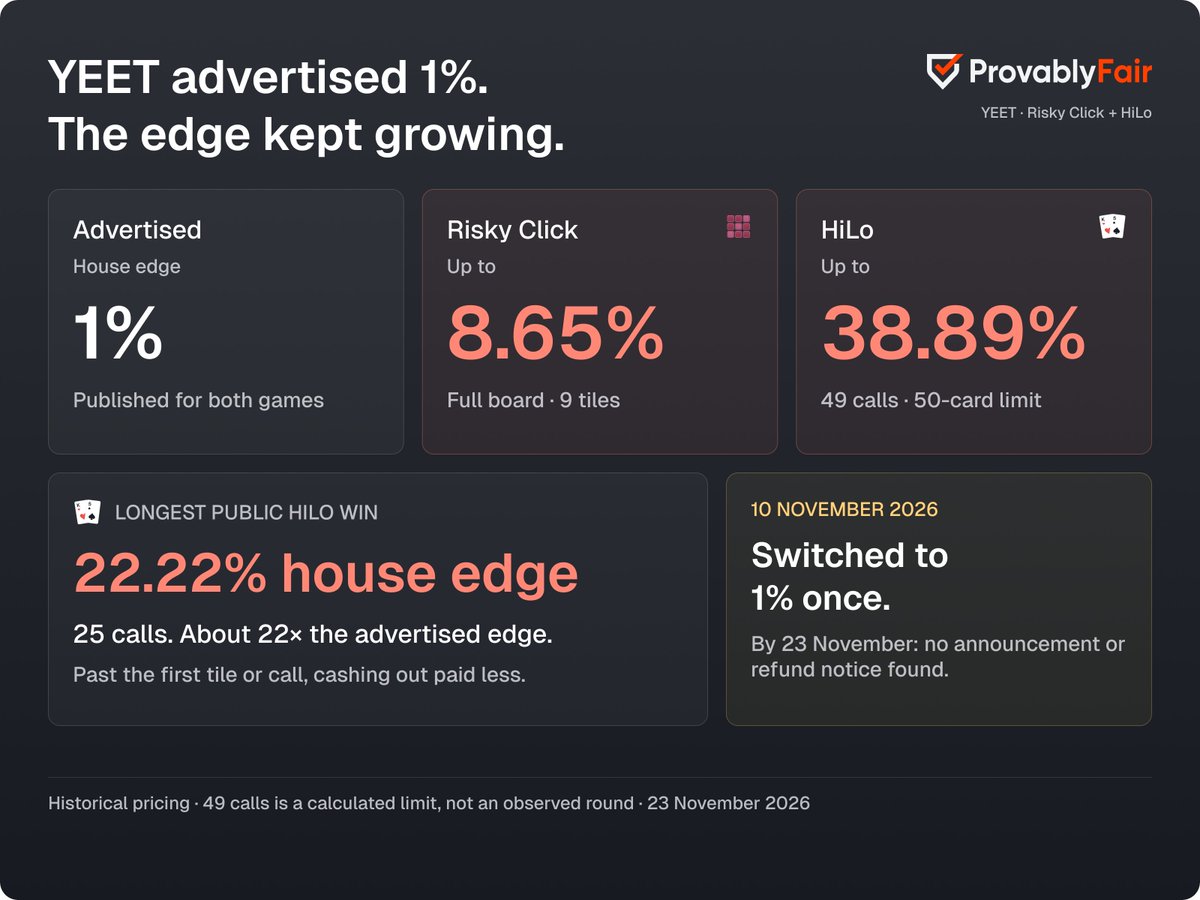
ProvablyFair.org’s summary of advertised and calculated house edges. Source: ProvablyFair.org on X.
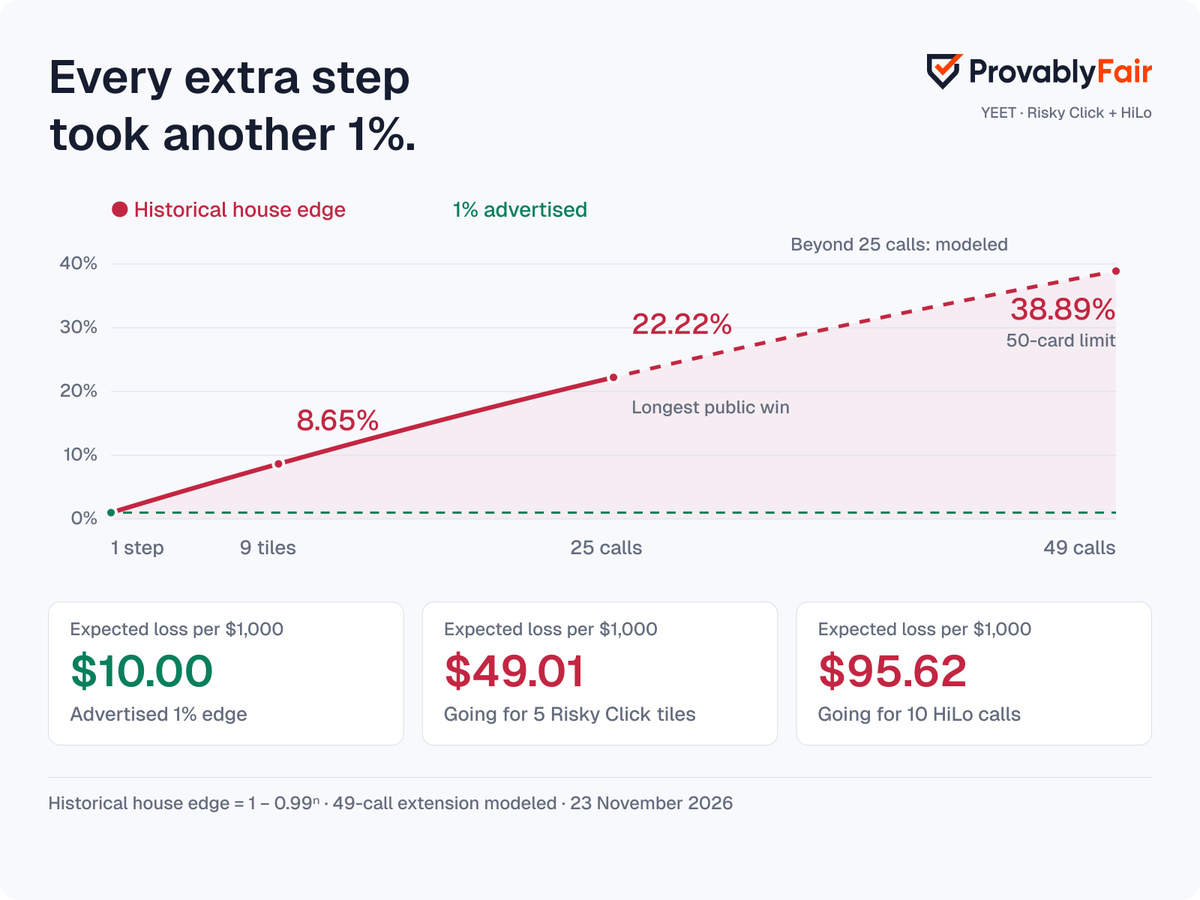
ProvablyFair.org’s published compounding curve for HiLo. Source: ProvablyFair.org on X.
It dated the change to Nov. 10 from the last public win still using the old prices, file timestamps, and later game rules. Current Risky Click rules, it said, now take 1% once and state that the game “returns 99% however many tiles you take.” It reported that it could not see YEET’s servers, and that by Nov. 23 it had not found a public notice or refund announcement.
In a mid-July 2025 post, YEET had promoted 99% return to player on in-house games including these two, alongside a June 2025 Discord message in the same terms. Those posts are advertising history. They are not evidence of when the compounding cut began, and the investigation does not treat them as a start date.
A public screenshot circulated in April 2026 showed a $13,229.31 HiLo payout after 21 correct calls from a $10 stake, credited to a player named Jerzy. ProvablyFair.org treated that image as a promotional screenshot, not a checked account record, and calculated that once-only 1% pricing would have paid $16,392.07, a $3,162.76 gap.

A promotional screenshot of a $13,229.31 HiLo payout after 21 calls, later cited in the investigation as a public example, not a checked account record. Source: Yeetcommunity on X.
From 40 selected public winning hands, 20 on each game, it calculated a $39,789.55 gap versus once-only 1% pricing. That figure is the gap on those selected hands, not a fully audited, site-wide player-loss total. The report is explicit about that limit. The 40 historical public wins in the pack, it said, all used the old prices, including 163 HiLo calls, while 17 of 50 current-receipt wins it kept were paid under the once-only 1% rule.

ProvablyFair.org’s published sample results. The $39,789.55 figure is the gap on 40 selected public wins, not a site-wide audited loss. Source: ProvablyFair.org on X.
The pack includes independently checked game records. One HiLo receipt in the current set, labeled RNEW01, shows 99.00% RTP, a $10 stake, and a $594.09 payout after 12 correct calls, matching once-only 1% pricing.
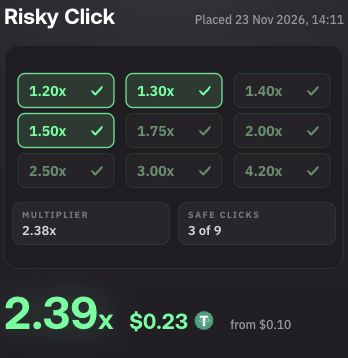
A checked current-receipt example, RNEW01, paid under once-only 1% pricing. Source: ProvablyFair.org evidence pack on GitHub.
YEET answered on Nov. 24. “The compounding RTP vs static was recently identified on Risky Click and Hi/Lo and was fixed 2 weeks ago,” the official account said. “All users who were affected will be emailed and compensated accordingly in the coming days.” It also said the issue affected only users who cashed out, and that “the games didn’t deviate from the advertised RTP with any statistical significance.” It added that it would keep supporting fairness and trust. That is YEET’s official statement.
Ben Lamb, whose profile lists YEET, later passed on a more detailed note, saying he was not at a computer. He wrote that anyone affected would be notified and paid in the coming days. The note he shared said volume on the two games was not huge, that the issue applied only to cash-outs, and that usual RTP “hasn’t moved much in any direction because of this.” It also mentioned AI bot swarms, said the team was waiting for a final data pull from an older system, and said amounts would then go to YEET accounts, with an email first. Lamb is restating an internal note; it is not an independent audit.
Earlier on Nov. 24, Mando, whose X profile also lists YEET, said he had flagged the issue about 13 days earlier. A catch-up was still under way, he said, because the history goes back to an old system and a previous team. The amount, he wrote, was “likely small like $40k” and was going to be paid as part of the monthly process once the full history was obtained. In a later post he said YEET only had data for its current remote gaming server and “for that it was around $40k,” while the older-system catch-up was still unfinished. Those figures are Mando’s statements about the current system, not a published, complete total, and they should not be confused with the $39,789.55 gap on the 40 selected public hands.
ProvablyFair.org later said YEET had confirmed both games took 1% on every step, changed the pricing on Nov. 10, and was sending refunds. It said the $39,789.55 gap on the 40 public wins “is the floor,” because only YEET has the full volume, and asked YEET to publish totals and send each affected player a list of bets and amounts. In a follow-up post, it also said the report does not claim the games were rigged or that YEET meant to apply the extra cuts, and that it messaged YEET’s owner about an audit in July and got no reply. The published investigation discloses the earlier contact but does not date it. ProvablyFair.org sells audits of casino-built games. That commercial relationship is disclosed, and it does not change the public records the report cites.
Later on Nov. 24 (18:55 UTC, or 2:55 a.m. Nov. 25 in Beijing), Lamb posted a longer statement, which the official YEET account quoted about 52 minutes later, writing: “We messed up. It’s been rectified. We’re putting together a plan to make sure this never happens again.” Lamb said Risky Click and HiLo were among YEET’s least-played titles, accounting for less than 1% of volume on its original games and less than 0.3% site-wide under the company’s figures.
Lamb said YEET identified the calculation issue early in November and began preparing payouts after updating the formula, attributing delays to Risky Click records stored on a retired gaming system and heavy bot-swarm attacks while acknowledging the company “dropped the ball” by not communicating sooner. After ProvablyFair.org published its thread, he said, data and development staff worked into the early morning to finish the review.
Addressing the cited 38.89% HiLo and 8.65% Risky Click figures, Lamb called them worst-case calculations, noting that a 38.89% HiLo edge required 49 steps in one round and occurred zero times—consistent with the investigation’s note that 38.89% was a model rather than an observed public game. According to YEET’s own calculations, HiLo’s realized return to player moved from 97.82% before refunds to 99.69% afterward against a 99% stated rate, while Risky Click moved from 98.34% to 100.03%. Those return figures are the company’s own accounting.
Lamb said YEET reviewed and recalculated every Risky Click and HiLo winning round placed on or before Nov. 10 in which a player cashed out after two or more steps. “As of last night, all refunds to active accounts have been issued. Emails have been sent stating the amounts refunded,” he wrote, without specifying a calendar timestamp for “last night,” a dollar total, or the number of accounts paid. He added that self-excluded players would be emailed their owed amounts and asked for a wallet address for manual payment.
Lamb also said YEET plans to launch a “transparency and fairness program” in the coming months, publishing testing methods and simulations with bounties for discrepancies; co-founder KeyboardMonkey3 similarly wrote that YEET would open-source its game math shortly and offer bounties. In direct replies and search checks after those posts, neither ProvablyFair.org nor Mando had issued a new response at the time of this update.
The matter remains an operator pricing issue and company response rather than a finding by a gambling regulator. YEET says active accounts have been credited and emailed, while self-excluded users still require manual wallet payouts and the company has not disclosed a total refund figure.
Updated November 25, 2026: YEET said refunds had been issued to active accounts and amount emails sent. It said self-excluded users still needed to provide a wallet address for manual payment. The company has not disclosed a refund total.
Cite This Article
Topics In This Story
The Newsroom covers the gambling industry, game providers, casino services and the public information that helps readers understand them. Its explainers focus on clear definitions, the scope of available evidence and practical questions for readers.
More From This Author