
Bingo Rush by BingoPlus
Bingo Rush by BingoPlus
by BingoPlus

 Local Game

 No Symbols Yet
No symbols have been added for Bingo Rush by BingoPlus yet.
Bingo Rush by BingoPlus Expert Review


Updated:
Here you can find detailed review information about Bingo Rush by BingoPlus.
Overview
Bingo Rush combines a compact 15-number card with three pattern groups and a full-card Jackpot target within 25 balls. Its orange-and-white diagrams make the patterns easy to follow. The main cautions are costs and payout details: Help lists PHP 5 per card before multiplier changes, Extra Balls can cost more, and the listed Jackpot share runs from 5% at 1× to 100% at 20×. The small card is approachable, though gaps in Help make the extra-ball limit and shared-Jackpot examples less clear than they should be.
1. A smaller card with two ways to match
Bingo Rush starts with a manageable-looking card: three rows, five columns and 15 numbers. You follow the called numbers and look for the shapes shown in the pattern guide. The same card can also qualify for a Jackpot if every number is covered within the first 25 balls. Those two targets share a card, but have different rules.
What I liked
✅ The 15-number card gives you fewer numbers to locate than Mega’s 24-number card.
✅ Orange-and-white pattern diagrams make the target positions visible.
✅ Three pattern groups give the same small card several different sets of shapes to follow.
What I didn’t like
❌ The later draw stage needs a clearer explanation in Help.
❌ Extra Ball charges scale with card count and multiplier, so the base card price tells only part of the cost story.
❌ The detailed shared-Jackpot explanation needs clarification.
BingoPlus includes Rush and Mega in its Original Filipino Games category. This light review is based on the in-game Help, desktop screenshots and a short clip assembled from actual sampled public-screen frames saved on 7 October 2026 UTC. We observed the interface without buying cards or placing bets.
Ahrefs estimated 150 average monthly searches in the Philippines for “bingo rush” when checked on 9 October 2026. This measures search interest, not player numbers.
2. Finding your way around the screen
The desktop view puts the presenter and drawing machine at the top, the called-ball strip beneath them, and the pattern diagrams and prize amounts below that. I find that order easy to read: first the draw, then its progress, then the shapes to watch for. The orange squares show which positions a pattern needs.
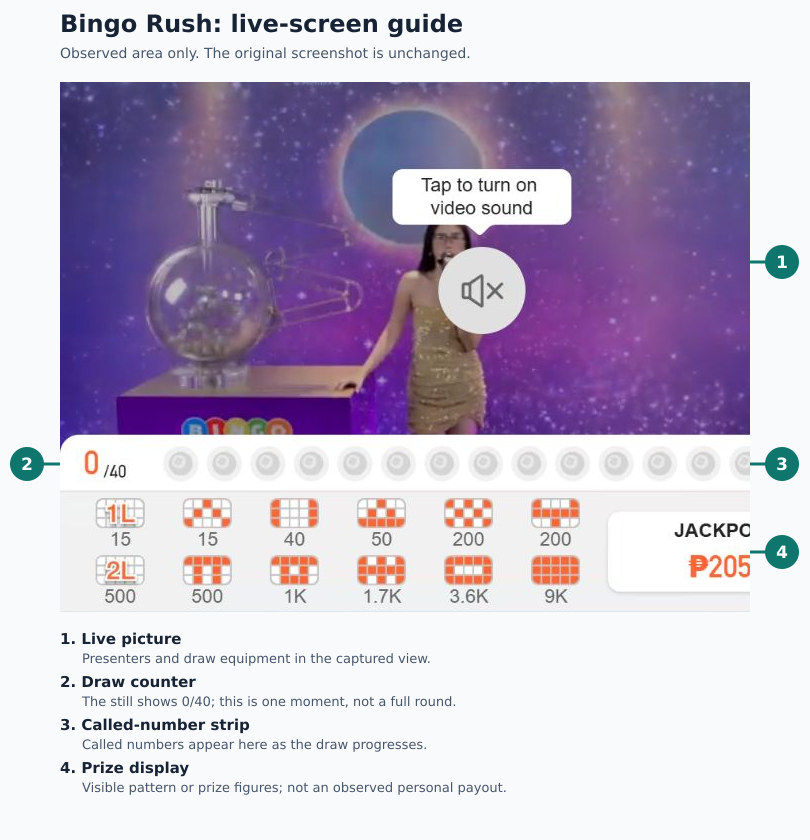
The saved public-screen crop, with the counter at 0/40. The video below comes from a different moment. The numbered guide identifies the four visible areas of this captured view.
The clip below catches the Extra Ball stage, with “EXTRA BALL” visible on the stage graphics. The called-ball strip advances through 37/40, 38/40 and 39/40 in the sampled frames. It is a different moment from the 0/40 still above, and only a short segment of the round.
A 14.4-second silent clip made from actual sampled screenshot frames of the Extra Ball stage. It is not a native continuous recording. Sampled frames from 7 October 2026 UTC show 37/40 → 38/40 → 39/40. The poster is the first source frame.
Help separates the card rules, Jackpot, patterns, Extra Ball, Auto-Play and Pre-Buy into their own sections. That organisation is useful when you need to look up one particular rule.
3. How to read the 15 numbers
Each card uses numbers from 1 to 60. Its five columns have their own number ranges, with three numbers in each column, arranged from low to high. A quick way to locate a called number is to find its range first.
Bingo Rush card layout in the checked Help
Column, left to right | Number range | Numbers on the card |
|---|---|---|
1 | 1–12 | 3 |
2 | 13–24 | 3 |
3 | 25–36 | 3 |
4 | 37–48 | 3 |
5 | 49–60 | 3 |
Help says matching numbers turn orange automatically. For Game Patterns, the marked positions need to form one of the shapes in the selected group within the 30-ball base stage. “1L” means one horizontal line and “2L” means two horizontal lines. A vertical line does not count as 1L under these rules.
Automatic marking only describes how a match appears on a card. Auto-Play is a separate purchasing feature.
4. Patterns, Jackpot shares and Extra Balls
The three pattern groups are Marvelous, Favorable and Superb. Their diagrams are worth looking at side by side: some shapes and prize amounts change between groups. The checked Help uses a PHP 5 card for its prize examples. One horizontal line is PHP 15 in all three groups; two horizontal lines are PHP 500, PHP 600 and PHP 750 respectively.
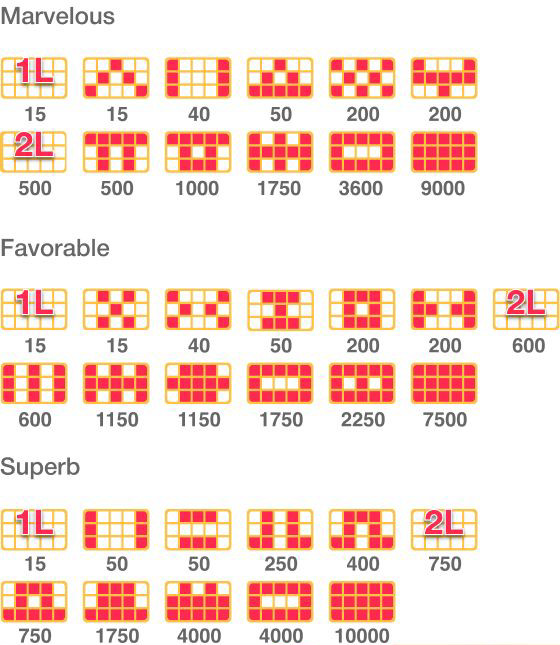
The three pattern groups as rendered in Help. Match a prize to its own diagram and group; the amounts shown are PHP 5 card examples.
To read every amount in that image, follow each group from left to right across its top row, then across its bottom row. The position numbers below are reading aids added for this review; they are not original labels printed on the diagrams. All amounts belong to the Help’s PHP 5 card example.
Marvelous
The top row contains positions 1–6; the bottom row continues with 7–12.
Position in this group | Prize, PHP |
|---|---|
1 (1L) | 15 |
2 | 15 |
3 | 40 |
4 | 50 |
5 | 200 |
6 | 200 |
7 (2L) | 500 |
8 | 500 |
9 | 1,000 |
10 | 1,750 |
11 | 3,600 |
12 (full orange card) | 9,000 |
Favorable
The top row contains positions 1–7; the bottom row continues with 8–13.
Position in this group | Prize, PHP |
|---|---|
1 (1L) | 15 |
2 | 15 |
3 | 40 |
4 | 50 |
5 | 200 |
6 | 200 |
7 (2L) | 600 |
8 | 600 |
9 | 1,150 |
10 | 1,150 |
11 | 1,750 |
12 | 2,250 |
13 (full orange card) | 7,500 |
Superb
The top row contains positions 1–6; the bottom row continues with 7–11.
Position in this group | Prize, PHP |
|---|---|
1 (1L) | 15 |
2 | 50 |
3 | 50 |
4 | 250 |
5 | 400 |
6 (2L) | 750 |
7 | 750 |
8 | 1,750 |
9 | 4,000 |
10 | 4,000 |
11 (full orange card) | 10,000 |
The full orange card at the end of each group is a pattern-prize entry. The Jackpot has its own 25-ball requirement, explained below.
Overlapping patterns do not all add together. If a card forms two horizontal lines, it also contains a single line, but Help says only the higher pattern prize is paid. The selected group also stays locked until the purchased rounds have finished.
The Jackpot has a separate target: cover all 15 numbers within 25 balls. Its listed share depends on the selected multiplier:
Jackpot shares listed in Bingo Rush Help
Multiplier | Listed Jackpot share |
|---|---|
1× | 5% |
2× | 10% |
5× | 25% |
10× | 50% |
20× | 100% |
These percentages are not a guarantee of the final amount received. Help also includes shared-winner, rounding and withholding rules.
Extra Ball applies to Game Patterns after the first 30 balls. It does not extend the Jackpot’s 25-ball requirement. Help says an Extra Ball can be bought seven seconds before it is called. The cost is a separate consideration, explained next.
5. Card cost, Extra Ball charges and RTP
The Help checked on 7 October states PHP 5 per card, with multipliers of 1×, 2×, 5×, 10× and 20×. All cards in the purchase use the selected multiplier, and pattern prizes change with it. Card count and multiplier matter to the total; PHP 5 should not be read as the price of every possible setup.
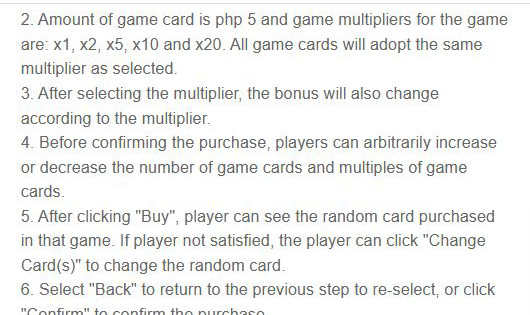
This is a crop of Help, not a purchase screen. PHP 5 is the base card amount stated in those rules.
Extra Balls can add another charge. Help gives a base cost range of 0–160 for one card at 1× and states this formula:
Final Extra Ball cost = base cost per card × number of cards × multiplier.
The rule lists the balls already drawn, the cards held and the possibility of completing a particular pattern among the cost factors. It also mentions free Extra Balls based on previous gameplay. Free is therefore a possible case, not a promise that all extra balls cost nothing. The published range is for one card at 1×, not a cap on every total charge.
Auto-Play can automatically buy cards for up to 100 rounds, but it does not buy Extra Balls. Help says it can continue buying while the player is outside the game and ends on returning to the Lobby. Pre-Buy is another paid feature: it reserves cards for the next round and deducts the amount immediately.
No verified RTP is available in the checked material. The prize diagrams and Jackpot shares explain payouts under particular conditions; they do not establish the game’s long-run return.
6. What the screen shows, and where Help needs work
The compact pattern diagrams are the strongest part of the presentation for me. Seeing the required positions next to the amount makes a rule such as “two horizontal lines” easier to understand. The full Help chart also lets you compare all three groups without needing names for every geometric shape.
In the recorded segment, the ball counter and called-number strip update while the pattern targets remain visible underneath. That gives the desktop screen a sensible reading order. A short, silent segment cannot tell us how comfortable a whole session feels, and we have no real-phone or audio assessment to add.
The less helpful part is the wording around a few important rules:
30 balls and the /40 counter: Help specifies a 30-ball base Game Patterns stage, with Extra Balls after it. The screen uses a /40 counter, but the Help’s maximum extra-ball number is missing. Neither the still nor the short clip confirms that every round includes ten extra balls.
Shared-Jackpot examples: one example uses a 9× multiplier that is absent from the selectable list. Another gives a remaining-pool calculation that does not match its stated percentage. Those cash examples should not be used to predict a final payout.
The older card price: the BingoPlus Rush guide, dated 20 May 2025, says PHP 1. The later in-game Help checked for this article states PHP 5, which is the source of the price used here.
These gaps matter because the basic card is so simple to read. A clearer explanation of the later draw stage and shared prizes would make the whole game easier to understand.
7. What works, what needs care, and how Mega differsBingo Mega is a useful comparison because the two games look related but handle their cards and extra balls differently. These differences come from the Help saved for each game.
Bingo Rush and Bingo Mega: checked rule differences
Rule | Bingo Rush | Bingo Mega |
|---|---|---|
Card | 3 × 5; 15 numbers from 1–60 | 5 × 5; 24 numbers from 1–75 and a free centre |
Base pattern stage | 30 balls | 44 balls |
Full-card Jackpot target | Within 25 balls | Within 44 balls |
Participation | One card can participate in Game Patterns and Jackpot | Extra Patterns and Bingo&Jackpot can be selected separately or together, with their corresponding fees |
Extra Balls | For Game Patterns; a separate charge may apply | Up to four for Bingo&Jackpot, with no extra charge under the checked Help |
Rush’s smaller card is its clearest attraction from a readability point of view. Mega gives you the familiar free centre and different full-card deadlines. Neither comparison tells us which game offers better returns, and Mega’s free-extra-ball rule should not be carried across to Rush.
Rush is easiest to appreciate as a compact, pattern-led bingo game. The small card and clear diagrams work well together. Its main weakness is that the costs and shared-prize details take more work to untangle than the card itself. For a first look, the full pattern chart is the most useful place to start.
We rate Bingo Rush 7.4/10 for its desktop presentation and how clearly it explains the game. The small card and clear pattern diagrams make a good first impression; Extra Ball costs and unclear parts of Help take more work to understand.
Bingo Rush by BingoPlus FAQs
Answers to common questions about Bingo Rush by BingoPlus.
Bingo Rush by BingoPlus Reviews
 No Player Reviews Yet
Played Bingo Rush by BingoPlus? Share your experience with other players.
 Write A Review