
Super Bingo by JILI
Play Super Bingo by JILI In Demo Mode
by JILI Games



 Other SymbolFree Ball
- Extra-ball stage
- Next ball free
- 10-second timeout
- Chance feature
 Other SymbolCollection coin
- Three tasks
- Pattern-based progress
- Up to 2 draws
- 3-day inactivity reset
 Other SymbolWild Ball W
- 1–4 candidates
- Number selection
- 15-second timeout
- Top-value auto choice
 Paying SymbolPattern 19
- 3 × 5 card
- 3 × per card
- Covered lower award excluded
- No Bonus award
 Paying SymbolPattern 18
- 3 × 5 card
- 3 × per card
- Covered lower award excluded
- No Bonus award
 Paying SymbolPattern 17
- 3 × 5 card
- 3 × per card
- Covered lower award excluded
- No Bonus award
 Paying SymbolPattern 16
- 3 × 5 card
- 8 × per card
- Covered lower award excluded
- No Bonus award
 Paying SymbolPattern 15
- 3 × 5 card
- 8 × per card
- Covered lower award excluded
- No Bonus award
 Paying SymbolPattern 14
- 3 × 5 card
- 10 × per card
- Covered lower award excluded
- No Bonus award
 Paying SymbolPattern 13
- 3 × 5 card
- 10 × per card
- Covered lower award excluded
- No Bonus award
 Paying SymbolPattern 12
- 3 × 5 card
- 40 × per card
- Covered lower award excluded
- No Bonus award
 Paying SymbolPattern 11
- 3 × 5 card
- 40 × per card
- Covered lower award excluded
- No Bonus award
 Paying SymbolPattern 10
- 3 × 5 card
- 100 × per card
- Covered lower award excluded
- No Bonus award
 Paying SymbolPattern 9
- 3 × 5 card
- 100 × per card
- Covered lower award excluded
- No Bonus award
 Paying SymbolPattern 8
- 3 × 5 card
- 100 × per card
- Covered lower award excluded
- No Bonus award
 Paying SymbolPattern 7
- 3 × 5 card
- 100 × per card
- Covered lower award excluded
- No Bonus award
 Paying SymbolPattern 6
- 3 × 5 card
- 100 × per card
- Covered lower award excluded
- No Bonus award
 Paying SymbolPattern 5
- 3 × 5 card
- 120 × per card
- Covered lower award excluded
- No Bonus award
 Paying SymbolPattern 4
- 3 × 5 card
- 200 × per card
- Covered lower award excluded
- No Bonus award
 Paying SymbolPattern 3
- 3 × 5 card
- 200 × per card
- Covered lower award excluded
- 5 Bonus games
 Paying SymbolPattern 2
- 3 × 5 card
- 300 × per card
- Covered lower award excluded
- 5 Bonus games
 Paying SymbolPattern 1
- 3 × 5 card
- 1500 × per card
- Covered lower award excluded
- 8 Bonus games
Super Bingo by JILI Expert Review


Updated:
Here you can find detailed review information about Super Bingo by JILI.
Super Bingo is at its best when you enjoy watching several number cards develop at once. JILI puts the drawn balls, potential patterns and collection progress in one view, then asks a more pointed question: is another ball worth its displayed price? I like that visible connection between the card and the next decision. The crowded portrait layout and immediate-start Auto button take more getting used to.
What I liked
✅ The card shapes and drawn numbers are easy to compare on the wide layout.
✅ Extra-ball quotes are visible before a manual purchase, and collection progress gives the cards a second thread to follow.
What I didn’t like
❌ Bet shows a single-card price; the whole round can cost more than Total Bet once extra balls are added.
❌ A displayed WIN can still be waiting to reach the balance, and Auto starts immediately.
❌ The landscape game becomes very small inside the simulated portrait viewport.
1. What kind of bingo is this?
This is JILI’s Super Bingo, game 151: a number-card game with 19 base winning patterns. Each base card has three rows and five columns. A paid round opens with 30 balls; qualifying near-complete patterns can lead to individually priced extra balls. Particular patterns award Bonus games, while Wild Ball and collection rewards add separate events.
You are following a draw across cards, so the useful unit is a complete paid round. The extra balls belong to that round. The word “spin” on a general casino site does not turn every ball into a separate bet or make this a reel game.
Philippine search interest is modest and mixed. In an Ahrefs PH query on 6 October 2026, “super bingo” had an estimated 150 searches per month, “super bingo jili” 60 and “super bingo demo” 30. These are keyword estimates over Ahrefs’ latest known 12 months, not player counts. The search results also contain Super Bingo HD and other entities, so the full generic volume cannot be assigned to JILI 151.
Round 1 at Normal speed: the draw and next extra-ball quote. This 10-second sequence ends before the extra-ball purchase and final round settlement.
2. Reading the cards and controls
The blue underwater backdrop stays behind a busy, practical layout. Four cards filled the central area in this sample. The top strip shows pattern awards and gold collection tiles; drawn numbers run below it. On a wide screen I could connect those areas without opening a second panel. The main amounts sit along the bottom, where Bet and Total Bet deserve separate attention.
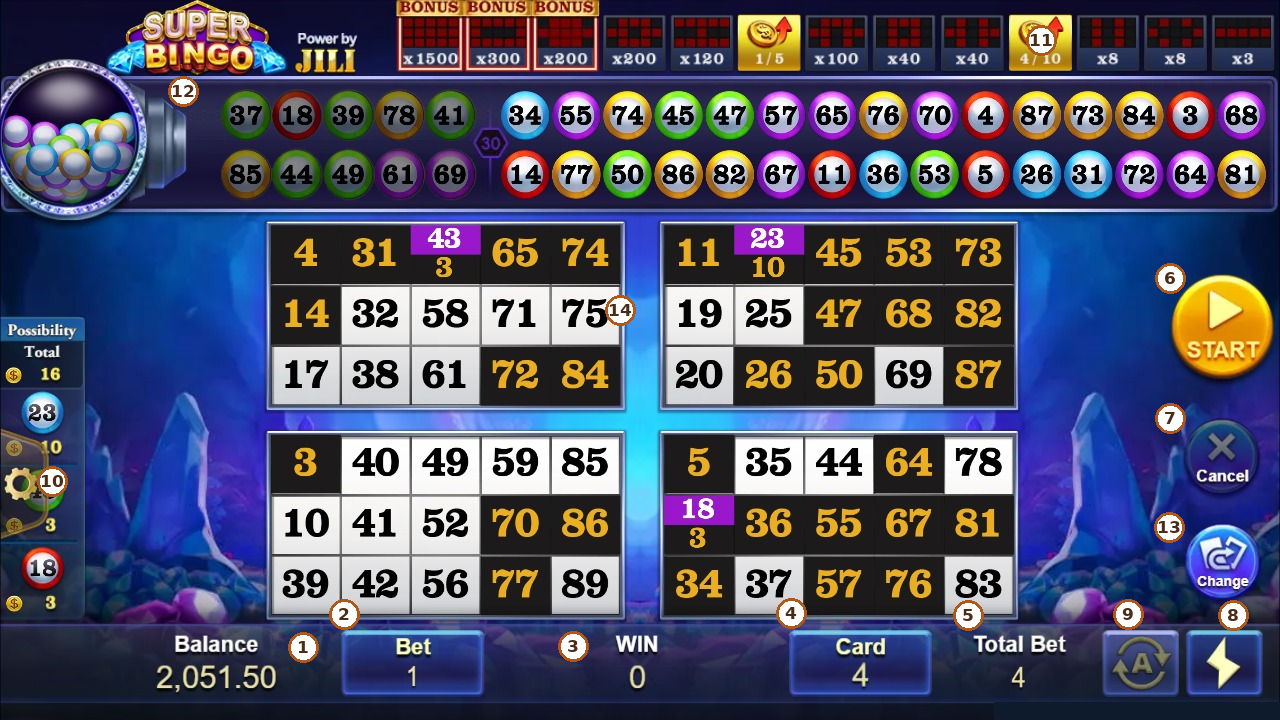
Round 50 after settlement: Balance 2,051.50, Bet 1, Card 4 and Total Bet 4.
Balance: check the settled credit balance here; extra-ball purchases also deduct from it.
Bet: the unit price of one card, set to 1 in the recorded sample.
WIN: the round payout display, not net profit and not always already credited.
Card: how many cards the next basic round buys; the sample used 4.
Total Bet: Bet × Card for the basic round. Extra balls add to this cost.
START / BUY EXTRA: starts a base round or buys the next offered ball, depending on the stage.
Cancel: stops further extra-ball purchases and lets that round settle.
Turbo: the single lightning speed toggle seen in this build.
Auto: starts the automatic flow immediately; it did not open a settings panel.
Menu: opens Help, sound and replay-style controls. Their presence is not an audio or recovery test.
Pattern and collection strip: shows payouts and gold progress tiles; it is not a fixed slot-payline count.
Draw / extra-ball quote: shows the ball sequence and, at the offer stage, the next ball’s price.
Change: visible while idle. It was not used during the fixed-card sample.
Number cards: each base card is 3×5; compare matched numbers with the required pattern.
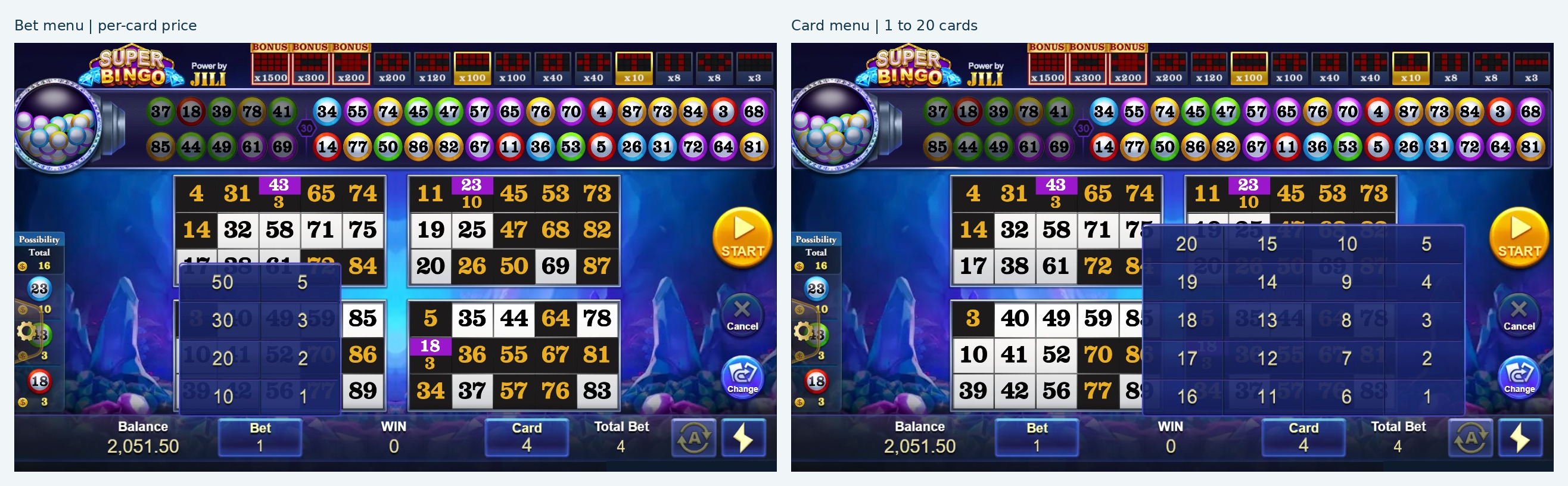
The actual Bet menu offered 1, 2, 3, 5, 10, 20, 30 and 50 per card; the Card control offered 1–20 cards. These panels were inspected without changing the four-card, one-credit sample setting.
The next manual round kept the card numbers, the one-credit card price and the four-card count. Round 1 used Normal speed; rounds 2–50 used Turbo. There was one speed toggle, with no separate Super Turbo control shown.
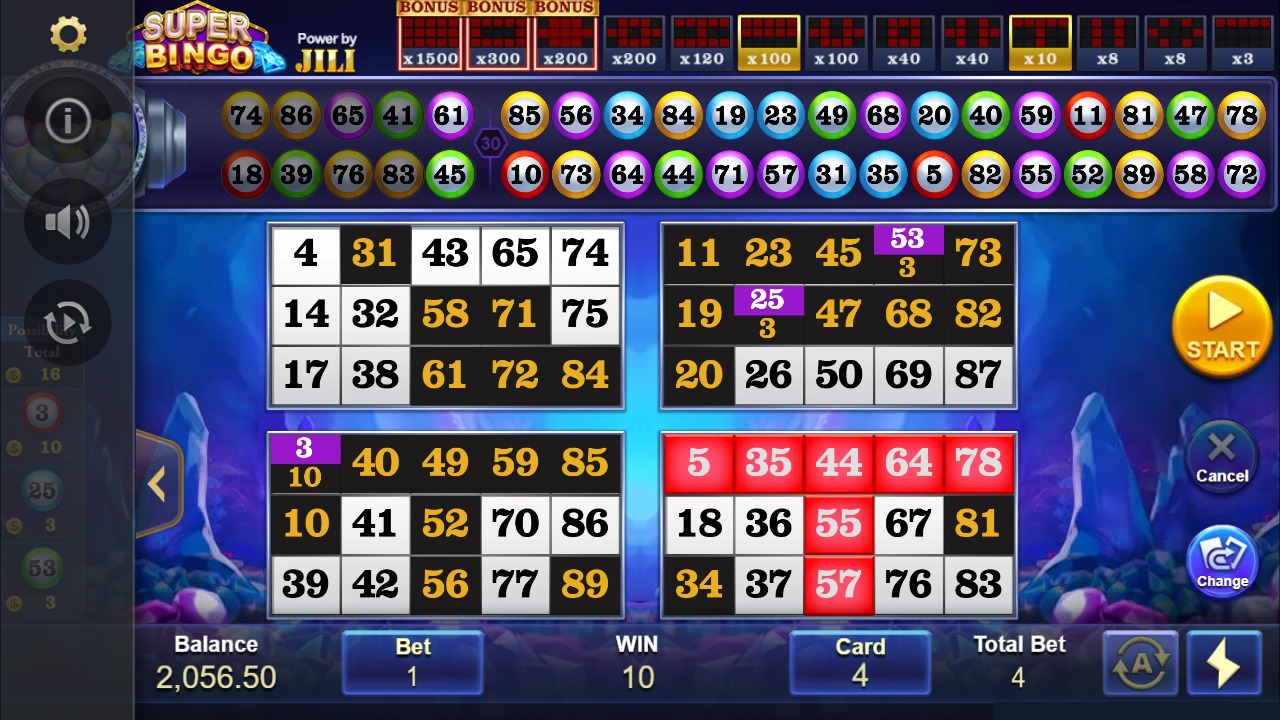
Expanded menu after the main sample. The visible sound control was not used to judge music or effects.
Auto needs a careful first look. During a separate control check after the fixed 50 rounds, pressing it started another round and the automatic flow continued into two extra balls before it was stopped. The retained images show ball numbers 45 and 61, WIN 10 and a final balance of 2,056.50. The individual extra-ball prices and complete cost were not independently captured, so that check stays outside the sample and its cost is not reconstructed from the wallet.
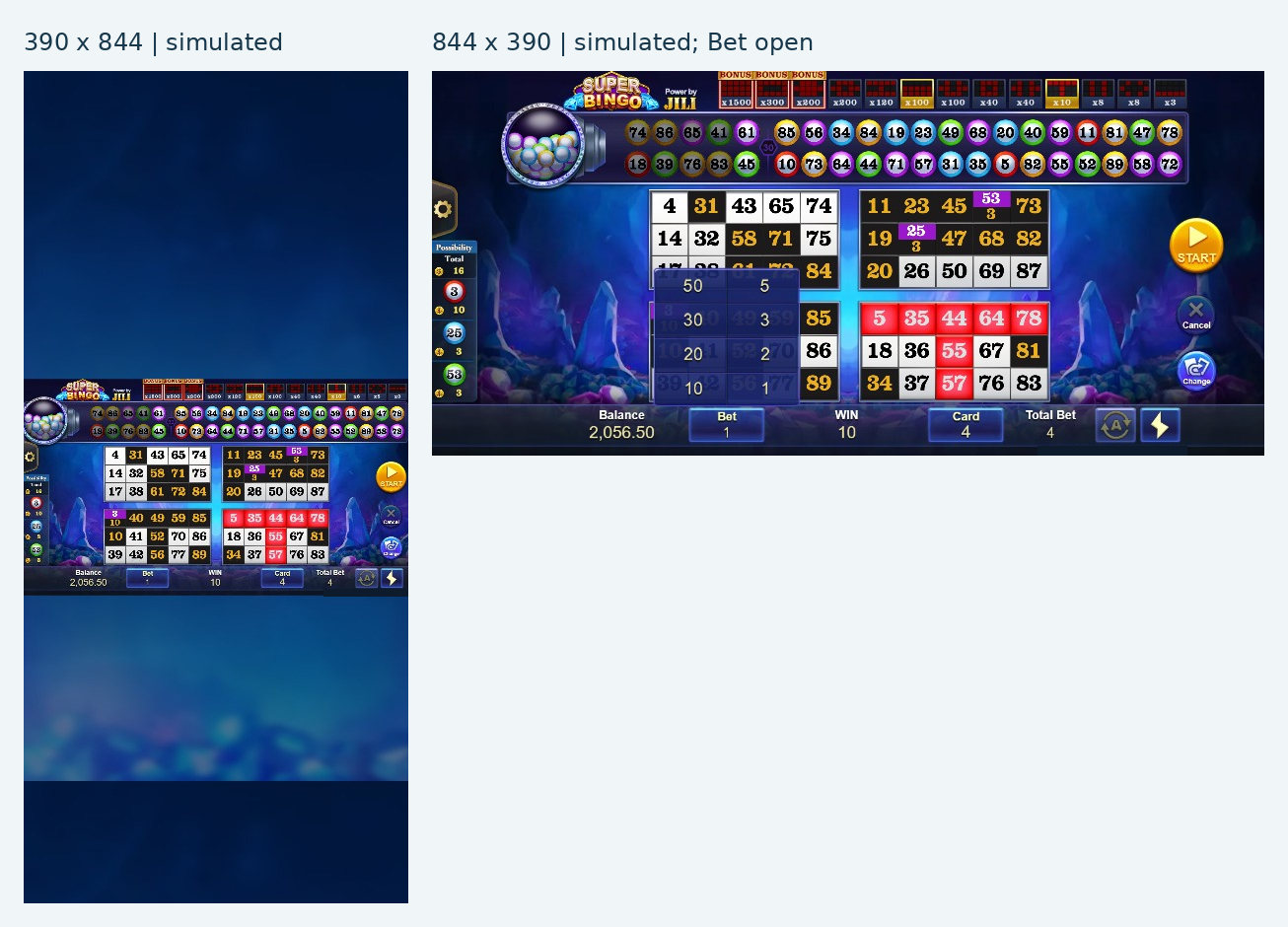
Desktop viewport simulations, not physical-phone tests. Portrait compresses the wide game into the middle; landscape gives the cards more room. The landscape Bet panel was opened and then closed by pressing Bet again.
I would use the wider layout for learning the pattern table. At 390×844, the cards and controls were small even though the page had plenty of empty vertical space. At 844×390, the same interface was easier to read. These observations do not establish real-phone touch performance or Philippine network speed.
3. How a base round pays
Choose 1–20 cards, set the price per card and start the draw. The first 30 balls mark matching numbers. A card wins when its matches complete a shape in the Help table. The award multiplier is applied to that card’s unit price, not to the total price of all cards.
For a simple example, a complete single horizontal row is a 3× pattern. At Bet 1, that pattern pays 3 credits on its card. With four cards costing 4 credits altogether, one 3-credit payout by itself still leaves the full round 1 credit down, before any extra-ball cost.
The coverage rule matters: when a lower-paying pattern is completely covered by a higher-paying pattern, only the higher award is taken for that covered pattern. Do not add every visible shape as an independent prize. The two 200× shapes also have different roles; only the designated Bonus-marked shape triggers Bonus games.
The pattern cards on this page show all 19 shapes separately. The examples below clarify the per-card award and the separate Bonus trigger.
A few useful payout anchors
Pattern example | Base award | Additional role |
|---|---|---|
Single horizontal row | 3× per-card price | No Bonus marker |
Specified 200× shape | 200× per-card price | 5 Bonus games |
Border-shaped 300× pattern | 300× per-card price | 5 Bonus games |
All 15 cells | 1,500× per-card price | 8 Bonus games |
4. Extra balls, Bonus games and collection rewards
The price of one more ball
After the first 30 balls, eligible near-complete hands may open the extra-ball stage. Help allows up to 10 additional balls. The price changes with the value of the ready hands, so a quote is the cost of the next ball, not a fixed fee for all remaining balls.
Round 1 gives a clear example. Four cards first cost 4 credits, leaving 1,996.00. The first extra ball was quoted at 1.50. Buying it drew number 11 and reduced the balance to 1,994.50; WIN stayed at 0. The next quote was 1.60, which was declined. The complete round therefore cost 5.50 and paid 0.
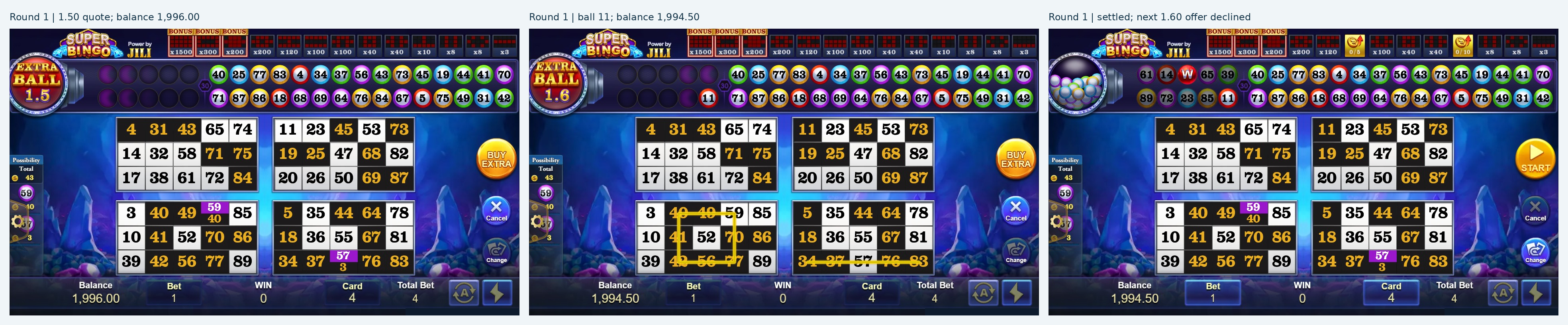
Same round, left to right: 1.50-credit offer → ball 11 and balance 1,994.50 → next 1.60 offer declined, zero payout settled.
BUY EXTRA purchases the next ball. It is different from buying entry into the Bonus game, and no separate BUY BONUS or EX control was found in the inspected main screen, Bet menu and Help.
When WIN reaches the balance
A win display can appear before wallet credit is complete. In round 2, WIN showed 43 while Balance was still 1,990.50. Ending further extra-ball offers brought the settled balance to 2,033.50. The net change for the complete round was +39: payout 43 minus the 4-credit cost. That is why the charts use the final settled images rather than an early WIN screen.
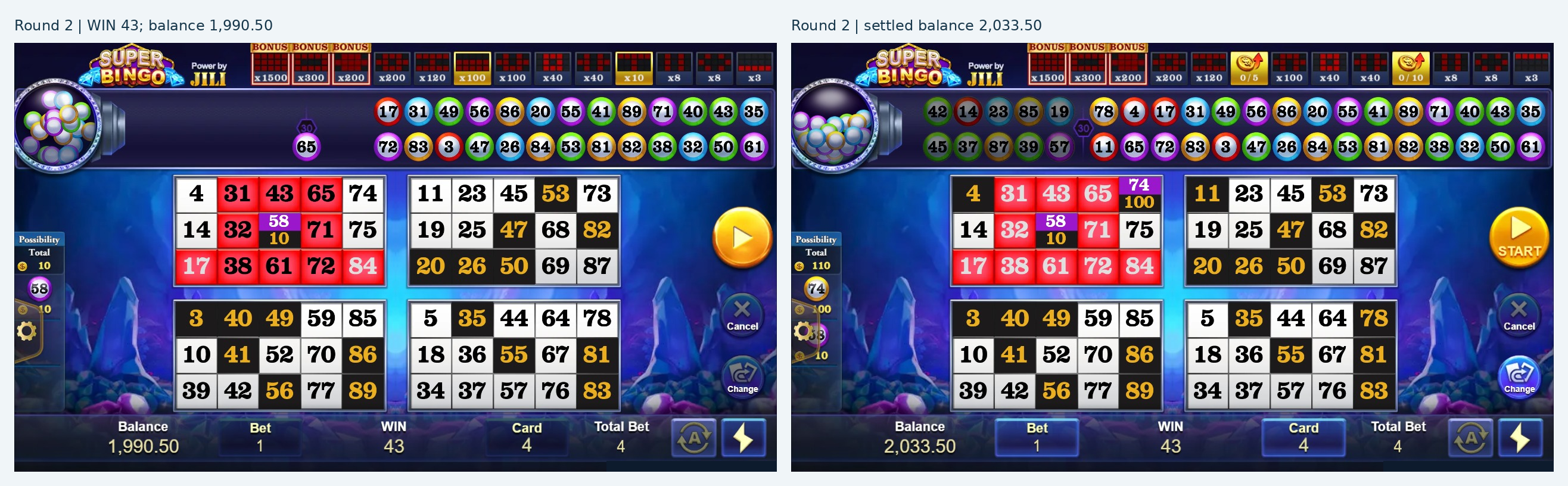
Round 2: the same 43-credit payout before and after settlement. It must be counted once, not added again when the balance catches up.
Features explained by the Help
The three marked base patterns award either 5 or 8 Bonus games. In the Bonus, the board changes to four 5×5 cards, with 39 numbers shown each round and a different award table. Only the highest reward counts in each Bonus round. The recorded 50 rounds did not trigger this feature.
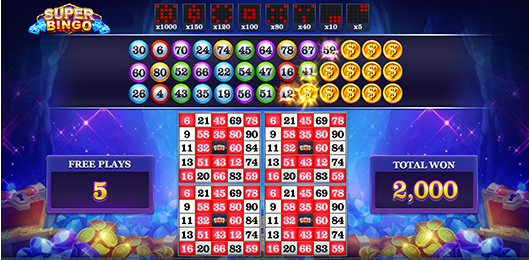
Official in-game Help illustration. The displayed 2,000 is an example, not a win from the recorded session.
Wild Ball can present 1–4 candidate numbers based on the highest-value ready hands. If no choice is made within 15 seconds, the game selects the highest-value candidate automatically. Free Ball is another possible event in the extra-ball stage: it makes the next ball free, and Help says it is taken automatically after 10 seconds without action. Neither event was triggered in the main sample; a future-ball preview alone is not an observed Wild Ball selection.
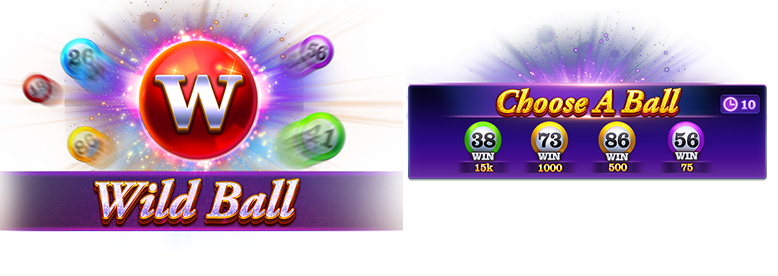
Wild Ball selects a number for the bingo cards. It does not act as a conventional reel Wild.
Collection rewards provide the longer-running thread. Three tasks are activated randomly; qualifying pattern wins add progress. Completing a target opens a prize draw, with up to two draws depending on difficulty, then creates new targets. Unfinished targets remain until completion, but Help says three days without betting resets them. The sample showed progress changes, with visible end markers of 1/5 and 4/10; it did not complete a prize draw.
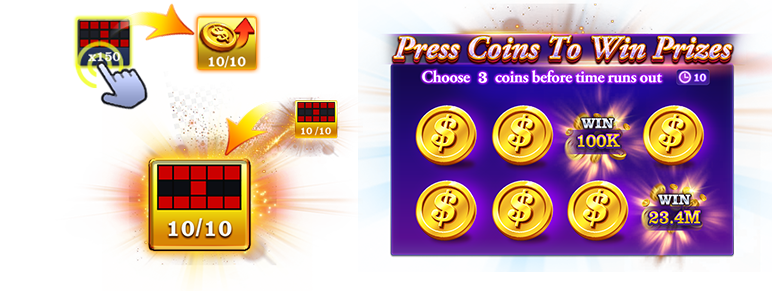
Help explains the completed collection and prize-draw sequence. The 100K and 23.4M amounts are artwork examples, not sample results.
Help also describes automatic completion of an interrupted Bonus and results in History. No deliberate disconnection was tested, so that remains a rule description rather than a recovery result.
5. Card costs, RTP and maximum awards
Item | What the evidence supports |
|---|---|
Basic round in this sample | 4 cards × 1 credit = 4 credits |
One manual extra ball | 1.50 credits in round 1; next quote 1.60 declined |
50-round actual cost | 200 basic credits + 1.50 extra = 201.50 credits |
Published product-sheet RTP | 96.53% Total RTP; active demo-session configuration not identified |
Highest base-card pattern | 1,500× that card’s unit price, plus 8 Bonus games |
Official product-page maximum | 3,000× advertised; retrieved panel does not specify its denominator |
Volatility | No confirmed official rating in the available product sheet or captured Help |
The official product sheet lists 96.53% Total RTP. The captured Help did not state the active session’s return configuration. RTP describes a long-run model; it is not a target a short session must reach.
The same sheet lists a €0.10 minimum, €5 maximum and €100,000 maximum payout. Our interface used unlabelled free-demo credits and a different visible per-card price menu, so those euro figures cannot be copied across as this session’s credit limits. More cards raise the basic total, and purchased extra balls raise the round’s final cost again.
JILI’s product page advertises 3,000×, while the base Help chart tops out at 1,500× per card. Those are different pieces of information. The retrieved product panel does not explain the 3,000× denominator or a route to it, so I would not turn it into a guaranteed payout formula.
6. What happened in the first 50 rounds
The main sample is the first 50 completed paid parent rounds from 6 October 2026, using four cards at one free-demo credit each. Round 1 ran at Normal speed and included the one verified 1.50-credit extra ball; rounds 2–50 ran at Turbo. Every result below uses the final payout and settled balance. The later Auto control check is recorded separately and excluded by that fixed cutoff.
Metric | Recorded result |
|---|---|
Paid parent rounds | 50 |
Basic / extra / total cost | 200.00 / 1.50 / 201.50 credits |
Payout | 253.00 credits |
Net change | +51.50 credits |
Starting → final balance | 2,000.00 → 2,051.50 |
Sample payout ÷ actual cost | 125.56% |
Rounds with any payout | 17 / 50 (34%) |
Rounds with payout above cost | 10 / 50 (20%) |
Zero-payout rounds | 33 / 50 |
Longest zero-payout run | 9 rounds, 40–48 |
Largest round payout | 110 credits, round 49 |
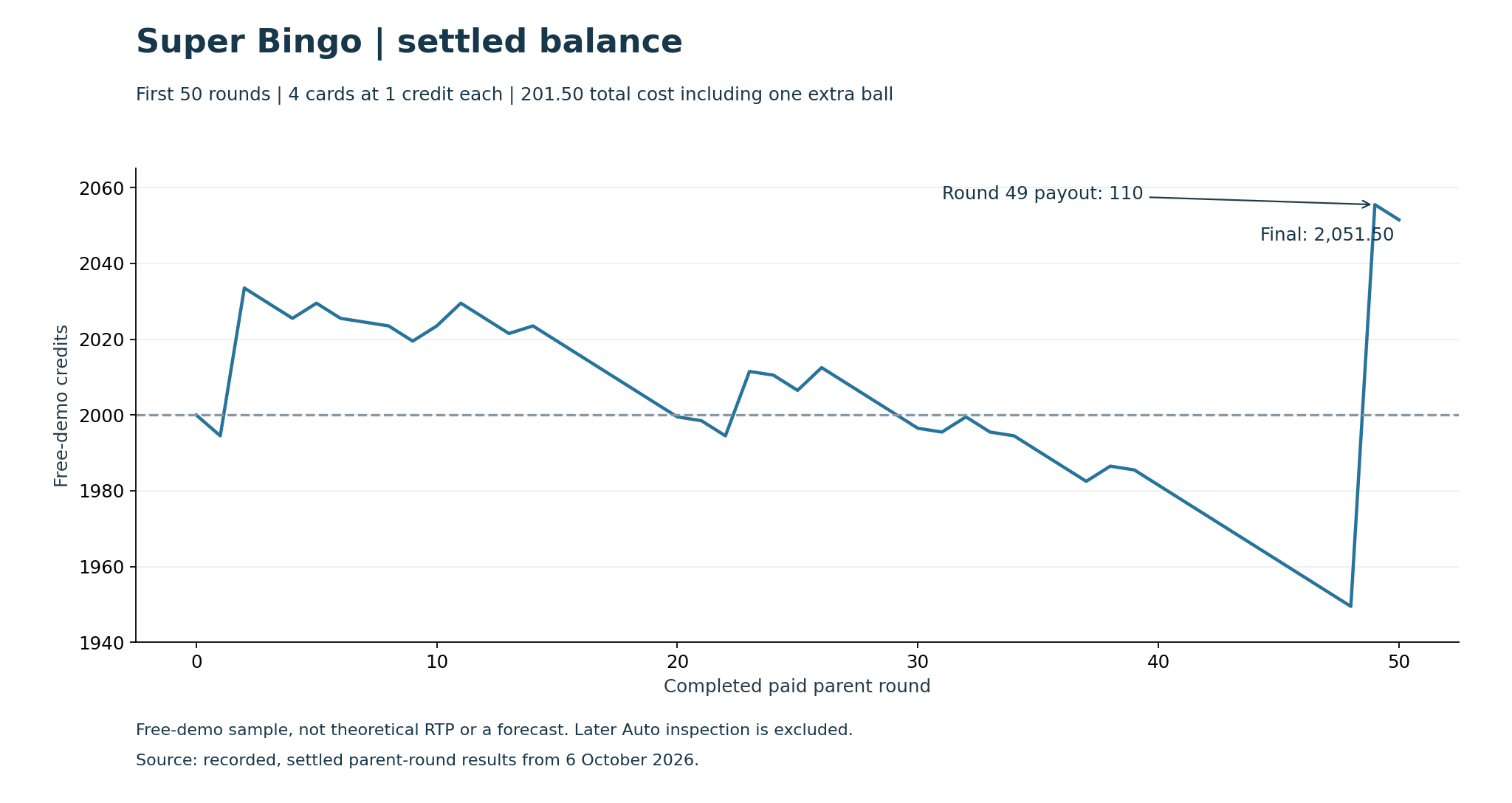
Settled balance after every complete round, with round 0 showing the starting balance. The vertical axis is a close-up, 1,940–2,065 credits, rather than zero-based.
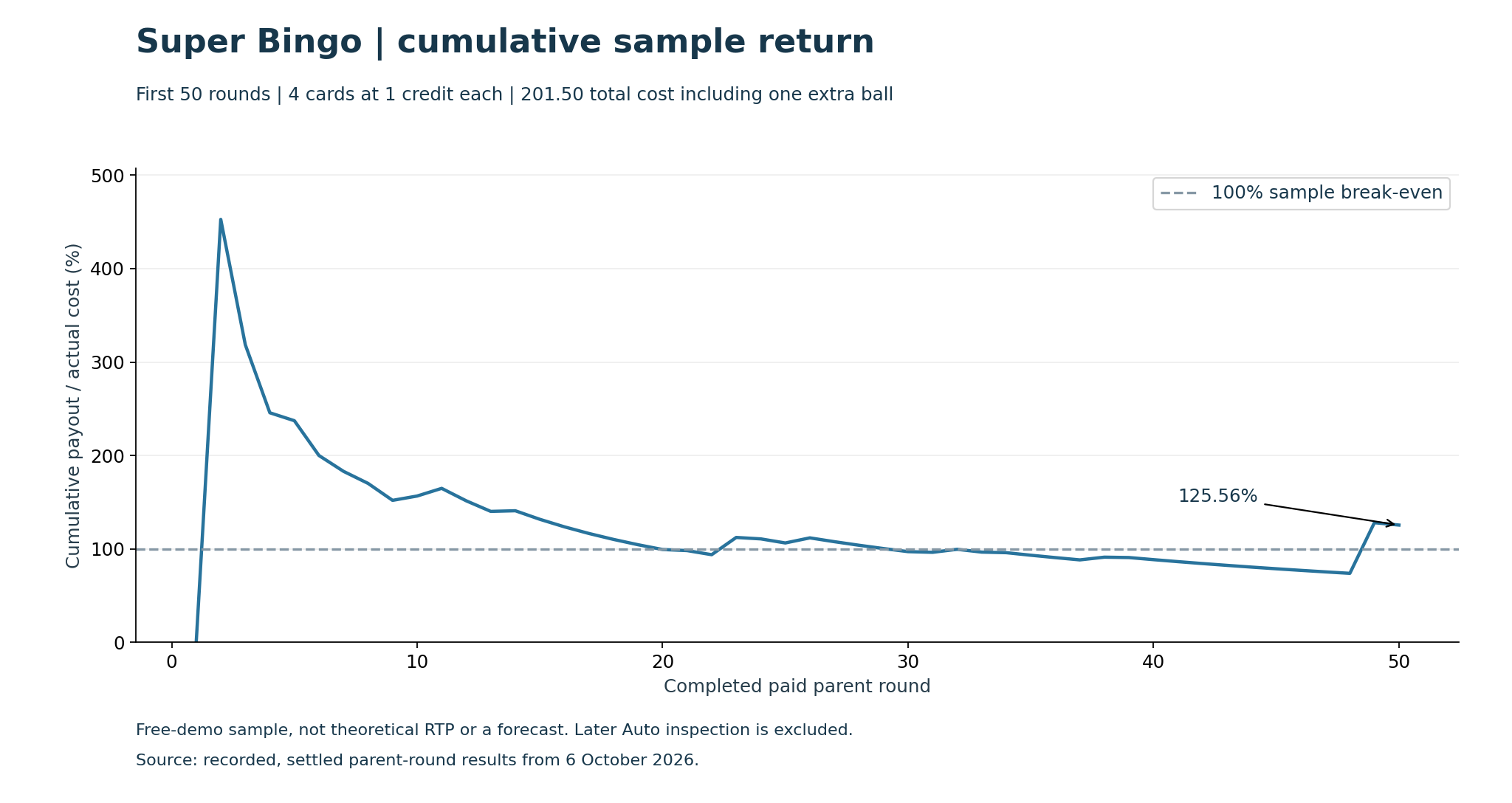
Cumulative from round 1, including the 1.50-credit extra-ball purchase. The 100% line marks sample break-even, not theoretical RTP.
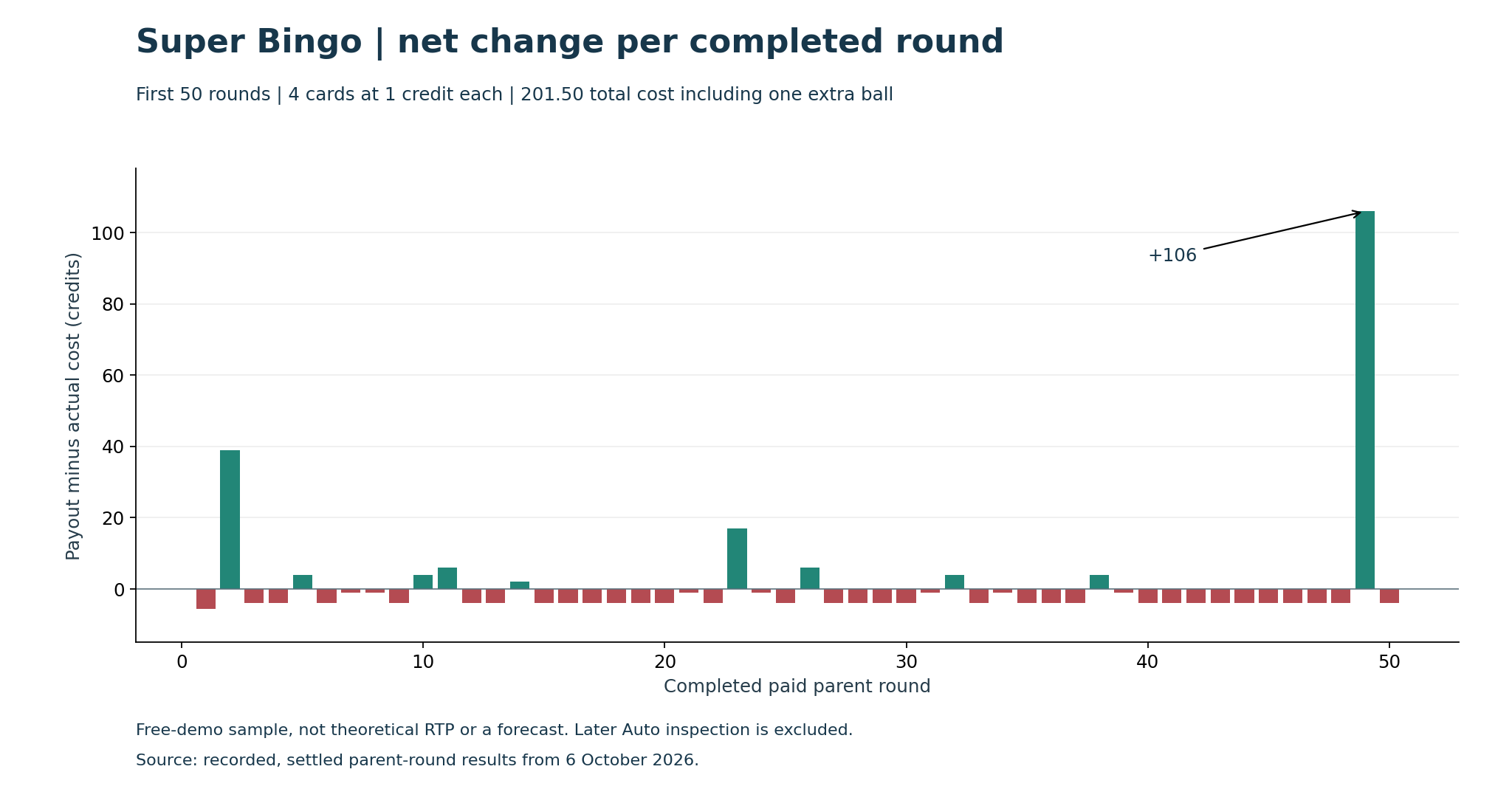
One bar per completed parent round. Round 1 includes its extra-ball cost; round 49 pays 110 against a 4-credit cost, for +106 net.
The ending profit hides a long downward stretch. Balance was 1,949.50 after round 48. Round 49 then paid 110 credits, accounting for 43.48% of all payout in the sample, and lifted the balance to 2,055.50 before the last 4-credit loss. One result changed the overall picture. That is useful evidence of short-run concentration, not enough to label the game’s theoretical volatility or recommend an extra-ball strategy.
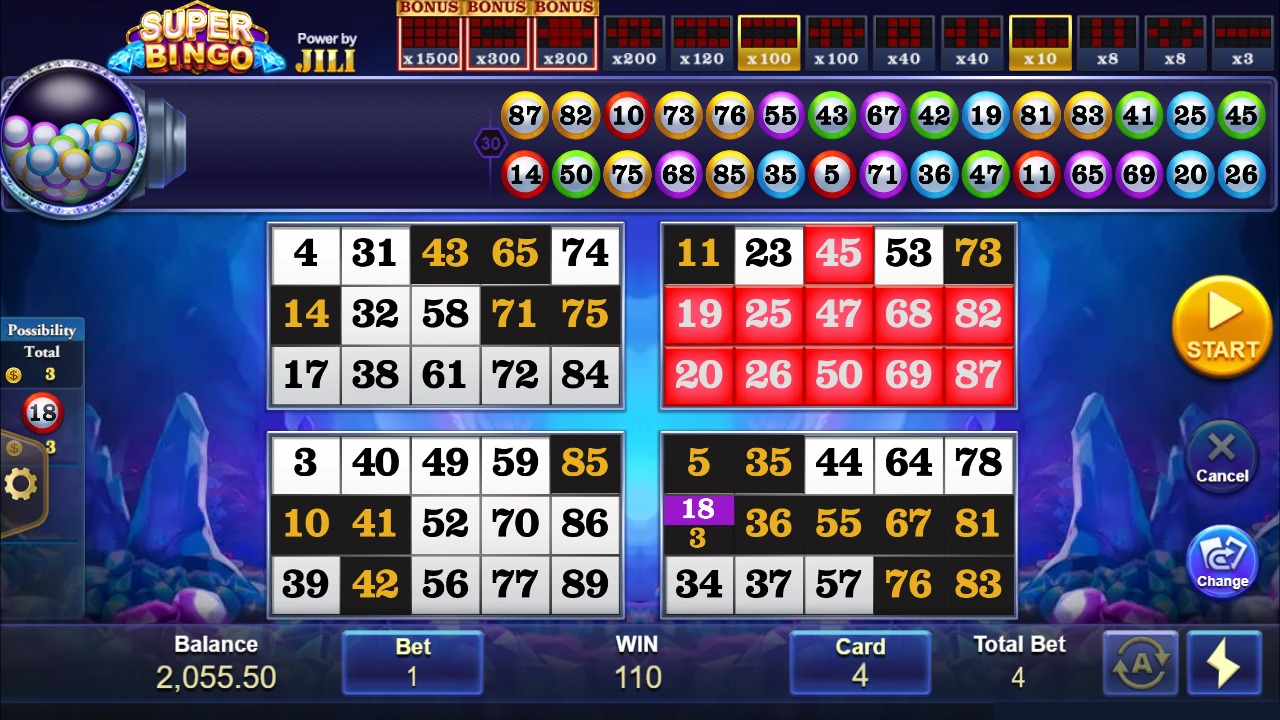
Round 49 settled at WIN 110 and Balance 2,055.50. The total is the read payout across the complete round, not just a single 100× symbol in the top strip.
For a separate illustration of how short runs can vary, try AskSpinner’s slot simulator. Its model does not reproduce Super Bingo’s number draws, extra-ball prices or undisclosed game maths.
7. My verdict and which way to play suits you
I rate this presentation 7/10. The attraction is the changing relationship between your cards, the missing numbers and the next-ball quote. I would choose the wide layout and manual control while learning it: the amounts are easier to follow and each extra-ball decision stays visible. That preference is about clarity, not better odds.
Choice within Super Bingo | What changes | Who it suits |
|---|---|---|
Basic draw, then stop | The card price and count set the starting cost; no paid continuation if extra offers are declined. | Readers who want a clearer round budget and a shorter decision chain. |
Manual extra-ball continuation | Each accepted quote adds a separate cost inside the same parent round. | Readers who enjoy tracking the near-complete shapes and reviewing each displayed price. |
Normal versus Turbo | The observed speed changes; the sample does not establish a change in return or pattern rules. | Normal for learning the sequence; Turbo once the controls and settlement stages are familiar. |
The game is easier to appreciate if number patterns themselves are the draw for you. If you want big, uncluttered controls in portrait or a start button that first asks for automatic-play settings, this interface may feel fussy. Keep the card total, extra-ball quotes and settled balance in view, and judge the experience separately from whether a short demo ends ahead.
Super Bingo by JILI FAQs
Answers to common questions about Super Bingo by JILI.
Super Bingo by JILI Reviews
 No Player Reviews Yet
Played Super Bingo by JILI? Share your experience with other players.
 Write A Review