
Super Ace Scratch by JILI
Play Super Ace Scratch by JILI In Demo Mode
by JILI Games



 BonusSuper Ace Scratch BONUS 4X
- Quadruples the prize
- Example: 20 to 80
- Highest BONUS value
- Three equal amounts
 BonusSuper Ace Scratch BONUS 3X
- Triples the prize
- Zero without match
- Help-defined value
- Three equal amounts
 BonusSuper Ace Scratch BONUS 2X
- Doubles the prize
- Example: 10 to 20
- Zero without match
- Three equal amounts
 BonusSuper Ace Scratch BONUS 1X
- Prize unchanged
- No separate prize
- Example: 25 to 25
- Three equal amounts
Super Ace Scratch by JILI Expert Review


Updated:
Here you can find detailed review information about Super Ace Scratch by JILI.
A quick-reveal Super Ace, with a different appeal
Super Ace Scratch is a simple reveal game: buy one card, uncover nine amounts and look for a matching trio.
What I liked
✅ I like how little there is to learn: the three-match rule is quick to grasp and easy to check on a completed card.
✅ Manual scratching gives the reveal a deliberate pace; OPEN ALL is convenient for repeat play.
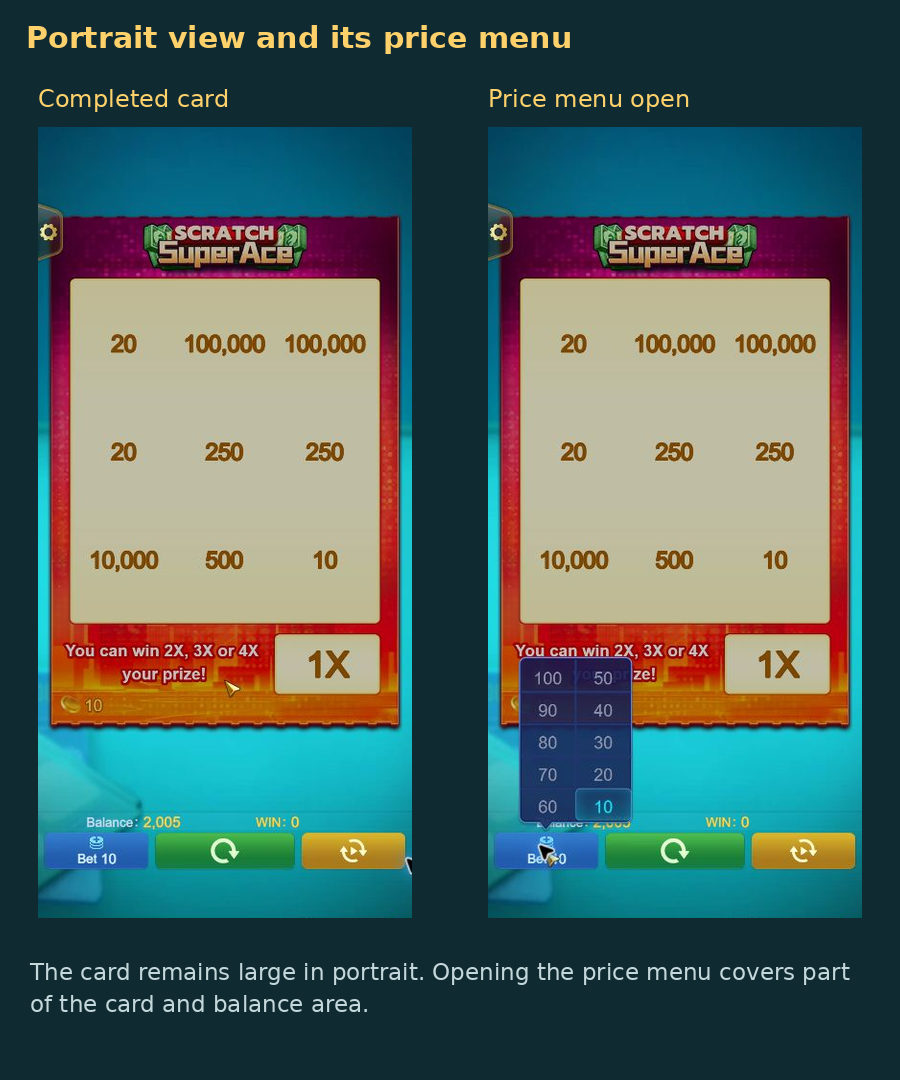
✅ The tall portrait card makes the main amounts prominent.
✅ The separate BONUS adds suspense as a clear second reveal.
✅ Start and OPEN ALL visibly distinguish purchase from reveal.
What I didn’t like
❌ Large unmatched numbers can distract from the simple question of whether a trio exists.
❌ The brief loop offers little variation once the matching and Bonus rules are familiar, becoming repetitive sooner than the reel-based Super Ace games.
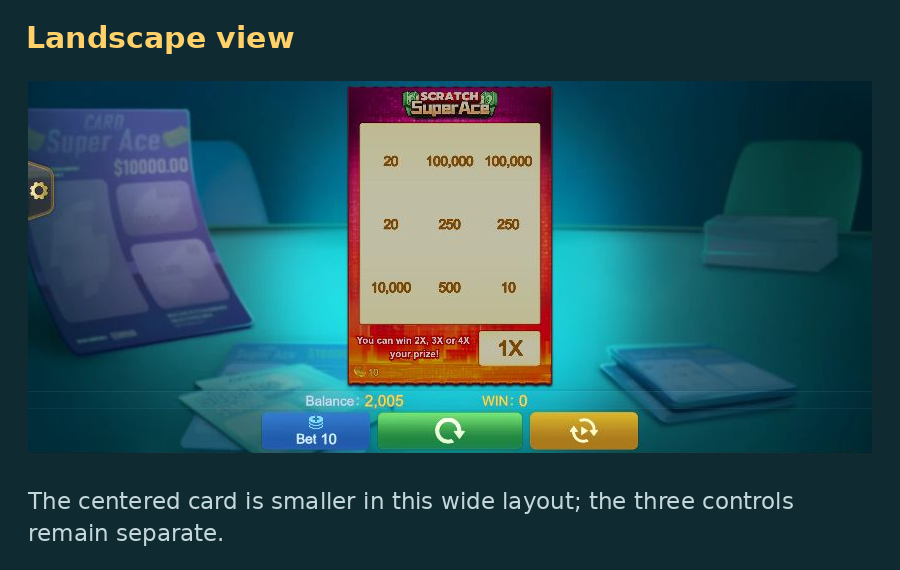
❌ Landscape leaves a much smaller card, and the price menu temporarily covers part of the view.
❌ A higher multiplier is easy to overvalue when the card has no qualifying prize.
❌ Rapid repeat purchases can make total cost less noticeable than individual card prices.
The key habit is to check the final WIN against the card price. A large amount appearing once is not a prize. A 4X BONUS can still pay nothing. Even a card that pays can merely return its purchase cost.
This is JILI game 439. The official product listing places it under Bingo, with zero paylines and a July 2024 publication month. Its actual format is a digital scratchcard. The crowns on the coating are artwork; they are not reel symbols with their own paytable.
If the demo is available on this page, start with one card and follow the reveal below before purchasing another.
Watch the manual reveal
An 11.1-second manual-scratching excerpt, assembled in order from captured gameplay frames. It starts partway through the reveal and ends before the BONUS and final payout. The clip has no audio.
Philippine search interest
Ahrefs estimated 30 monthly searches for “super ace scratch” in the Philippines when checked on 4 October 2026, and 10 for “super ace scratch demo.” Related terms can overlap, so these figures should not be added together as a traffic forecast. Google Trends had insufficient data for either exact term in the Philippines over the past 12 months. Search interest says nothing about payout odds.
The interface, buying a card and revealing it
The tall red-and-gold ticket is the visual focus. Its amount area is easy to scan once uncovered, and the BONUS sits directly below it. The background is deliberately softer than the card. That helps the ticket stand out, although the balance and WIN text deserve a closer look than the big prize artwork.
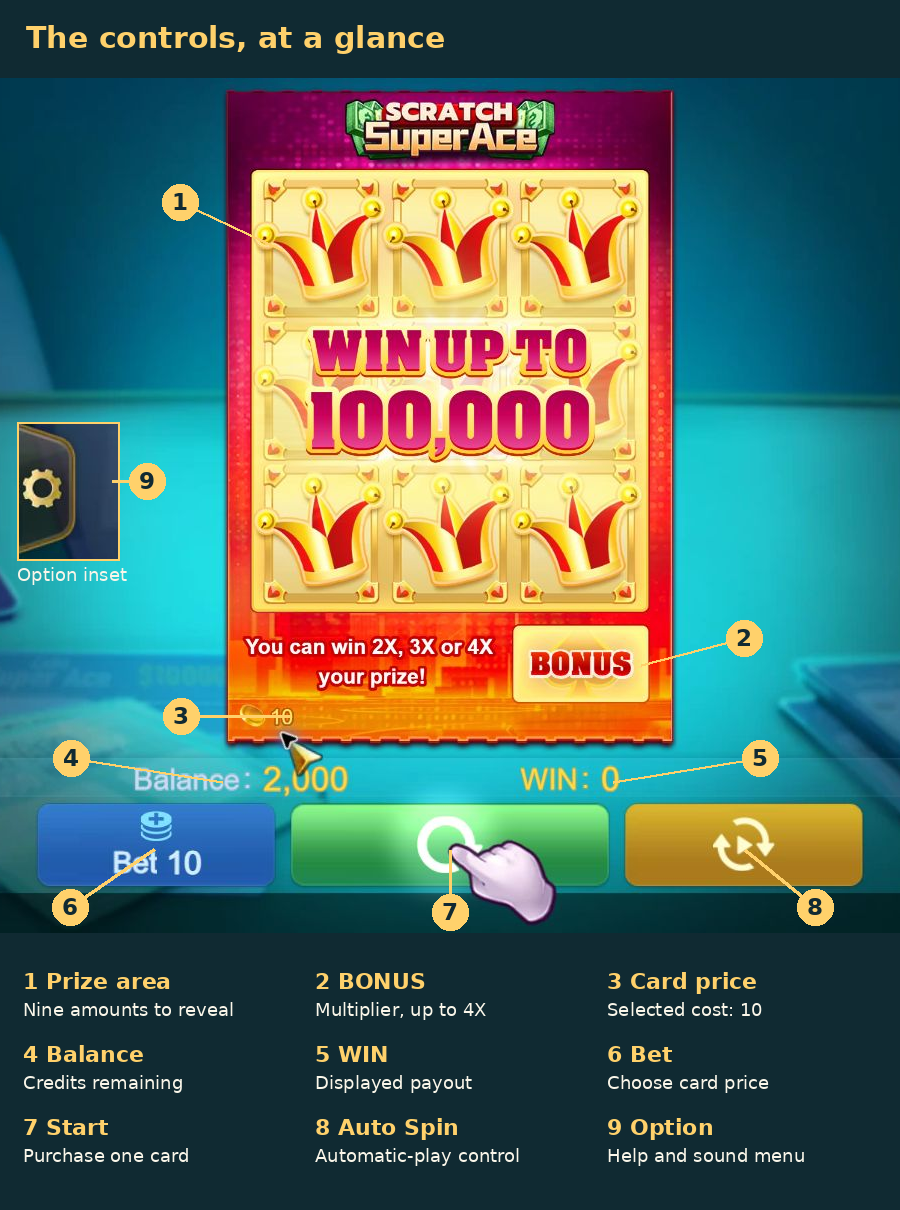
Prize area: reveal nine amounts and look for three identical values.
BONUS: reveal the multiplier below the prize area.
Card price: the small value along the ticket’s bottom edge is 10 here.
Balance: your remaining credits. A purchase reduces it before the result appears.
WIN: the displayed payout, not profit after the card cost.
Bet: open the card-price selector before buying.
Start: the green center control purchases a card at the selected price. After purchase, it becomes red OPEN ALL.
Auto Spin: the yellow automatic-play control. Help says tap to start and tap again to stop.
Option: the far-left gear opens the information and sound controls.
Start and OPEN ALL do different jobs
Card 1 began with Balance 2,000 and Bet 10. Purchasing it reduced Balance to 1,990 and changed the green Start button to red OPEN ALL. That is the moment the card cost was charged. OPEN ALL then reveals the card already purchased; it does not buy an additional card.
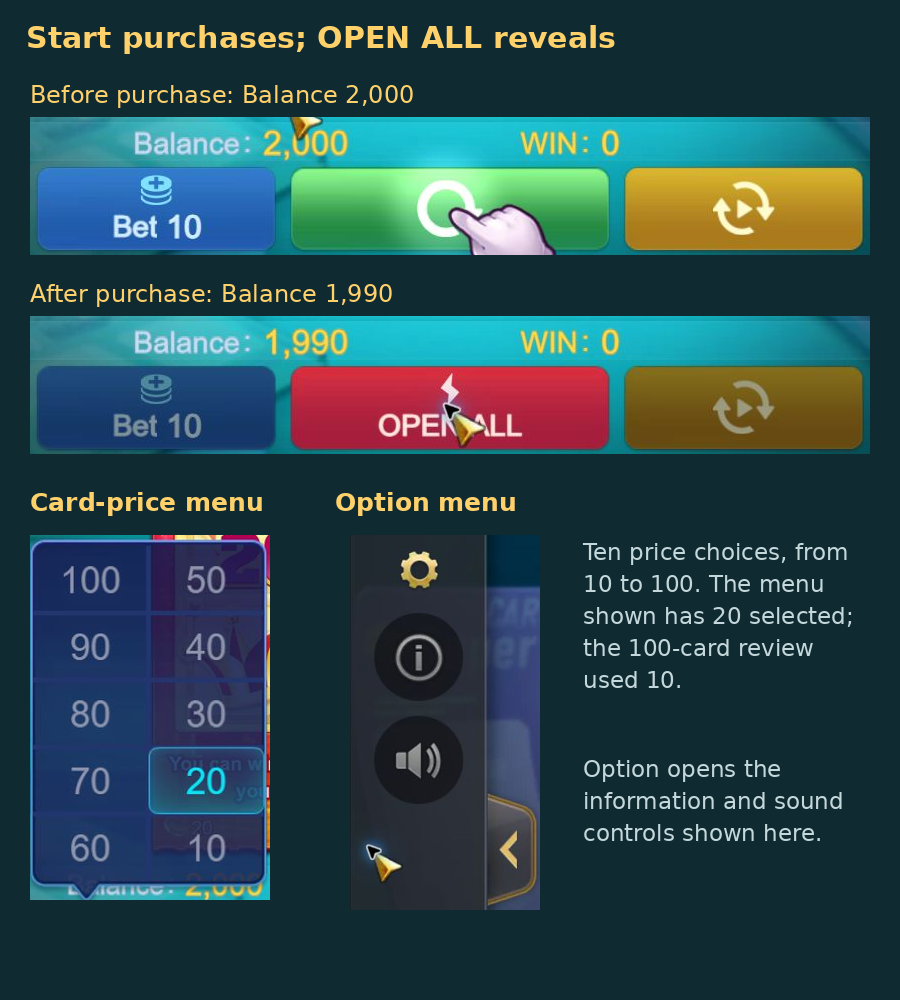
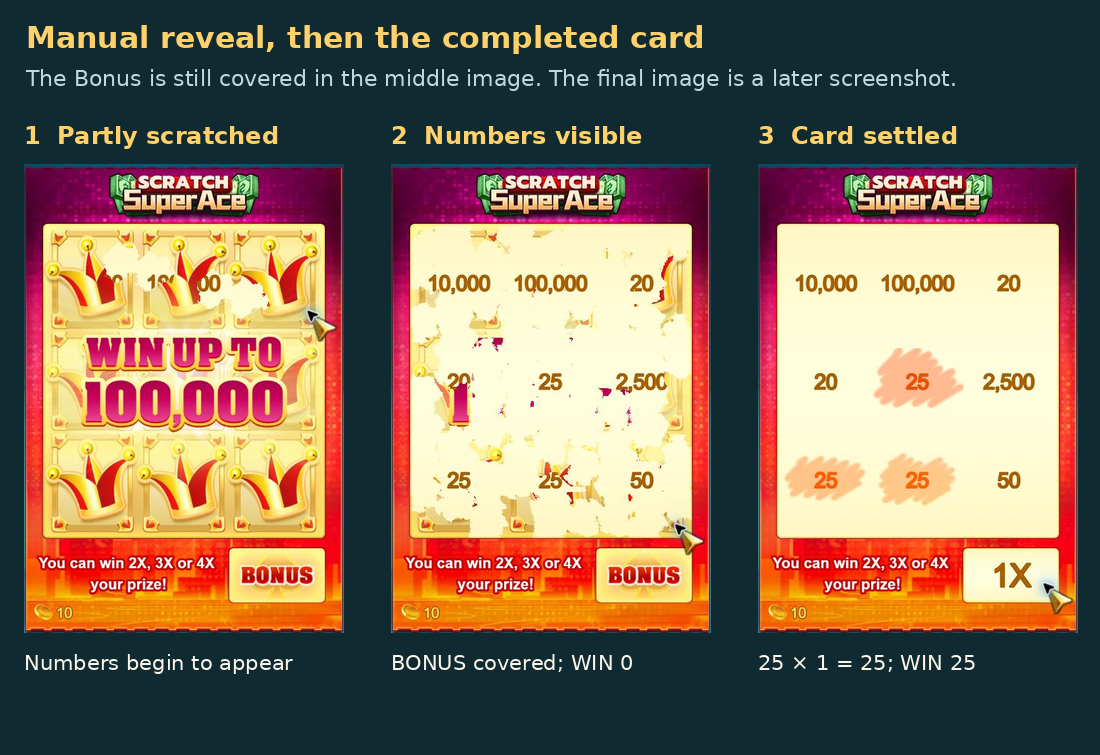
For manual play, press and drag over the coating to uncover the amount area, then reveal the BONUS. Alternatively, use OPEN ALL to reveal the current card at once. Help calls this control “Scratch All.” When the card has finished, check WIN and Balance before using green Start again.
There was no separate card-quantity selector, EX purchase or Turbo tier in the inspected controls. OPEN ALL is a reveal shortcut. The yellow Auto Spin button is a separate function; this review did not test a long automatic run or any stop threshold.
The open Option menu shows the information and sound buttons. Help also describes a History control for viewing past bets, but that screen was not opened during this review.
Portrait keeps the card easier to read
I prefer the portrait layout. In the captured 390 × 844 view, the card occupies most of the width, with all three main controls below it. The amount grid is more prominent than the small balance strip. Opening the price menu covers part of the card and balance area, so close it before reading a result.
The 844 × 390 landscape view leaves much more space beside the narrow ticket. The controls remain separate, but the amounts and BONUS become smaller. These images came from resized browser viewports; they show layout, not a physical-phone touch or network test.
How to read a winning scratchcard
Read the nine amounts as a matching puzzle. Three identical amounts produce one prize of that value. Their positions do not have to make a horizontal line: card 1 matched 25 in the center, bottom-left and bottom-middle cells.
The calculation is matched amount × BONUS = payout. Three 25s with BONUS 1X pay 25, not 75. The other exposed amounts do not join the total.
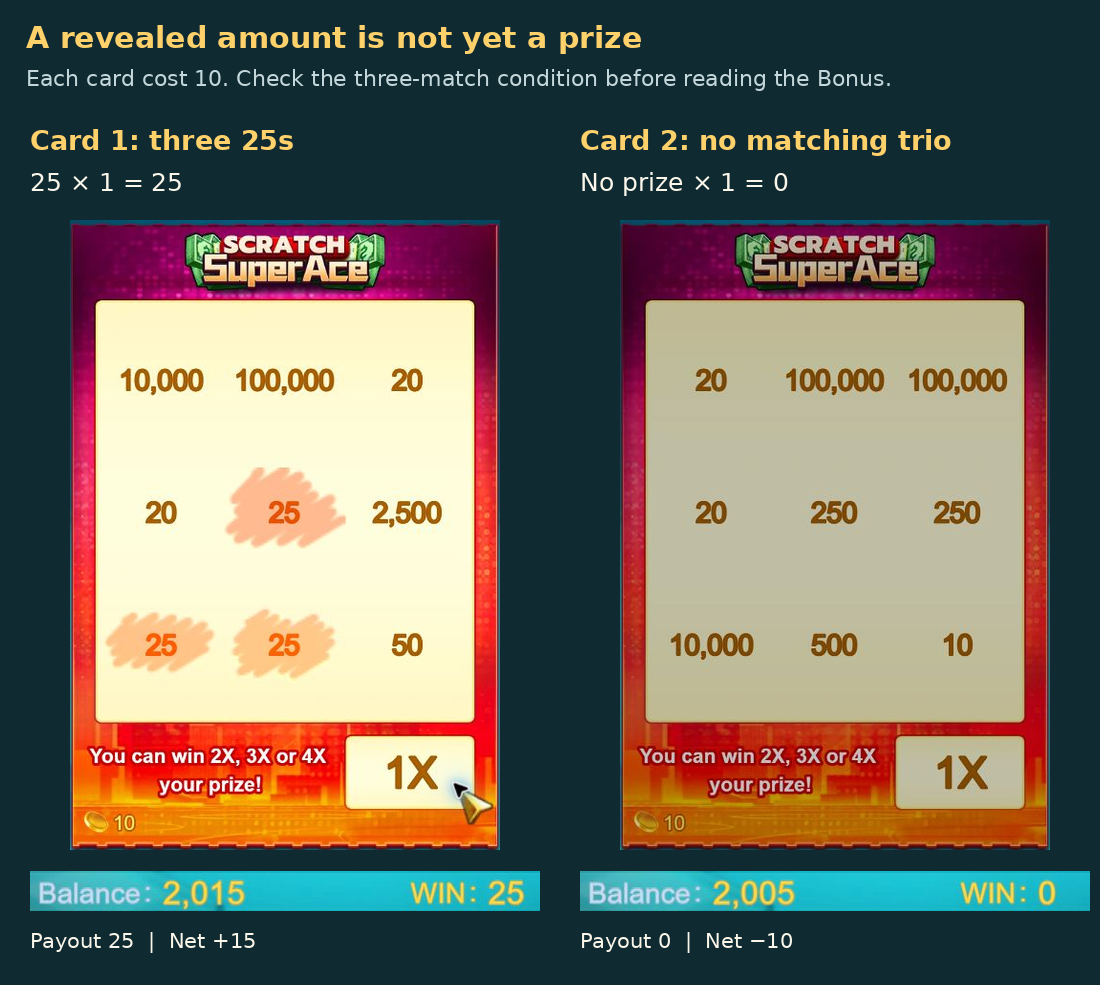
Card 2 is a useful counterexample. It revealed pairs of 20, 250 and 100,000, but no amount appeared three times. Its BONUS was 1X and the final WIN was 0. Neither the size of a number nor two matching values is enough.
Reveal the full result before counting it
During card 1’s manual reveal, the nine values became readable while the BONUS remained covered and WIN still showed 0. A later completed screenshot showed BONUS 1X, WIN 25 and Balance 2,015. The intermediate view and final result belong to one purchased card.
The numbered interface guide above identifies the prize area, BONUS and controls. The amounts determine the prize; the crown artwork is not a separate paying symbol. The captured rules did not explain how several different matching trios on one card would be combined, and that situation did not occur in these 100 cards.
BONUS multipliers and the reveal sequence
BONUS can show 1X, 2X, 3X or 4X. It multiplies the prize from the nine-amount area. It is not a separate prize, and revealing a higher multiplier does not repair a card without a matching trio.
A complete 4X example
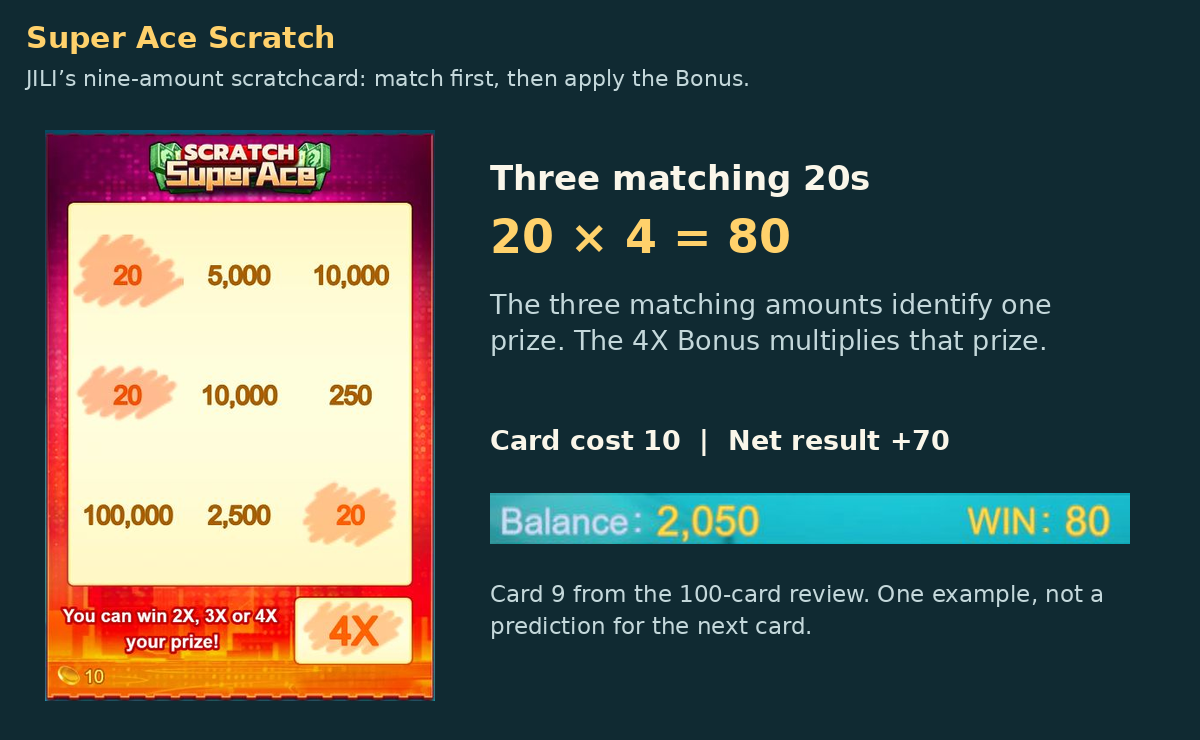
Card 9 began at Balance 1,980. Its 10-credit purchase reduced that to 1,970. The card revealed three 20s and BONUS 4X, giving 20 × 4 = 80. After completion, WIN showed 80 and Balance reached 2,050.
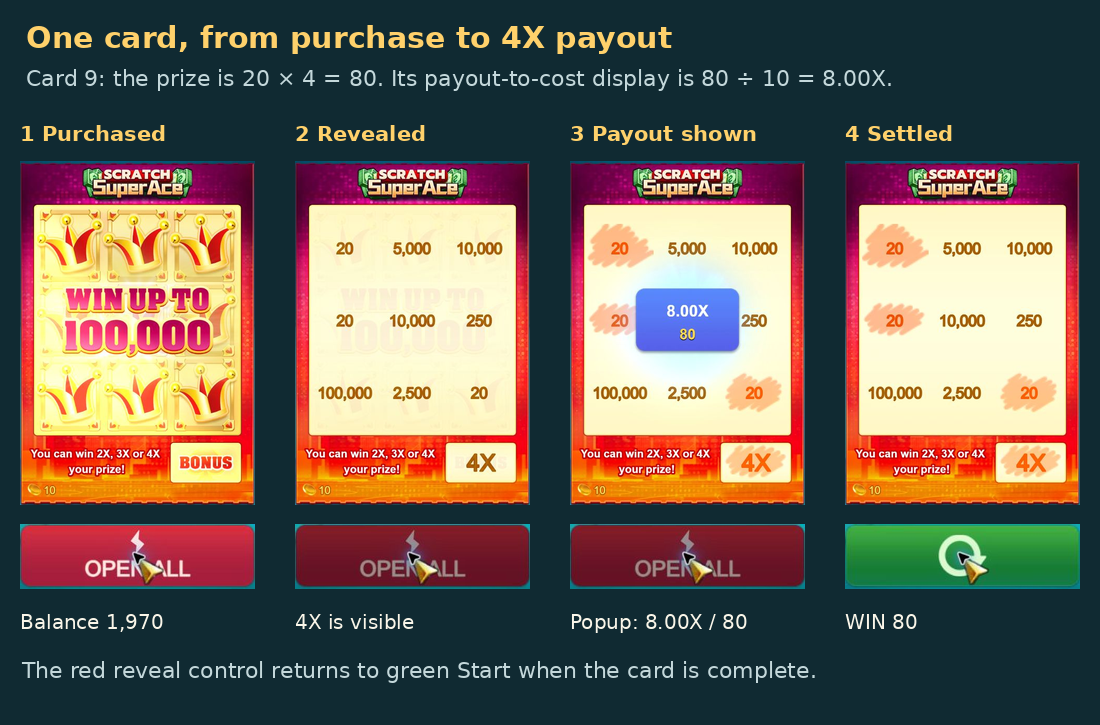
The two multipliers on that screen have different meanings. BONUS 4X changes the matched prize from 20 to 80. The 8.00X popup says that 80 is eight times the purchase cost of 10. It is not an additional eightfold multiplier to apply again.
Why a bigger BONUS can still lose
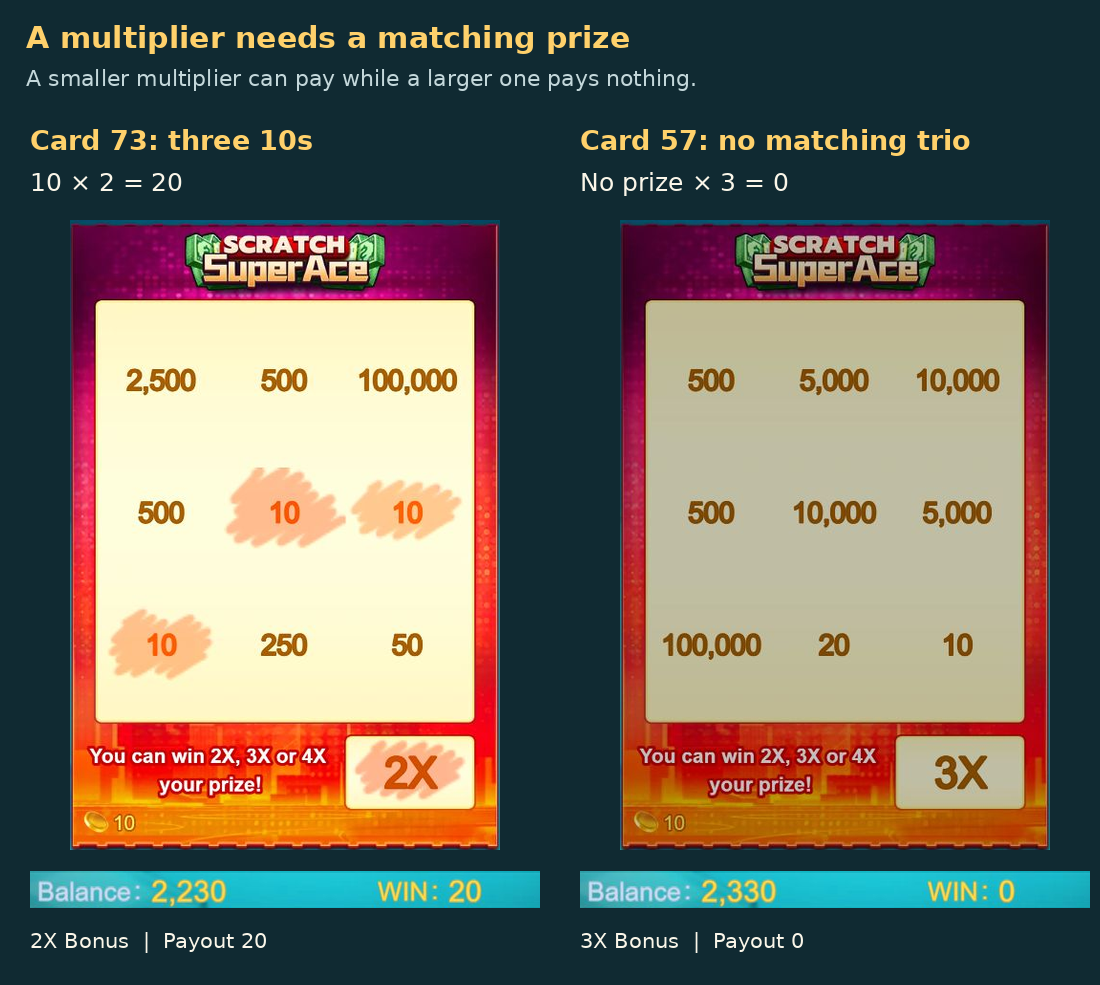
Card 73 matched three 10s and used BONUS 2X to pay 20. Card 57 had BONUS 3X but no matching trio, so it paid 0. Both 3X cards in this sample were losses; no 3X winning payout was observed.
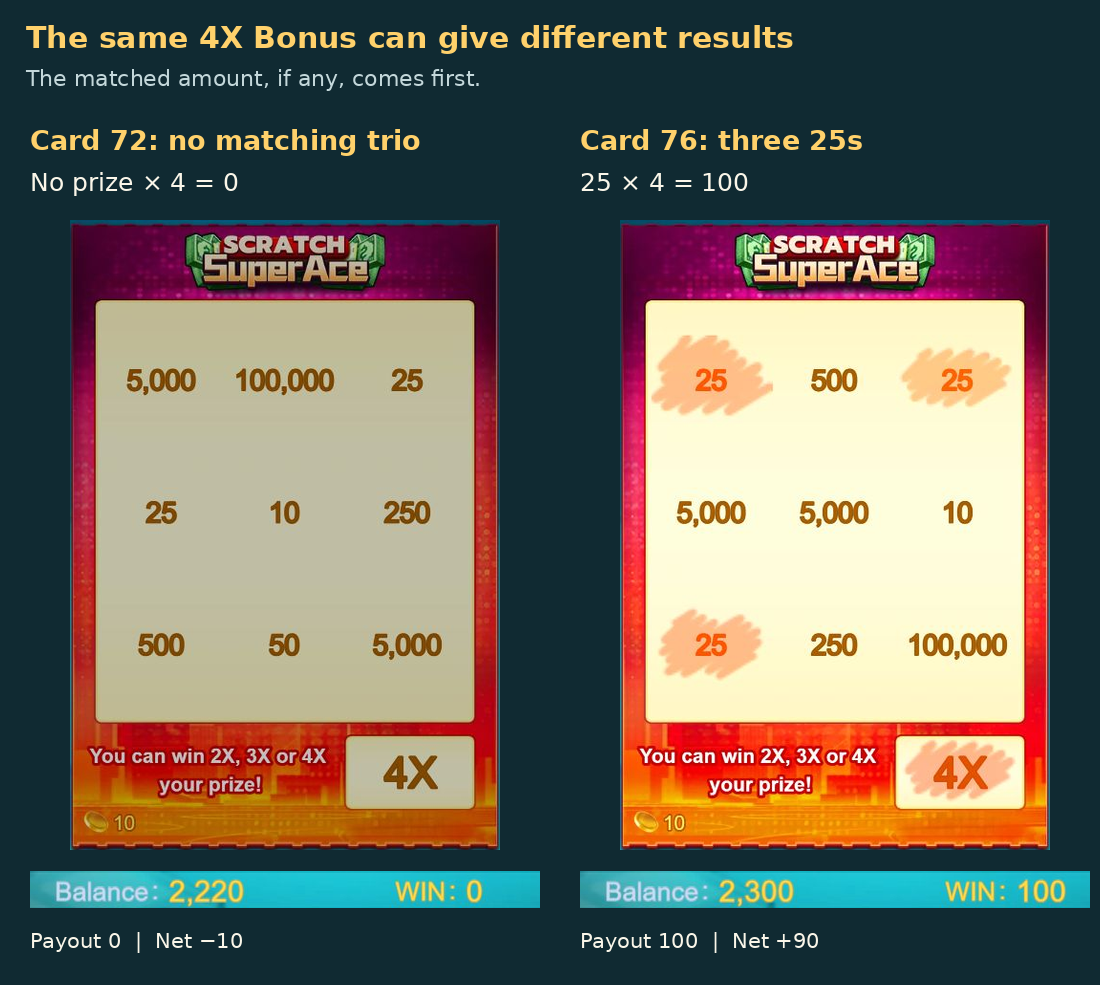
The same distinction applies at 4X. Card 72 had no matching trio and paid nothing. Card 76 matched three 25s and paid 100 with the same 4X multiplier. This is why I read the prize area first and use the BONUS only after confirming the match.
Manual scratching makes this two-part reveal more deliberate. OPEN ALL skips the rubbing action and is more convenient once the rule is familiar. The inspected rules give neither method a separate payout advantage. Changing the reveal method should be a pacing choice, not a winning strategy.
Card prices, payout limits and the missing RTP
The available prices were 10, 20, 30, 40, 50, 60, 70, 80, 90 and 100. Each Start purchase charges the selected price once. Manual scratching and OPEN ALL are two ways to reveal that purchase; they are not separately priced modes.
Action or value | What it means here |
|---|---|
Start at Bet 10 | Purchase one card and deduct 10 from Balance. |
Manual reveal / OPEN ALL | Reveal the current card. No second purchase charge in the reviewed sequence. |
WIN 10 on a 10-credit card | Return of the card cost; net result 0. |
WIN 25 on a 10-credit card | Payout 25; net result +15. |
BONUS maximum | 4X applied to a qualifying matched prize. |
Help’s overall maximum multiplier | 40,000×. This is separate from BONUS 4X. |
Help’s maximum payout | 4,000,000 in the displayed game units. |
The Help limits are product limits, not likely session results. Our largest observed payout was 500 at a cost of 10, or 50× the card cost. Neither that sample maximum nor the card’s prominent prize artwork should replace the Help’s stated overall cap.
RTP and volatility
The official product page and all seven inspected Help screens gave no numerical theoretical RTP. They also did not provide a volatility rating for this game. Percentages or ratings from Classic, Deluxe or Joker do not establish Scratch’s values.
Our payout-to-cost result below is 118.5% for 100 cards. That is a description of what those cards paid, not an estimate precise enough to use as the game’s RTP. A short profitable run does not tell you what the next card or a long session will return.
For cost control, count purchases rather than swipes. At the lowest observed price, ten new cards cost 100 before any payouts. OPEN ALL can make it easier to buy the next card quickly, so choose a card-count or spending limit before the session. There is no demonstrated reveal pattern that improves the outcome.
What happened across 100 completed cards
We reviewed 100 consecutive completed cards in JILI’s official free mode on 4 October 2026, at 10 game credits per card. These are game credits, not Philippine pesos. The game was product 439; no build number was shown. Card 1 used manual scratching, and the later cards used Scratch All. Each purchased and settled card counts once, including its BONUS and final payout.
Measure | Observed result |
|---|---|
Cards / price per card | 100 / 10 |
Total card cost | 1,000 |
Total payout | 1,185 |
Net change | +185 |
Opening / closing Balance | 2,000 / 2,185 |
Sample payout-to-cost return | 118.5% |
Cards with a payout | 27 of 100 |
Net-profitable cards | 15 of 100 |
Break-even cards | 12 of 100 |
Zero-payout cards | 73 of 100 |
Largest payout / net win | 500 / +490, both on card 38 |
Longest run of zero payouts | 10 cards, numbers 57–66 |
The distinction between 27 paying cards and 15 profitable cards matters. Twelve payouts merely returned the purchase cost. Counting every positive WIN as profit would make the session look more successful than it was.
Balance: one card changed the whole shape
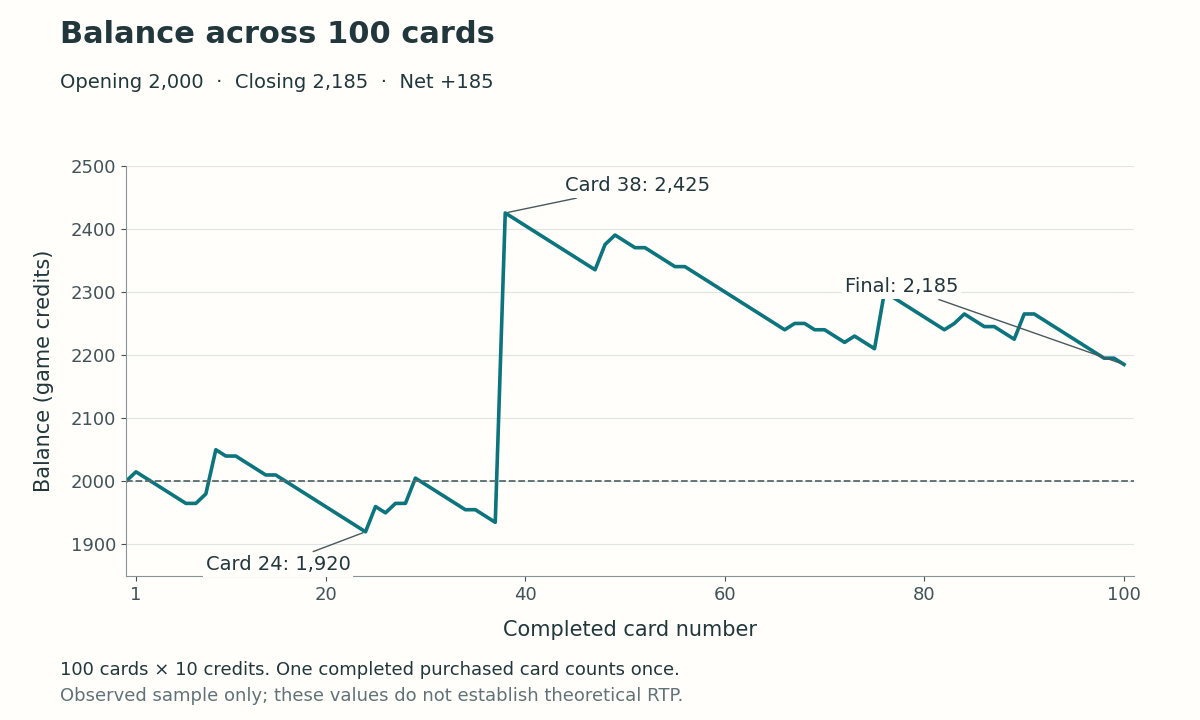
Balance fell to 1,920 after card 24. Card 38 later produced a 500 payout and a +490 net jump, taking Balance to 2,425. The session finished above its starting point, but below that peak. The graph is a better picture of the session than the final +185 alone.
Cumulative return: a changing sample ratio
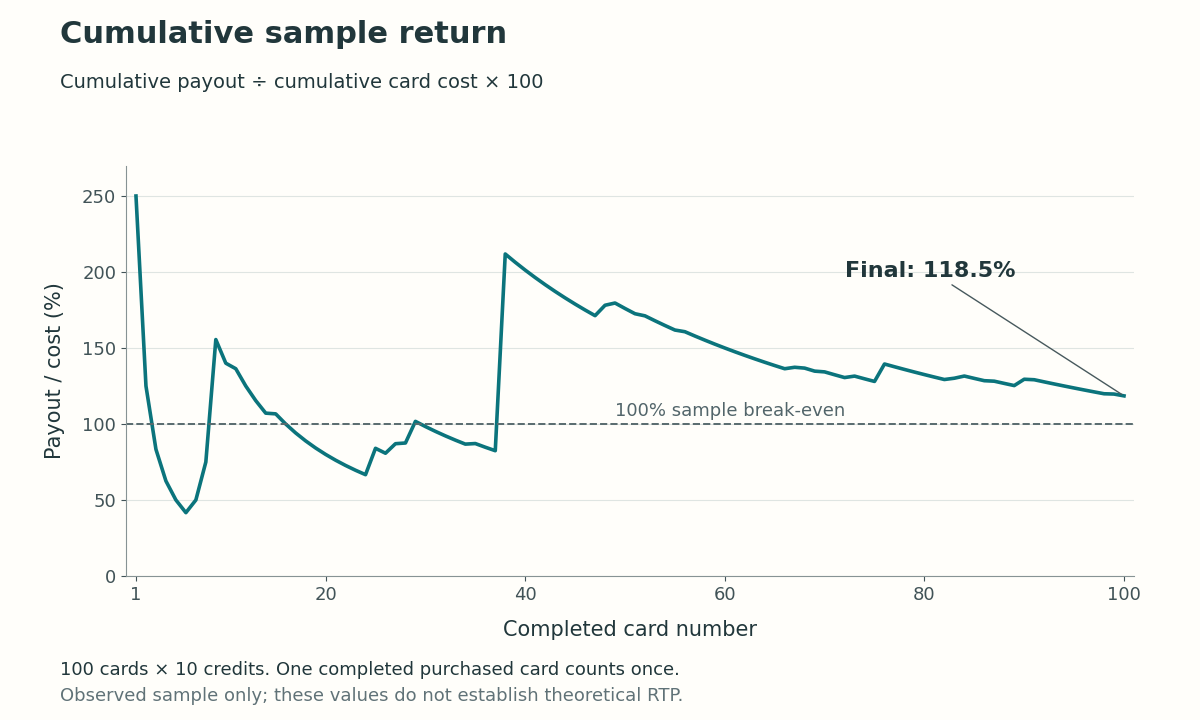
The first card paid 25 for a cost of 10, so the ratio began at 250%. That striking percentage represented just one card. By the end, 1,185 ÷ 1,000 × 100 gave 118.5%. Its movement shows why an early high return is a poor guide to the rest of a session.
Net result: many small losses and one large lift
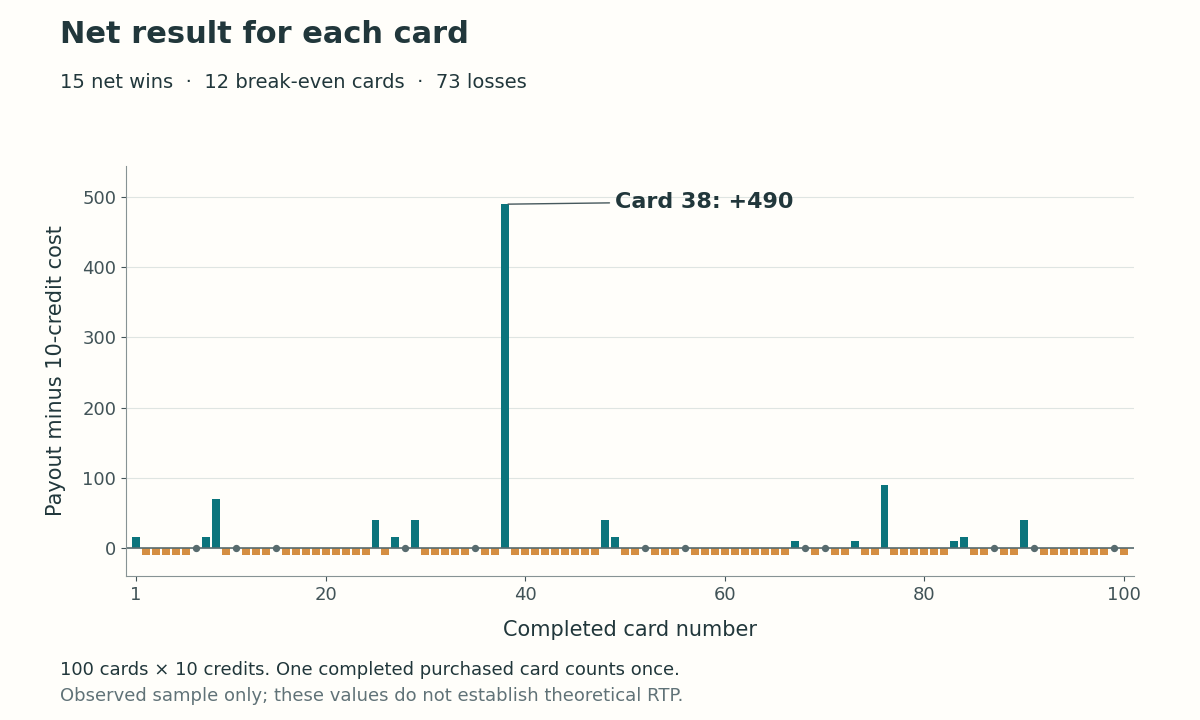
Card 38 supplied 500 of the total 1,185 payout, about 42.2%. That concentration explains much of the positive result. The ten-card zero-payout stretch from 57 to 66 cost 100 without a return, despite visible amounts and Bonus values appearing on every card.
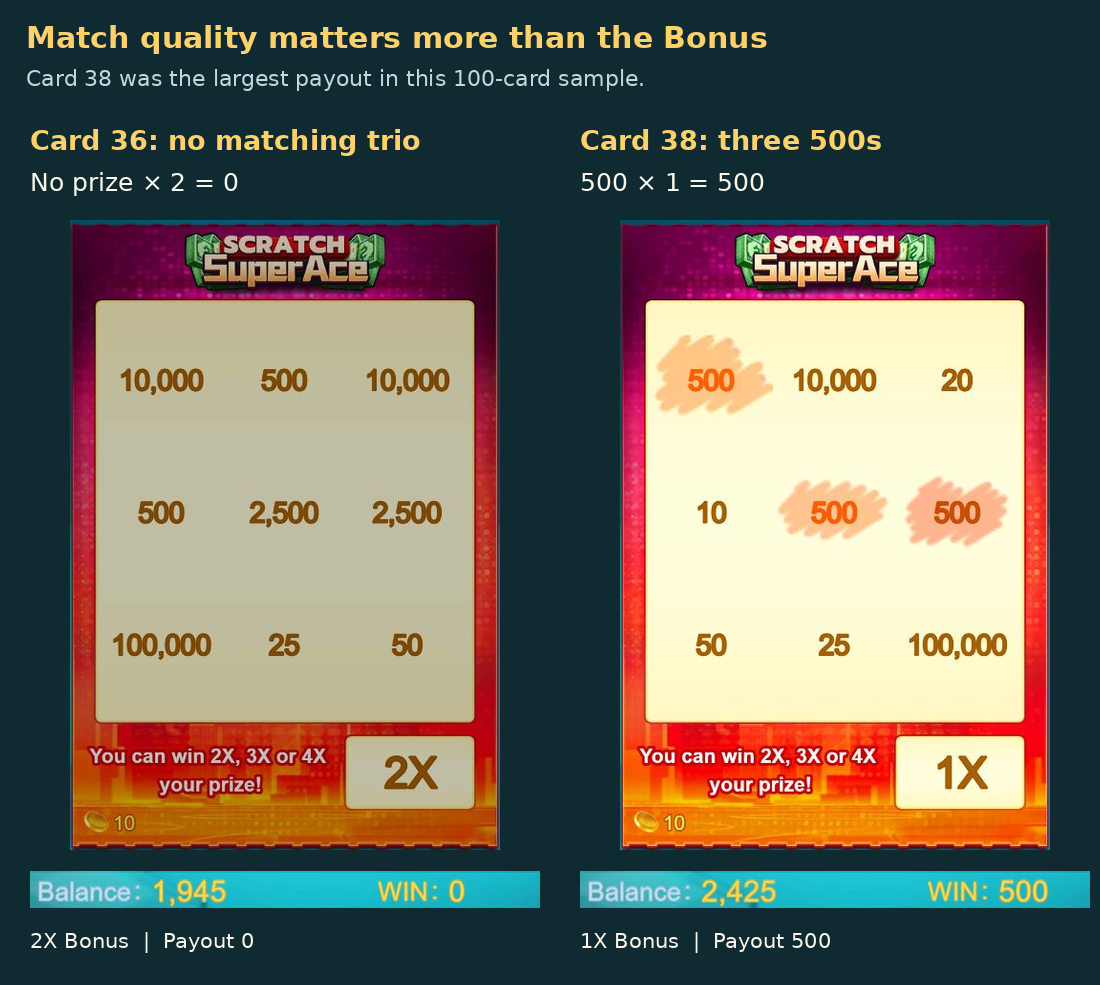
The evidence supports these card results and the rules illustrated by them. It does not establish long-run multiplier frequencies, a winning pattern or theoretical volatility. I would judge the game by whether its short reveal loop is enjoyable, rather than by this sample’s positive finish.
The verdict and which Super Ace to choose
My verdict is 7/10. Scratch is coherent and accessible, with a useful choice between a hands-on reveal and an instant one. It loses ground on variety and the cramped landscape presentation. The score reflects the design and readability, not the 118.5% sample return.
How it compares with the reel-based games
Game | Core result | Main interest | Choose it for |
|---|---|---|---|
Super Ace Scratch | Three identical amounts among nine | A prize match followed by a 1X–4X BONUS reveal | A short, easy-to-read scratchcard routine |
1,024 ways | Consecutive symbol eliminations, multipliers and Golden Joker changes | Following a chain of changing reel results | |
1,024 ways | Star Card adds golden cards; five-step base multiplier ladder; 42× Buy Bonus | More linked features within the familiar reel layout | |
2,000 ways | Golden symbols, WILD transformations and Mystery symbols | More symbol interactions to follow |
The comparison is about how you read and experience a result. More ways or a larger advertised maximum do not demonstrate better value. JILI’s Classic, Deluxe and Joker listings confirm their reel-based formats and Ways counts. The linked reviews explain their different features; their specifications should not be copied into this scratchcard.
I would choose Scratch for a few deliberately paced reveals, especially in portrait. I would choose one of the reel-based games when I wanted to follow changing symbols and longer feature sequences. For Scratch itself, the best first step is to learn one card fully: purchase, match, BONUS, final WIN, then the net result.
Super Ace Scratch by JILI FAQs
Answers to common questions about Super Ace Scratch by JILI.
Super Ace Scratch by JILI Reviews
 No Player Reviews Yet
Played Super Ace Scratch by JILI? Share your experience with other players.
 Write A Review