
Super Ace by JILI
Play Super Ace by JILI In Demo Mode
by JILI Games




 ScatterSuper Ace - Scatter
- 3 Scatters
- 10 Free Spins
- +5 retrigger
- ×2/4/6/10
 WildSuper Ace - Little Joker
- From Golden
- Same cell
- No copies
- No Scatter
 WildSuper Ace - Big Joker
- From Golden
- Same cell
- Random copies
- No Scatter
 Paying SymbolSuper Ace - Golden Club
- 5 reels 0.25×
- Per way
- Reels 2–4
- Win to Wild
 Paying SymbolSuper Ace - Golden Diamond
- 5 reels 0.25×
- Per way
- Reels 2–4
- Win to Wild
 Paying SymbolSuper Ace - Golden Heart
- 5 reels 0.5×
- Per way
- Reels 2–4
- Win to Wild
 Paying SymbolSuper Ace - Golden Spade
- 5 reels 0.5×
- Per way
- Reels 2–4
- Win to Wild
 Paying SymbolSuper Ace - Golden Jack
- 5 reels 1×
- Per way
- Reels 2–4
- Win to Wild
 Paying SymbolSuper Ace - Golden Queen
- 5 reels 1.5×
- Per way
- Reels 2–4
- Win to Wild
 Paying SymbolSuper Ace - Golden King
- 5 reels 2×
- Per way
- Reels 2–4
- Win to Wild
 Paying SymbolSuper Ace - Golden Ace
- 5 reels 2.5×
- Per way
- Reels 2–4
- Win to Wild
 Paying SymbolSuper Ace - Regular Club
- 3 reels 0.05×
- 4 reels 0.15×
- 5 reels 0.25×
- Per way
 Paying SymbolSuper Ace - Regular Diamond
- 3 reels 0.05×
- 4 reels 0.15×
- 5 reels 0.25×
- Per way
 Paying SymbolSuper Ace - Regular Heart
- 3 reels 0.1×
- 4 reels 0.3×
- 5 reels 0.5×
- Per way
 Paying SymbolSuper Ace - Regular Spade
- 3 reels 0.1×
- 4 reels 0.3×
- 5 reels 0.5×
- Per way
 Paying SymbolSuper Ace - Regular Jack
- 3 reels 0.2×
- 4 reels 0.6×
- 5 reels 1×
- Per way
 Paying SymbolSuper Ace - Regular Queen
- 3 reels 0.3×
- 4 reels 0.9×
- 5 reels 1.5×
- Per way
 Paying SymbolSuper Ace - Regular King
- 3 reels 0.4×
- 4 reels 1.2×
- 5 reels 2×
- Per way
 Paying SymbolSuper Ace - Regular Ace
- 3 reels 0.5×
- 4 reels 1.5×
- 5 reels 2.5×
- Per way
Super Ace by JILI Expert Review


Updated:
Here you can find detailed review information about Super Ace by JILI.
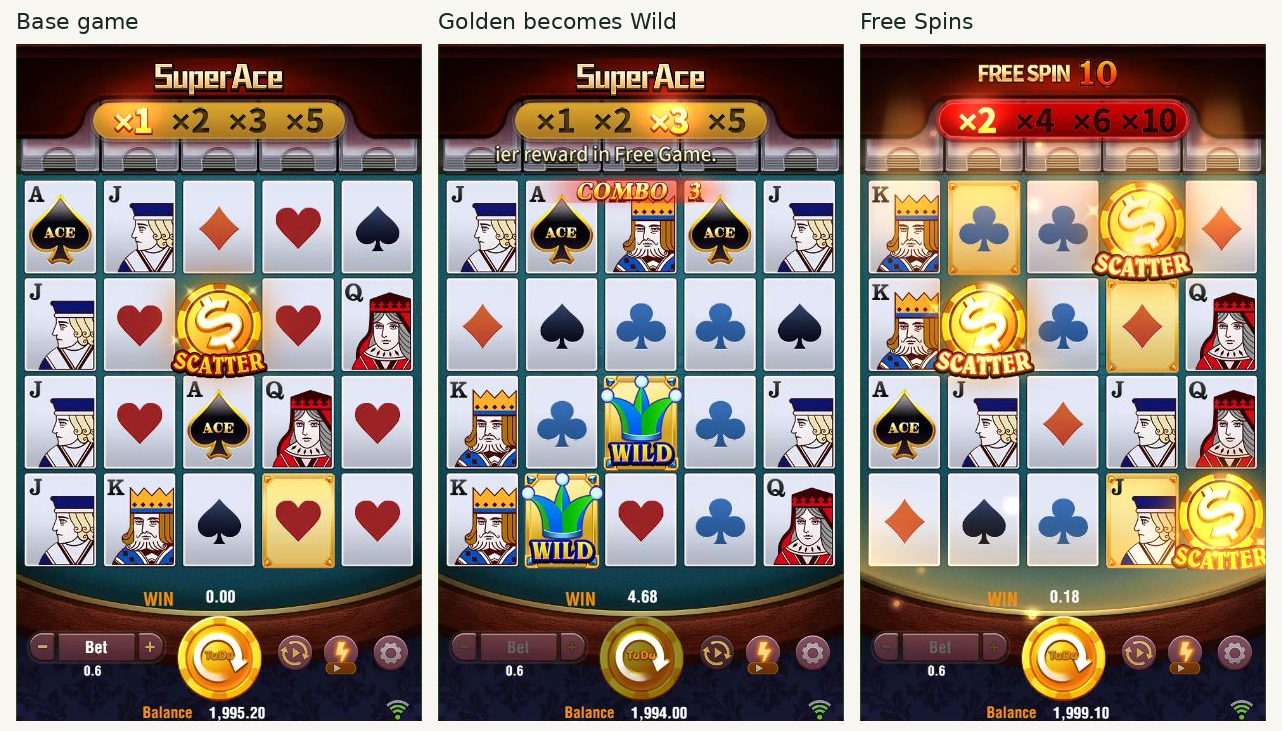
Super Ace at a glance: the base game, a Golden-to-Wild transformation and Free Spins. These screenshots come from different rounds and moments; they are not one continuous sequence.
What I liked
✅ What I like most about JILI Super Ace is Golden Cards turning Wild in the same position, potentially connecting the next cascade at a higher multiplier.
✅ Free Spins build on the same Golden Card and Joker rules, with higher multipliers.
✅ The portrait layout keeps the full grid, bet and balance easy to follow.
What I didn’t like
❌ The higher multipliers require consecutive wins within the same cascade.
❌ Small payout celebrations can accompany a net loss after the bet.
❌ The tested landscape viewport makes the game area and text much smaller.
The playing-card theme is simple, but that sequence gives the grid more to watch.
My verdict: this is an interesting choice if you enjoy following cascades. My 100-round demo session finished 47.82 credits ahead, yet roughly 65.2% of all payouts came from one complete round that triggered Free Spins. The closing balance alone gives a misleading impression of the typical spin.
Try it on this page. Start at normal speed so you can follow the Golden Cards and multiplier changes before deciding whether the pace suits you. This review covers the original Super Ace by JILI GAMES.
Watch ten seconds of gameplay
This silent clip shows three periods of reel movement at normal speed. It contains repeated frames, so use it to see the interface and spin sequence rather than to judge animation smoothness.
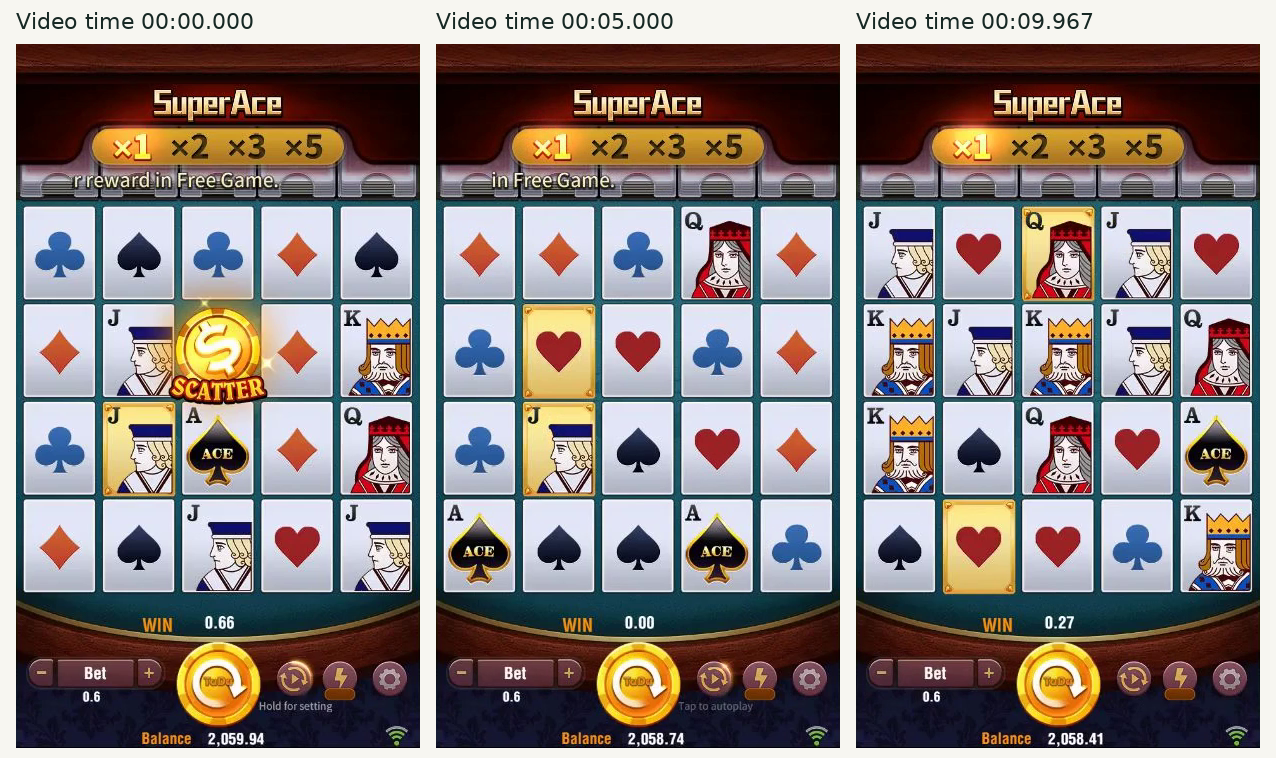
Frames from the accompanying 10-second silent clip at 00:00.000, 00:05.000 and 00:09.967. The clip includes three periods of reel movement; it is not a native screen recording.
Silent gameplay clip.
Game details and the version reviewed
Super Ace specifications for the reviewed build
Detail | Reviewed version |
|---|---|
Provider and layout | JILI GAMES; 5 reels, 4 rows and 1,024 Ways |
Basic winning condition | Matching symbols on at least 3 consecutive reels, starting on the leftmost reel |
Main features | Cascades, Golden Cards that turn into Jokers, rising multipliers and Free Spins |
Base-game multipliers | 1×, 2×, 3× and 5× |
Free Spins multipliers | 2×, 4×, 6× and 10× |
Free Spins trigger | 3 Scatters award 10 spins; another 3 during Free Spins add 5 |
Bet range in this build | 0.20–200 demo credits |
Maximum in this build | 10,000×; Help also lists a maximum payout of 2,000,000 |
RTP and volatility | No verified numerical RTP; the JILI product page labels volatility LOW–MED |
Build and review date | v_189_0008; October 4, 2026 |
The official sources disagree on the maximum multiplier. Both the reviewed Help and the JILI product page state 10,000×; the German TaDa product page states 1,500×. I have kept the rules tied to the build above. Check the in-game Help when playing through another entry point.
I used the official free demo for 100 wagered base-game rounds at a fixed 0.60 demo credits per round: 96 in Turbo and 4 at normal speed. The game did not label the amounts with a real-world currency. I also checked the desktop layout and two simulated mobile viewports. Physical-device touch controls, Philippine network conditions, sound and reconnection behaviour are outside this review.
Search interest in the Philippines
Ahrefs estimates 86,000 average monthly searches in the Philippines for “super ace”. Related queries show interest in the demo, the JILI version and Scatter rules.
Search query | Estimated monthly searches in PH |
|---|---|
super ace | 86,000 |
super ace demo | 18,000 |
super ace jili | 5,500 |
super ace scatter | 2,300 |
jili super ace | 1,700 |
how to play super ace | 1,300 |
Source: Ahrefs Philippines snapshot retrieved on 4 October 2026. These are average monthly estimates for separate queries. The queries overlap, so the figures should not be added together or treated as counts of players.
Straightforward controls work better in portrait
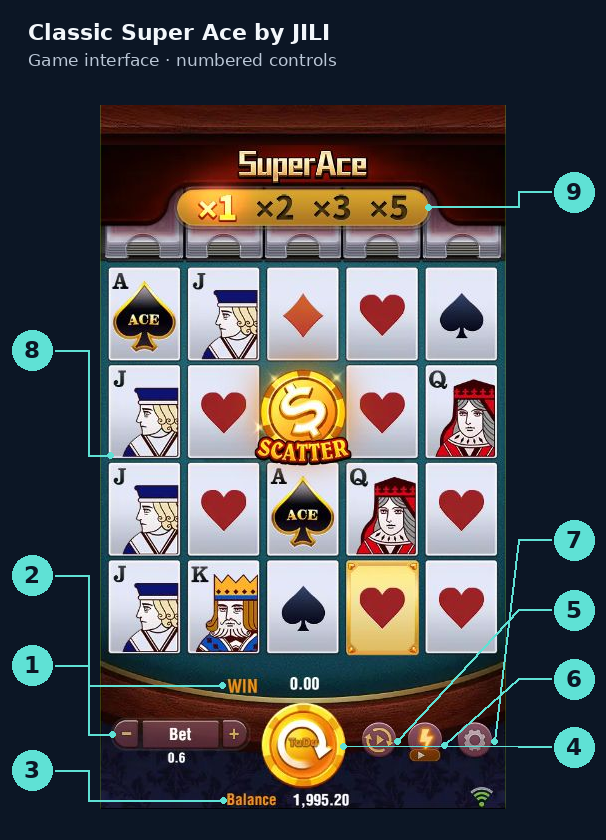
Classic Super Ace places its multiplier ladder above a five-reel, four-row grid. Bet, Spin, AutoSpin and speed controls sit below the reels, with Balance on a separate line.
Bet controls. Minus, Bet selector and plus; 0.60 shown.
WIN. Payout display beneath the reels; 0.00 shown.
Balance. Available demo credits: 1,995.20.
Spin. Start a spin at the selected stake.
AutoSpin. Tap to start; hold to open its settings.
Speed control. The lightning control changes spin speed.
Options. Open the menu for Help and sound.
Main grid. Five reels, four rows and 1,024 Ways.
Multiplier ladder. Main-game steps: 1×, 2×, 3×, then 5×.
Balance, Bet, WIN and the spin button sit together below the reels. The bet panel presents the available amounts directly, from 0.20 to 200 in this build; I used 0.60. I find the visible choices easier to scan than repeatedly tapping plus or minus, and the current amount is easy to check before changing it.
The Auto panel shows spin counts, win-ratio and balance conditions, plus an option to stop when Free Spins trigger. It can reduce repetitive clicking, although I did not test every stop condition. For a first look, I would still use manual spins at normal speed to follow the Golden Cards and multipliers.
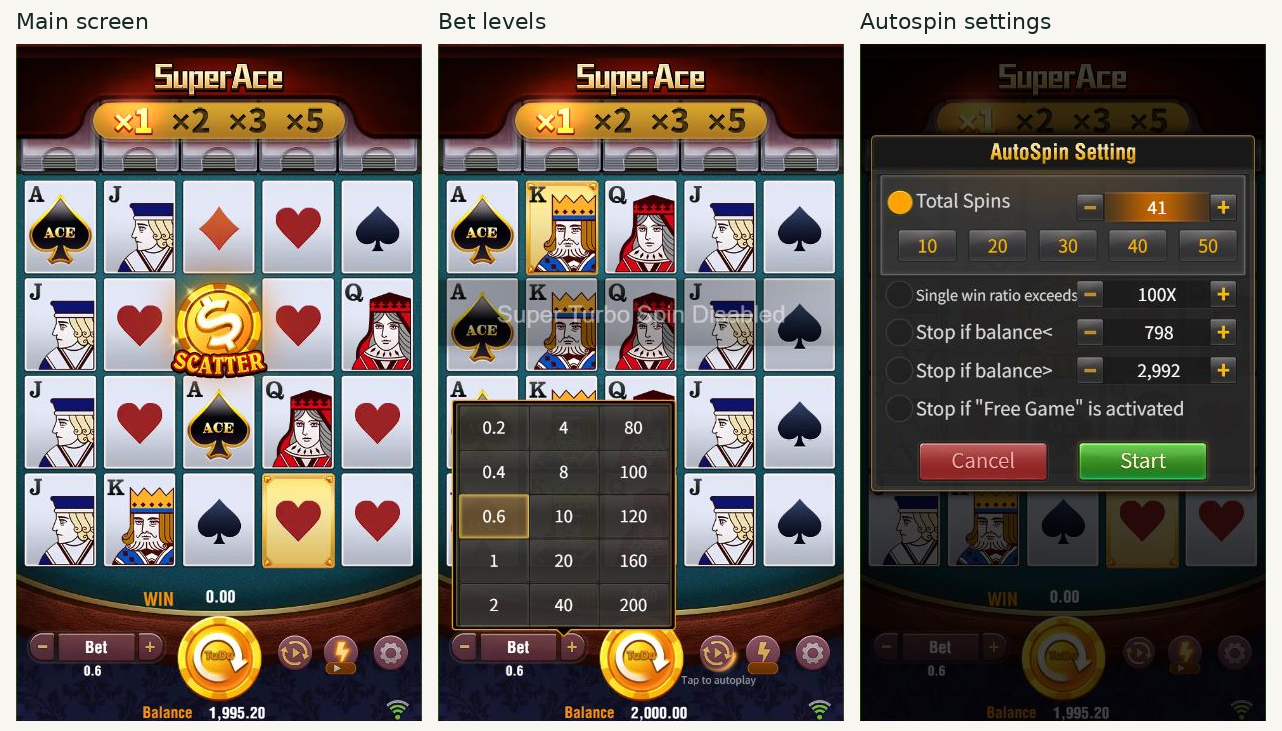
Main screen, bet selector and Autospin settings in the demo build. The images show the available controls, bet levels and stop conditions; the presence of an option does not mean every stop rule was tested. These are independent interface observations, not a gameplay sequence.
In a simulated 390 × 844 portrait viewport, the full 5 × 4 grid and the amounts below it remained visible. The game used the available width well, making the cards easy to distinguish.
At a simulated 844 × 390 landscape size, the game kept its vertical layout in the centre. The main game area shrank to about 220 pixels wide, with large spaces on either side. Cards, buttons and Help text all became smaller. I would choose portrait; rotating the viewport did not produce a wider reel area.
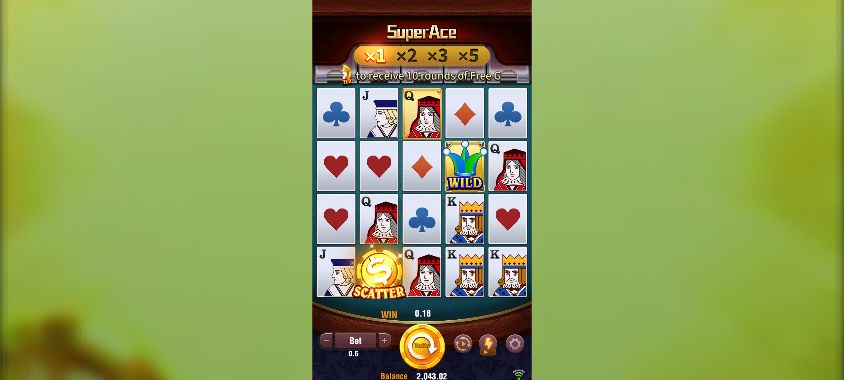
A simulated 844×390 landscape browser viewport. The narrow game remains centered and both native green side areas are preserved. Portrait and landscape figures are each fitted to the article column and are not displayed as a 1:1 size comparison. This was not a physical-phone test.
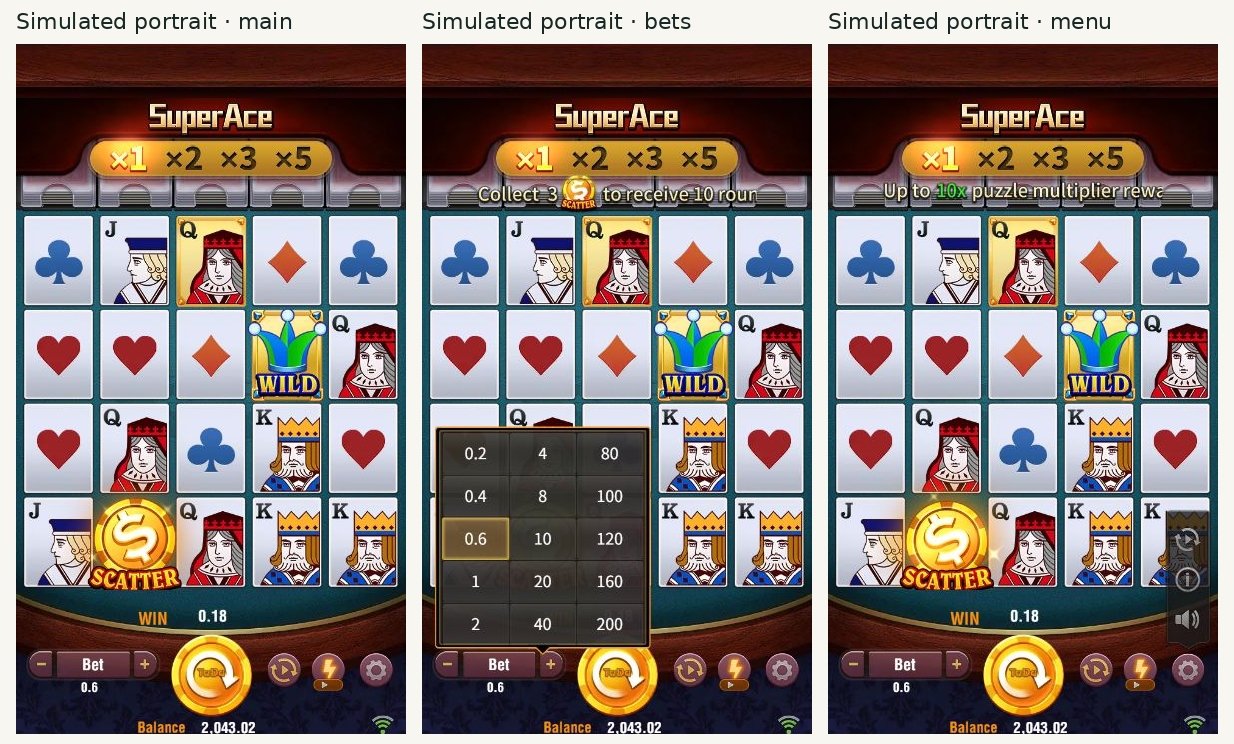
Main screen, bet selector and menu in a simulated 390×844 portrait browser viewport. The bet panel still overlaps WIN as it did in the source. This was viewport simulation, not a physical-phone or touch test.
I found no Buy Bonus or EX entry in the main screen, settings or Help reviewed for this build. The visible route to Free Spins was a natural Scatter trigger.
How to play Super Ace and read its 1,024 Ways
Super Ace pays across adjacent reels rather than fixed lines. A matching symbol must appear on at least three consecutive reels, beginning with reel 1. There are four positions on each reel, so all five reels offer 4 × 4 × 4 × 4 × 4 = 1,024 possible position combinations.
The starting reel matters. A suit appearing on reels 2, 3 and 4 will not make this left-to-right win if reel 1 has neither that suit nor a Joker that can replace it. Multiple matching symbols on a reel can contribute to several winning Ways at once.
Here is a simple example without Jokers. Suppose the first three reels contain two, one and three Kings, with no continuation on reel 4. That makes 2 × 1 × 3 = 6 three-reel King combinations. At the reviewed 0.60 bet, Help shows 0.24 per three-reel King combination. At the base-game 1× stage, the example pays 1.44 in total. The actual payout also depends on how far the symbols connect, other simultaneous wins and the current multiplier.

Winning-ways examples from the in-game Help. This is a rule illustration, not an observed win from the test.
The regular symbols are A, K, Q, J and the four card suits. Ace has the highest base value, followed by King, Queen and Jack. Spades and hearts share one tier; diamonds and clubs share another. The symbol guide on this page contains the full images and payout tiers. Golden Cards deserve a closer look because they change what can happen next.
Golden Cards turning Wild are the main attraction
A Golden Card first acts as the letter or suit on its face. A Golden King matches Kings; a Golden Diamond pays as a diamond. After contributing to a win, it turns into a Joker in the same position and stays involved in the cascade. Golden Cards appear only on reels 2, 3 and 4.
That changes where I look. Beyond the current payout, I want to know whether the winning group contains a Golden Card and whether its new Wild can connect the next group. The result of one win visibly shapes the next part of the round.
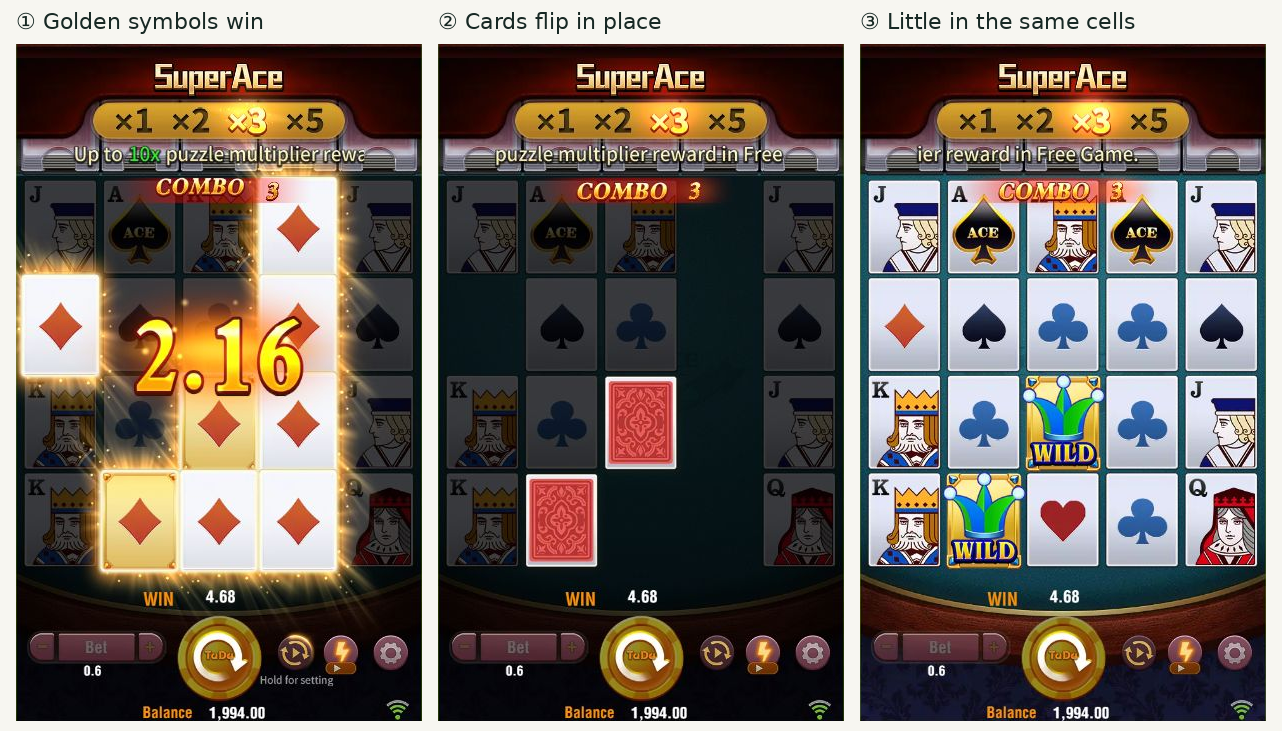
Paid base round 2, in capture order: two winning Golden diamonds flip to card backs, then become blue-green Little Jokers in the same cells.
There are two Jokers. Little Joker stays in the original Golden Card position. Big Joker also copies itself to random positions, replacing other symbols. Both substitute for regular symbols, but neither substitutes for Scatter.
The gameplay sequence here shows Little Joker. The Big Joker spread is illustrated by the in-game Help below; I did not capture an actual Big Joker spread to show in this session.
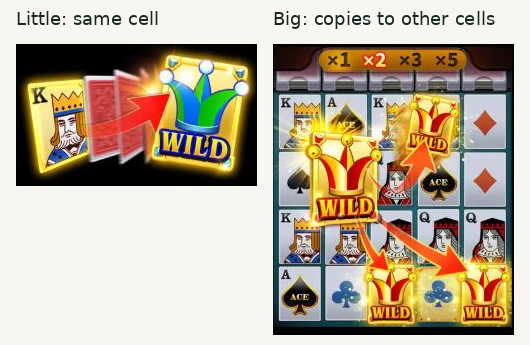
Little and Big illustrations from the in-game Help: Little remains in the original Golden cell, while Big also copies to other cells. The saved gameplay frames did not capture a live Big-copy event; this figure is Help evidence only.
Cascade multipliers give the fourth win more weight
Winning regular symbols are replaced, and the game checks the grid again. Further wins continue within the same round without another base-game bet. The multiplier rises with each winning stage.
Base-game and Free Spins multiplier progression
Winning stage in one cascade | Base game | Free Spins |
|---|---|---|
First | 1× | 2× |
Second | 2× | 4× |
Third | 3× | 6× |
Fourth and later | 5× | 10× |
Each multiplier applies to the new win at that stage. Earlier payouts are not multiplied again when the cascade later reaches 5×. Once the cascade ends, the next spin begins at the starting multiplier for its mode.
Round 2 showed why the sequence works. Two Golden Diamonds turned into blue-green Wilds at the 3× stage, and the round later reached 5×. Its final payout was 13.83 credits, or 23.05 times the 0.60 bet. The memorable part was seeing the same positions change from matching symbols into Wilds that could connect the next win.
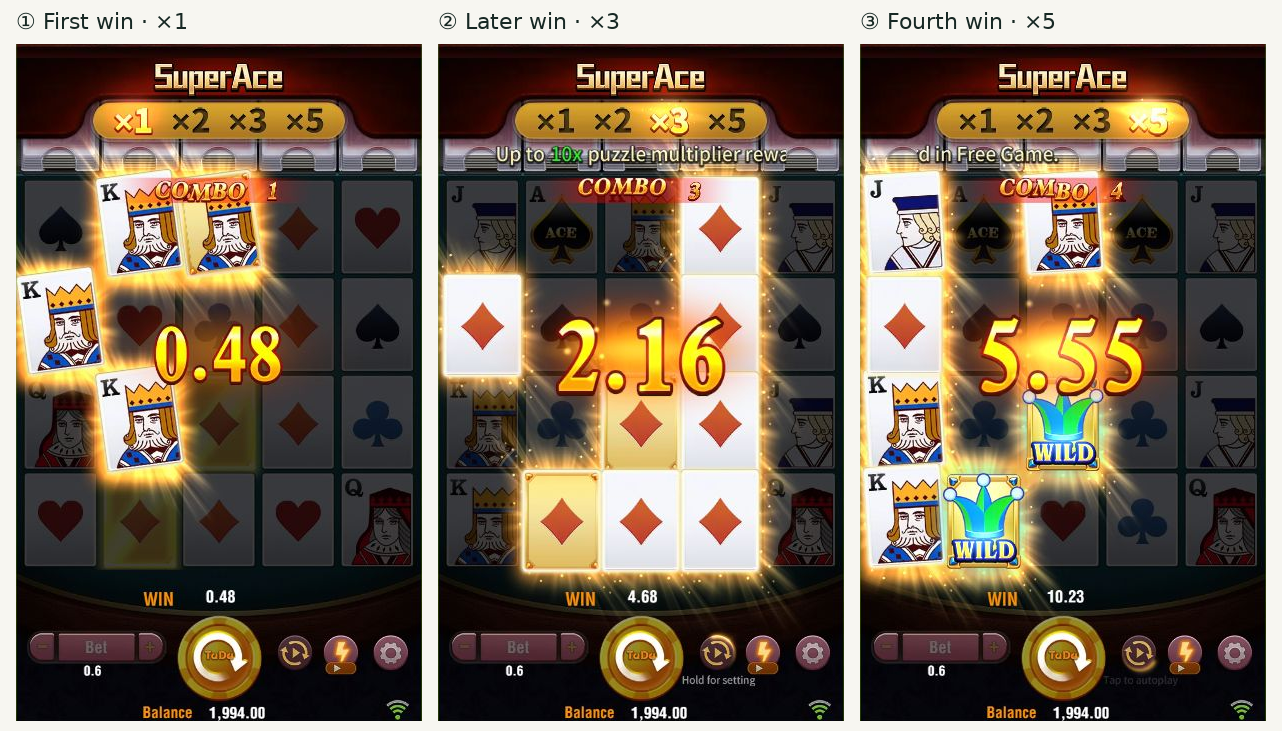
Three saved winning states from paid base round 2: ×1, ×3 and ×5. The ×2 stage fell between captured frames, so this is a selection of moments rather than a complete cascade-by-cascade record.
The multiplier strip sits above the reels and highlights the active stage, making it easy to follow. I prefer normal speed while learning the game because it leaves time to see each transformation. Turbo is more comfortable once the rules are familiar; at first, it is easy to notice only the changing WIN total.
Free Spins double the entire multiplier ladder
Three Scatters award an initial 10 Free Spins. Golden Cards, Jokers and cascades work as before, but the multipliers start at 2× and reach 10× from the fourth win onward. The higher ladder therefore matters from the first winning stage.
Help also says that another three Scatters during Free Spins add five spins, with further retriggers possible. This session triggered the initial 10 spins; it did not provide a captured retrigger sequence.
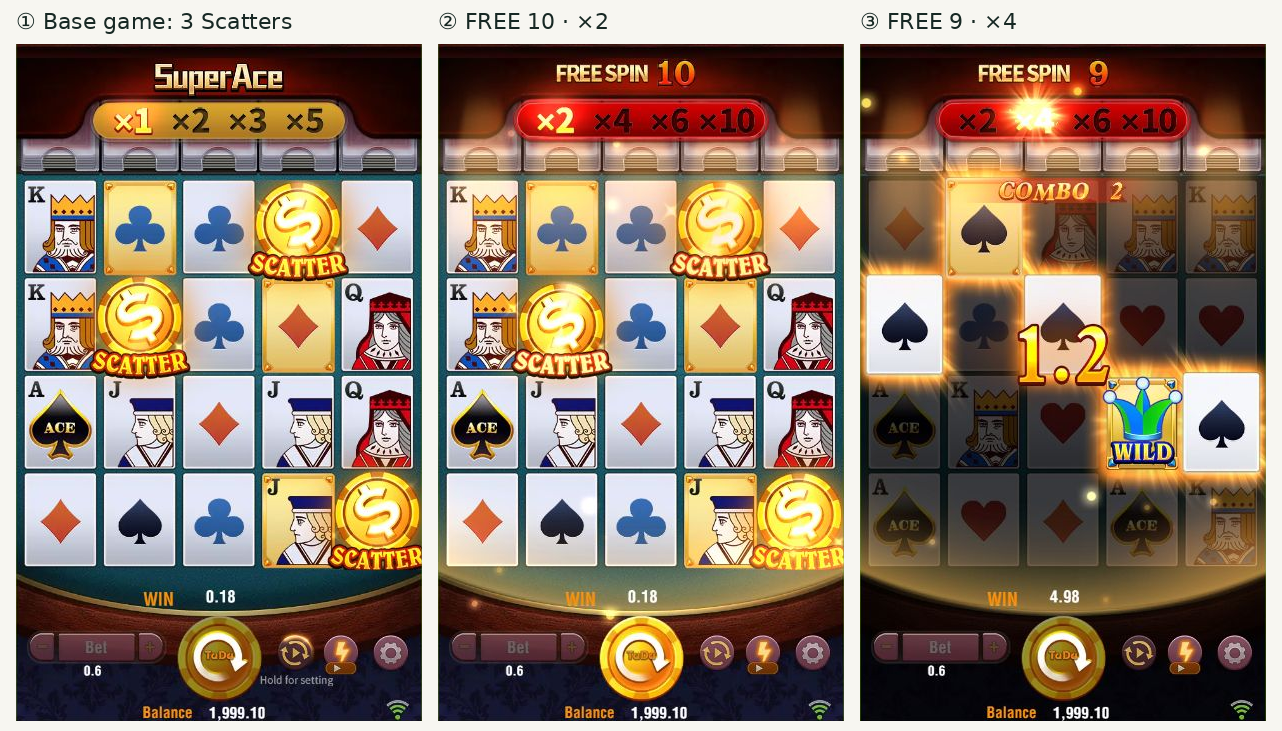
Paid parent round 21 naturally triggered Free Spins with three Scatters. The saved sequence shows FREE SPIN 10 at ×2, followed by a winning state at FREE SPIN 9 with ×4 active. These are selected captured moments, not every Free Spin.
I like how naturally Free Spins follow the base game. There is no separate mini-game to learn. The Golden Cards and Wilds already make sense, and the higher multiplier ladder gives the later cascade stages more weight.
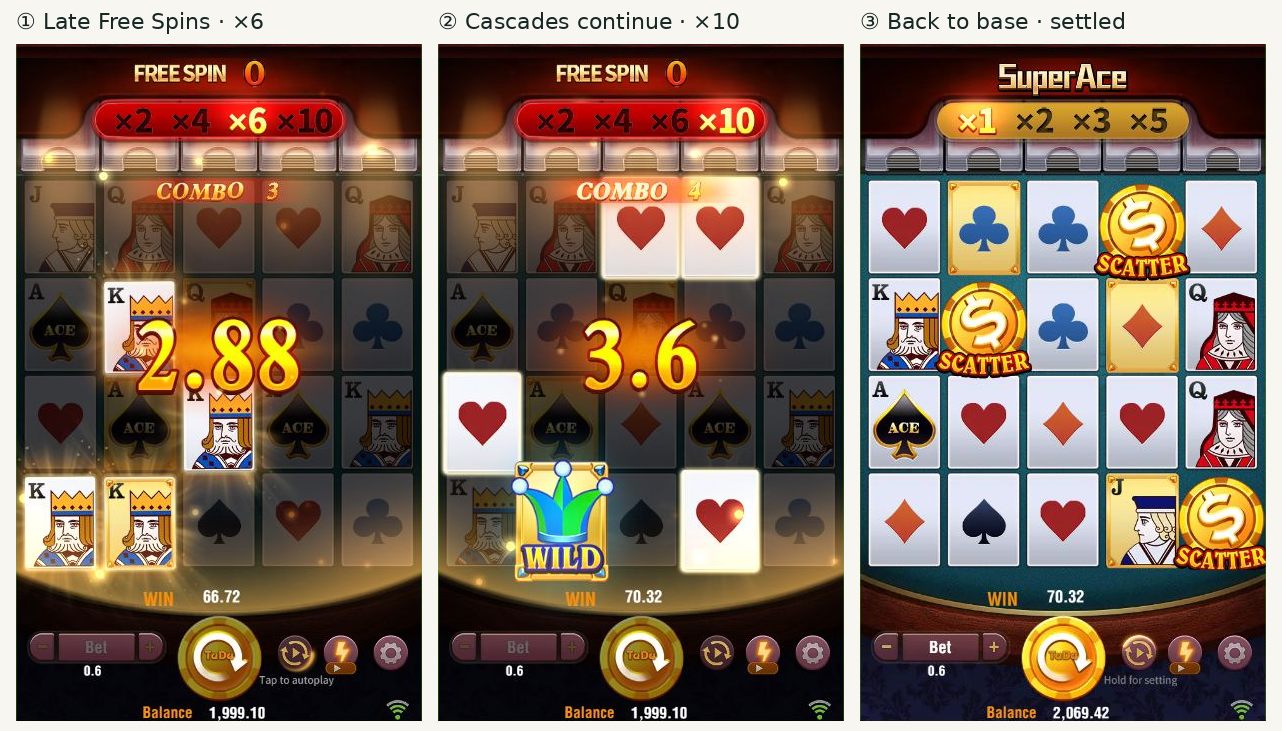
Later in the same round-21 feature, cascades continue at FREE SPIN 0: COMBO 3 at ×6, then COMBO 4 at ×10. The final frame returns to the base game with parent-round WIN 70.32 and Balance 2,069.42. Intermediate Free Spins were not all captured; the 10→9→0 displays are not a complete spin-by-spin record.
Round 21 paid 70.32 credits in total, or 117.2 times the bet. That includes the triggering base spin and the Free Spins feature, counted once as one complete round. WIN can accumulate during the sequence, so the earlier 4.98 display must not be added to the final 70.32. After the return to the base game, the balance was 2,069.42, compared with 1,999.70 before the triggering bet.
Cost and RTP in perspective
Each paid base round in our sample cost 0.60 demo credits. Cascades and any Free Spins awarded within that round are included in the same round’s result, without another base stake. The listing retains 97% RTP, although the official product page and complete Help checked for this review did not independently confirm that value for the tested build. The 179.70% sample payout-to-stake ratio is a separate short-session result.
What happened across 100 demo rounds
The session finished ahead, but most individual spins felt much quieter than the final result suggests. There were payouts in 28 of the 100 rounds. Only 11 payouts exceeded the 0.60 bet. The other 17 paying rounds still left the balance lower than it had been before the spin.
Results of the 100-round demo session
Measure | Result |
|---|---|
Base-game rounds and cost per round | 100 rounds at 0.60 demo credits |
Total cost / total payout | 60.00 / 107.82 |
Net change | +47.82 |
Opening / closing balance | 1,995.20 / 2,043.02 |
Paying rounds / payouts above the bet | 28 / 11 |
Zero-payout rounds / net-losing rounds | 72 / 89 |
Largest complete-round payout | Round 21: 70.32 |
Sample payout divided by cost | 179.70% |
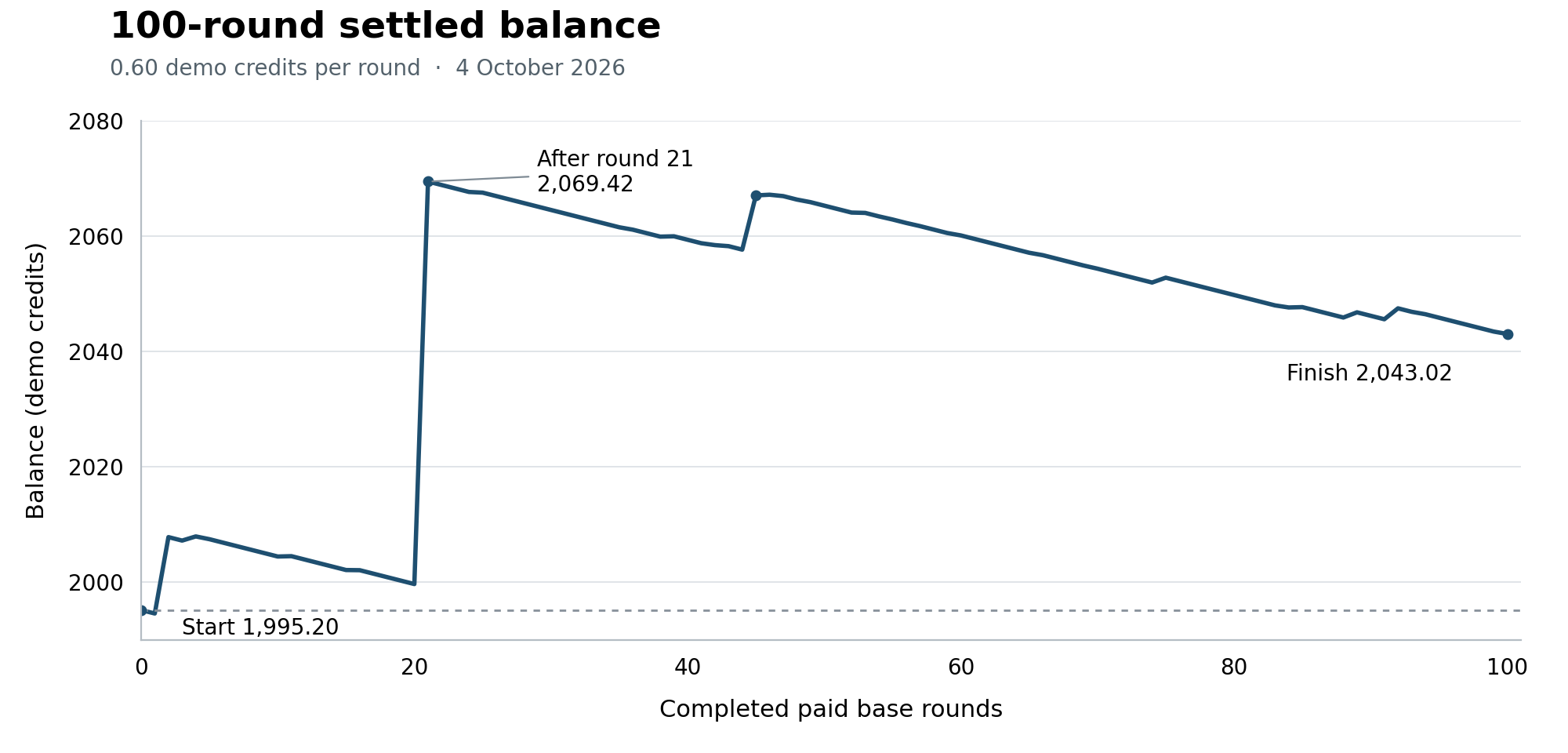
Settled balance across 100 paid base rounds at 0.60 demo credits per round on 4 October 2026. Start: 1,995.20; after round 21: 2,069.42; finish: 2,043.02. Free Spins are included in the triggering parent round and are not counted again. The y-axis is focused on 1,990–2,080; this one observed session is not a forecast or an estimate of long-run RTP.
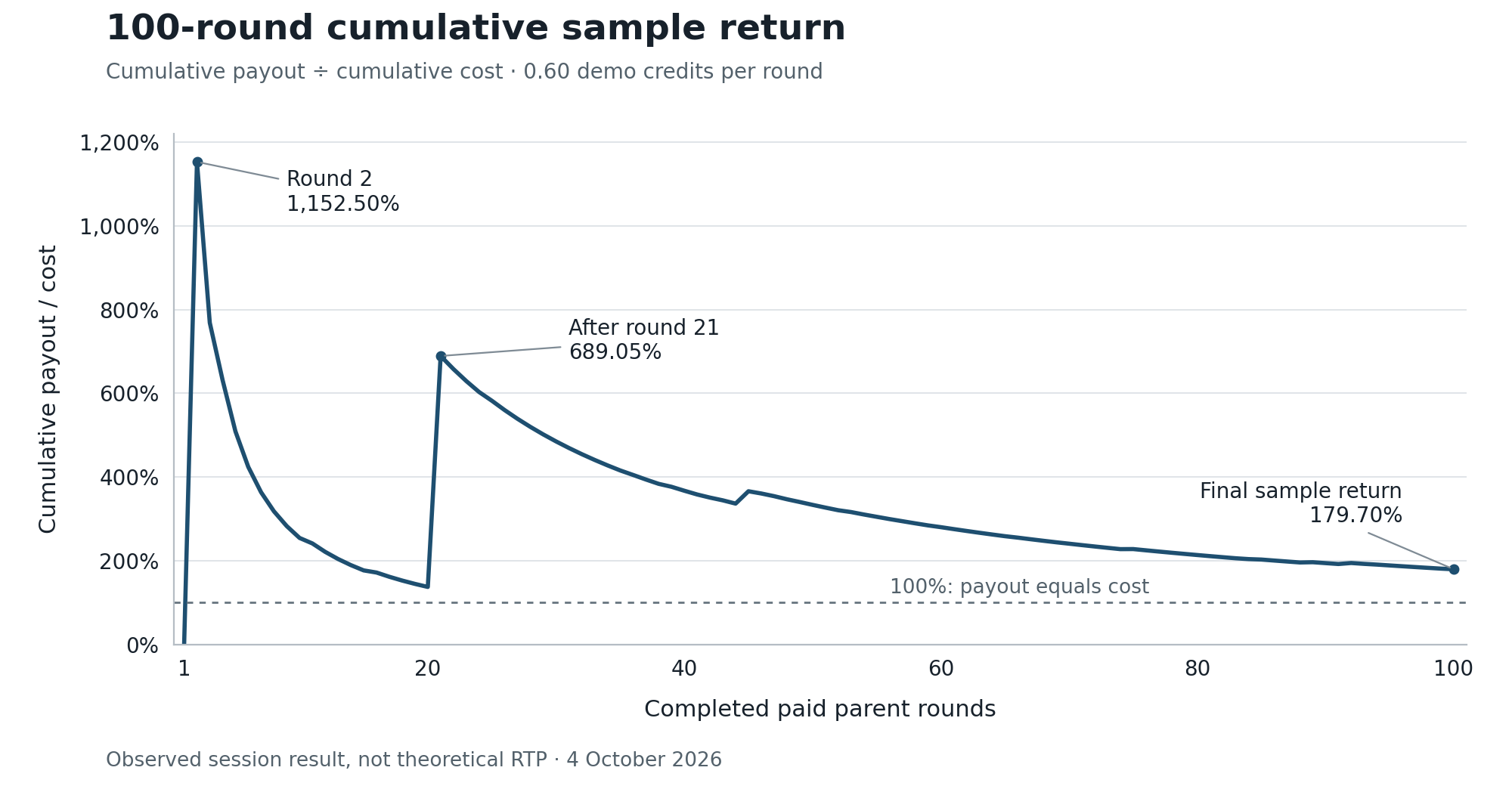
Cumulative payout divided by cost across 100 settled parent rounds at 0.60 demo credits each. The final sample return was 179.70%. Free Spins are included once in round 21. This session result is not theoretical RTP.
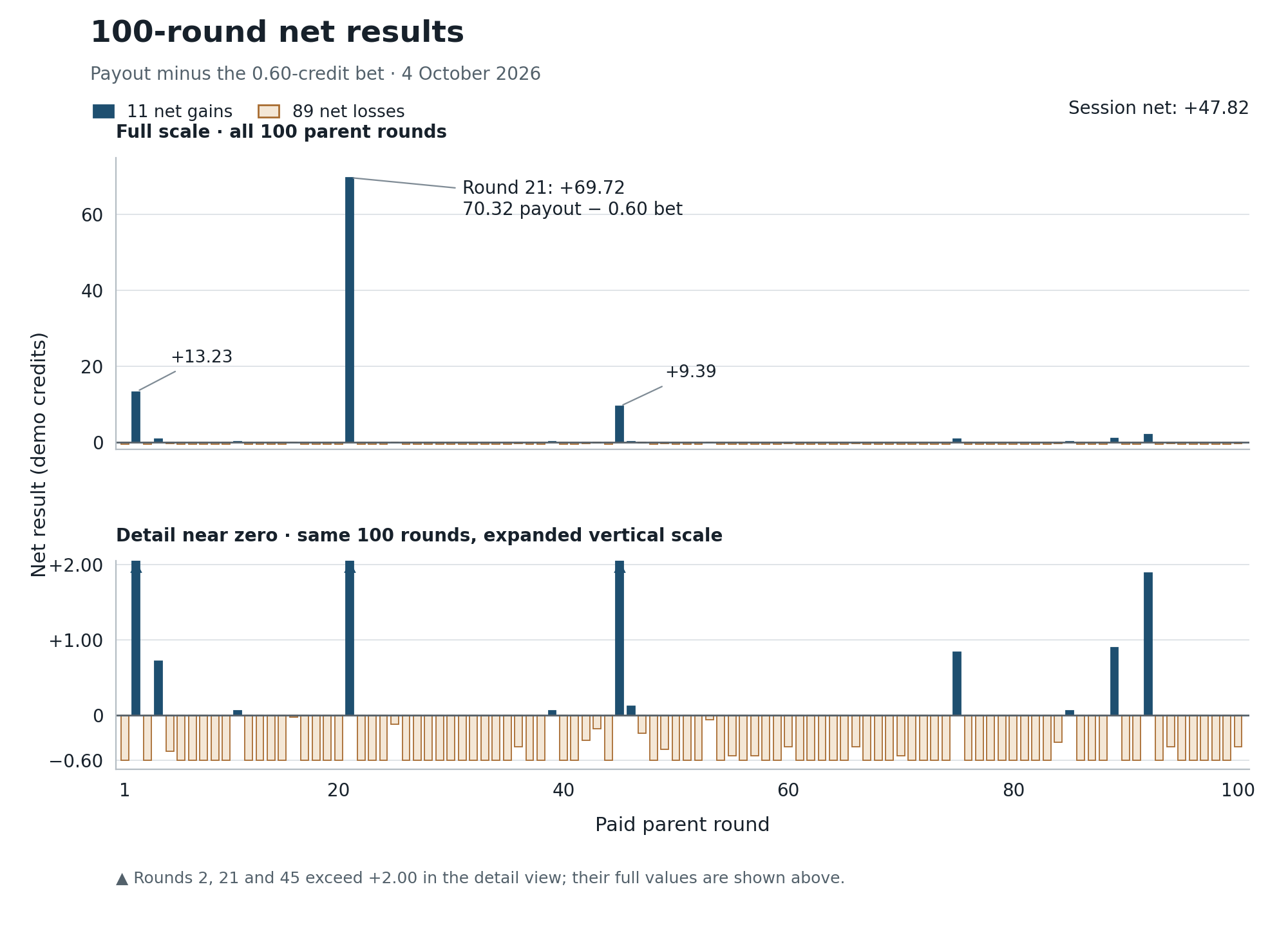
Payout minus the 0.60-credit bet for each of 100 parent rounds: 11 net gains and 89 net losses. Round 21 includes its Free Spins feature and gained 69.72 credits. The lower panel expands the scale near zero; triangles mark gains above that view. This chart describes the session, not the game's theoretical volatility.
The 179.70% figure is this short sample’s payout-to-cost ratio, not the game’s RTP. Round 21 alone contributed about 65.2% of all payouts. The other 99 rounds cost 59.40 and paid 37.50, a net decrease of 21.90. That is how heavily the positive result depended on the round with Free Spins.
You can explore hypothetical session swings in our slot simulator.
The later stretch is worth noticing too. The balance fell from 2,069.42 after round 21 to 2,043.02 at the end. There were still payouts, including a noticeable recovery at round 45, but the overall direction gave back some of the earlier gain. Rounds 26–35 produced ten consecutive zero payouts.
This is my reservation about the small-win feedback: a win animation can play while the balance is still falling. If recovering the full bet matters to your enjoyment, watch Bet, WIN and Balance together when trying the demo. The celebration alone does not tell you what the spin did to your balance.
How the mechanics fit together
The strongest part is how the mechanics work together. A Golden Card helps form a win, turns Wild and then contributes to the next stage at a higher multiplier. Each visual change has a purpose. Free Spins retain the same rules, and the simple card theme keeps attention on positions and cascades.
The biggest drawback for me is the gap between small-win celebrations and the actual balance change. Many paying rounds still ended in a net loss. Multipliers also need consecutive wins within the same cascade, so rounds without a longer chain can finish quickly. If you prefer richer themes and character-led presentation, the card-table styling may feel sparse.
Super Ace vs Fortune Gems 3 and Money Coming
This comparison uses the games’ official mechanics. Fortune Gems 3 and Money Coming were not part of a matched hands-on session.
Mechanics-based comparison with two other JILI games
Game | Main focus | Who it may suit |
|---|---|---|
Super Ace | 5 × 4 grid, 1,024 Ways, Golden Cards turning into Jokers and cascade multipliers | Players who enjoy watching one grid develop through successive wins |
3 × 3 grid, 5 lines, win multipliers and symbol splitting | Players who prefer compact three-reel layouts and splitting-symbol effects | |
Money Coming | 1 winning line, a number-based grid, Special Wheel and Lucky Wheel | Players more interested in numbers and wheel outcomes |
For mechanical flow, I prefer Super Ace: the base symbols, Wild transformations and Free Spins all build on the same rules. Fortune Gems 3 has its compact grid and symbol splits; Money Coming focuses on numbers and wheels. I would choose by the kind of sequence you enjoy watching, rather than ranking them by maximum multiplier.
My final take: Super Ace is worth trying for the Golden Card-to-Wild cascades. Its best moments come when symbol positions, Wilds and multipliers connect within one round. Try it on this page. Follow a few complete rounds with free demo credits before deciding whether you like it. Real-money play carries a risk of loss, and this session’s positive result is not a profit expectation.
Sources
Gameplay and in-game Help were reviewed through JILI’s official free demo on October 4, 2026, build v_189_0008. Screenshots show actual gameplay or Help from that build. Help illustrations are identified in their captions. The balance chart uses the settled balance after each complete demo round.
Super Ace by JILI FAQs
Answers to common questions about Super Ace by JILI.
Super Ace by JILI Reviews
 No Player Reviews Yet
Played Super Ace by JILI? Share your experience with other players.
 Write A Review