Chinese Employee Escapes and Reports to Police; Thai Immigration Bureau Breaks Up “HGA” Online Gambling and Scam Base in Bangkok’s Sai Mai District
Thai immigration police raided homes in Bangkok’s Sai Mai district linked to HGA. Suspects denied involvement, and reports differ on arrests and money flows.
 6 Min Read
Overview
- Thai immigration police raided homes in Bangkok’s Sai Mai district linked to HGA. Suspects denied involvement, and reports differ on arrests and money flows.
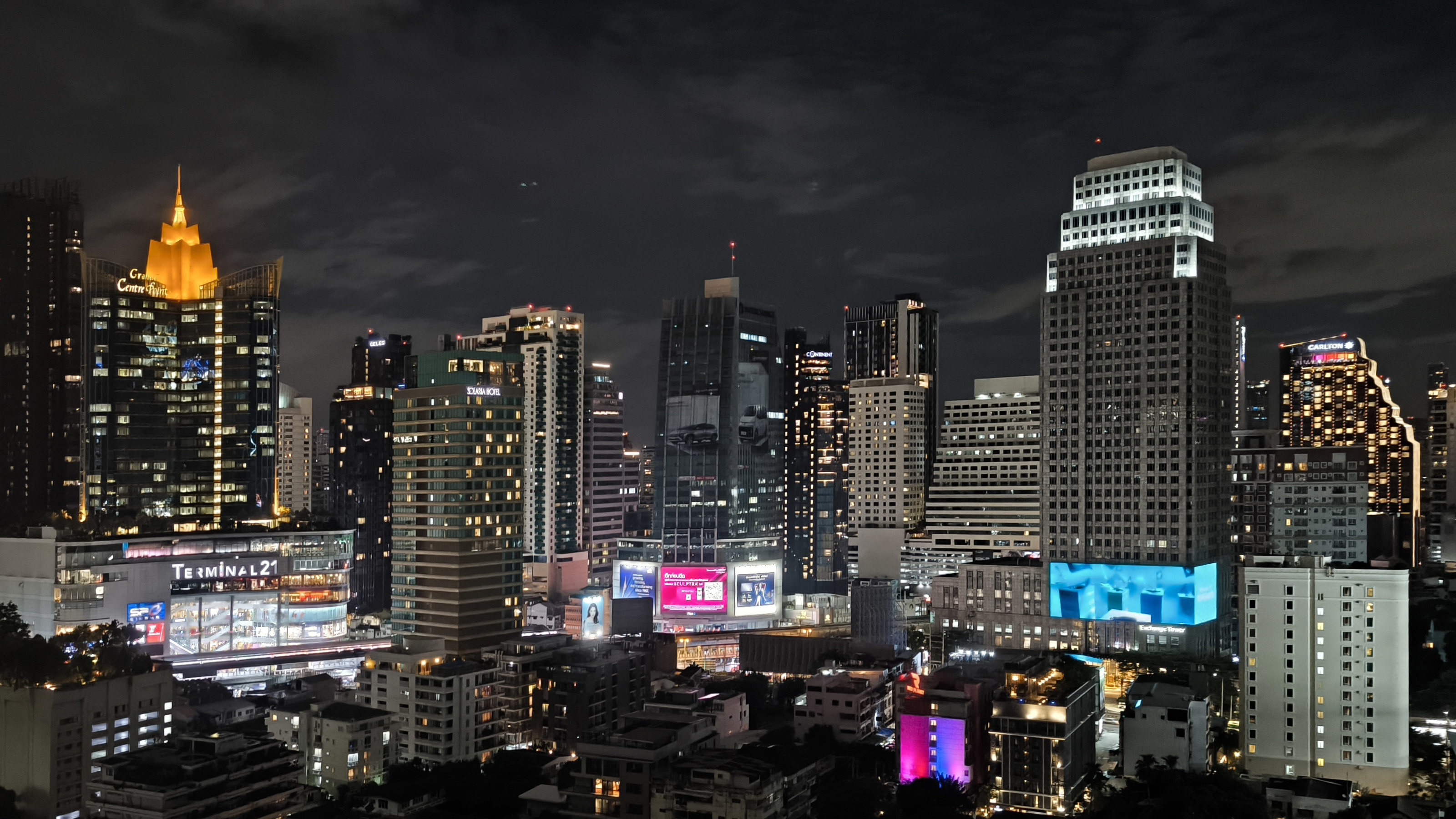
File photo: the Sukhumvit skyline in Bangkok, Thailand, 13 July 2024. City context only; this is not Sai Mai district, the reported raid scene, HGA premises or any property linked to the suspects. Photo: OPK-Photography / Wikimedia Commons, CC BY-SA 4.0. Image source.
Thailand’s Immigration Bureau simultaneously searched three adjacent luxury homes in Sai Mai district on Bangkok’s northern outskirts on October 22, breaking up a base that operated both online gambling websites and telecommunications scams. The operation was led by Immigration Bureau Commissioner Police Lieutenant General Noppasin Poonsawat. Officers seized 58 mobile phones, approximately 100 Malaysian SIM cards, 10 laptops, three desktop computers and one tablet. Police said evidence found on the computers and phones linked the group to an online gambling website called HGA, rendered phonetically in Thai as Hong Guan (หงก้วน) and translated by the Thai Chinese News Agency as “洪冠.”
The Lead Came from an Employee Who Escaped
According to the Thai Immigration Bureau’s briefing to the media, the case began with a 25-year-old Chinese man surnamed Liu. He said he came to Thailand after applying for an “administrative job” paying THB 80,000 a month, only to discover after arrival that he was expected to do illegal work. His supervisor threatened to beat or even kill him if he refused. He said the people in the house worked in two rotating shifts, one from 11 a.m. to 9 p.m. and the other from 9 p.m. to 8 a.m. the following day. They maintained the gambling website’s back end while also scamming Chinese people through pitches about “completing tasks” and “boosting page views,” gradually inducing them to transfer money.
According to reports by The Thaiger and the Thai Chinese News Agency, Liu said he overheard managers discussing plans in September to move the base to Cambodia because enforcement in Thailand was tightening. He escaped while out shopping and handed photographs and chat records to immigration police. Police then investigated for nearly two months before identifying the targets. Thai PBS reported that officers were unable to enter another house in the Rama 9 area that had been scheduled for a simultaneous search because the people concerned had left beforehand; police were still pursuing the matter.
Two Key Suspects
Police identified two Chinese suspects. A 33-year-old man surnamed Fu was suspected of being in charge and was the subject of a wanted notice issued by Chinese police in connection with online gambling. The Standard reported that Chinese authorities had identified him as the group’s leader. Fu acknowledged that the wanted notice concerned him, but said he did not know when it had been issued and denied knowing about the HGA website or the other people in the house. Another man, surnamed Han, was subject to an arrest warrant in a drug case in Thailand. According to the Thai Chinese News Agency, citing Thai PBS, the case involved ketamine, had reached court proceedings, and Han had been granted bail. Han denied involvement, saying he had worked as a tour guide for three years, was currently unemployed, and had come over only after hearing that someone had been arrested. Police, however, said he had been trying to flee.
Immigration records showed that the group entered Thailand from Ho Chi Minh City, Vietnam, in 2025 and did not establish its Bangkok base until 2026. Five of the arrested Chinese nationals had overstayed, one by more than 1,200 days. Another five held student visas, and the Immigration Bureau had asked for the relevant schools to be contacted to verify whether they were actually attending classes.
Discrepancies between Media Reports
Reports differ on several key figures in this case, which readers should bear in mind:
- Number arrested: The Nation, Thai PBS and The Standard all reported “11 Chinese nationals.” The Thaiger reported “14 people”: 10 Chinese, three Myanmar nationals and one Thai. The Thai Chinese News Agency instead listed 10 Chinese, three Thai and one Myanmar national, and noted that the police briefing itself gave inconsistent accounts of the nationalities involved.
- Money involved: The Nation reported “hundreds of millions of baht in losses.” The Thaiger and The Standard reported “more than THB 100 million in fund flows.” Losses and fund flows are not the same thing, and police have not yet provided a victim count.
- Rent: The Nation said that one of the two-storey luxury homes, valued at THB 30 million to THB 40 million, had been rented for THB 80,000 a month since April 2026. The Thaiger instead said the three homes together cost THB 80,000 a month to rent.
- The person who overstayed by 1,200 days: The Thaiger and The Standard identified him as Han. The Nation said only that one of those arrested had overstayed by more than 1,200 days, without naming him.
What Comes Next
Police said they were analyzing the seized phones, computers, bank accounts and money flows to trace the organizers behind the operation, its financiers and those still at large. The Immigration Bureau was also investigating whether the landlords had violated Section 38 of the Immigration Act, 1979, which requires homeowners and accommodation managers to report foreign guests to immigration authorities. Noppasin also urged Chinese citizens to verify offers of highly paid jobs in neighboring countries first. Immigration officers would also check suspicious journeys in which people picked up at airports were driven directly to border areas.
This case again illustrates how Chinese-language online gambling businesses targeting Chinese users and scams are often run by the same people from the same base. When enforcement tightened in Thailand, the group’s first thought was to move to Cambodia.
Sources
Original source image caption (reference only): Thailand’s Immigration Bureau detains suspects inside a house in Sai Mai district. Photo source: Thailand’s Immigration Bureau, published via The Nation
- The Nation (October 22, 2026), citing Thailand’s Immigration Bureau: https://www.nationthailand.com/news/general/40072625
- The Thaiger (October 22, 2026): https://thethaiger.com/news/bangkok/14-foreign-and-thai-suspects-held-over-gambling-and-scam-network
- Thai PBS (October 22, 2026, in Thai): https://www.thaipbs.or.th/news/content/571469
- The Standard (October 22, 2026, in Thai): https://thestandard.co/immigration-raids-chinese-gambling-network-saimai/
- Thai Chinese News Agency case tracker: https://thais.com/special/tracking-bangkok-saimai-chinese-scammer-house-raid-2026-10-22/
- On-site photographs: Thailand’s Immigration Bureau Facebook, published via The Nation
Cite This Article
Topics In This Story
Related Countries


Andrea Rivera explores the evolving world of iGaming through the companies trying new things and the markets taking shape around them. An editor at AskSpinner News, Andrea combines research with storytelling, bringing information and perspective to industry analysis without losing the story that makes it worth reading.
More From This Author