Mass-Producing Sites “in 10 Minutes” from Vietnam and Cambodia: South Korean Police Dismantle an Illegal Gambling Website Supply Chain with About KRW 23 Trillion in Total Wagers
South Korean police say they dismantled a Vietnam- and Cambodia-based illegal gambling website supply chain. Reports differ on arrests and asset preservation.
 7 Min Read
Overview
- South Korean police say they dismantled a Vietnam- and Cambodia-based illegal gambling website supply chain. Reports differ on arrests and asset preservation.
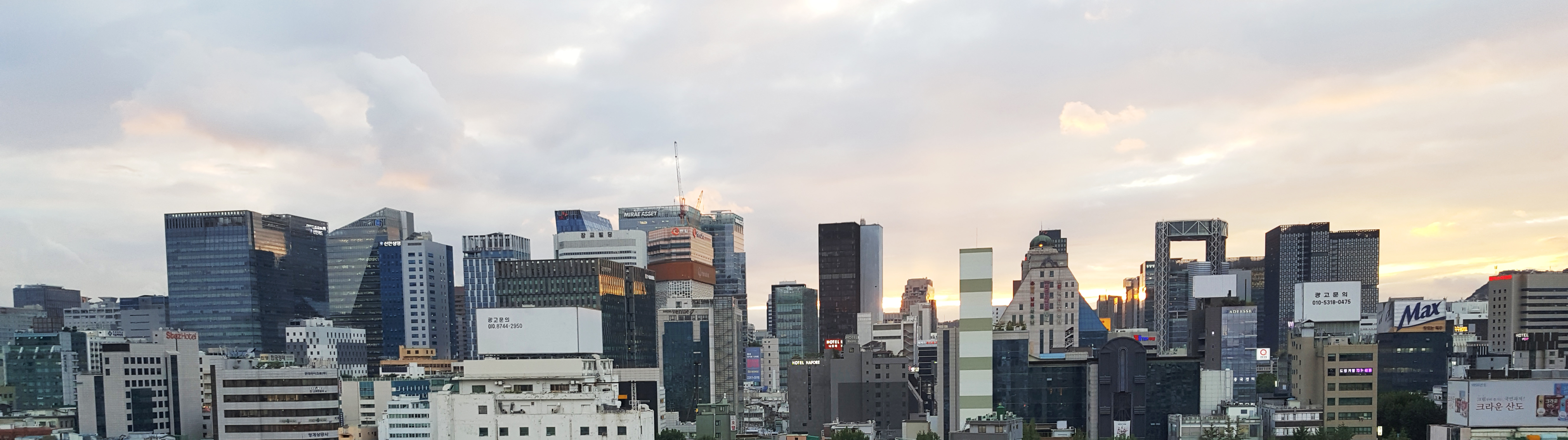
File photo: downtown Seoul, South Korea, 1 October 2018. Country context only; not the Chungnam police headquarters, an overseas operation site or any premises implicated in the investigation. Photo: Minseong Kim / Wikimedia Commons, CC BY-SA 4.0. Display cropped to fit. Image source.
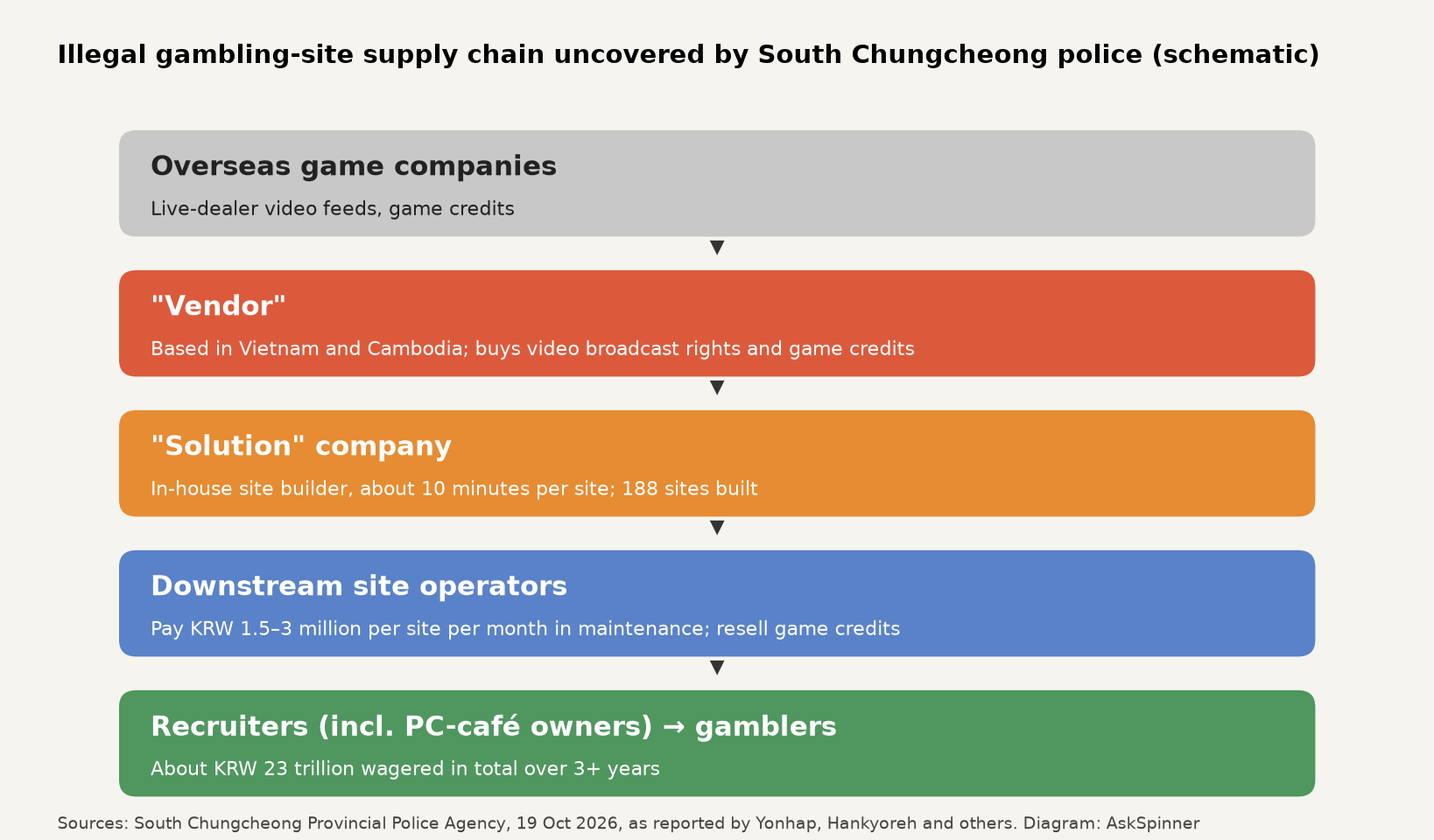
Diagram created by this publication based on case details released by the Chungnam Provincial Police Agency
The Cybercrime Investigation Unit of South Korea’s Chungnam Provincial Police Agency announced on October 19 that it had broken up a “top-level supply organization” based in Vietnam and Cambodia that mass-produced and distributed illegal gambling websites for the South Korean market. Police said the organization produced and distributed 188 gambling websites between March 2023 and July 2026. The sites handled approximately KRW 23 trillion in cumulative wagers, making this the largest illegal gambling website case uncovered in South Korea.
Police arrested 77 people, of whom 21 were held in custody. According to Yonhap News Agency, the 77 comprised 25 members of the upstream supply organization, 33 members of website-operating organizations, and 19 gamblers; those held in custody comprised 18 members of the supply organization and three operators. Another 12 suspects remain at large overseas. Police have requested INTERPOL Red Notices and are pursuing their forced repatriation.
How the Chain Was Built
What makes this case noteworthy for the industry is not the number of websites but the division of labor. Police described the organization as a “vertically integrated pyramid structure”: suppliers, solution companies, website operators, recruiters, and gamblers. The more participants there were downstream, the greater the upstream earnings from markups on game currency.
At the very top were companies referred to as “vendors.” According to police, these companies signed contracts directly with “well-known overseas gaming companies” to purchase broadcasting rights to live-dealer video feeds and game currency, then sold the feeds and currency to downstream “solution” companies. The Hankyoreh, citing police, reported that the vendors operated only in Vietnam and Cambodia, while the solution companies moved between South Korea and Southeast Asia. Police did not disclose the names of the overseas gaming companies involved or say whether those companies knew that the video feeds ultimately reached illegal websites in South Korea.
The middle tier consisted of solution companies. Police said the head of one such company hired IT personnel who had previously worked at major South Korean companies and developed a website-building program that could set up a gambling website in about 10 minutes. All 188 websites were built using this program and distributed to lower-tier operators, with maintenance fees charged for each site.
The operators at the bottom then attracted customers through recruiters in various locations, including adult internet café owners, according to Yonhap, and made money by reselling game currency. The Hankyoreh reported one set of markups: operators bought 100 million “알” (a unit of game currency) for KRW 7.5 million to KRW 8.2 million, then sold them to gamblers for KRW 100 million. Police also said the organization brought in gang members to participate in operating lower-tier websites.
To evade detection, the organization maintained offices in both Southeast Asia and South Korea, moving every one or two months, and used accounts held in other people’s names, overseas servers, and overseas instant-messaging applications. The JoongAng Ilbo reported that transaction payments were made mainly in cryptocurrency.
How Police Traced the Upstream Organization
According to police, the lead came from a lower-tier website-operating group apprehended in November last year. Police subsequently analyzed 795 financial accounts used in the offenses, along with records of overseas messaging-app use, to identify the upstream organization. The estimate of approximately KRW 23 trillion in total wagers was calculated from the back-office management pages used by vendors to sell game currency and from account transaction records.
Police estimated that the two upstream organizations generated approximately KRW 150 billion in combined criminal proceeds, with about KRW 120 billion attributed to the vendor and KRW 30 billion to the solution company. All 188 websites have ceased operations, and the Korea Broadcasting, Media and Communications Standards Commission has blocked the 408 web addresses they used. Article 114 of South Korea’s Criminal Act (organization of a criminal group) was also additionally applied to the 24 members of the solution company.
Kim Tae-woo (name transliterated), head of the Cybercrime Investigation Unit at the Chungnam Provincial Police Agency, said: “This investigation dismantled the supply chain at the very top, causing hundreds of gambling websites to wither along with it.” He said future enforcement efforts would continue to focus on the supply chain at its most upstream level.
Several Discrepancies in the Accounts
Media accounts of the same police briefing differ on several points. The following sets these out based on the majority of reports and this publication’s assessment:
Headcounts: Yonhap, Chungcheong Today, the Chungnam Ilbo, and other outlets reported 77 arrests and 21 people held in custody; Newsis and the Gukmin Ilbo reported 72 and 19. This may reflect an initial version of the briefing or different counting criteria. This article uses 77 and 21.
Recovery of criminal proceeds: Yonhap and other outlets reported that pre-indictment preservation measures for the recovery of KRW 9.6 billion had been “completed.” The police account relayed by Newsis, the Gukmin Ilbo, and The Hankyoreh was more detailed: a court had approved KRW 6 billion relating to the head of the solution company and others, while the remaining KRW 3.6 billion was still under court review. Under the latter account, the full KRW 9.6 billion had not yet been secured.
Maintenance fees: Most reports put the fee at KRW 3 million per website per month; the JoongAng Ilbo and The Hankyoreh gave a range of KRW 1.5 million to KRW 3 million.
Website count and timing: One JoongAng Ilbo report said “118 websites shut down,” which conflicts with the figure of 188 in other reports and earlier in the same article and appears to be a typographical error. In one passage, Newsis said the period of offending ran through “July last year,” which differs from “July this year” in other reports.
Currency conversion: Some overseas commentary converted KRW 23 trillion to approximately USD 17.3 billion at the exchange rate; the police briefing itself did not provide a US-dollar figure.
This publication was unable to obtain the original briefing from the Chungnam Provincial Police Agency. The account above was compiled entirely from South Korean media reports of the briefing and press conference. The case has not yet gone to trial.
Sources
Cite This Article
Topics In This Story
Related Countries

Andrea Rivera explores the evolving world of iGaming through the companies trying new things and the markets taking shape around them. An editor at AskSpinner News, Andrea combines research with storytelling, bringing information and perspective to industry analysis without losing the story that makes it worth reading.
More From This Author