
€1,000 a Month Across All Platforms: How Germany’s Cross-Platform Online Gambling Deposit Limit Differs from Spain’s New Cap
Germany’s calendar-month deposit cap and Spain’s daily, weekly and four-week caps share a centralised model but differ in limits, waiting periods and exceptions.
 7 Min Read

Overview
- Germany’s calendar-month deposit cap and Spain’s daily, weekly and four-week caps share a centralised model but differ in limits, waiting periods and exceptions.
File photo: Madrid, Spain, 9 August 2009. Geographic context for the Spanish side of the Germany–Spain deposit-limit comparison; not a regulator’s office or a scene of the new rules being announced. Photo: Alberto Racatumba / Wikimedia Commons, CC BY 2.0. Image source.
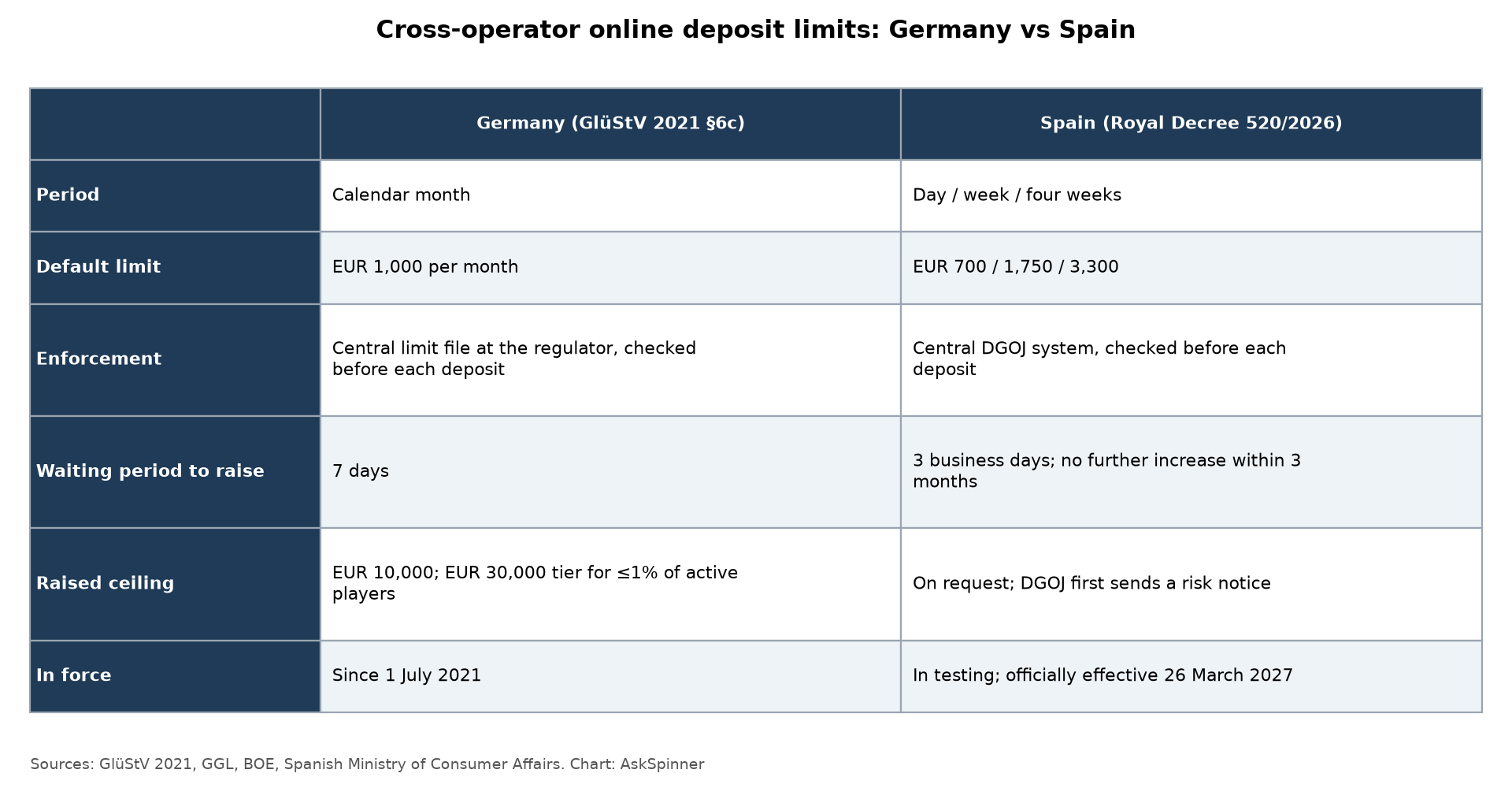
Comparison of cross-platform deposit limits, compiled from Germany’s GlüStV 2021, GGL and Spain’s BOE materials. Graphic: AskSpinner
Article 6c of Germany’s Interstate Treaty on Gambling 2021 (GlüStV 2021), which took effect on 1 July 2021, stipulates that an online gambling player’s combined deposits across all platforms must, in principle, not exceed €1,000 per calendar month. It is among Europe’s earliest mandatory deposit limits calculated “per person rather than per platform.” Spain launched a test system for a per-person aggregate deposit cap just this month. The two countries share the same approach, but their implementation differs in several clear respects.
Germany: A “Cross-Platform Monthly Limit” Must Be Set at Registration
Under Article 6c(1) of GlüStV 2021, players must set an “individual monthly cross-operator deposit limit” when registering, or confirm that they will continue to use a previously established limit. Players who have not set a limit may not participate in gambling. In principle, this limit must not exceed €1,000 a month. If a player tries to enter an amount above the cap, the platform may only prompt them to correct it, and the treaty stipulates that the numerical cap may be displayed to the player only in that correction prompt.
The limit is calculated by calendar month. Once a player’s total deposits for the month with all online gambling operators subject to the cap reach their self-set limit, that limit is “exhausted,” and no further deposits may be made that month.
A Central Record Maintained by the Regulator, Checked Before Every Deposit
Enforcement relies on a central “limit file” (Limitdatei), maintained by the competent authority and currently operated by the Joint Gambling Authority of the German States (GGL) through the Cross-State Gambling Supervision System (LUGAS). Article 6c(6) of the treaty requires operators to submit the player’s identity data and proposed deposit amount to the limit file before completing each deposit. The system responds with whether the limit has already been exhausted and whether the deposit would exceed it. If the limit is exhausted, the operator must refuse the deposit. If the deposit would exceed the limit, the system provides the remaining allowance, and the player can initiate a new deposit within that amount.
The limit file may process only data such as the player’s name, date and place of birth, address, limit amount and the date it was set, deposit amounts and dates, and total deposits for the current month. Individual deposit records are deleted immediately after the end of that month. A player’s basic data must also be deleted after a full year without any activity.
Reductions Take Effect Immediately; Increases Require a Seven-Day Wait
Article 6c(3) stipulates that a reduction in the limit takes effect immediately, while an increase takes effect only after a seven-day protection period. GGL explains that this period is calculated in accordance with the law, with the increase taking effect at the end of the seventh day counted from the day after the request (that is, after 24:00).
In addition, Article 6h of the treaty prohibits the same player from “simultaneous play” on multiple platforms. To move from one platform to another, a player must first log out of the original platform and wait five minutes. Operators must also automatically log out players who have been inactive on a platform for more than 30 minutes.
€1,000 Is Not an Absolute Ceiling
Article 6c(1) also allows licences to provide for licensees to set higher cross-platform limits for players in individual cases. The rules published by GGL are as follows:
- Applicants must show no signs of addiction or problem gambling and must undergo enhanced monitoring by the operator;
- Financial capacity must be demonstrated in a verifiable way, for example through income tax assessments, other proof of income and bank statements. A player’s self-declaration does not count;
- The increased limit may be no more than €10,000 a month;
- The tier above €10,000 and up to €30,000 may be granted to no more than 1% of the operator’s average number of active players over the preceding three months.
GGL also makes clear that deciding whether to increase a particular player’s limit is entirely up to the operator. The regulator has no power to compel an operator to approve an increase and will not change a player’s limit on their behalf. In January this year, GGL separately published binding framework rules for setting amounts that deviate from the cap for online casino products.
Comparison with Spain
The new aggregate cross-platform cap introduced by Spain’s Royal Decree 520/2026 is likewise enforced through a central system run by the regulator, the Directorate General for the Regulation of Gambling (DGOJ), which operators must query before accepting deposits. The main differences are:
- Calculation period: Germany has only one period, the calendar month, with a limit of €1,000 in principle. Spain has three concurrent periods: daily, weekly and four-week, with limits of €700, €1,750 and €3,300 respectively.
- Limit levels: On a monthly comparison, Spain’s aggregate cap of €3,300 every four weeks is approximately 3.3 times Germany’s default cap, but deposits in Spain are capped at €700 a day.
- Waiting period for increases: Seven days in Germany; three working days in Spain, where players may not apply again if fewer than three months have passed since the previous increase.
- Requirements for increases: Germany requires written proof of financial capacity and sets two ceilings, €10,000 and €30,000. Spain’s decree requires DGOJ to send a risk warning to the player before an increase.
- Whether setting a limit is mandatory: German players must set a figure no higher than the cap themselves when registering, or they cannot play. Spain’s aggregate cap applies by default.
- Timing: Germany’s rules have been in force since 2021. Spain’s aggregate cap is currently in the testing phase, with the Ministry of Consumer Affairs announcing 26 March 2027 as the official effective date.
Conclusion
Germany’s experience since the treaty took effect in 2021 shows that a deposit cap aggregated “per person” is technically feasible. It relies on a central ledger held by the regulator and a mandatory check by operators before every deposit. Spain is following the same path, but with a tighter daily allowance and a faster process for increases. Both countries leave room for high-deposit players, but Germany spells out its exceptions in greater detail: proof of income is required, hard ceilings apply, and the proportion of eligible players is capped.
Sources
- Interstate Treaty on Gambling 2021, Article 6c (Bavaria’s official legislation database): https://www.gesetze-bayern.de/Content/Document/StVGlueStV2021-6c
- Interstate Treaty on Gambling 2021, Article 35 (effective date): https://www.gesetze-bayern.de/Content/Document/StVGlueStV2021-35
- Interstate Treaty on Gambling 2021, Article 6h: https://www.gesetze-bayern.de/Content/Document/StVGlueStV2021-6h
- GGL: FAQs on the cross-operator deposit limit: https://www.gluecksspiel-behoerde.de/de/fuer-spielende/informationen-fuer-spielende-faqs/faq-anbieteruebergreifendes-einzahlungslimit
- GGL: LUGAS FAQs: https://gluecksspiel-behoerde.de/de/fuer-spielende/informationen-fuer-spielende-faqs/faq-fuer-spielende-lugas
- GGL: Publications by the state gambling regulators (including the January 2026 framework rules): https://www.gluecksspiel-behoerde.de/de/gemeinsame-geschaeftsstelle/aktuelle-veroeffentlichungen
- Spain’s Royal Decree 520/2026 (BOE-A-2026-13762): https://www.boe.es/eli/es/rd/2026/06/24/520
- Press release from Spain’s Ministry of Social Rights, Consumer Affairs and the 2030 Agenda (2026-10-21): https://www.dsca.gob.es/es/comunicacion/notas-prensa/consumo-establece-limite-global-depositos-juego-online-lanza-portal
Cite This Article
Topics In This Story
Related Countries


Patricia Cruz aims to bring a different perspective to familiar industry conversations. Through in-depth articles and thematic reports at AskSpinner News, Patricia draws attention to details worth questioning and connections that can be overlooked, using the news as a starting point for a closer look at the business of iGaming.
More From This Author