
Indonesia’s New Criminal Code Reduces Online Gambling Prison Terms, While the Heaviest Offence Sits in the Electronic Information and Transactions Law
Indonesia’s new code lowers maximum gambling prison terms while increasing fines. The article compares ITE penalties, blocking, case counts and funding data.
 7 Min Read

Overview
- Indonesia’s new code lowers maximum gambling prison terms while increasing fines. The article compares ITE penalties, blocking, case counts and funding data.
File photo: Jakarta, Indonesia, 2 January 2017. Geographic context for the Indonesian legal framework; not a police operation, gambling premises or any person discussed in the article. Photo: Georgi Kovachev / Wikimedia Commons, CC BY-SA 4.0. Image source.
On January 2, 2026, Indonesia’s new Criminal Code (Law No. 1 of 2023) officially took effect. Online gambling remains illegal in Indonesia; that has not changed. What has changed is the penalty structure: the new code reduces the maximum prison term for gambling operators from 10 years to nine and for participants from four years to three, while substantially increasing fines. For online gambling, the heaviest offence is no longer in the Criminal Code but in the Electronic Information and Transactions Law (ITE Law), carrying up to 10 years in prison and a fine of IDR 10 billion. Another set of figures is even more noteworthy: the government blocks online gambling content by the million, yet the number of cases opened by police fell by nearly 60% within a year, with only 55 cases in the first eight months of this year.
1. Why It Is Illegal: Three Layers of Law
The first layer: the old Criminal Code, applicable until January 1, 2026. Article 303(1), as amended by Law No. 7 of 1974, provided for up to 10 years in prison or a fine of IDR 25 million for operating gambling without permission. The former Article 542 became Article 303 bis, under which participants faced up to four years or a fine of IDR 10 million. The legislative purpose of the 1974 law was to “suppress gambling.”
The second layer: the new Criminal Code, effective from January 2, 2026. Article 624 provides that the code takes effect three years after promulgation. Under Article 426, offering gambling opportunities without permission or making gambling a business carries up to nine years in prison or a Category VI fine of IDR 2 billion. Under Article 427, participating in gambling without permission carries up to three years in prison or a Category III fine of IDR 50 million. Article 622 also repeals Law No. 7 of 1974.
The wording “without permission” is worth noting. This publication found no public record of the Indonesian government granting permission to any online gambling operator. In practice, therefore, all online gambling targeting Indonesia falls on the prohibited side of this line.
The third layer: the ITE Law, as amended by Law No. 1 of 2024. Article 27(2) prohibits anyone from intentionally distributing, transmitting or making accessible electronic information containing gambling content. Article 45(3) provides for up to 10 years in prison and/or a fine of IDR 10 billion. For website operators, promoters and agents, the fine under this provision is five times the maximum under the new Criminal Code. The amended Article 40(2c) also provides that the government may order electronic system operators to block or moderate gambling content themselves, providing the legal basis for platforms’ moderation obligations.
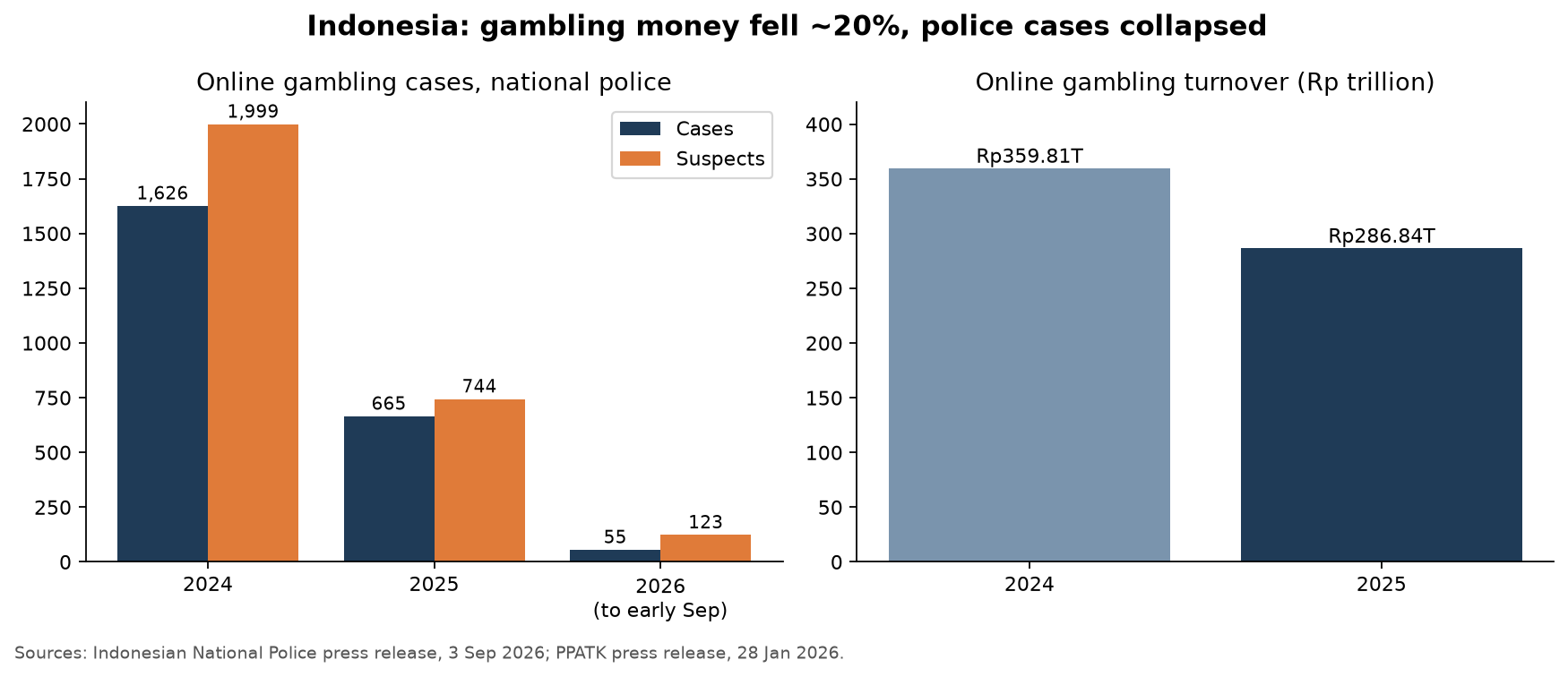
Chart: Created by this publication using official data from the Indonesian National Police and PPATK.
Why Does the New Code Impose “Shorter Sentences but Heavier Fines”? The new code replaces fines with a tiered system and generally increases their amounts while lowering some maximum custodial sentences, showing a legislative preference for financial penalties over long-term imprisonment. For online gambling, this means that a prosecution relying solely on the new code carries a lower maximum prison term than under the old code, giving prosecutors greater reason to invoke the ITE Law. It is foreseeable that more cases involving websites, apps and social-media promotion will be prosecuted under Article 45(3) of the ITE Law, while Articles 426 and 427 of the new code will apply mainly to physical gambling venues and individual participation.
2. Blocking Runs into the Millions, but Fewer and Fewer Cases Are Opened
The Ministry of Communication and Digital Affairs (Komdigi), the body that carries out blocking, has published several sets of figures:
- In 2025 as a whole, it dealt with 2,087,109 items of online gambling content, including 1,809,358 websites and IP addresses;
- From October 20, 2024, to September 11, 2026, it dealt with 5.15 million items of negative content, including 4.03 million relating to online gambling;
- According to figures released by police on September 3, more than 8.8 million online gambling websites have been blocked since 2017.
Police enforcement figures moved in the opposite direction. Nationwide, there were 1,626 online gambling cases and 1,999 suspects in 2024; this fell to 665 cases and 744 suspects in 2025; by early September 2026, there had been only 55 cases and 123 suspects.
The financial figures fall between the two. The Financial Transaction Reports and Analysis Center (PPATK) reported online gambling turnover of IDR 286.84 trillion across 422.1 million transactions in 2025, down 20% from IDR 359.81 trillion in 2024. Deposits fell from IDR 51.3 trillion to IDR 36.01 trillion, with approximately 12.3 million depositors. Online gambling still accounted for 47.49% of the predicate offences in suspicious transaction reports.
Putting the three sets of figures together leads to a straightforward conclusion: in 2025, the scale of funds fell by only about 20%, while the number of cases opened fell by 59% and the number of suspects by 63%; the 55 cases in the first eight months of 2026 were less than 4% of the total for all of 2024. Indonesia’s approach to online gambling has shifted from criminal prosecution towards blocking and intercepting funds. Blocking is inexpensive and can be done at scale, but it cannot replace prosecution of domestic agents and funding channels.
3. Who Is Paying the Price?
An official Komdigi release in October this year disclosed that the identity numbers of 571,410 social assistance recipients were linked to online gambling activities in 2024, involving approximately IDR 957 billion in deposits and 7.5 million transactions. The government also recorded nearly 200,000 children exposed to online gambling in 2026, about 80,000 of them under the age of 10.
On the payment side, PPATK observed that funds were moving towards QRIS QR-code payments. Indonesia’s central bank has introduced measures to block this flow. We analysed those measures individually in “A Bean-Flour Dumpling Vendor Received One Hundred IDR 50,000 Payments at Night: Indonesia’s Central Bank Takes Four Measures to Block QRIS Gambling Funds.”
4. Practical Implications
Players: Article 427 of the new code applies from 2026. Participation in gambling carries up to three years in prison, while the maximum fine rises from IDR 10 million to IDR 50 million.
Operators, agents and promoters: They face both Article 426 of the new Criminal Code and Article 45(3) of the ITE Law. The latter carries a higher fine and directly targets “making gambling content accessible,” including directing traffic to online gambling through social media.
Payments and accounts: Lending, buying or selling bank accounts, e-wallets and QRIS merchant IDs will be flagged as suspicious transactions. Account freezes by PPATK and the central bank are currently the most common response.
Platforms: Blocking and moderation orders under Article 40(2c) of the ITE Law must be obeyed. The digital affairs ministry issues blocking lists in batches.
5. What Remains Unclear
- Police have not explained whether the sharp fall in cases opened reflects a shift in enforcement priorities, a change in statistical definitions, or the transfer of cases to other agencies.
- No public statistics are yet available on the number of cases decided under Articles 426 and 427 since the new Criminal Code took effect.
- Komdigi has not disclosed deduplicated data showing how much of the blocked content reappears, such as the same site switching domains.
Sources
- Articles 303 and 303 bis of the Criminal Code (KUHP); Law No. 7 of 1974 on the Suppression of Gambling
- Articles 426, 427, 622 and 624 of Law No. 1 of 2023 (the new Criminal Code)
- Articles 27(2), 40 and 45(3) of Law No. 1 of 2024 (the second amendment to the ITE Law)
- Official releases by the Ministry of Communication and Digital Affairs (Komdigi), September and October 2026
- Indonesian National Police press release, September 3, 2026
- PPATK press release, January 28, 2026
Cite This Article
Topics In This Story
Related Countries

Andrea Rivera explores the evolving world of iGaming through the companies trying new things and the markets taking shape around them. An editor at AskSpinner News, Andrea combines research with storytelling, bringing information and perspective to industry analysis without losing the story that makes it worth reading.
More From This Author