Jeju weighs three-month suspension after marked-card casino case
Jeju is reviewing a possible three-month suspension of a foreigner-only casino over alleged marked-card cheating of three Chinese tourists in June, with police citing proceeds above KRW100 million. GGRAsia named the venue Gold Mountain Casino; Jeju has not publicly confirmed that. A final administrative decision is still pending.
 6 Min Read
Overview
- Jeju is reviewing a first-offence administrative penalty that can suspend a foreigner-only casino for three months over alleged marked cards.
- Police cite proceeds of more than KRW100 million from a June blackjack-table incident involving three Chinese tourists.
- Trade outlet GGRAsia, citing Jeju, named the venue Gold Mountain Casino; Jeju has not publicly confirmed that name.
- On 11 September, police referred six casino-linked individuals and the operating company to prosecutors on fraud-related grounds.
- Officials say operator representations are still under review and a final penalty decision has not yet been made.
Jeju Special Self-Governing Province is completing a final review of an administrative penalty against one of the island’s foreigner-only casinos. Under Korea’s Tourism Promotion Act and Jeju’s casino supervision ordinance, using altered gaming equipment triggers a three-month suspension for a first offence and licence revocation for a second. On 21 October, a Jeju official told Yonhap that if no mitigating grounds are found, the casino faces a three-month suspension—but “representations submitted by the operator are still under review, and a final decision has not yet been made.”
Korean local media have referred to the venue only as “Casino A.” Trade outlet GGRAsia, citing information from the Jeju provincial government on 23 October, named it as Gold Mountain Casino—formerly Megaluck Casino, previously operated by Hong Kong-listed New Silkroad Culturaltainment and sold in 2024 to local company Geumsan. That name has so far been disclosed only by GGRAsia; Jeju has not publicly confirmed it.
Two days at one blackjack table, about KRW100 million
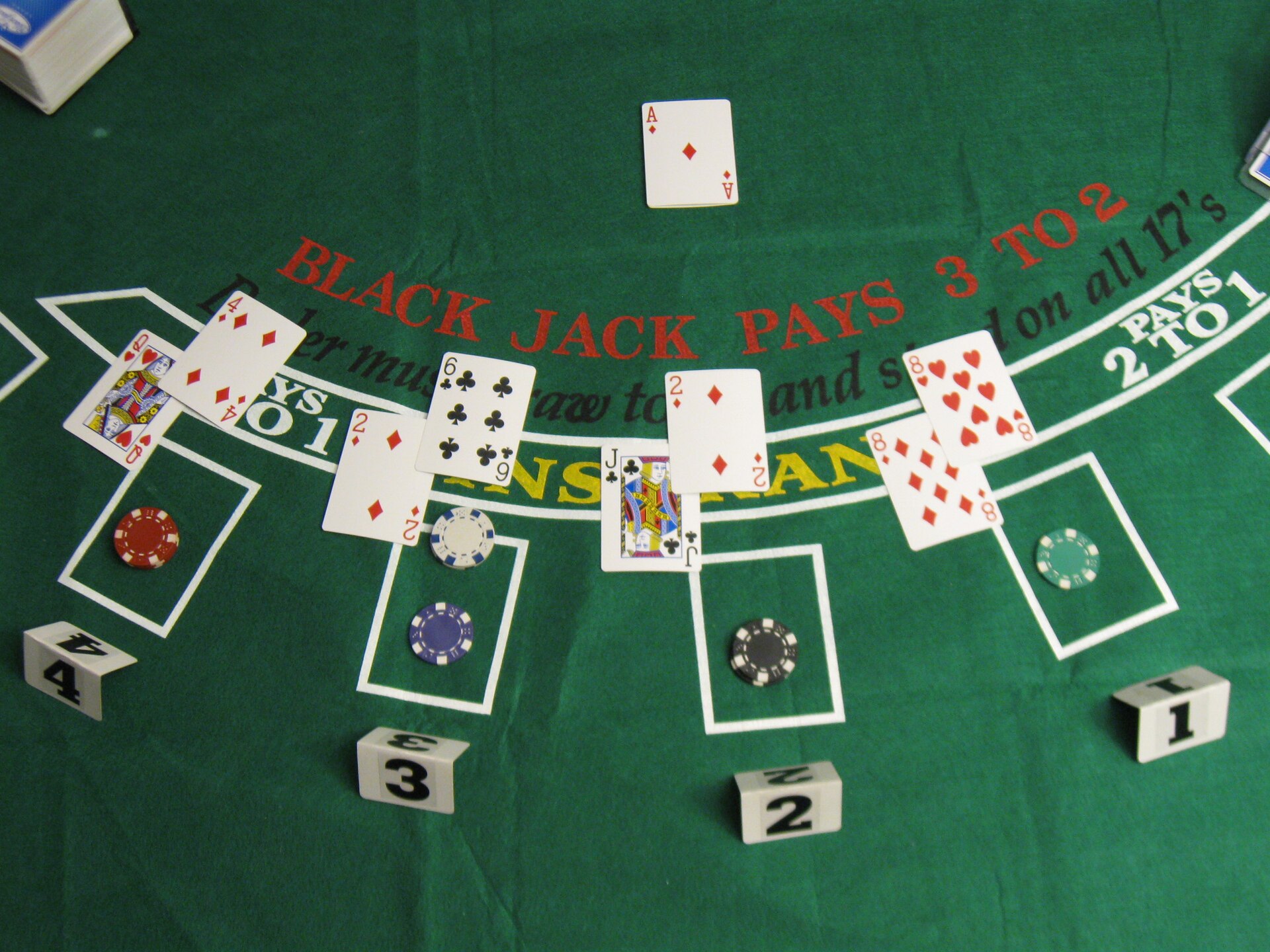
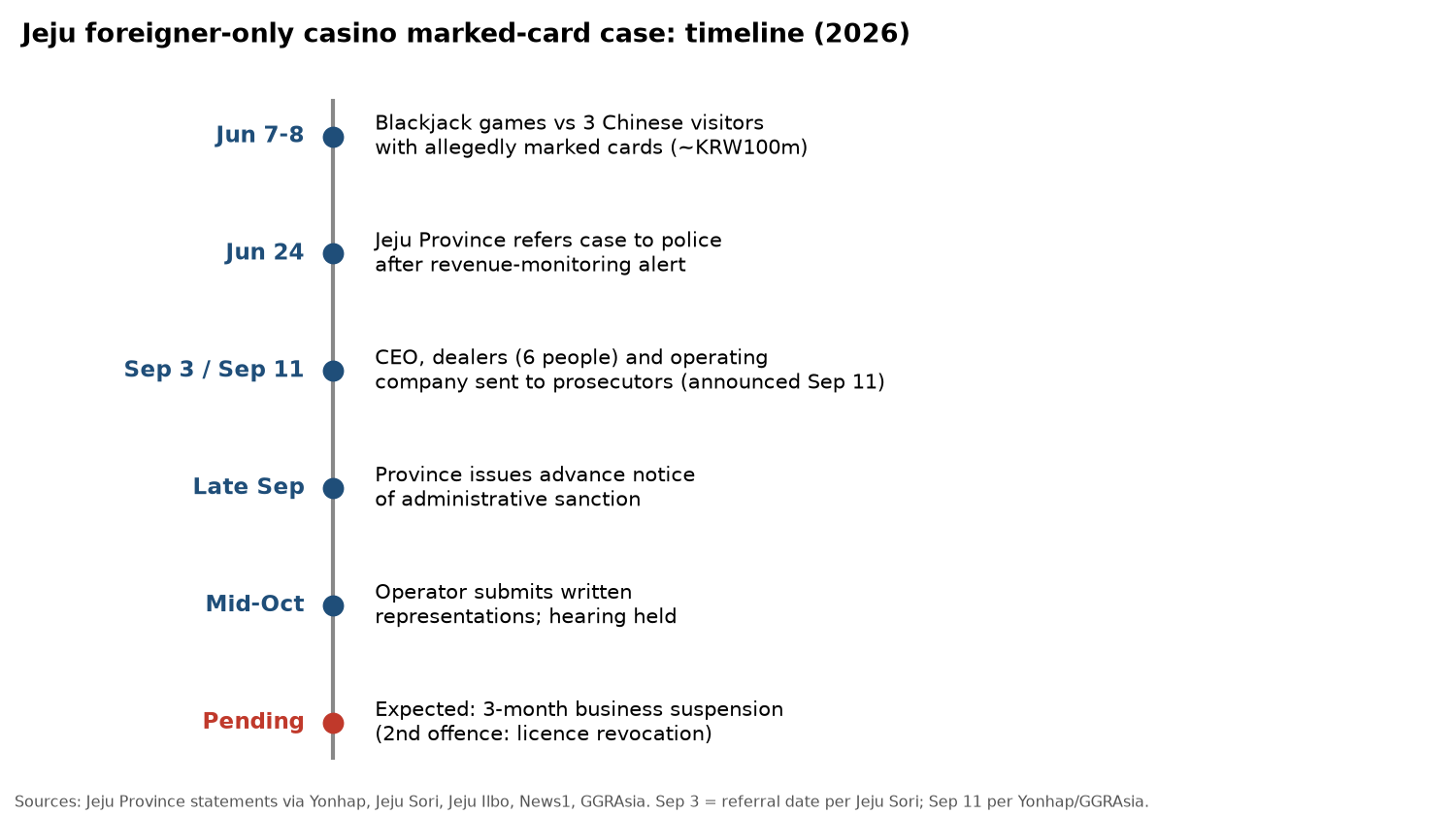
According to disclosures by Jeju Province and police, the incident took place on 7–8 June this year. On a blackjack table, casino staff allegedly used “marked cards”—cards with subtle marks on the back or edge that allow specific cards to be recognised in advance—against three Chinese tourists. Early reports put the sum at KRW80 million; when Jeju police referred the case to prosecutors in September, they cited proceeds of “more than KRW100 million” (about USD75,500 at the rate used by GGRAsia).
Jeju Ilbo reported in June that the three Chinese tourists had already left Korea without realising they had been cheated. The paper also said that on 7 June itself, dealers at the same casino had lost about KRW50 million to Chinese tourists at baccarat, after which the blackjack tables showed unusually large wins over the following two days. Jeju officials at the time also noted that the incident coincided with a change of representative director—the previous representative resigned on 5 June—and said they were examining whether the owner had been involved. Those two points appear only in Jeju Ilbo’s reporting and have not been independently confirmed by other outlets.
Flagged by the regulator’s “abnormal revenue” system
The case was not tipped off by a player. Jeju’s own supervision system caught it. Through its casino operations monitoring system, the province checks daily turnover at each casino and noticed that a single blackjack table at this small property was booking far more revenue than usual. Jeju Ilbo reported that most casinos on the island focus on baccarat, so a large win on blackjack at this venue drew regulators’ attention.
Jeju then sent inspectors to the site, seized cards suspected of having been altered, and reviewed CCTV that showed signs of game manipulation. Jejusori reported that the marks on the cards were visible to the naked eye. News1 reported that Jeju analysed system data together with Korea’s National Forensic Service. On 24 June, Jeju asked the Jeju Provincial Police Agency to open an investigation on suspicion of fraud and obstruction of business by deceit.
Six people plus the corporate operator referred to prosecutors
On 11 September, Jeju Provincial Police announced that six people connected to the casino—including its representative (in his 50s) and the dealers on duty—had been referred to prosecutors on fraud charges without detention. Under Korea’s dual-punishment (joint liability) rules, the operating company was also referred for alleged failure of care and supervision. Newsis, citing police, said investigators believe the individuals had conspired in advance.
Referral dates differ across outlets: Jejusori wrote that police referred the case on 3 September and announced it publicly on 11 September; Yonhap and GGRAsia write 11 September. This article treats 11 September as the public announcement date.
How far the penalty process has gone—reports do not fully agree
Jeju issued a prior notice of administrative penalty to the casino in late September; the casino submitted a written response last week. On the same day, 21 October, coverage of where the process stands diverged:
- Yonhap, quoting a Jeju official, said operator comments were still under review and “a final decision has not yet been made”;
- News1 and Jejuin News said the hearing procedure had already finished; Jejuin News went further, writing that “the final penalty level has been confirmed”;
- GGRAsia on 23 October cited a Jeju official in line with Yonhap: “We are still reviewing the casino operator’s representations. Under existing regulations, we may reduce the three-month suspension if mitigating grounds are identified.”
What is clear: for a first offence the maximum suspension is three months, and Jeju cannot go beyond that; statutory mitigating grounds can shorten it. The official quoted by GGRAsia also said Jeju’s administrative penalty is “independent” of the criminal investigation and any later court judgment, and does not wait on the criminal outcome.
Jeju’s foreigner-only casinos: one giant, many small
Casinos on Jeju Island are open only to foreigners. Since 2009, licensing, supervision and administrative penalties for casinos on the island have been delegated to the Jeju provincial governor; Korea’s Ministry of Culture, Sports and Tourism remains responsible for the national casino industry. There are currently eight foreigner-only casinos on the island.
Citing Jeju provincial data via Jeju Ilbo, island-wide casino turnover in 2025 was KRW646.5 billion, up 40.8% from KRW458.9 billion a year earlier, with 913,900 admissions. Dream Tower alone accounted for KRW520.6 billion—about 80%. Smaller casinos turn over only a few billion won; the paper cited two that booked KRW379 million and KRW656 million last year. Jeju Ilbo argued that this polarisation and prolonged losses make smaller venues more likely to cut corners.
The case matters for the sector on two fronts: it exposes operating pressure and internal-control gaps at small foreigner-only casinos; and it shows that Jeju’s daily revenue monitoring can flag anomalies at a single table, with a clear penalty ladder—“first offence suspension, second offence licence loss.” A final penalty decision is expected soon.
the Gold Mountain Casino name has so far been disclosed only by GGRAsia; the casino has not publicly responded; the final penalty has not been announced; there is no word yet on whether prosecutors will indict.
Cite This Article
Topics In This Story
Related Countries

Daniel Tan is an editor at AskSpinner News who believes industry writing can be informed, approachable and engaging. Daniel turns complex subjects into accessible articles and reports, giving readers a welcoming way into unfamiliar topics and room to build their understanding as they read.
More From This Author