
Macau’s Fourth “Proxy Betting” Case in Five Weeks: Two Mainland Men Livestream Baccarat and Place Bets for Mainland Clients at a Cotai Casino
Macau police say two mainland men livestreamed baccarat and placed bets for mainland clients at a Cotai casino. Both were referred to prosecutors.
 6 Min Read
Overview
- Macau police say two mainland men livestreamed baccarat and placed bets for mainland clients at a Cotai casino. Both were referred to prosecutors.
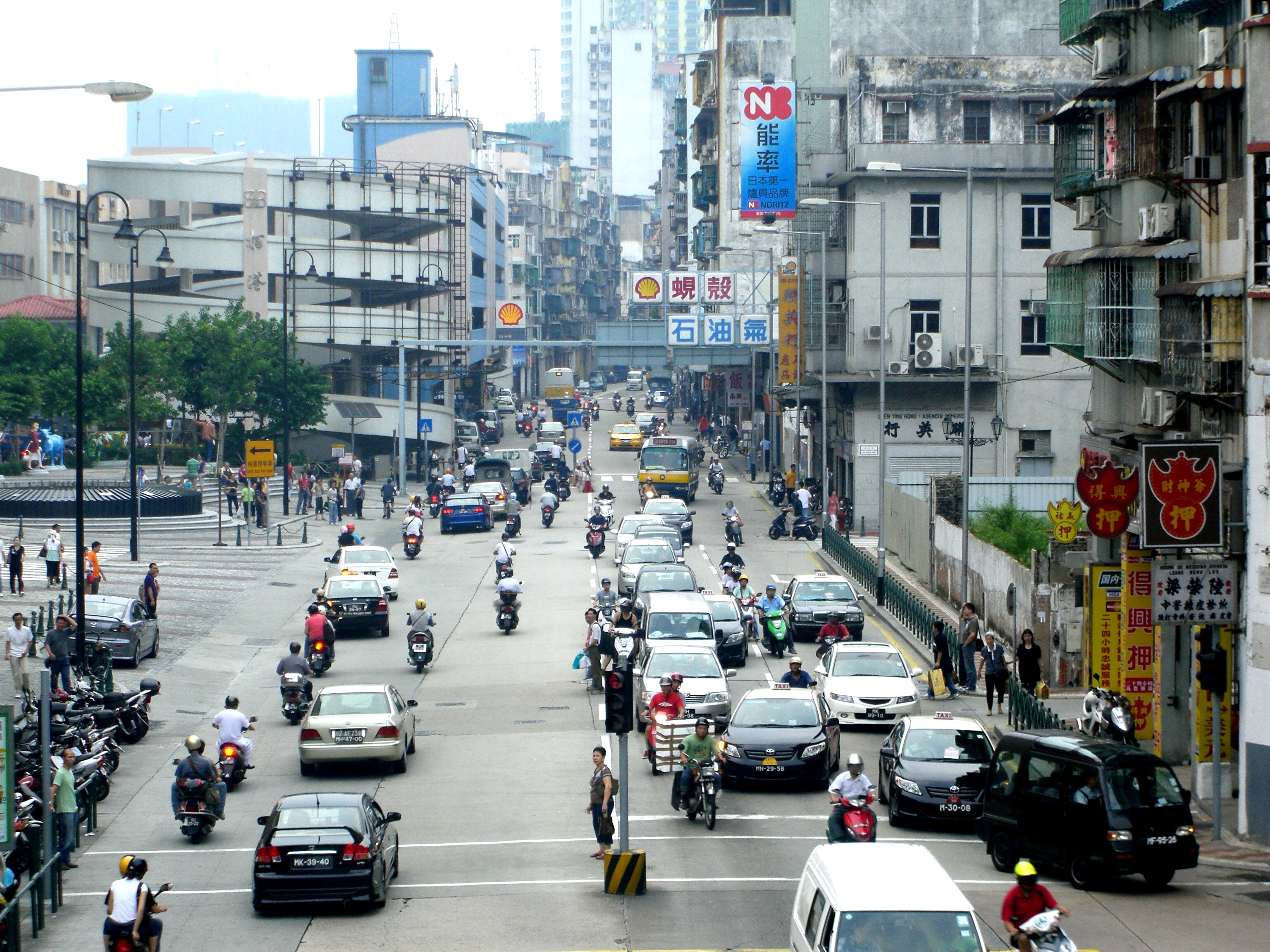
File photo: Rua do Visconde Paço de Arcos in Macau, 10 August 2009. Geographic context only; none of the people or premises pictured is identified as connected to the reported Cotai investigation. Photo: Cdip150 / Wikimedia Commons, released into the public domain by the photographer. Image source; Public domain dedication by photographer (PD-self).
Macau’s Judiciary Police held a special press conference on October 22 to announce another case of unlawful online gambling, commonly known as “proxy betting”. Two mainland Chinese men, both of whom said they were farmers, allegedly divided the work at a casino in Cotai: one livestreamed a baccarat table, while the other placed bets according to instructions from mainland gamblers received through Bluetooth earpieces. Both men have been referred to the Public Prosecutions Office on suspicion of “unlawfully operating online games of chance or online pari-mutuel betting”.
The Case: Half an Hour and HK$50,000 in Betting Funds
According to a Judiciary Police spokesperson at the press conference, police received a tip-off at around 3:30 p.m. on October 20 that someone was suspected of engaging in proxy betting at a Cotai casino. Officers were sent to the scene and intercepted the two men. The arrested men, surnamed Li, 44, and Zhang, 41, both said they were farmers.
The investigation found that the two men entered the casino at 2 p.m. that day, both wearing earpieces. Zhang was responsible for placing bets, while Li stood behind him holding a mobile phone and livestreaming play at a baccarat table. Both men received betting instructions from mainland gamblers through Bluetooth earpieces, and the betting lasted around 30 minutes in total. Police said the mainland gamblers had provided the two men with HK$50,000 in betting funds.
Police found three mobile phones, two Bluetooth earpiece receivers, HK$115,000 in chips and RMB2,600 in cash on the two men, all of which were seized. Their unlawful earnings remain under investigation.
Not an Isolated Case
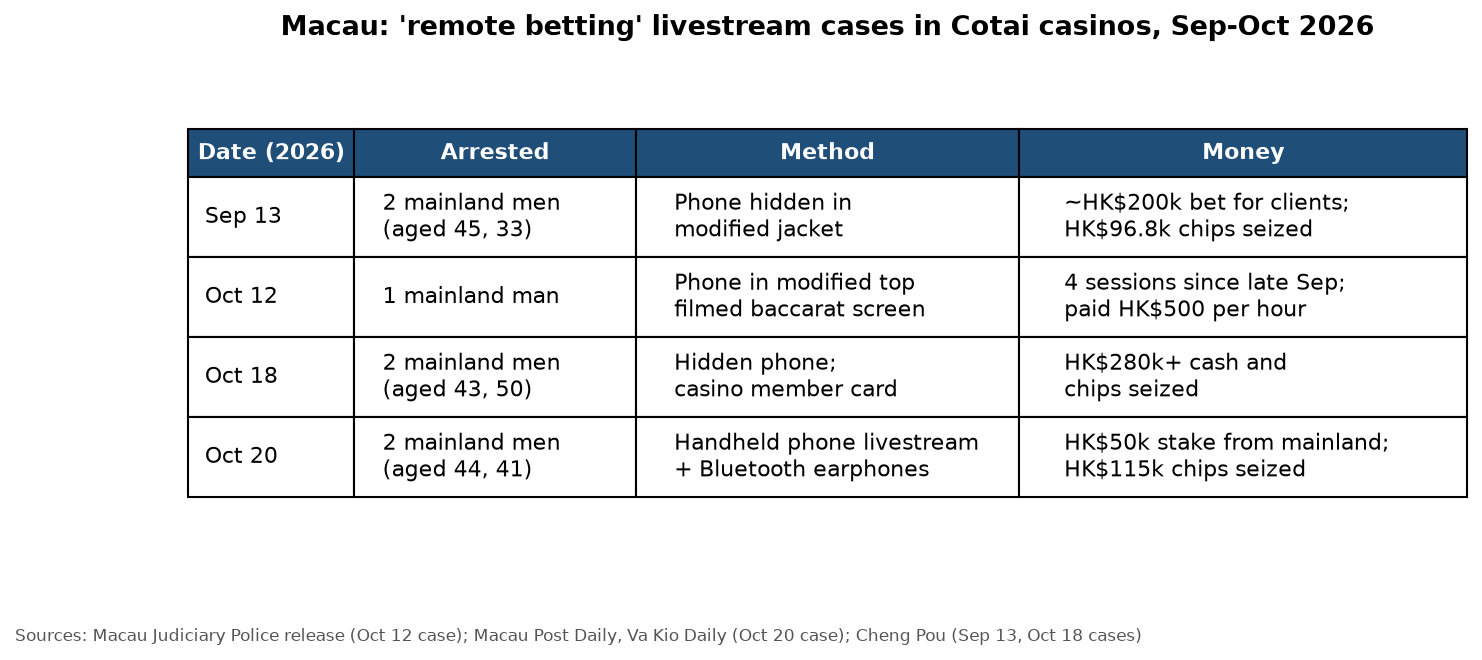
Judiciary Police announcements and reports in local Macau newspapers indicate that this is at least the fourth such case at Cotai casinos since mid-September. The methods have been broadly similar, although the details have varied:
- September 13: Two mainland men, aged 45 and 33, both of whom said they were farmers, entered a casino at around 8 p.m. One used a mobile phone concealed in his clothing to secretly film baccarat play and received instructions from mainland gamblers through an earpiece, while the other kept watch. According to Cheng Pou, by the time they were arrested they had placed around HK$200,000 in bets for clients and earned at least HK$3,800 in “betting commissions”. Police seized HK$96,800 in chips. (The newspaper’s headline stated “more than HK$98,000”, which was inconsistent with the HK$96,800 in the body of the report; this article uses the figure in the body.)
- October 12: According to an official Judiciary Police announcement, a mainland man concealed a mobile phone in an altered black top and secretly livestreamed the screen of a baccarat gaming machine through a small hole in the clothing, transmitting the footage in real time to an accomplice who remains at large. Since late September, he had livestreamed betting for others on four occasions, receiving HK$500 per hour and around HK$2,000 in total.
- October 18: According to Cheng Pou, two unemployed mainland men, aged 43 and 50, used a mobile phone in a hidden compartment in altered clothing to secretly film play. They also used their own casino membership cards to place bets and accumulate points for clients who were not in Macau, earning more than HK$3,700 in commissions. Police found more than HK$280,000 in cash and chips.
- October 20: The current case. Unlike the preceding cases, in which phones were concealed in clothing, this time a phone was held openly behind the person placing the bets to livestream the play.
It is worth noting that a separate Judiciary Police announcement shows that, also on October 20, police conducted an anti-crime inspection under “Thunderbolt 2026”, coordinated by the Unitary Police Service. Twenty-five criminal investigators inspected several casinos and surrounding areas in Cotai, stopped and checked 167 people, and found no one engaged in unlawful activity or deemed suspicious. The announcement did not specify the time of the inspection, making it impossible to determine whether it overlapped with the time of the alleged offences in this case.
Legal Basis: Up to Eight Years
The offence of which the two men are accused is set out in Article 7 of Law No. 20/2024, the Law to Combat Crimes of Illegal Gambling, promulgated in October 2024: anyone who operates, promotes or organises online games of chance or online pari-mutuel betting in Macau without the approval required by law, whether on a regular basis or otherwise, is liable to one to eight years in prison. The article defines “online” broadly, covering gambling conducted remotely through electronic, information, remote-transmission or interactive media, regardless of whether the relevant systems and equipment are located in Macau. Negligence is also punishable.
The proxy-betting model enables gamblers in mainland China who cannot or do not wish to enter Macau to “remotely control” bets at real gaming tables through people on site. From the perspective of Macau’s regulators, the issue is that these bets ostensibly take place at gaming tables in licensed casinos, but the funds and instructions come through unlawful channels from outside Macau. In the recent cases, most of the people hired to work on site have been mainland men who said they were farmers or unemployed. They were paid by the hour or through “betting commissions”, and the amounts were not high.
Police have not yet disclosed who organised the operation in this case, the identities of the mainland gamblers or the source of the funds. As of publication, no written announcement about the October 20 case had appeared on the Judiciary Police website. This article’s details of that case are based on the press conference and reports by the Macau Post Daily and Jornal Wa Ou.
Sources
- Macau Post Daily, October 23, 2026: Police arrest 2 mainlanders livestreaming casino gambling for online bets
- Jornal Wa Ou, October 23, 2026: Two Mainland Men Arrested on Suspicion of Proxy Betting
- Judiciary Police announcement (October 12 case): Mainland Man Arrested on Suspicion of Unlawfully Operating Online Gambling
- Judiciary Police announcement: “Thunderbolt 2026”: Inspections of Casinos and Surrounding Areas in Cotai
- Cheng Pou, October 21, 2026: Two Mainland Men Accused in Unlawful Proxy-Betting Case
- Cheng Pou, September 16, 2026: Illegal Proxy Betting Is Lucrative; Arrests Have Not Stemmed It
- Macao Special Administrative Region Official Gazette: Law No. 20/2024, Law to Combat Crimes of Illegal Gambling
Cite This Article
Topics In This Story
Related Countries

Daniel Tan is an editor at AskSpinner News who believes industry writing can be informed, approachable and engaging. Daniel turns complex subjects into accessible articles and reports, giving readers a welcoming way into unfamiliar topics and room to build their understanding as they read.
More From This Author