
The physics of a money wheel: how Crazy Time's wheel stops, what an "abrupt stop" means, and what rigging it would take
Viral clips of Evolution's Crazy Time wheel appearing to "brake" one segment short of a bonus have led to claims that the wheel — and even Evolution's roulette tables — are rigged with magnets. This explainer looks at the physics: how a big vertical money wheel loses speed, why its last moments are jerky by design, and what a hidden brake would physically require and leave behind. AskSpinner found no regulator, court or lab finding that any Evolution wheel has been manipulated; the claims, including an anonymous "former dealer" quoted by @HouseMoneyFYI on 5 November 2026, remain unverified.
 11 Min Read

Overview
- Viral Crazy Time clips of an “abrupt stop” one segment short of a bonus sparked magnet-rigging claims; this explainer covers the physics of a vertical money wheel.
- A spinning money wheel loses energy through friction and air drag; the flexible pointer then decides the segment through a chaotically sensitive peg-by-peg finish.
- Near-misses are expected physics, not evidence of aiming: small differences in early spin speed diverge into different late-peg outcomes.
- A hidden brake that could pick segments on demand would need power, control and concealment — and would leave physical and statistical traces auditors look for.
- AskSpinner’s assessment: the viral clips fit ordinary stop dynamics; documented live-casino cheating cases have involved other attack paths than a secret wheel brake.
Video: @sriougambles on X. A Crazy Time round in which the wheel stops one segment short of Coin Flip — the clip at the centre of the rigging debate.
- Viral Crazy Time clips of an “abrupt stop” one segment short of a bonus sparked magnet-rigging claims; this explainer covers the physics of a vertical money wheel.
- A spinning money wheel loses energy through friction and air drag; the flexible pointer then decides the segment through a chaotically sensitive peg-by-peg finish.
- Near-misses are expected physics, not evidence of aiming: small differences in early spin speed diverge into different late-peg outcomes.
- A hidden brake that could pick segments on demand would need power, control and concealment — and would leave physical and statistical traces auditors look for.
- AskSpinner’s assessment: the viral clips fit ordinary stop dynamics; documented live-casino cheating cases have involved other attack paths than a secret wheel brake.
Key points
- A money wheel is a large disc on a low-friction bearing with a peg between every segment and a flexible pointer at the top. Crazy Time’s wheel has 54 segments (Evolution rules).
- Two things slow it: smooth drag in the bearing and air, and a small energy loss every time a peg flicks the pointer. In the final second the wheel moves peg by peg, so stops look sudden.
- The final segment is extremely sensitive to launch speed: a few percent harder or softer moves the stop by many segments. That is why hosts cannot aim — and why “near misses” happen constantly on a fair wheel.
- A hidden brake is physically possible in principle (motor-controlled wheels that stop at a pre-chosen segment are even patented for other products), but it would leave deceleration anomalies on video, frequency anomalies in public result trackers, and hardware that inspections and staff would see.
- Weighing mechanics, statistics, economics and oversight, AskSpinner sees no evidence of rigging and strong reasons against it — while noting what outsiders still cannot verify.
Anatomy of the wheel
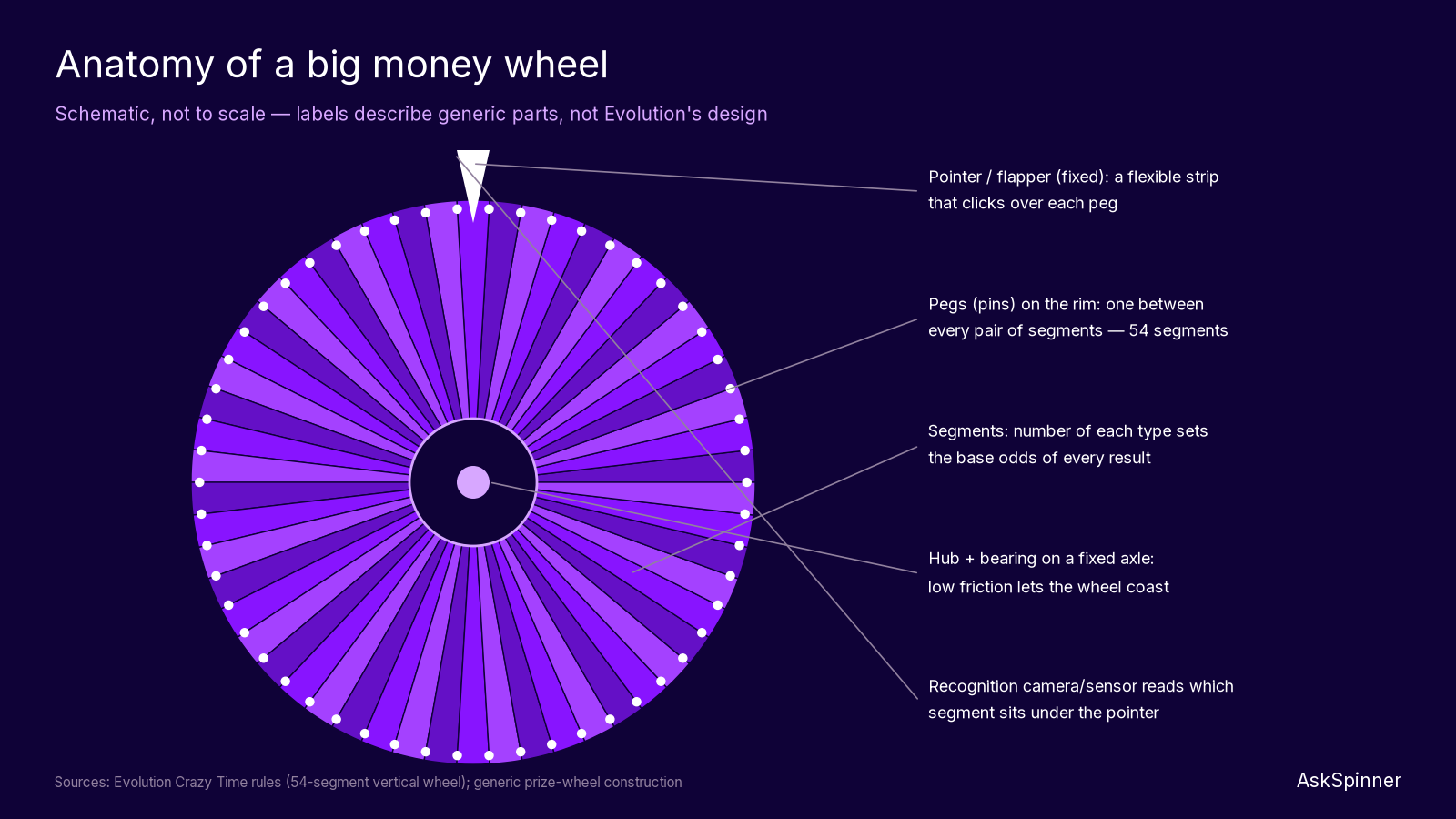
Evolution’s rules describe Crazy Time as “a game of chance that is played using a large 54-segment vertical wheel, spun by the game presenter”. Dream Catcher and Monopoly use the same money-wheel format. Generic parts:
- Hub and bearing. The wheel turns on a fixed axle. A good bearing has little friction, so the wheel coasts for many revolutions.
- Segments. The count of each segment type sets base odds. Per tracker CasinoScores (third-party, not Evolution’s rules), Crazy Time carries 21 × “1”, 13 × “2”, 7 × “5”, 4 × “10”, 4 × Coin Flip, 2 × Pachinko, 2 × Cash Hunt and 1 × Crazy Time — 9 bonus segments, or 1 in 6.
- Pegs. A pin sits on the rim between every pair of segments.
- Pointer (flapper). A flexible strip fixed above the wheel. Each peg pushes it aside — the “click”. Prize-wheel builders note that the pointer’s stiffness and contact length are the main factors in how long a wheel spins.
- Recognition. A camera or sensor reports which segment stopped under the pointer. Under GLI-19, if that read disagrees with the physical wheel, “the Physical Randomness Device’s outcome shall be considered correct.”
How a spin loses energy
The host’s pull gives the wheel angular momentum. From then on, energy only leaves the system:
- Bearing friction and air drag — continuous, and larger at high speed. Alone, this gives a smooth, roughly exponential slowdown.
- Peg strikes — each peg must bend the pointer, costing a near-fixed amount of energy per segment passed. At high speed this is a small fraction of the wheel’s energy; near the end it dominates. A 2020 Interblock patent for a motorised wheel (US 10,803,699) describes exactly these two terms — constant “friction deceleration” and speed-proportional “damping” — as the ingredients needed to make a motor-driven stop “appear as though the wheel randomly stopped”. That is a different, disclosed product category, not evidence about Evolution, but it is a useful public description of natural wheel decay.
How the pointer picks the segment
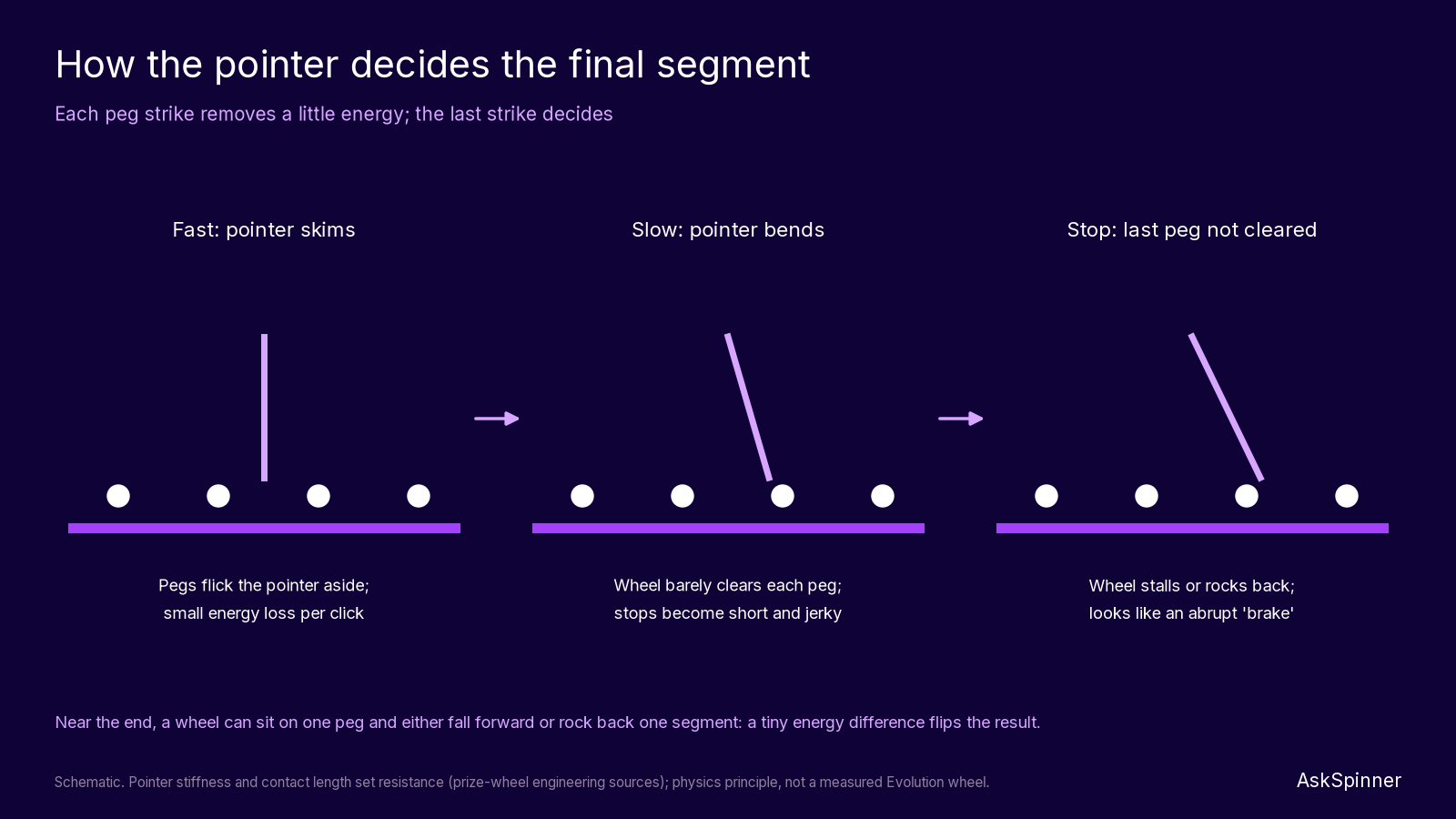
Fast: the pointer skims, clicking rapidly. Slow: each peg bends the pointer further and the wheel visibly hesitates. Final: the wheel no longer has enough energy to push the next peg past the pointer. It stalls against it, often rocking back into the previous segment. On video this looks like a sudden “brake” — but it is the normal end of every spin. When the wheel sits on a peg with barely enough energy, a tiny difference decides between “fall forward” and “rock back”, which is why so many stops land one segment from something a viewer wanted.
Why the host can’t aim (and why near-misses are normal)
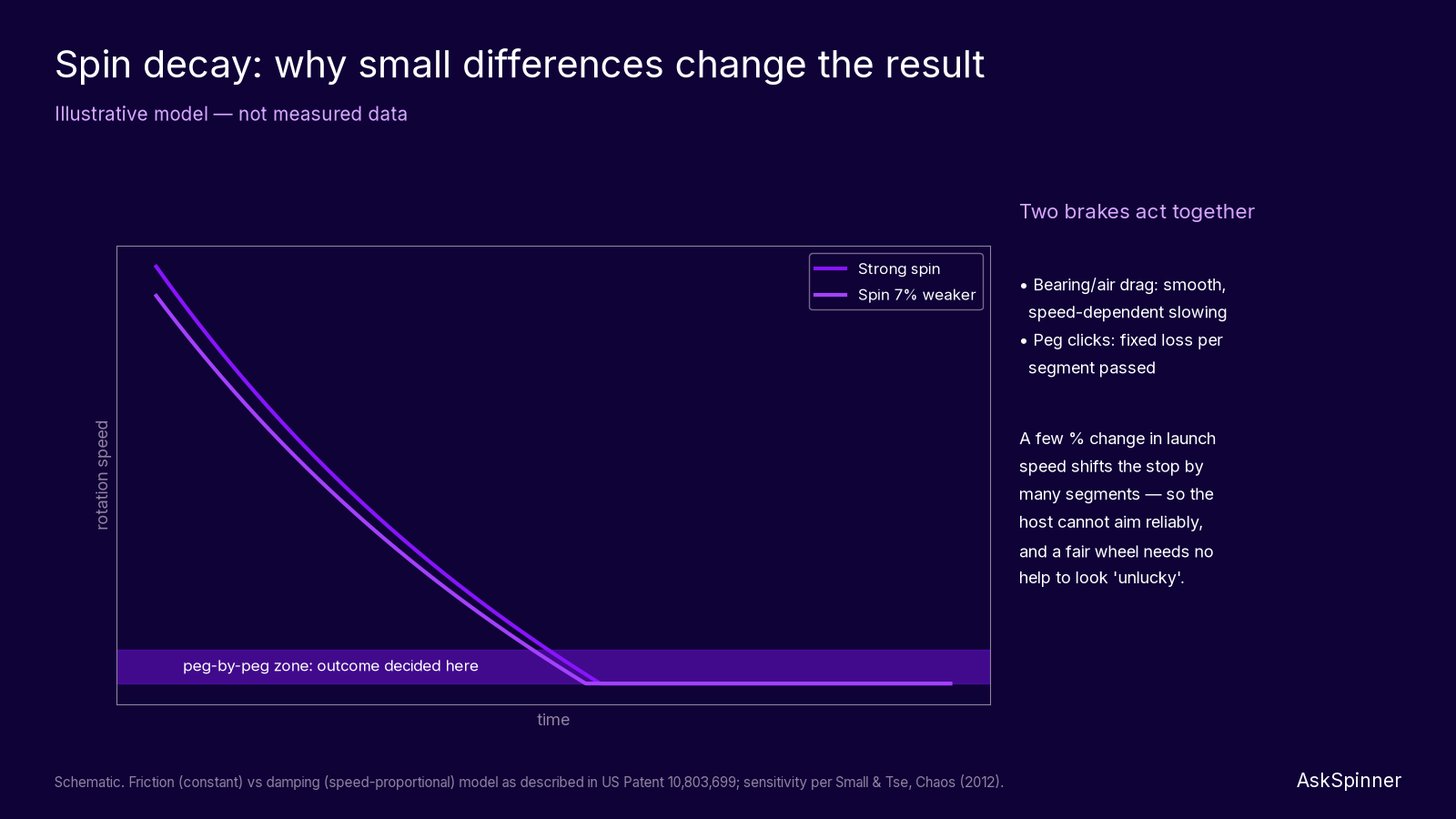
Over a spin of many revolutions, a few-percent change in launch speed shifts the stopping point by several segments or more. Small and Tse (Chaos, 2012) showed that roulette is deterministic in principle — prediction needs precise measurement of initial position, speed and deceleration — but the scatter at the end (deflectors in roulette, peg strikes here) limits accuracy. They also found that “even a very slight slant” creates a pronounced bias, which is why levelling and wear checks matter. Human hosts cannot reproduce launch speeds to that precision, and betting closes before the spin. The odds also guarantee near-misses: with 9 bonus segments out of 54, most spins land on a number — and with bonus segments distributed around the rim, landing next to one is common. A clip of one “near-miss” is expected, not anomalous.
What rigging would take — a feasibility analysis
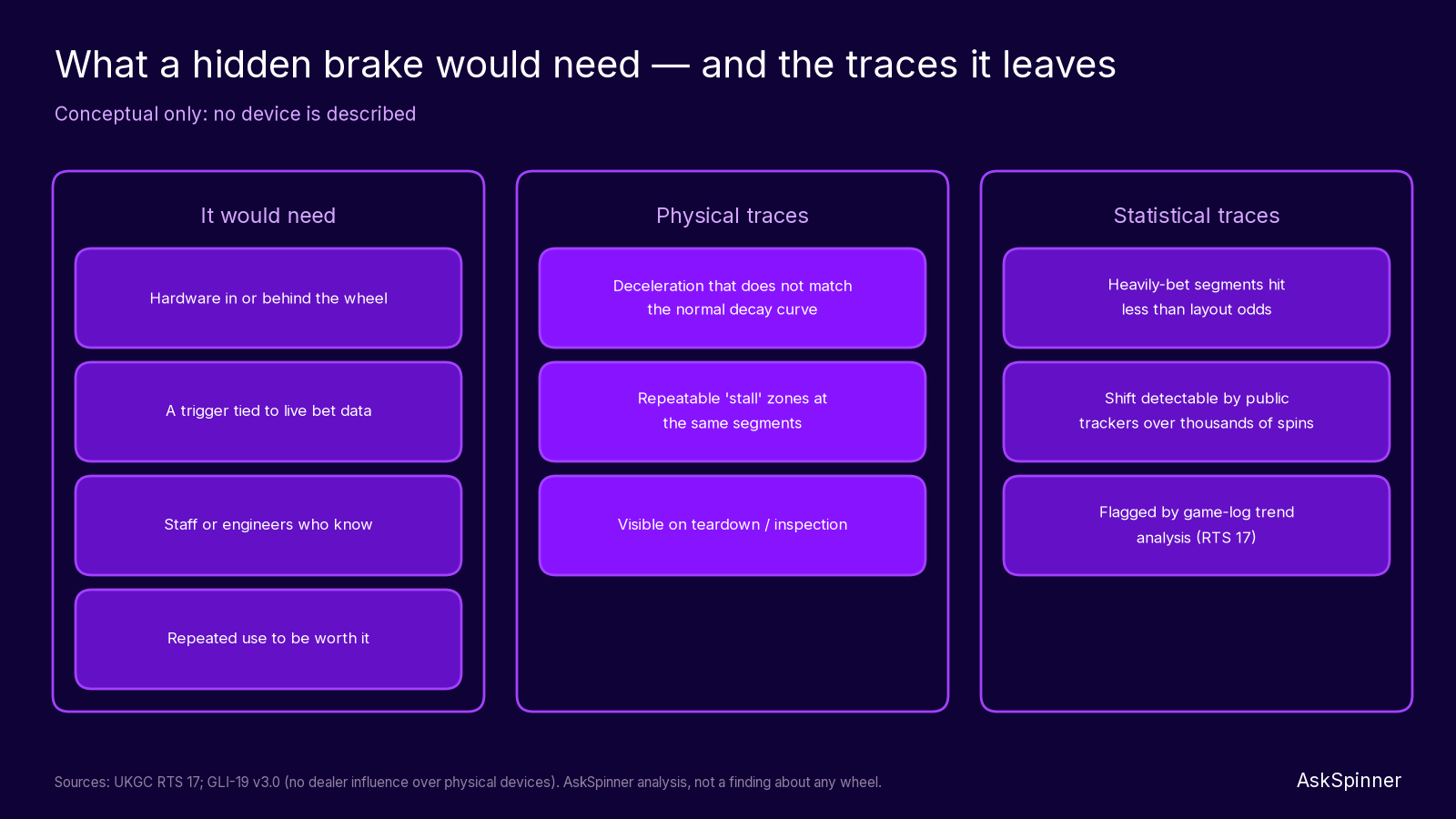
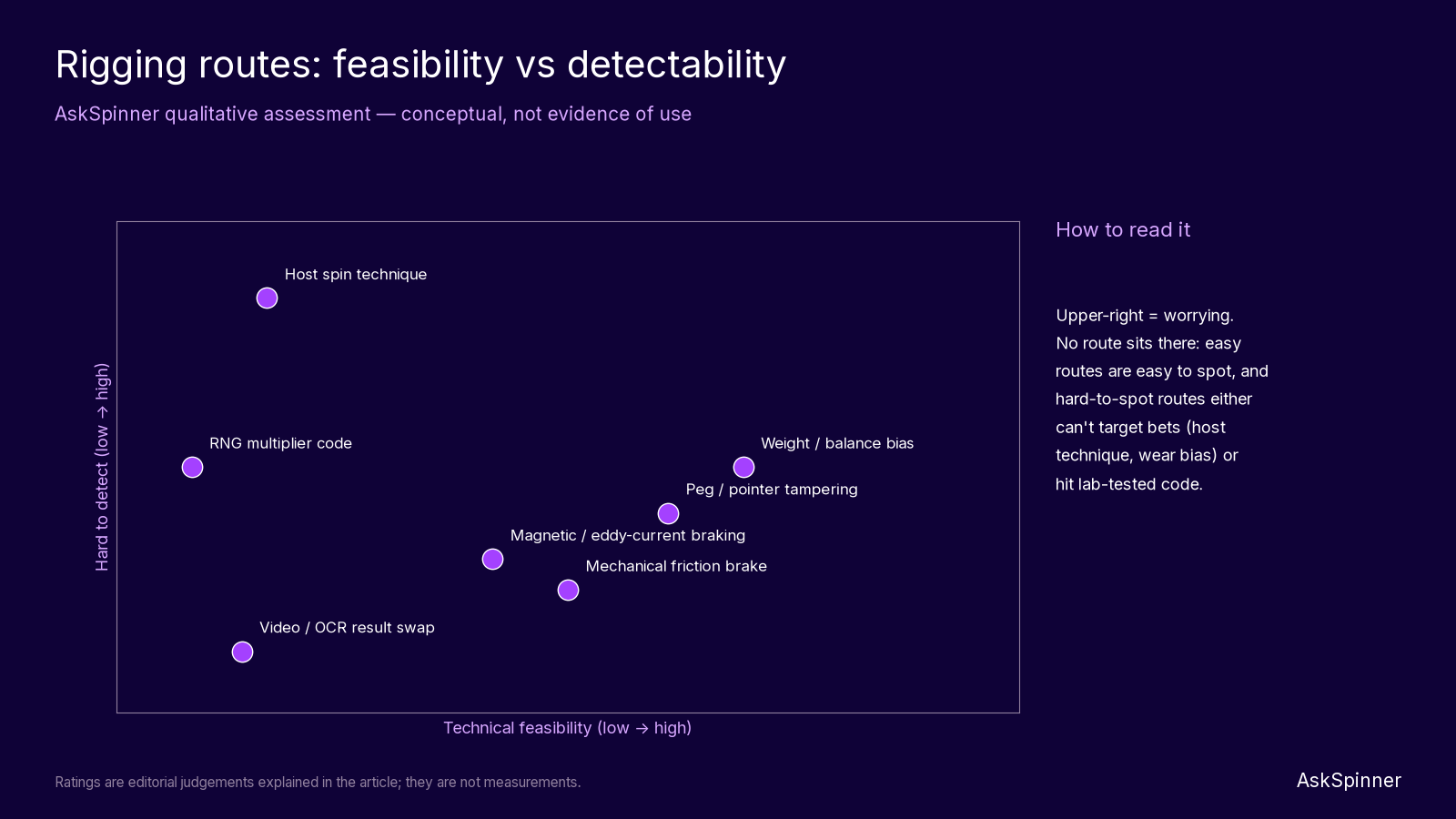
This section asks, conceptually, what each route would require and how it would show. It is not a guide and describes no device.
- Magnetic or eddy-current braking. Principle: a moving conductor near a magnetic field feels a drag force proportional to speed. Would require: conductive material in the rim and a switchable field source hidden nearby, triggered by live bet data. Detectability: the drag would change the deceleration curve in a way frame-by-frame video analysis can measure; it must act selectively, leaving segment-frequency anomalies on heavily-bet outcomes; hardware is visible to engineers and inspectors. Feasibility: technically possible, operationally hard to hide. Rating: low.
- Mechanical friction brake. Principle: a pad pressing the hub or rim. Would require a hidden actuator and trigger. Detectability: abrupt, non-peg-related deceleration and audible/visible contact; easy to find on inspection. Rating: low.
- Weight or balance bias. Principle: an off-centre mass makes the wheel prefer to stop with the heavy side down. Would require deliberate mass changes — or happens by accident through wear or tilt. Detectability: creates a constant bias (not targeted at live bets) that shows up in segment frequencies over thousands of spins; this is exactly what game-log trend analysis (UKGC RTS 17) and public trackers catch. Rating: low for cheating — it can’t respond to who bet what — but a genuine maintenance risk.
- Peg or pointer tampering. Principle: stiffer pointer or uneven pegs change where the wheel stalls. Would require physical modification. Detectability: constant, not selective; visible in close-up video and inspection; statistically detectable. Rating: low.
- Host spin technique. Principle: controlling launch speed. Would require precision humans don’t have over many revolutions (see above); GLI-19 requires that dealers “shall not have the ability to manipulate or influence” physical devices beyond game design. Detectability: hard to prove per spin, but ineffective. Rating: very low.
- Video or result-recognition manipulation. Principle: report a different segment from the one shown, or alter the stream. Would require software changes in lab-tested systems. Detectability: high — the physical result prevails under GLI-19, and every viewer sees the wheel. Rating: very low.
- RNG multiplier side. Principle: Top Slot and bonus multipliers come from software. Would require altering certified RNG/mapping code. Detectability: test-house source-code and statistical review before release, plus live RTP monitoring (UKGC). Rating: low; this is the most audited part of the game. The pattern: routes that could target live bets are easy to see, and routes that are hard to see cannot target bets.
Does Evolution cheat? A multi-angle assessment
Weighed honestly, with labels:
- Mechanics (against rigging): “abrupt stops” are the normal peg-by-peg end of a spin; the viral clips show nothing that physics can’t explain. (Limitation: a clip cannot prove the absence of a subtle mechanism either.)
- Statistics (against, with caveats): a selective brake would push heavily-bet segments below layout odds. Third-party trackers such as CasinoScores publish Crazy Time result histories; AskSpinner did not obtain a long sample for this piece and has not run a frequency test. That is the single most useful check anyone could do.
- Economics (against): the house edge is built in — Evolution’s rules give theoretical RTP of 94.33% to 96.08% depending on the bet — so the game earns on volume without manipulation. Evolution is listed on Nasdaq Stockholm and holds licences including MGA and UKGC; proven rigging would put those licences, and its whole B2B business, at risk.
- Insiders (against): a rig would need engineers, studio technicians and managers to keep quiet indefinitely. The one documented Evolution insider case — a Connecticut card dealer who pleaded guilty in 2025 to cheating blackjack for his own accounts — was detected and reported by Evolution itself.
- Oversight (against, partially): UKGC RTS 17 requires CCTV of all dealer activity and game logs analysed for trends; GLI-19 requires that physical devices can’t be manipulated. These apply where games are offered under those licences, not to every offshore site showing the same stream.
- What remains unverifiable (for): raw round logs, wheel maintenance and inspection records, and lab reports for specific wheels are not public. Evolution has not publicly explained the November clips. The anonymous “magnet” claim has no named source or documents. Bottom line: the physics explains the clips; no evidence shows rigging; and the most plausible real-world risk — wear or tilt bias — is constant, untargeted and detectable by the trend monitoring regulators require.
Short note: oversight and documented cheating
Regulators split assurance: RNG software is lab-tested (UKGC testing strategy), while physical wheels are covered by studio controls under UKGC RTS 17 — “fair and independently auditable”, casino-grade equipment, CCTV, game logs. Documented live-game cheating cases involve insiders or players, not providers: Evolution’s Connecticut dealer (guilty plea, 2025), dealer–player roulette collusion at Marina Bay Sands (jail, 2023), late-bet collusion in Louisiana (federal case, 2011), and the 2004 Ritz case in London, where players with an alleged prediction device kept £1.3m because nothing touched the wheel. Each was caught by surveillance, logs or account analysis.
Sources
Evolution Crazy Time rules (Loto-Québec copy); CasinoScores Crazy Time page (third-party); Small & Tse, “Predicting the outcome of roulette”, Chaos 22 (2012), arXiv:1204.6412; US Patent 10,803,699 (Interblock, 2020); prize-wheel construction notes (Engineer Fix; Printables WinSpin pointers); GLI-19 v3.0; UKGC RTS 17 and RTS testing strategy; Evolution licences page; The Hour (2025); CNA (2023); PNK v. Tannous (W.D. La. 2014); BBC (2004).
Cover photo: Image: Evolution.
If you hold rights to images used in this article and have concerns, please contact us at support@askspinner.com.
Cite This Article
Topics In This Story
Andrea Rivera explores the evolving world of iGaming through the companies trying new things and the markets taking shape around them. An editor at AskSpinner News, Andrea combines research with storytelling, bringing information and perspective to industry analysis without losing the story that makes it worth reading.
More From This Author