Utah and Ohio take the prediction-market fight to market makers and suppliers
On 20 October 2026, Utah’s attorney general sued Kalshi and two Susquehanna market-maker entities, while Ohio’s casino regulator ordered licensed sportsbooks, suppliers, integrity monitors and labs to stop serving unlicensed event-contract operators and confirm compliance by 30 October.
 5 Min Read
Overview
- Utah sued Kalshi and, for the first time in a state action, two Susquehanna market-maker entities on 20 October 2026.
- Ohio’s casino regulator ordered all sports gaming and fantasy licensees—including suppliers and labs—to stop serving unlicensed event-contract operators.
- Ohio licensees must email written compliance confirmation by 30 October or face reopened suitability reviews.
- Utah’s complaint estimates more than 3.06 billion wagers and $30.6–$61.2 million in fees from Utah Kalshi accounts.
- The wider dispute is headed toward the US Supreme Court after New Jersey’s petition; Kalshi’s response is due 9 November.
Two US states moved on 20 October against the business partners that keep prediction markets running, not just the exchanges.
In Salt Lake City, Utah Attorney General Derek Brown filed a verified civil complaint in the Third Judicial District Court against five Kalshi entities and two Susquehanna companies: Susquehanna International Group, LLP and Susquehanna Government Products, LLLP. In Columbus, the Ohio Casino Control Commission (OCCC) sent a notice, signed by Interim Executive Director Andromeda Morrison, to all sports gaming and fantasy contest licensees and applicants, ordering any that support unlicensed sports event contract operators in Ohio to “immediately cease such activities.”
Utah: the market maker is a defendant
Utah’s complaint describes Kalshi as playing “the same role as a traditional sportsbook,” taking a fee on each wager and relying on “market makers” that act as institutional counterparties to retail bettors. It says Susquehanna Government Products became Kalshi’s first dedicated institutional market maker around 3 April 2024, and that Susquehanna, directly or through that unit, routinely takes positions opposite retail wagers, including those placed by Utah residents.
Trade outlet SBC Americas described the filing as the first known case in which a market maker has been named as a defendant alongside the exchange it trades on. SBC Americas said Susquehanna had not responded to a request for comment.
The complaint’s key figures are estimates built from Kalshi’s own disclosures in earlier litigation:
- As of 25 February 2026, 32,940 accounts with a Utah address had fully completed Kalshi’s sign-up, and Utah accounts held about 1.11% of open positions on the platform.
- Applying that share over Kalshi’s lifetime, Utah estimates more than 3.06 billion wagers from Utah accounts and between $30.6 million and $61.2 million in fees, at $0.01–$0.02 per wager.
- Citing outside research, it estimates retail losses by Utah bettors at about $5.5 million.
Utah asks for preliminary and permanent injunctions barring the covered contracts in the state, enforced through a court-approved third-party geolocation provider, plus restitution, disgorgement, abatement costs and punitive damages. Brown also signed a formal Declaration of Public Nuisance the same day, the legal step that authorises the state to sue on that basis. Utah’s Constitution has barred the Legislature from authorising gambling since 1896, and the state has no lottery, casinos or sportsbooks.
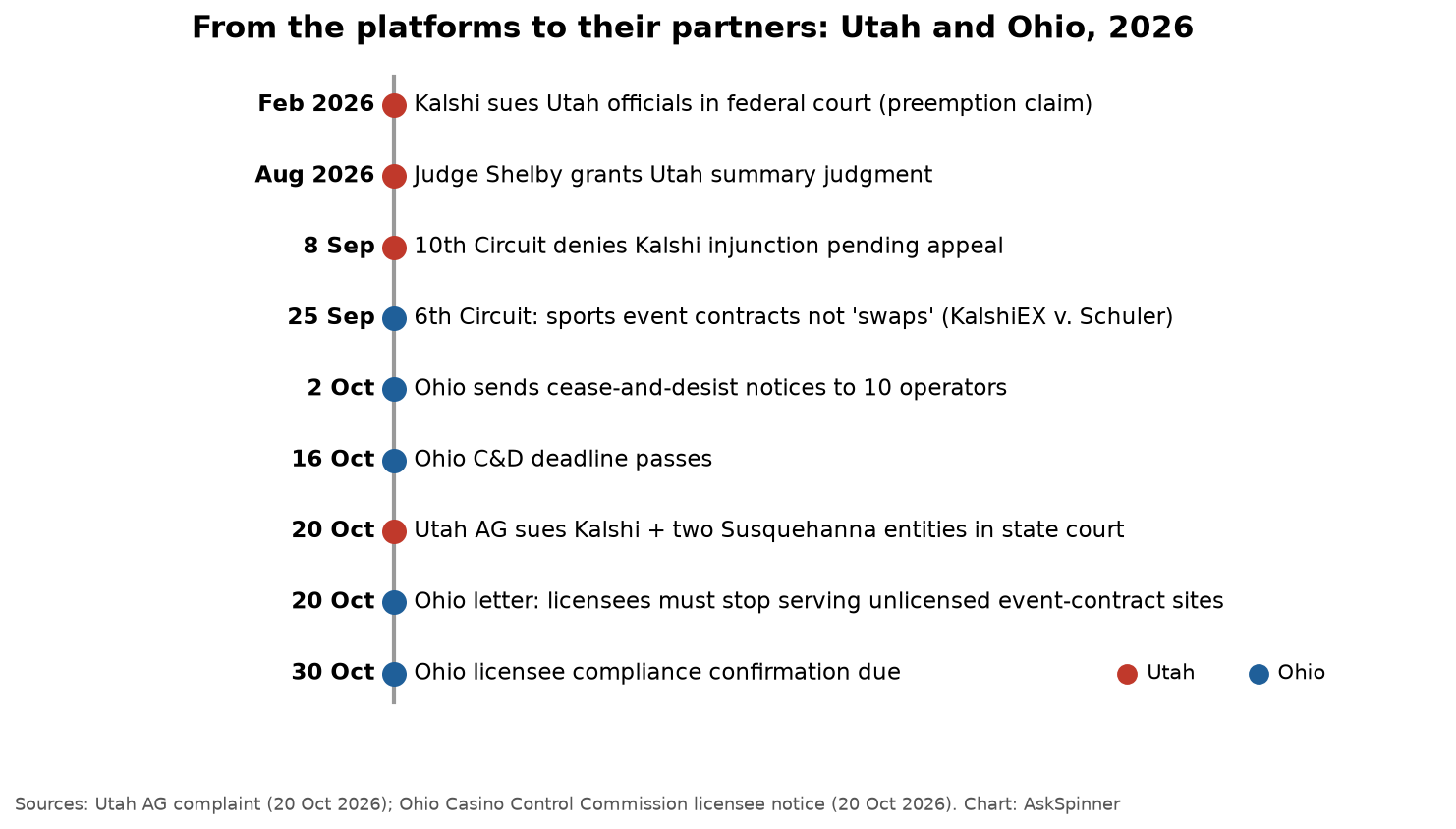
The case follows Kalshi’s own federal suit against Utah officials, filed in February 2026. In August, US District Judge Robert Shelby granted Utah summary judgment, holding that the Commodity Exchange Act does not override Utah’s gambling laws; on 8 September the Tenth Circuit denied Kalshi’s request to block enforcement pending appeal. That appeal is still pending. Kalshi has consistently argued that it is a federally regulated exchange overseen by the CFTC.
Ohio: suppliers and labs are on notice
The OCCC notice cites the Sixth Circuit’s 25 September ruling in KalshiEX LLC v. Schuler, which held that sports event contracts are not swaps under the CFTC’s exclusive jurisdiction. After that decision the commission sent cease-and-desist notices to 10 operators on 2 October with a 16 October deadline. The letter says that deadline “has passed” and the commission “intends to take action” against those that did not comply.
The new notice targets the supply chain. A footnote defines “licensee” to include fantasy contest operators, sports gaming proprietors, management services providers, mobile management services providers, suppliers and their key employees, certified independent integrity monitors, certified testing laboratories, and applicants. Covered services include market making, liquidity, integrity monitoring, data, platform, technology and security services.
The commission says supporting unlicensed operators “raises significant suitability concerns,” heightened where platforms accept 18- to 20-year-olds, stay outside Ohio’s responsible gaming and voluntary exclusion programmes, or offer bets outside the state’s approved wagering catalogue. Licensees must email the commission’s legal division confirming compliance by 30 October and keep supporting records. Those that do not will face reopened suitability investigations that can end in denial, nonrenewal, suspension or revocation. Futures commission merchants and introducing brokers are treated as compliant if they block Ohio customers from sports event contracts.
According to Legal Sports Report, the OCCC said only Plus500US had confirmed compliance with the cease-and-desist notices, while Kalshi and Polymarket are litigating against the commission. Polymarket US sued Ohio officials in federal court on 16 October, the day of the deadline.
Why it matters
Both actions aim at the parties that make prediction markets work: liquidity providers in Utah, and in Ohio the licensed vendors many of these platforms share with regulated sportsbooks. For B2B suppliers, data firms and integrity monitors licensed in Ohio, 30 October is now a hard compliance date. For trading firms, Utah’s complaint raises the question of whether market-making on sports contracts can create direct liability under state gambling law.
The wider fight is heading for the US Supreme Court. New Jersey has asked the justices to hear its case after the Third Circuit sided with Kalshi, and trade reports say Kalshi’s response is due 9 November.
Cite This Article
Topics In This Story
Related Countries

Patricia Cruz aims to bring a different perspective to familiar industry conversations. Through in-depth articles and thematic reports at AskSpinner News, Patricia draws attention to details worth questioning and connections that can be overlooked, using the news as a starting point for a closer look at the business of iGaming.
More From This Author