
Mines by JILI
Play Mines by JILI In Demo Mode
by JILI Games




 Other SymbolChest Coin
- Observed at 20 mines
- Qualification visual
- No jackpot confirmed
- Cashout still required
 Other SymbolCovered Tile
- Unrevealed cell
- 25-cell grid
- Coin or mine
- No safe-tile signal
 Other SymbolMine
- Ends the round
- Clears uncashed win
- Zero round payout
- Stake remains spent
 Other SymbolCoin
- Surviving reveal
- Advances multiplier
- Mine-count dependent
- Cashout to settle
Mines by JILI Expert Review


Updated:
Here you can find detailed review information about Mines by JILI.
Mines makes the next decision easy to understand and hard to ignore: keep the amount shown on screen, or reveal another tile and put that unsettled amount at risk. Its clean 5×5 board is more appealing to me than a busy reel display. The main weakness is the surrounding information: a rising jackpot pool, a red treasure-chest tile and the WIN counter can each suggest a reward before a final payout has actually been confirmed.
What I liked
✅ The coin, mine and Cashout loop is easy to follow in a real sequence of screenshots.
✅ Bet and mine-count controls sit next to the main action, and the portrait layout keeps the full board visible.
✅ The recorded rounds separate the selected stake, provisional WIN and settled balance, so the difference between a payout and profit can be checked.
What I didn’t like
❌ The betting menu covers part of the board and balance; landscape retains a narrow portrait-shaped game with much smaller text.
❌ Help describes Fairness and History, but neither was available in the inspected menu. The jackpot list is not a substitute for personal round history.
❌ An idle-session interruption reset the demo wallet. Help also contains unclear wording about simultaneous jackpot awards, which this sample could not resolve.
1. What Mines by JILI offers
This is JILI’s Mines, product 229: a grid-reveal game with 25 cells, an adjustable mine count and a Cashout decision within each round. JILI places it in its Crash category, although the observed playfield has no rising crash curve, reels or paylines. The blue board, gold coins and purple mines keep the visual language deliberately simple. JILI’s product listing gives May 2023 as its publication month, without an exact day.
The appeal is choosing when to end a surviving round. That choice changes how much remains exposed before cashout; it does not reveal a safe tile or turn a repeatable clicking pattern into a proven way to win. This review uses a recorded free-demo study from 6 October 2026: 50 ordinary rounds and a separate five-round configuration check. All amounts are virtual demo units, with no verified currency designation.
If a demo module is available on this page, check its provider, selected Bet and Mines values before using it. Current same-page loading and playability have not been verified. The official product page is provided as a source, not as a claim that a playable embed is available here.
Philippine search interest
Ahrefs’ Philippines Google estimates retrieved on 6 October 2026 were 150 average monthly searches for “jili mines”, 150 for “mines jili”, 70 for “jili mines demo”, 30 for “mines jili demo” and 20 for “how to play mines in jili”. These are keyword search estimates, not player counts or expected visits to this page. The overlapping phrases should not be added together as separate people.
A real 10-second excerpt from ordinary round 1: one tile reveals a coin, followed by a natural pause. This has no audio and does not include final cashout.
2. The screen, controls and small-screen layout
The board occupies the centre, with remaining coins and mines near the top. The multiplier strip sits above the tiles, and the balance, WIN, Bet, Mines and action buttons sit below. The green Start button changes to a red Cashout button during a round. WIN can show an amount that has not yet been added to the balance.
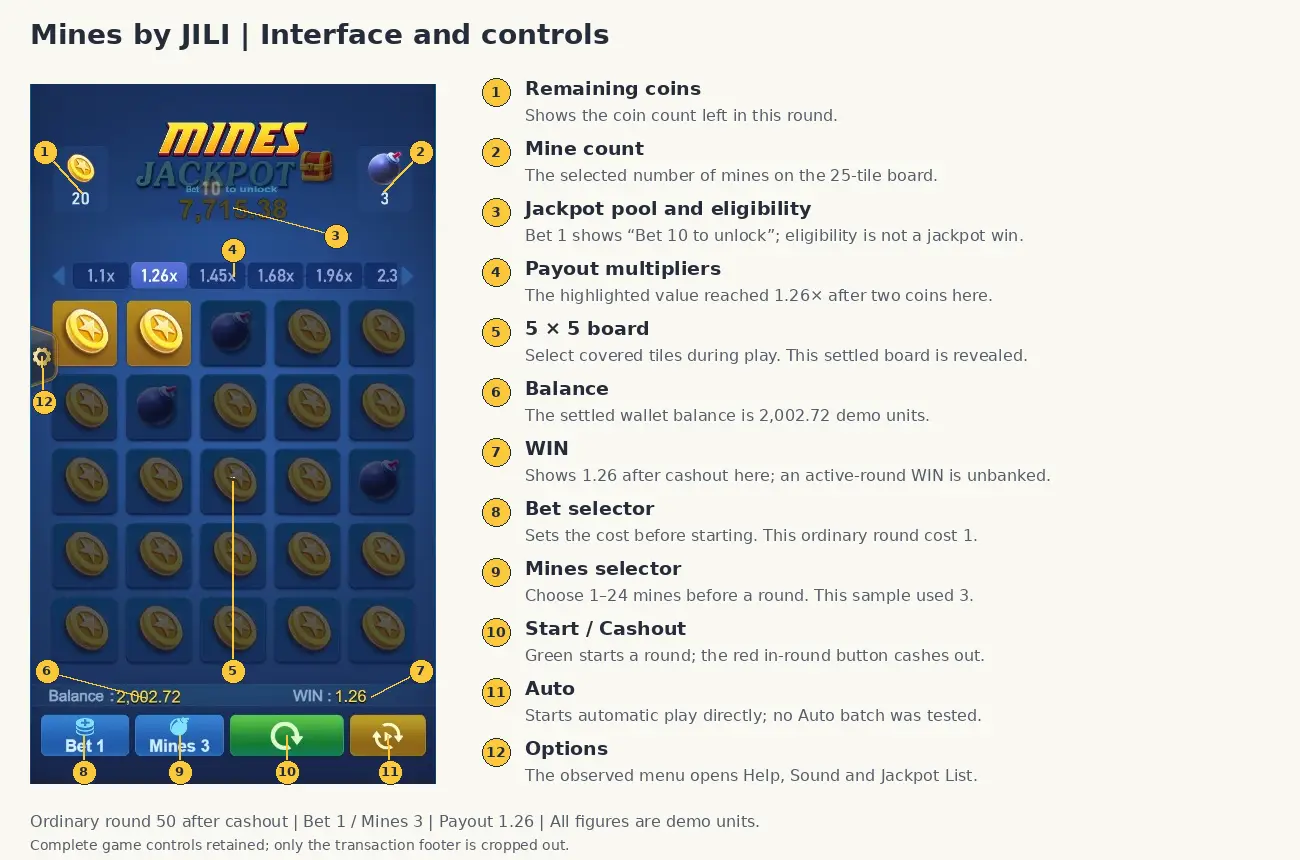
A recorded settled ordinary board at Bet 1 and Mines 3. Its WIN 1.26 and balance 2,002.72 belong to the completed round, not a promise for the next one.
Remaining coins: The count of coin tiles left on this board.
Mine count: The configured number of mines for the round.
Jackpot area: The displayed pool and qualification information; a moving pool is not a personal payout.
Multiplier strip: The progression associated with the selected mine count and surviving reveals.
Tile grid: The 25 covered or revealed cells.
Balance: The wallet figure; compare it after final settlement.
WIN: The provisional cashout amount during play, or the final round display after settlement.
Bet: Opens the available stake choices before starting.
Mines: Changes the mine count before a round.
Start / Cashout: Starts a round or settles the current surviving amount, depending on state.
Auto: Help says one tap starts automatic play and another stops it. It was not activated in this study.
Option: Opens the available menu entries, including Help, Sound and Jackpot List.
The inspected Bet menu offered 1, 2, 3, 5, 8, 10, 15, 20, 30, 50, 60, 70, 80, 90 and 100. The mine-count setting allows 1–24 mines. Those are configuration choices, not extra spins or a separate bonus purchase. No actionable Turbo, BUY BONUS or EX control was found in the inspected main screen, full menu or Help.
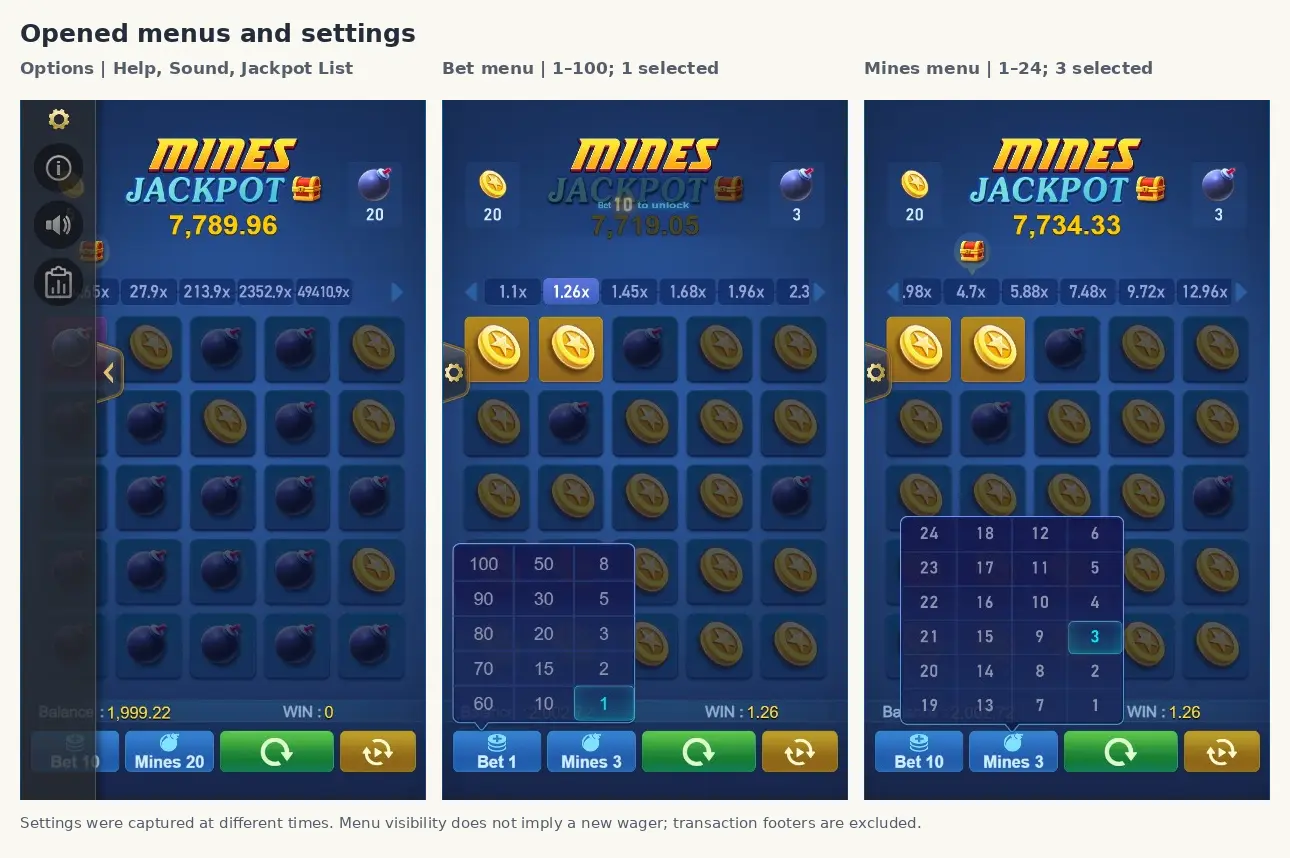
Actual expanded controls from the recorded study. Auto was not opened as a settings dialog or run; Help describes it as a start/stop action.
At a 390×844 desktop-emulated viewport, the main grid and lower controls remain visible. Opening Bet covers the lower part of the board and part of the balance, and a small repeated-logo strip is visible at the bottom. I would favour the portrait layout for reading the numbers. These observations concern a desktop viewport simulation, not physical-phone touch accuracy, Philippine network performance or sound quality.
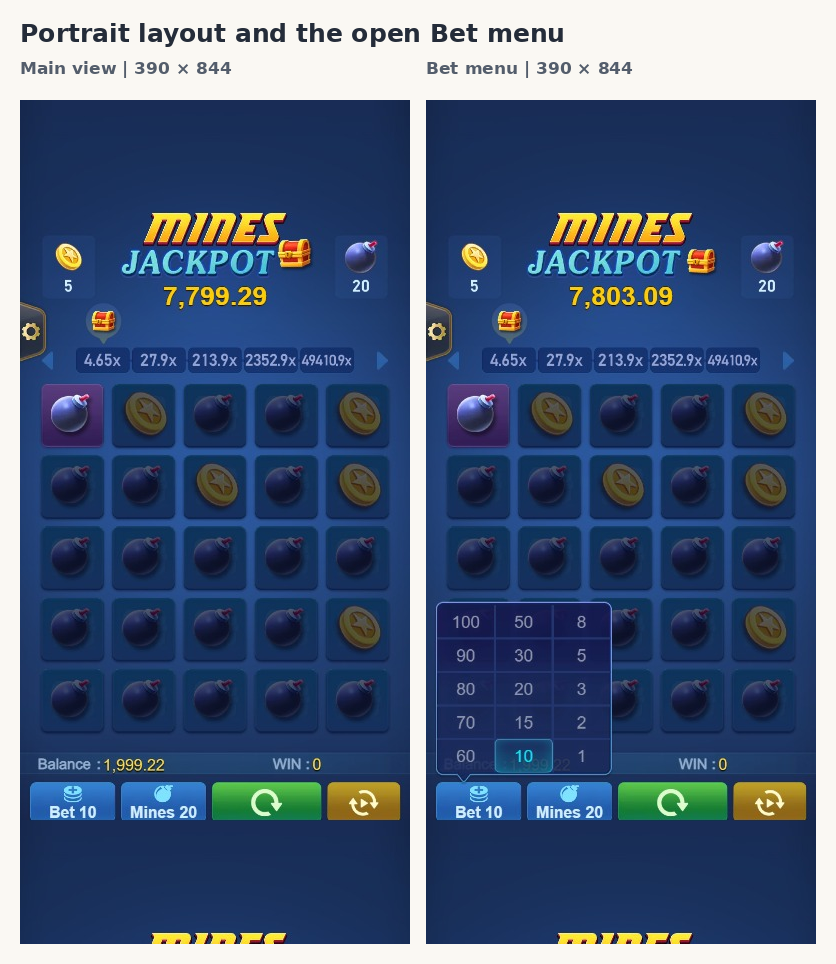
Portrait simulation: the board is readable with the menu closed; the open Bet selector covers part of the lower game. No new round was started for these layout captures.
The 844×390 landscape simulation keeps a roughly 220-pixel-wide portrait game in the middle. The unused side space does little to help the small text, and the recorded betting menu remains open in that capture. It should not be described as an unobstructed full-width landscape design.
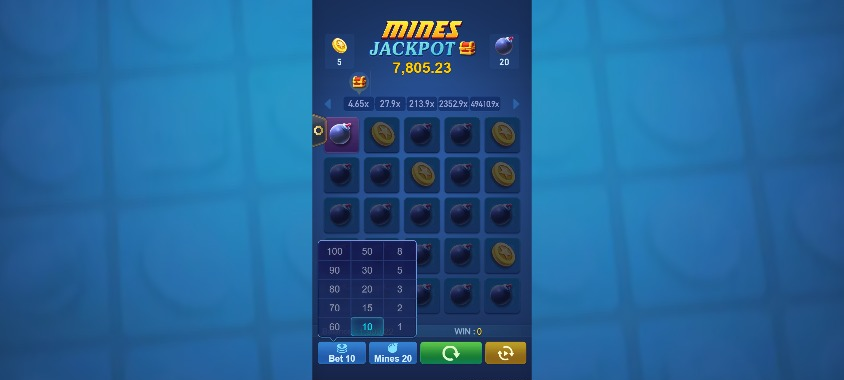
Landscape simulation retains the tall game layout and visibly smaller amount labels. The menu shown here was still open.
3. How a round and its payout work
Before a round, choose the stake and mine count. Starting deducts the stake. Revealing a coin increases the current multiplier and available cashout amount; revealing a mine ends the round with no payout of the unsettled winnings. Cashout settles the amount already reached. There are no matching-symbol lines, Wild substitutions or Scatter-triggered free spins to count.
The board objects have different jobs
Object | What it means | What it does not establish |
|---|---|---|
Covered tile | An unrevealed cell that can contain a coin or mine. | The chest-like cover does not mean it contains a jackpot. |
Coin | A surviving reveal advances the round’s displayed multiplier. | The displayed amount is not settled until cashout or a final result. |
Mine | Ends the round and clears its unsettled win. | Earlier coin reveals are not kept as a separate payout. |
Red chest coin | An observed qualification-related appearance in the separate 20-mine check. | Its appearance alone is not evidence of a GRAND, MAJOR, MINOR or MINI award. |
Ordinary round 1 gives the clearest example. Bet 1 reduced the wallet from 2,000.00 to 1,999.00. The first coin showed WIN 1.10, and the second showed WIN 1.26 while the balance stayed at 1,999.00. After Cashout, the balance became 2,000.26. The final payout was 1.26 including the original stake, so the net increase was 0.26.
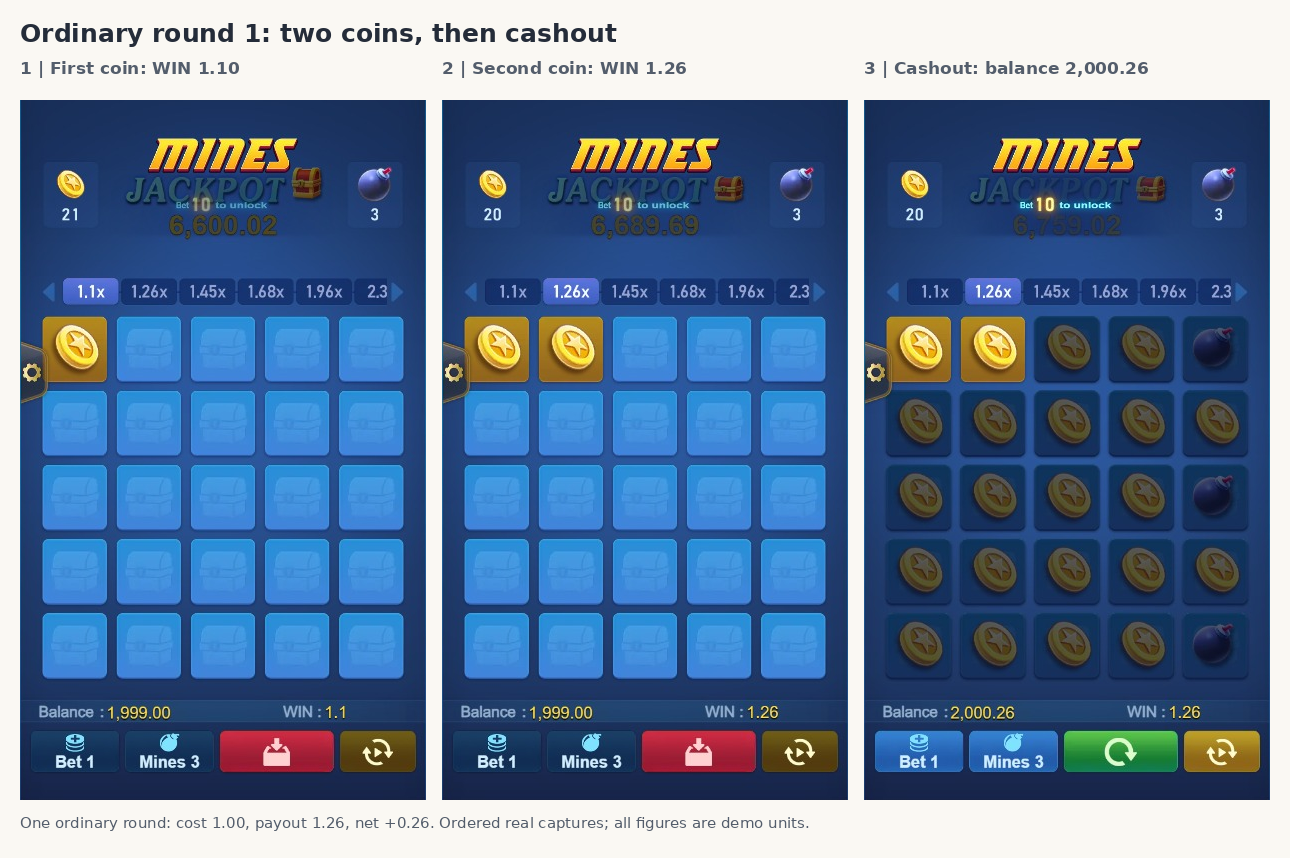
The same round progresses from WIN 1.10 to WIN 1.26 and then a settled balance of 2,000.26. These are stages of one round, not three separate payouts.
The recorded ordinary configuration used three mines. Its first two coin steps showed 1.10× and 1.26×. Those values are specific to that configuration and step count; they should not be reused as a general payout table for every mine setting. Ordinary round 4 hit a mine and paid zero, losing its one-unit stake.
The fixed first-row selection order in this study was a sampling rule established before the results. It kept the recorded rounds comparable. There is no evidence here that those positions are safer, that recent losing tiles predict the next board, or that a predictor can supply the game’s hidden outcome.
4. Cashout, jackpot eligibility and what was actually seen
Cashout is the core mechanism. Continuing after a coin keeps the current uncashed amount exposed to a later mine. Ending the round settles the current multiplier; it does not guarantee a profit across several rounds. The ordinary sample always stopped after two coins when it survived, so it does not measure every possible stopping rule.
Jackpot eligibility has separate conditions. The recorded Bet 1 screen said “Bet 10 to unlock”; at Bet 10, the jackpot region lit up. Help says 0.7% of the stake contributes to the progressive pool and ties eligibility to the number of successful selections required for the chosen mine count. Meeting that threshold gives a chance at an award, not an award on every eligible round.
Mines selected | Selections required by Help |
|---|---|
1 | 20 |
2 | 14 |
3 | 10 |
4 | 8 |
5 | 6 |
6–7 | 5 |
8–9 | 4 |
10–11 | 3 |
12–19 | 2 |
20–24 | 1 |
This table describes qualification, not the likelihood of surviving those selections or a recommendation to increase the mine count. The rules also list GRAND as 50% of the pool, MAJOR as 20%, MINOR as 5%, and MINI as three times Total Bet. The pool value displayed on screen may differ from the actual award value because of server communication delay.
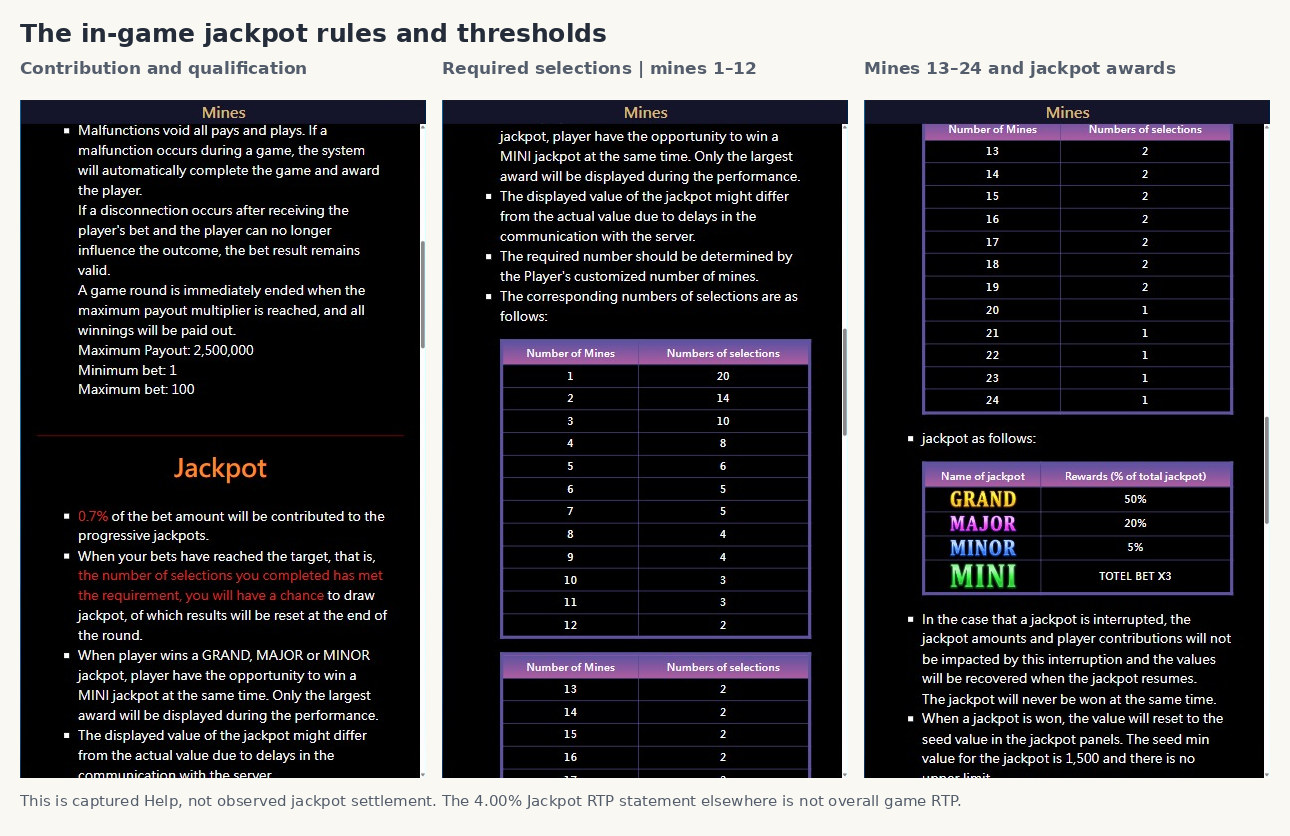
Game Help supplies the qualification and award rules. These are rule illustrations; no four-tier jackpot award was observed in the recorded sample.
The separate five-round check used Bet 10, Mines 20 and one reveal per round, with Cashout after any surviving coin. Round 4 showed a red chest coin and WIN 46.50, matching the displayed 4.65× multiplier. The wallet had fallen from 1,972.72 to 1,962.72 on the stake; after cashout it read 2,009.22. That is a 46.50 payout and a 36.50 net gain for that round. No named jackpot award appeared.
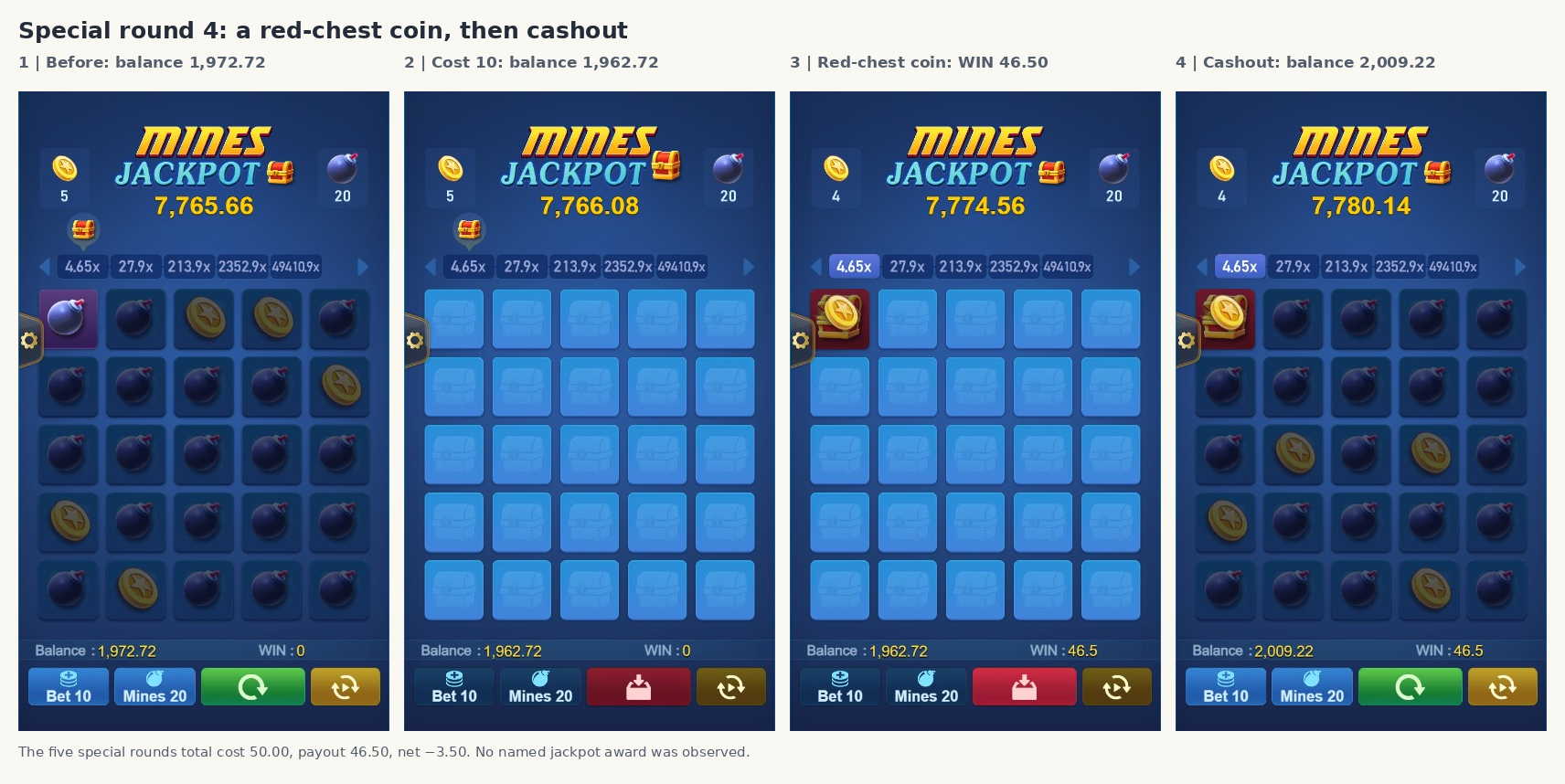
Bet 10 and Mines 20: provisional WIN 46.50 is followed by the settled balance of 2,009.22. The red chest coin does not by itself prove a jackpot win.
The other four special rounds hit mines and paid zero. Across all five, cost was 50.00, payout 46.50 and net change −3.50. The larger individual payout does not make this configuration a better long-run choice: its stake, mine count, stopping rule and sample size all differ from the ordinary group.
One limitation deserves attention. Help describes a possible MINI award alongside a GRAND, MAJOR or MINOR result, but also contains a separate statement about jackpots not being won simultaneously. The reviewed rounds triggered no named jackpot, so they cannot settle the scope of that wording. Likewise, Help describes seed checking and History, while the inspected menu supplied neither usable entry. A Jackpot List containing recent GRAND, MAJOR and MINOR winners is not a personal betting record or an independent fairness verification.
5. Bet costs, RTP and maximum-win claims
Parameter | What the reviewed sources support |
|---|---|
Bet range | 1–100 virtual units in the inspected menu and Help; actual sample stakes were 1 and 10. |
Mine range | 1–24; the recorded groups used 3 and 20. |
Ordinary paid cost | 1 per round. Cashing out at 1.26 pays 1.26 in total and nets 0.26. |
Additional cost | No BUY or EX charge was observed. The 0.7% contribution is described as part of the stake, not an extra stake added to the ledger. |
Overall RTP | Not obtained from the captured product page or complete Help. |
Jackpot RTP | Help states 4.00% for the jackpot component; it is not the game’s overall RTP. |
Volatility | No verified overall supplier rating for this configuration. A 50-round sample cannot establish long-term volatility. |
Maximum claims | The product snapshot advertises 10,000×. In-game Help separately states Maximum Payout 2,500,000. Neither limit was reached or independently tested. |
The page’s existing specification lists 97% overall RTP. That figure was not independently confirmed by the inspected product page or Help, so it is not used as a verified benchmark for this sample.
There is a further display conflict: the recorded 20-mine multiplier strip shows a later, untested 49,410.9× step, above the product page’s advertised 10,000×. Only the 4.65× step was reached in the separate check. The study cannot establish how a later displayed step would be constrained by the advertised limit or the maximum-payout rule. The two maximum figures have different stated units. The product’s multiplier claim and Help’s payout-amount limit should remain separate; neither should be converted into the other without a matching stake and rule definition. Help also says a round ends when its maximum payout multiplier is reached, but the recorded rounds do not test that behaviour.
For the amounts actually observed, use the straightforward equation: final payout minus the deducted stake equals net change. A zero payout loses the whole stake. A provisional WIN can disappear if a later reveal hits a mine. The rolling jackpot total at the top of the game is not part of a player’s round payout unless a qualifying award is actually recorded.
The slot simulator can illustrate general bankroll and return assumptions. It does not reproduce Mines’ hidden boards, cashout probabilities or jackpot mathematics, and cannot validate this game’s RTP or predict a safe cell.
6. What the 50 ordinary rounds showed
The ordinary sample contains 50 completed rounds at Bet 1 with three mines, recorded on 6 October 2026. Each used the same predeclared sequence: first cell in the top row, then the next cell if the first was a coin, followed by Cashout if both survived. A mine ended the round. This describes the historical sample, not a profitable pattern.
Measure | Ordinary sample |
|---|---|
Completed rounds | 50 |
Total cost | 50.00 demo units |
Total payout | 47.88 |
Net change | −2.12 |
Sample return | 95.76% |
Rounds with payout / zero payout | 38 / 12 |
Net-winning / net-losing / break-even rounds | 38 / 12 / 0 |
Highest round payout / net gain | 1.26 / +0.26 |
Longest losing run within one session | 2 rounds |
Observed named jackpot awards | 0 |
The 38 surviving rounds each paid 1.26; the 12 mine results paid zero. The 76% observed payout rate describes these 50 rounds under this exact rule. It is not a prediction for the next reveal, an official hit-rate specification or a substitute for a theoretical RTP value.
Session | Rounds | Starting → ending balance | Cost | Payout | Net |
|---|---|---|---|---|---|
First | 1–25 | 2,000.00 → 1,995.16 | 25.00 | 20.16 | −4.84 |
Second | 26–50 | 2,000.00 → 2,002.72 | 25.00 | 27.72 | +2.72 |
Combined | 50 | Two separate baselines | 50.00 | 47.88 | −2.12 |
An idle-session MSG205 interruption occurred after round 25. Re-entry supplied a fresh 2,000.00 baseline, 4.84 above the previous 1,995.16 balance. That reset is excluded from payout and profit. An earlier unconfirmed attempt without a verified debit or settlement is also excluded; the completed-round count is based on the 50 settled records, not button attempts or tile clicks.
Balance shows two separate wallet paths
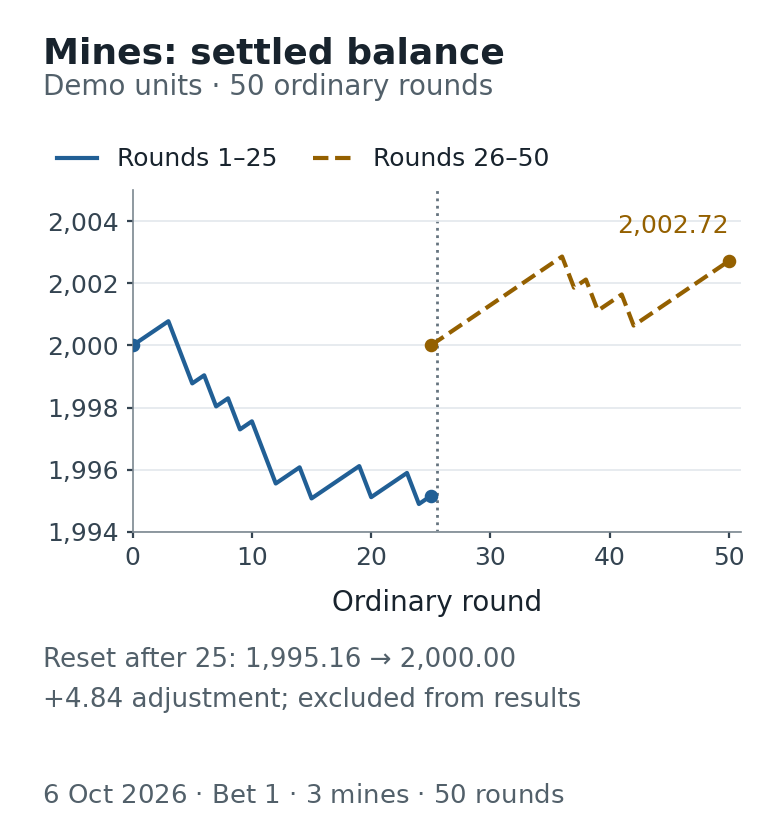
Ordinary rounds only. The +4.84 re-entry reset is a separate baseline adjustment. Final wallet 2,002.72 minus the original 2,000.00 would misleadingly hide the first session’s loss.
Cumulative sample return uses actual payout divided by actual cost
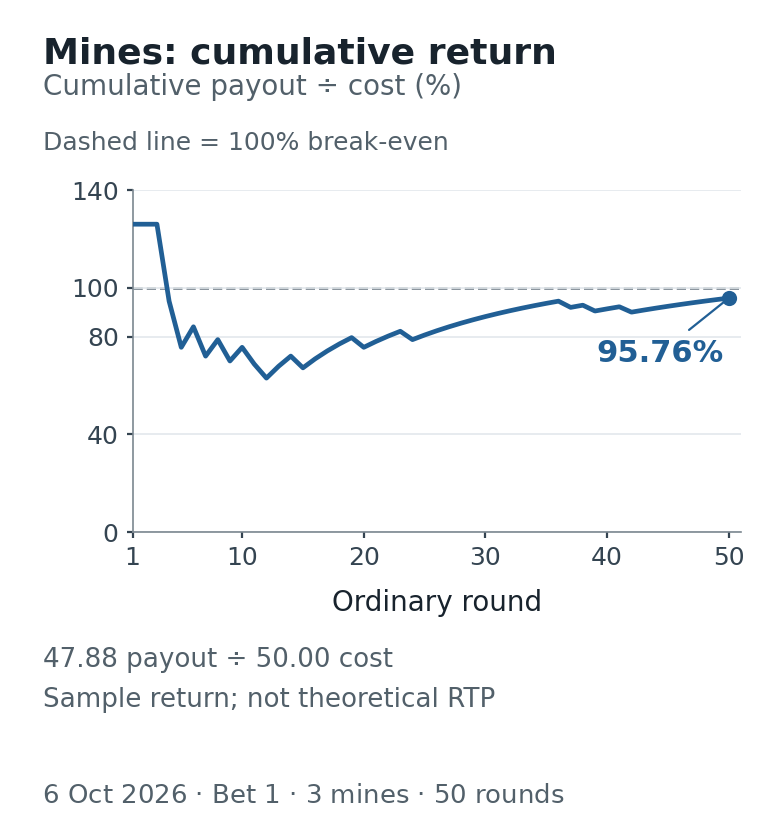
47.88 ÷ 50.00 = 95.76%. The 100% line marks recovery of recorded cost; it is not a theoretical RTP claim. The wallet reset contributes to neither numerator nor denominator.
Net change keeps cost and payout together
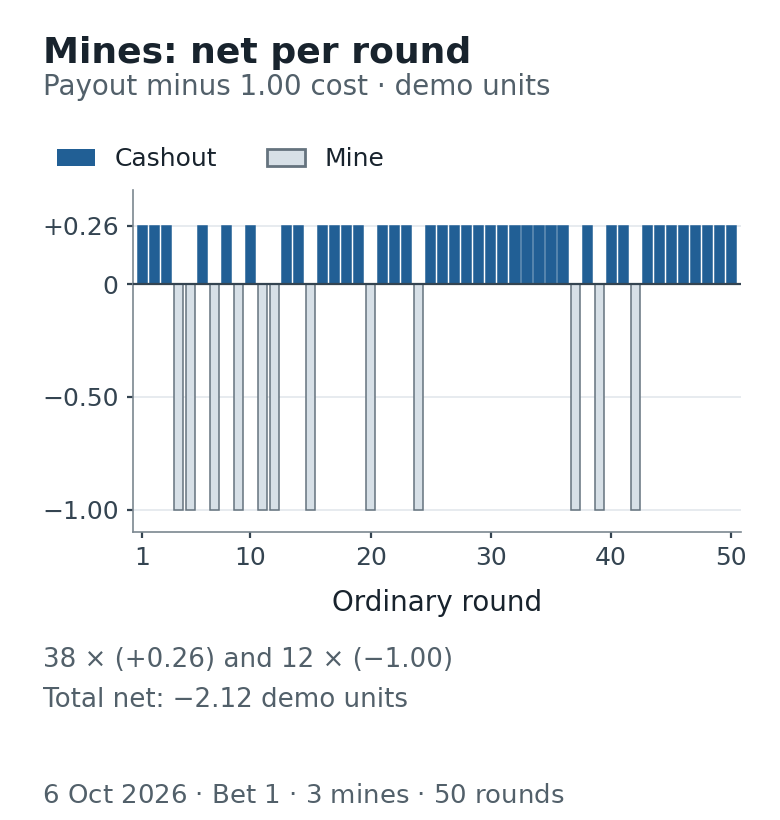
38 × 0.26 − 12 × 1.00 = −2.12 demo units. All three charts exclude the separate five-round Bet 10 / Mines 20 group.
The second session’s upward wallet path and the four-digit jackpot display are both visually striking, but neither changes the combined −2.12 result. There were 55 unique transaction identifiers across the 50 ordinary and five special rounds, with the two groups accounted for separately. No extra rounds were added for the two coin reveals in a winning ordinary round.
7. Verdict and the useful comparison
My editorial rating for the recorded experience is 7.0/10. The strongest feature is the legibility of the core decision: reveal, read the provisional amount, and cash out or continue. The score is held back by the cramped landscape presentation, menu overlap and the mismatch between Help’s verification features and the menu actually available. It is an experience rating, not a score for expected winnings.
Within Mines, the two recorded configurations show how the screen and settlement differ. Their unequal small samples cannot rank long-term returns.
Reading dimension | Bet 1 / Mines 3 | Bet 10 / Mines 20 |
|---|---|---|
Study role | 50 ordinary rounds; stop after two surviving coins. | Five separate rounds; stop after one surviving coin. |
Displayed milestone | 1.10× after one coin, 1.26× after two. | 4.65× for the observed surviving first coin. |
Jackpot status | Bet 10 unlock message remained visible. | Area unlocked and one red chest coin observed; no named award. |
Recorded net | −2.12 across 50 rounds. | −3.50 across five rounds. |
What can be concluded | A clear example of two-step cashout and settlement. | A clear example separating jackpot eligibility from an actual award. |
Mines and Aviator: two different cashout decisions
Aviator by SPRIBE is a useful comparison for readers interested in deciding when to cash out. Its shared, time-driven flight differs from Mines’ tile-by-tile board. The following mechanics come from separate recorded demo studies; they are not a head-to-head profitability test.
Reading dimension | Mines by JILI | Aviator by SPRIBE |
|---|---|---|
How the round advances | A selected covered cell reveals a coin or mine. The next reveal follows the player’s tile choice. | A shared flight multiplier rises over time until the plane leaves. |
Main decision | Cash out the current amount or select another tile. | Cash out before the flight ends; the recorded interface also offered a preset Auto Cash Out target. |
What ends the exposed bet | A mine clears the unsettled win. | The plane leaves before that bet has cashed out. |
What the displayed number means | WIN can be provisional; the final cashout and wallet show settlement. | The public flight multiplier is separate from the player’s exit multiplier and payout. |
Reader fit | A step-by-step board and repeated reveal-or-stop decisions. | A time-driven flight and an exit-timing decision. |
Mines suits readers who prefer to make the next reveal themselves; Aviator suits those who prefer a continuously moving round. In either case, choosing an exit point does not reveal the hidden outcome or establish a profitable strategy. The two studies used different games and conditions, so their sample returns are not used to pick a winner.
I would choose this style of game for its compact board and active cashout decision, rather than for a forecast of returns. Readers who prefer a single automatic outcome per round may find the repeated stop-or-continue choice tiring. Portrait is the easier layout to read in the captured views, while a reload is a reason to recheck the selected stake and wallet baseline.
The evidence is strongest on ordinary manual play, cashout accounting and the visible jackpot conditions. It does not verify a named jackpot win, automatic play, disconnection cashout during an active round, the advertised maximum, seed fairness or physical-phone performance. Help’s automatic-disconnection wording remains a rule description; the observed interruption happened while idle.
Sources: the recorded JILI 229 demo Help, visible controls and settled-round screenshots, together with JILI’s Mines product page. The public product category and maximum multiplier are kept separate from the in-game rules and this sample’s outcomes.
Mines by JILI FAQs
Answers to common questions about Mines by JILI.

