Inside South Africa’s Gambling Support System: Only Around 3% of 80,000 Helpline Calls Lead to Treatment Referrals
SARGF’s 2023/24 report records 80,921 calls and 2,662 referrals. This analysis examines wrong-number calls, funding and gaps in treatment reporting.
 8 Min Read

Overview
- SARGF’s 2023/24 report records 80,921 calls and 2,662 referrals. This analysis examines wrong-number calls, funding and gaps in treatment reporting.
File photo: Cape Town city and bay in South Africa, 30 July 2022. Geographic context only for the gambling-help report, not a SARGF facility, patient or service-delivery scene. Photo: Ad Meskens / Wikimedia Commons, CC BY-SA 4.0. Image source; CC BY-SA 4.0.
South Africa’s system for helping people with gambling problems is often regarded as Africa’s most developed model: it has a statutory framework, industry funding, a free round-the-clock helpline and a treatment network spanning the provinces. Yet a detailed reading of the South African Responsible Gambling Foundation’s (SARGF) own 2023/24 Annual Report shows that the system’s bottleneck is not money but its point of entry. Most helpline calls are wrong numbers, and only around a quarter of those actually referred onward are recorded as attending treatment.
This article uses only primary sources: the text of the National Gambling Act, Act No. 7 of 2004, the SARGF website and its annual reports.
1. The Institutional Framework: Law, Regulators and the Delivery Organisation
The legal framework. Section 14 of the National Gambling Act establishes a “self-exclusion” system. Anyone may register as an “excluded person” at any time and may also apply to cancel their registration at any time. Family members, and people who are financially dependent on or responsible for someone, may apply to a court for that relative’s compulsory registration. The National Gambling Board (NGB) must maintain a national register of excluded persons, make it continuously available to provincial licensing authorities and all licensees, and “must not charge a fee for registration”.
The same section also requires licensees to provide registration forms at each premises, along with “a directory of local recognised counselling, treatment or education services”, and to display notices prominently at every entrance. Section 15 requires gambling advertisements to carry warnings about the dangers of addictive and compulsive gambling and prohibits them from encouraging anyone in any way to leave the exclusion register.
Regulation. The NGB is responsible at the national level, while provincial gambling boards handle licensing and enforcement in their respective provinces. According to the SARGF website, provincial boards from the Eastern Cape, KwaZulu-Natal, Limpopo, the Western Cape and elsewhere participate alongside the NGB in the biennial Responsible Gambling Summit.
Service delivery. The organisation actually operating the support services is the SARGF, which implements the National Responsible Gambling Programme (NRGP). Its website says the SARGF was registered in 2004 as a nonprofit company under the Companies Act, is a registered Public Benefit Organisation (PBO), and has a mandate “anchored in the National Gambling Regulations of 2004”. The website describes it as a “public–private partnership” between gambling regulators and operators: its funding comes from the industry, but it “operates independently, with its own governance structure”.
2. Where the Money Comes From: A 0.1% Ceiling, but Only Around Half Collected
SARGF funding is written into licence conditions, with a ceiling of 0.1% of industry-wide gross gambling revenue (GGR). Figure 5 of the annual report lists actual receipts over the past five years:
- 2020: R24.50 million
- 2021: R17.82 million (the pandemic low)
- 2022: R23.01 million
- 2023: R27.26 million
- 2024: R33.19 million
Of these contributions, the betting sector accounted for 44%, casinos 39.9%, limited payout machines (LPMs) 10%, and bingo 4%.
Citing NGB data, the same annual report puts industry GGR in the 2023/24 financial year at R59.3 billion. At 0.1%, the theoretical ceiling would be around R59.3 million; actual receipts of R33.19 million were around 56% of that ceiling. It should be noted that the annual report lists receipts by year, whereas GGR is reported by financial year. The reporting bases do not fully align, so this percentage should be treated only as an indication of scale, not a precise shortfall. But the direction of the conclusion is clear: the industry nearly doubled in size over five years, with GGR rising from R30.8 billion in 2018/19 to R59.3 billion and amounts wagered increasing from R425.6 billion to around R1.1 trillion, while NRGP funding was far from being collected “up to the ceiling”. The annual report does not explain the gap between the ceiling and actual receipts, and the currently available public materials do not clarify it.
3. What the Helpline Really Looks Like: 84% Are Wrong-Number Calls
The NRGP’s free counselling helpline, 0800 006 008, operates 24 hours a day, and there is also a WhatsApp channel at +27 76 675 0710. In the 2023/24 financial year, the case management system recorded 80,921 calls, broken down as follows:
- Wrong-number calls: 67,919 (around 84%)
- Silent calls: 6,095
- General enquiries: 2,353
- Prank calls: 1,870
- People with gambling problems: 1,582 calls, plus 266 people with gambling problems on WhatsApp
- Self-exclusion: 736 calls, plus six people seeking self-exclusion on WhatsApp
- Relapse: 57 people
- Family referrals: 14 people, plus one family referral on WhatsApp
The final total was 2,662 people referred onward, equivalent to around 3.3% of all calls. They included 1,209 women, 1,452 men and one person whose gender was not specified.
Why were there so many wrong-number calls? The previous year’s annual report, for 2022/23, gave a direct explanation: incorrect calls were “attributed to account-related enquiries from users of online gambling companies”, and the foundation was engaging with specific online gambling companies to reduce them. In other words, the legal requirement to display the helpline number in advertising and on platforms was well-intentioned, but following the surge in online betting, many players mistook the support helpline for a customer-service line. The 2022/23 financial year saw 64,239 calls and 2,299 referrals. By 2023/24, calls had increased by around 26%, but referrals had risen by only around 16%.
4. The Treatment Network: After Referral, the Data Trail Breaks Down
Rather than establishing its own clinics, the SARGF outsources treatment to registered “Treatment Professionals” (TPs) across the provinces. Standard outpatient treatment consists of eight face-to-face sessions, with the option of two additional sessions. Screening uses the Problem Gambling Severity Index (PGSI).
The annual report’s treatment evaluation section discloses that, according to records submitted by TPs, 690 clients attended a first and/or second session during the year, equivalent to around 26% of that year’s referrals. A total of 1,188 summary problem-gambling assessment reports should have been received, but “approximately 952 remain outstanding”.
Provincial data also show uneven coverage: Gauteng recorded 36 reports and 120 clients; Limpopo, 35 people; KwaZulu-Natal and the Western Cape, 25 people each; Mpumalanga, 20 people; the North West, seven people; and the Free State and Eastern Cape, only two reports each. On staffing, the 2022/23 annual report noted that 16 TPs had resigned or retired, while three were recruited in 2023/24.
Among the assessments submitted, 90 clients reported suicidal thoughts. Finding this number in the roughly one-fifth of expected reports that were returned suggests that the full picture is very likely more serious.
5. Demand Is Rising
The chairperson’s message in the annual report cites preliminary findings from the NGB’s national socioeconomic impact study: the rate of problem gambling “jumped” from 5.8% in 2017 to 31% in 2023. The annual report also cautions that earlier studies used different methods: a 2005 survey based on the 20 Gamblers Anonymous questions estimated that 0.26% of the adult population exhibited problem gambling behaviour. The 31% figure therefore cannot be compared directly with the earlier figures, but the foundation itself also agrees that demand is rising.
6. Assessment and Lessons
First, the weakness in South Africa’s system lies in “triage”, not in “whether there is a helpline”. An 84% share of wrong-number calls crowds out call-handling resources. The most direct improvement would be to separate the channels at operator level: clearly distinguish customer-service numbers from the support helpline on platforms and in advertising, or introduce voice-based routing at the start of helpline calls.
Second, the funding mechanism has a ceiling, but also room where contributions are “not fully collected”. The 0.1% ceiling applies to a fast-growing industry. If actual receipts remain only a little over half of the ceiling over the long term, the issue lies in collection and enforcement, rather than the percentage itself.
Third, an outsourced treatment network needs outcome data. With around 80% of assessment reports unreturned, it is impossible to answer the question: “After referral, how many people complete eight sessions, and how effective are they?” Other developing markets building support systems can learn from South Africa: the three-part package of statutory self-exclusion, industry funding and a free helpline can be replicated, but call-routing design and treatment-outcome reporting also need to be written into the rules.
For researchers and practitioners: when citing South African helpline data, distinguish between “call volume” and “referral volume”. The former substantially overstates the actual scale of help-seeking.
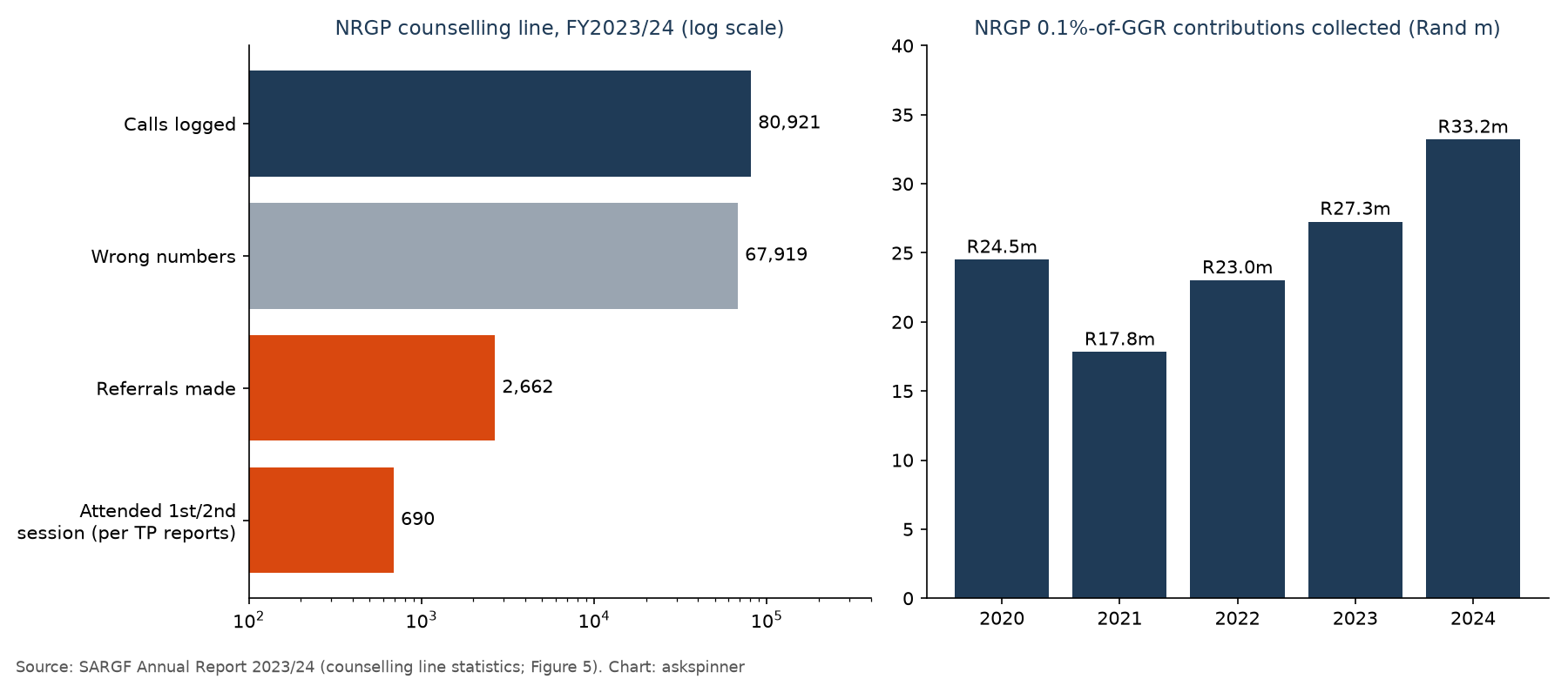
Figure: NRGP counselling helpline calls and referrals in the 2023/24 financial year (left, logarithmic scale); actual annual receipts from NRGP contributions at 0.1% of GGR (right). Data source: SARGF 2023/24 Annual Report.
Sources
- 1. National Gambling Act 7 of 2004, sections 14–15 (Government Gazette No. 26670, August 12, 2004), statutory text
- 2. SARGF / NRGP official website (About, The NRGP, The SARGF, Counselling and Treatment pages), official website
- 3. SARGF Annual Report 2023/24 (call statistics, referrals, contributions in Figure 5, treatment evaluation and the chairperson’s message), annual reports page on the SARGF website
- 4. SARGF Annual Report 2022/23 (64,239 calls, 2,299 referrals and the reasons for incorrect calls), same source as above
Cite This Article
Topics In This Story
Related Countries
Andrea Rivera explores the evolving world of iGaming through the companies trying new things and the markets taking shape around them. An editor at AskSpinner News, Andrea combines research with storytelling, bringing information and perspective to industry analysis without losing the story that makes it worth reading.
More From This Author