
What Is RNG? Random Number Generators in Online Casino Games
RNG supplies random inputs; the game’s rules turn them into results. The guide explains pseudorandom generation, stateful features, testing and why a losing streak does not create a repayment schedule.
 4 Min Read
Editorial illustration, not a gameplay screenshot or observed result.
An RNG, or random number generator, supplies random inputs that a digital game's rules turn into outcomes. In an online slot, those inputs help determine symbols and feature events; the reel animation presents the result rather than acting like a physical reel deciding where to stop.
This guide covers software-driven casino games. A live-dealer game may instead use physical cards or a wheel, so “online” does not mean every result comes from the same kind of RNG.
How does an RNG work?
Software generators can use a pseudorandom algorithm, which produces a sequence from an internal state. Deterministic does not mean a player can predict the sequence. The algorithm, initial state, seeding and security of the implementation all matter.
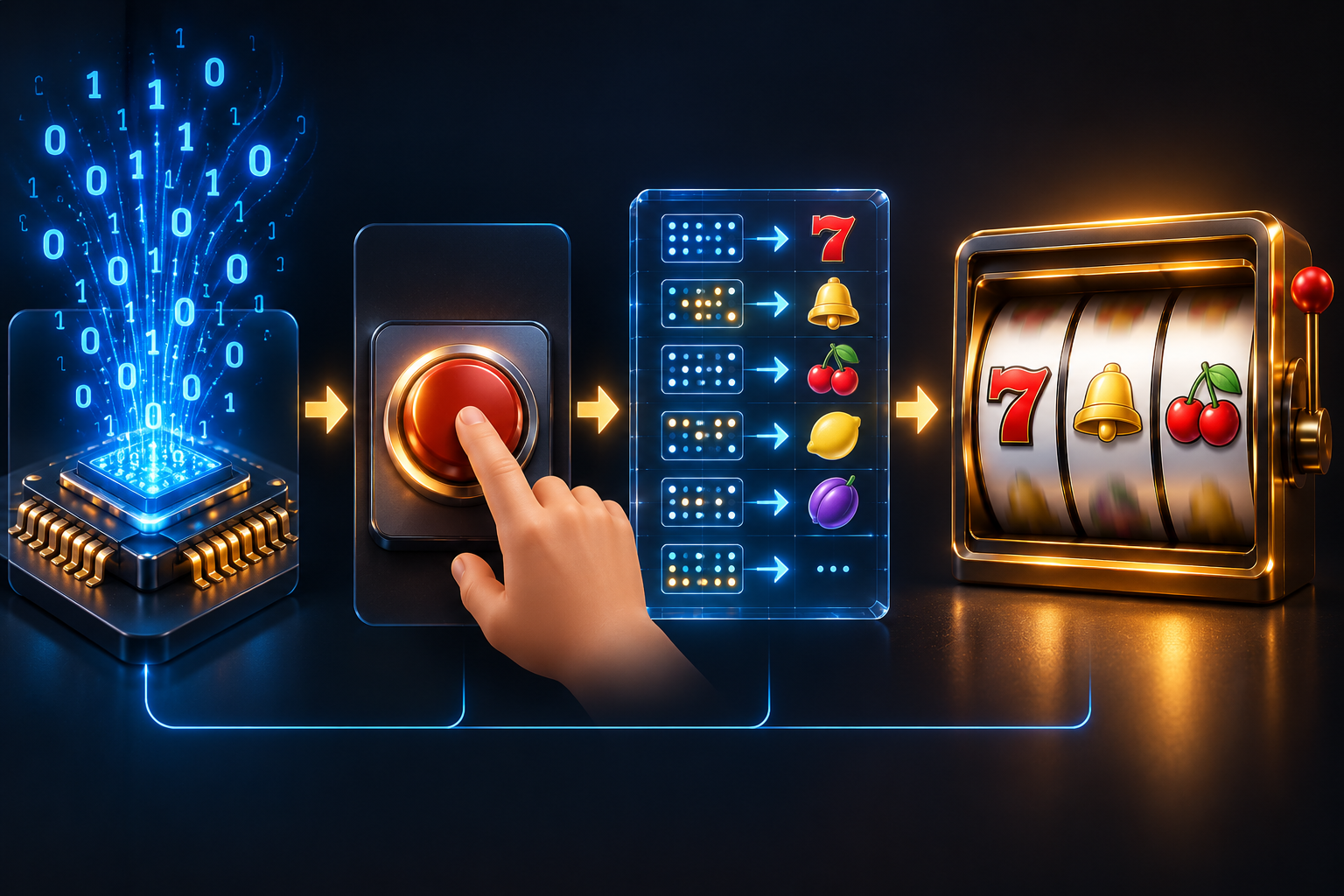
A useful simplified process is:
- The game requests or consumes random inputs.
- Its mathematical rules map those inputs to eligible outcomes.
- Any applicable feature state is taken into account.
- The interface displays the result and the corresponding award.
Some implementations generate values continuously; others obtain them when needed or use buffered outputs. “The RNG always runs continuously and takes the number at the instant you press Spin” is not a universal description. The Gambling Commission’s RTS 7 standard addresses unpredictability, correct mapping and the use of requested number sequences, rather than prescribing that single timing model.
What makes a random result trustworthy?
Random inputs must be used correctly. An even distribution of raw numbers does not mean every symbol, prize or feature is equally likely: the mapping and game mathematics determine those probabilities.
For games subject to Great Britain's remote standards, RTS 7 requires acceptably random results and prohibits compensated behaviour that changes probabilities to manage past payouts. That is a jurisdiction-specific requirement, not proof that every website claiming to use an RNG complies.
Check the provider, exact game version, applicable regulator and any relevant testing evidence. A certificate should identify what product and scope it covers. A logo or the letters “RNG” alone do not verify a game's source or operation.

Are all results independent?
For independent rounds played under unchanged rules and state, losing 20 times does not make the next win due. A large previous win likewise does not create a requirement to lose the next round. Treating such a streak as a repayment schedule is the gambler's fallacy.
But random generation and independent game outcomes are different ideas. Cards drawn without replacement depend on cards already removed. A slot feature may retain wilds, increase a multiplier or accumulate symbols, so the next stage depends on its current state.
A concrete example appears in NetEnt’s Big Bang Boom feature description: Persistent Bombs can remain active during subsequent free spins, and prizes can remain on the grid. Those rules carry information forward; they do not mean that the game is compensating a player's earlier losses.
How do RNG, RTP and volatility fit together?
- RNG supplies the random inputs used by the game.
- RTP describes its theoretical average return relative to wagers under specified assumptions.
- Volatility describes the variation in the payout distribution.
A hypothetical 96% RTP is compatible with small payouts, rare large awards and long runs of losses. It does not instruct the RNG to return exactly 96 units whenever someone stakes 100.
Can a casino change the game?
Game design and configuration are separate from manipulation of an individual outcome. Providers define probabilities, paytables and features, and some products support more than one RTP configuration. A game's title alone is not enough to establish the deployed version.
Under the same Great Britain standard, material rule or payout changes are controlled and must be disclosed; specified bonus states can legitimately use different rules. Check the rules and licence relevant to your own jurisdiction rather than treating any one regulator as a worldwide guarantee.
What does demo play show?
Demo play is useful for learning the paytable and features, but a short sequence cannot predict later real-money results. Also distinguish a normal demo from a labelled promotional feature demonstration.
For operators covered by Great Britain's RTS 6 rules for free-play games, the free version on the same website must use corresponding rules and represent the real-money game's probabilities and prizes accurately. A supplier's separately labelled demonstration is a different context. Check the version and mode rather than assuming every page with the same title uses identical settings.

What should players take away?
Waiting for a certain time, watching previous scatters or changing devices does not supply a method for predicting an independent random outcome. A stop button that only skips animation is not a timing strategy; any genuine player-choice or skill element must be explained in the game's rules.
The useful checks are the actual game rules, version, provider and applicable testing and regulatory evidence. Neither a losing streak nor a brief lucky session proves how a system works.
Cite This Article
Topics In This Story
Andrea Rivera explores the evolving world of iGaming through the companies trying new things and the markets taking shape around them. An editor at AskSpinner News, Andrea combines research with storytelling, bringing information and perspective to industry analysis without losing the story that makes it worth reading.
More From This Author