How Do Slots Work? A Guide to Symbols, Features and Bonuses
A concise introduction to winning systems, special symbols, cascades, free spins, paid features and the difference between a jackpot and a payout cap.
 4 Min Read
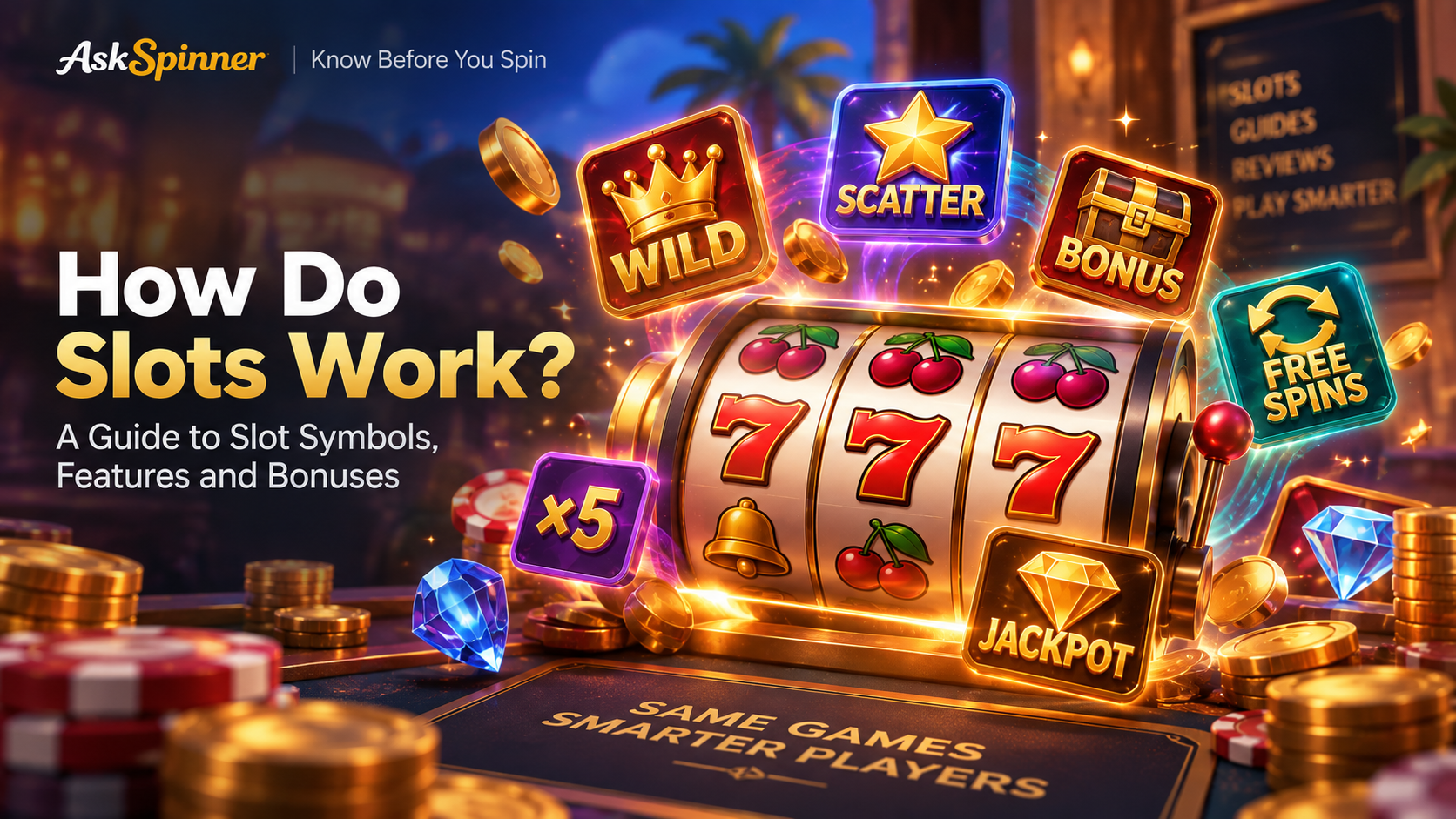
Illustrated cover, not a real game interface. Feature labels are examples rather than universal rules.
Modern video slots use a random number generator (RNG) to produce random outcomes, then evaluate the displayed symbols under the game’s rules. Those rules determine which combinations pay and how Wilds, Scatters, multipliers and bonus features work. The reel animation is not a forecast of the next result.
For an example of a regulatory standard, the British Gambling Commission’s RTS 7 requires appropriately random and unpredictable outcomes within its scope. It is not proof that every game or operator worldwide meets that standard. The practical starting point is the paytable and help for the exact version you are viewing.
Start with the paytable
The paytable lists symbol awards; the accompanying game rules explain winning combinations, special features and limits. Common winning systems include:
- Paylines: symbols must form a qualifying combination along an active line.
- Ways to win: matching symbols usually need to appear on consecutive reels, with the direction and minimum count specified by the game.
- Cluster pays: symbols must form a qualifying connected group.
- Pay anywhere: a qualifying count can pay regardless of its position, without the cluster’s connection requirement.
These last two systems are not interchangeable. Pragmatic Play’s Sugar Rush description requires at least five matching symbols connected horizontally or vertically. Its Gates of Olympus description instead describes matching symbols paying anywhere on the screen. Check the exact symbol count and payout base in each game.
What are Wilds, Scatters and multipliers?
A Wild substitutes for specified symbols to help form a win. It may not replace Scatters or other special symbols. Sticky, expanding and walking Wilds add their own rules about where a Wild remains or moves.
A Scatter commonly pays or triggers a feature without following a payline. The required count and permitted positions vary: Gates of Olympus uses four or more Scatters to start its free-spins feature, so three is not a universal trigger.
A multiplier increases the award to which it applies. In a hypothetical peso example, a ₱100 qualifying award multiplied by five returns ₱500. Check whether the multiplier affects one symbol group, one cascade or a wider feature, and whether multiple multipliers add or multiply together.
How do cascading reels create multiple wins?
With cascading or tumbling reels, winning symbols are removed and new symbols fill the spaces. The game checks the new layout for another win and may repeat the process until no further winning combination forms. One paid round can therefore contain several awards.
Some games raise or retain multipliers during cascades or free spins, but the sequence and reset point are game-specific. For example, Sugar Rush uses multiplier spots associated with positions where symbols have already won. Cascades explain how a round continues; they do not reveal which symbols will appear next.
Free spins, bonus rounds and Bonus Buy
In-game free spins are spins included in a feature without another ordinary stake for each spin. They can use different multipliers or symbols from the base game. They are distinct from a casino’s promotional free-spins offer, whose winnings may carry separate wagering terms.
A bonus round is a broader feature: free spins, a prize wheel, a selection game or another set of game rules. Scatters and other symbols may trigger it.
Some paid options buy direct feature entry, but a menu labeled Bonus Buy can also contain enhanced ordinary spins. Hacksaw Gaming’s Wishbringer page lists both direct Arabian Nights entry and BonusHunt FeatureSpins that increase the chance of a random trigger. Check what the selected option buys, whether the charge is once or per spin, and whether it is available in your market. Buying a feature does not guarantee a profit.
Jackpot and max win are not the same
A jackpot is a specified prize mechanism. Its award may be fixed or progressive. A progressive pool usually grows through qualifying contributions and resets under the rules after an award; not every prize called a jackpot grows.
Max win is a payout limit. If a fictional game caps a round at 10,000 times a ₱10 bet, that cap equals ₱100,000. The peso amount is illustrative, not an offer. A high cap says nothing by itself about the chance of reaching it.
Check whether a stated cap applies to a spin, an entire bonus or another unit, and whether jackpot awards are included. A jackpot mechanism and a maximum payout limit describe different things and may coexist in one game.
Read the rules before the result
Start with the full spin cost and winning system, then check special symbols, feature charges and payout limits. More features do not make a game easier to win. RNG, return to player (RTP), volatility and hit frequency answer different questions from the paytable, and no feature label guarantees what your next round will return.
Cite This Article
Topics In This Story
Andrea Rivera explores the evolving world of iGaming through the companies trying new things and the markets taking shape around them. An editor at AskSpinner News, Andrea combines research with storytelling, bringing information and perspective to industry analysis without losing the story that makes it worth reading.
More From This Author