
How to Read Slot Bets and Paytables
Follow a hypothetical slot round from coin value to total cost, calculate line and total-bet awards correctly, and separate return from net profit.
 5 Min Read
The screen says “0.25,” but pressing Spin deducts 10. A paytable shows “20,” but the payout is nowhere near 20 times the total bet. Both results can be correct. Coin value, the bet per line and the total bet may all appear on the same screen, even though they measure different things. Knowing which number you are reading lets you work out the cost of a spin and check the payout against your balance.
The Philippine peso amounts below are hypothetical examples.
First check what the number means
A game may use coins or credits as units for calculating bets. “Coin Value” or “Denomination” usually means the money value of one unit. In some games, “Bet Level” means how many units are wagered on each line. If one credit is worth ₱0.25, then 40 credits equal ₱10, provided the game explicitly uses that conversion. A display of “100 credits” does not automatically mean ₱100, and numbers in a demo game should not be treated as money you can withdraw.
Game credits are not the Coins used in AskSpinner activities; the shared name does not establish a cash exchange rate. Check whether the game displays credits or an already-converted currency amount. Switching that display changes the units shown, not the balance’s value.
The number to identify is the full cost of one paid spin in the selected mode. Look for “Total Bet,” “Total Stake,” or a “Bet” field that the rules explicitly define as the total stake. Labels vary, and coin value, Bet Level and total stake may be separate fields. The smallest number on the screen may describe only one part of the cost.
Work from coin value to the total cost
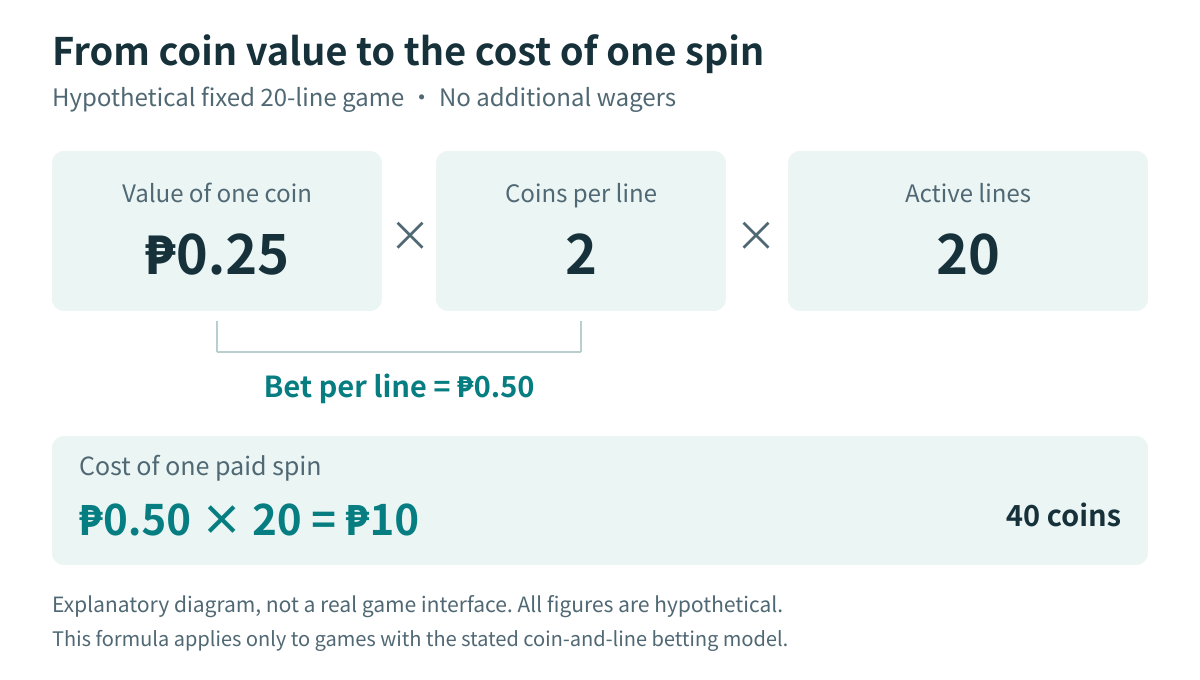
Consider a hypothetical fixed-line game with 20 active lines, 2 coins wagered per line and a coin value of ₱0.25. There are no additional wagers:
Bet per line: 2 × ₱0.25 = ₱0.50
Total bet: ₱0.50 × 20 lines = ₱10
Total coins wagered: 2 × 20 = 40 coins
One paid spin deducts ₱10.
The formula “coin value × coins per line × active lines” applies only when the game's rules use that pricing model. Some games have a fixed number of lines, some let you change it, and others let you select the total bet directly. If the display already says “Total Bet = ₱10,” do not multiply that amount by 20 lines again. In ways-to-win or cluster games, the number of winning paths or grid positions cannot simply be substituted for paid paylines.
Extra modes can change the cost too. After enabling “Ante Bet,” “Extra Bet” or a similar option, check the final amount and read what the additional wager pays for. Suppose a mode costs 1.5 times the base bet: a ₱10 base bet would then cost ₱15. Whether the extra ₱5 also counts toward the amount used to calculate ordinary symbol payouts is a separate question. Check the mode's rules before applying the same increase to a payout.
Find out what the paytable multiplier applies to
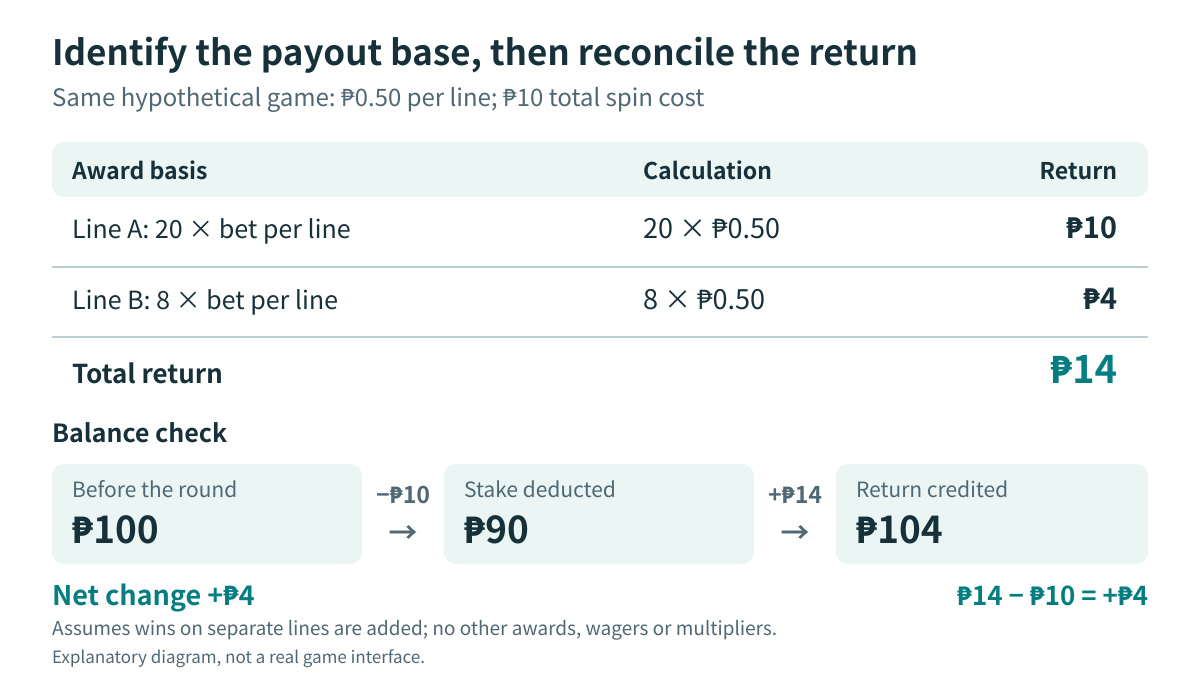
In the same example, the bet per line is ₱0.50 and the total bet is ₱10. If a combination pays 20 times the line bet, that line returns ₱10. If the rules say 20 times the total bet, the return is ₱200. The difference comes from the amount being multiplied. A “20” on its own is not enough to calculate a payout.
Some paytables list awards in coins; others show money amounts already adjusted for the current bet. In a hypothetical coin-based model, the rules might define the money payout as the paytable award multiplied by Bet Level and then Coin Value. Under that model, a 20-coin award at level 2 and a coin value of ₱0.25 produces ₱10. If the paytable already displays ₱10, do not multiply it by the coin value or bet amount again.
Check that the award qualifies as well. The required symbol count, direction, active line and highest-win rules can all affect the result. If the rules pay only the highest combination on a line, four matching symbols do not also earn a separate three-symbol award for the same sequence.
Check the payout base separately for each award type. For example, if the rules express a line win as a multiple of the line bet and a Scatter win as a multiple of the total bet, use the corresponding amount for each calculation. A formula used for ordinary symbols does not automatically apply to every entry in the paytable.
Add the awards and reconcile the balance
Suppose two different active lines win in this hypothetical round. One pays 20 times the line bet and the other pays 8 times it. The rules allow wins on separate lines to be added, and there are no other awards or multipliers. The two returns are ₱10 and ₱4, for a total of ₱14.
With an opening balance of ₱100, the game deducts the ₱10 stake and then credits the ₱14 return. The settled balance is ₱104. “Win = ₱14” is the total returned; the balance has increased by ₱4.
A round with cascades, respins or free spins may first show individual results and then a running total for the whole round. Check whether “Win” refers to one step or the complete round. Do not add a subtotal again if it is already included in “Total Win.” If the rules say certain follow-on spins carry no additional stake, each new animation should not be counted as another charge.
To check a game record:
Establish the amount actually deducted for the whole round.
Calculate each qualifying award using the correct payout base.
Compare the total return with the settled balance.
Allowing for any other clearly recorded balance changes, the figures should reconcile as “opening balance − round cost + round return = closing balance.” If they do not, first check the units, extra modes, missing awards and cumulative totals. Use the settled record rather than the winning animation alone.
Sources
Cite This Article
Topics In This Story
Andrea Rivera explores the evolving world of iGaming through the companies trying new things and the markets taking shape around them. An editor at AskSpinner News, Andrea combines research with storytelling, bringing information and perspective to industry analysis without losing the story that makes it worth reading.
More From This Author