
Fortune Gems by JILI
Play Fortune Gems by JILI In Demo Mode
by JILI Games




 WildFortune Gems - Wild
- 3 on a payline
- 5× base bet
- Multiplier applies
- Substitutes symbols
 Paying SymbolFortune Gems - J
- 3 on a payline
- 0.4× base bet
- Multiplier applies
- Wild can substitute
 Paying SymbolFortune Gems - Q
- 3 on a payline
- 1× base bet
- Multiplier applies
- Wild can substitute
 Paying SymbolFortune Gems - K
- 3 on a payline
- 1.6× base bet
- Multiplier applies
- Wild can substitute
 Paying SymbolFortune Gems - A
- 3 on a payline
- 2× base bet
- Multiplier applies
- Wild can substitute
 Paying SymbolFortune Gems - Green Gem
- 3 on a payline
- 2.4× base bet
- Multiplier applies
- Wild can substitute
 Paying SymbolFortune Gems - Blue Gem
- 3 on a payline
- 3× base bet
- Multiplier applies
- Wild can substitute
 Paying SymbolFortune Gems - Red Gem
- 3 on a payline
- 4× base bet
- Multiplier applies
- Wild can substitute
Fortune Gems by JILI Expert Review


Updated:
Here you can find detailed review information about Fortune Gems by JILI.
1 Where the original Fortune Gems fits
Fortune Gems puts most of its action into a single calculation: the value of a three-symbol line multiplied by the number in the center of the right-hand reel.
What I liked
✅ Reading a result: The compact board’s five fixed paths and visible line highlights make combinations traceable.
✅ Multiplier display: A gold frame identifies the active center value, and the multiplier reveal supplies the suspense.
✅ Extra Bet explanation: The displayed bet makes the 50% price increase visible
✅ Win presentation: The final WIN field provides the round payout
✅ Feature scope: Core play revolves around lines, Wild substitution and a multiplier
What I didn’t like
❌ Reading a result: Three matching symbols must still occupy one valid path
❌ Multiplier display: Visible neighboring values do not count; even a 15× multiplier pays nothing when the main grid misses.
❌ Extra Bet explanation: The unchanged normal-stake payout basis requires reading the full rules
❌ Win presentation: Line plaques and counting animations can be intermediate amounts; payout is not net profit
❌ Feature scope: Players looking for a separate free-spin or Buy Bonus round will not find one in the inspected build
This is the original JILI Fortune Gems, game 109, tested in build V_189_340. Its five paylines, Wild substitutions and Extra Bet option keep the focus on the base game. There is no separate free-spin or Buy Bonus round in the inspected build. The main choice is whether to pay the EX surcharge for a different multiplier distribution.
All test amounts below are demo credits; the display did not identify them as pesos. On a peso-denominated version, use its displayed stake and limits when applying these calculations.
Normal-speed gameplay, recorded on 14 October 2026 in the original Fortune Gems, build v_192_340. This silent 18-second native recording shows only the second ordinary spin of that separate capture session: a 1-credit bet, zero payout and a demo balance moving from 1,999 to 1,998. It is separate from both 100-spin samples in build V_189_340 discussed below; it does not add spins to those samples or demonstrate Extra Bet.
The Fortune Gems demo on AskSpinner lets you check the five paths and compare the bet display with EX off and on.
Philippines Search Interest
Approximately 3,700 searches per month. Ahrefs estimates this average monthly Google search volume in the Philippines for the keyword “fortune gems”, using its latest known 12 months of data. It indicates how often the term is searched, not how many people play the game.
Method: Ahrefs Keywords Explorer, country PH, Google, keyword “fortune gems”, volume field; queried 2 October 2026. The exact start and end of the averaging period were not returned. Searches may include similarly named apps or other games in the series, so the estimate does not isolate the original Fortune Gems. See Ahrefs’ search-volume field definition for the measurement basis.
2 Reading the temple screen and its controls
The artwork places the reels inside a carved stone structure, with distant temple towers, greenery and a warm sunset behind it. Gold frames and brightly coloured gems stand out against the brown reel surfaces, while the card letters use a more subdued metallic treatment. The three matching reels dominate the screen, with the red-backed multiplier strip set apart on the right. Individual symbols and their values are covered in the Atlas on this page.
Fortune Gems’ carved-stone reels, sunset temples and brightly framed gems. This is the starting demo screen, not a winning result.
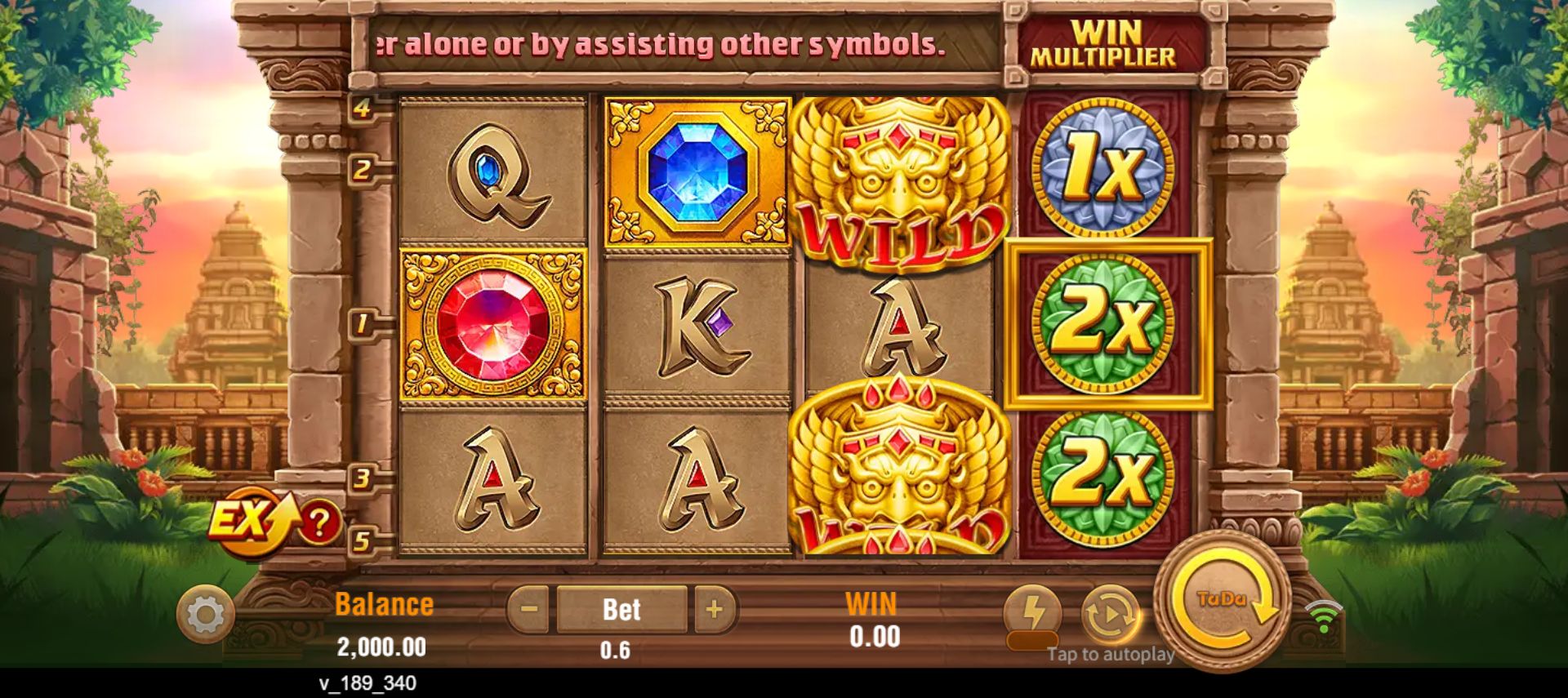
The gold frame around the middle position of the multiplier strip identifies the active value. The numbers above and below remain visible, but they are not additional multipliers to add or multiply together. Small numbered markers at the left identify the five paylines, and red line highlights show winning paths during the payout sequence. A highlighted line shows exactly which positions contributed to the payout.
Across the bottom, Balance shows the available credits, Bet shows the selected spin cost, and WIN shows the round’s payout. Bet has adjacent minus and plus controls and a selector for the available values. The large circular button at the lower right starts a spin. Beside it are the automatic-spin control and the lightning-bolt speed control. The EX switch is at the lower left of the reels, with a question-mark explanation; switching EX on changes the displayed cost. The gear button opens the options menu, where the inspected demo exposed automatic-spin settings, information and sound controls.
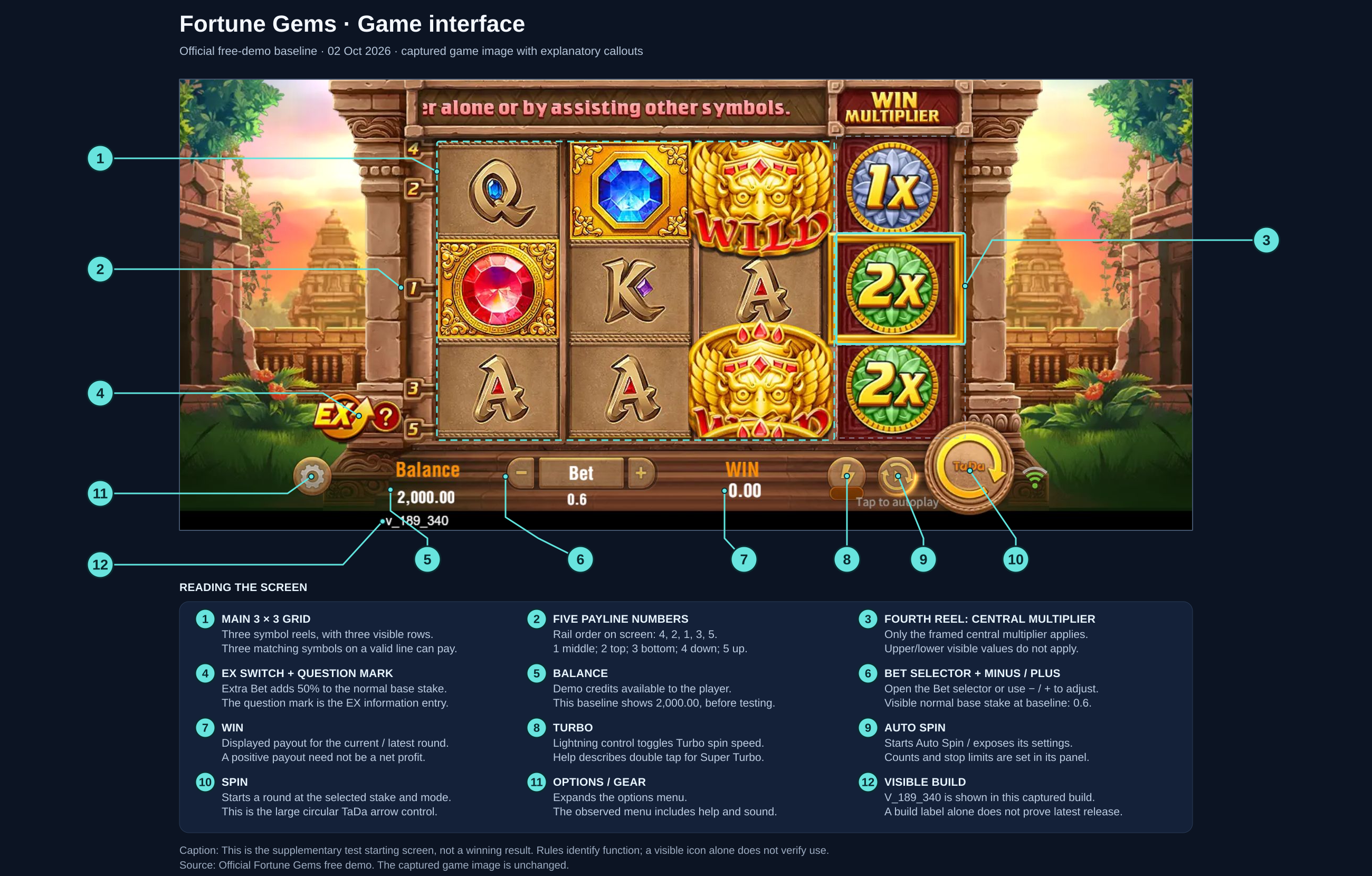
Automatic-spin settings offer a round count and additional stopping conditions for a single award or upper and lower balances. The original test completed two 50-spin automatic batches; the later per-round sample used manual spins. The optional thresholds were not tested. Turbo and Super Turbo were used, without a controlled speed comparison, and no usable account-history ledger was obtained.
Manual spins kept the selected stake within a session. Re-entering the demo restored the normal 0.60 stake, switched EX off and returned the speed setting to its default. Those settings therefore needed checking again before play continued. In the narrow portrait layout, the reels sit lower and Spin moves to the center beneath them; the larger background area leaves some lower controls relatively small. The layout checks do not establish real-handset or touch performance.
The most easily misread part of the presentation is the win animation. In supplemental spin 82, the central BIG WIN counter was still showing 11.84 while the bottom WIN field had settled at 36.00. The celebration even continued over spin 83, whose own payout was zero. Use the current round’s WIN and settled balance, rather than a moving celebration counter, to read the result.
3 How the five winning lines are counted
The main board has three reels and three rows. A paying combination needs three matching symbols from left to right on one of five fixed paths: the middle, top or bottom row, or either full diagonal. Matching pictures scattered around the board do not pay unless their positions complete one of those paths. The right-hand multiplier strip is separate from that matching grid.
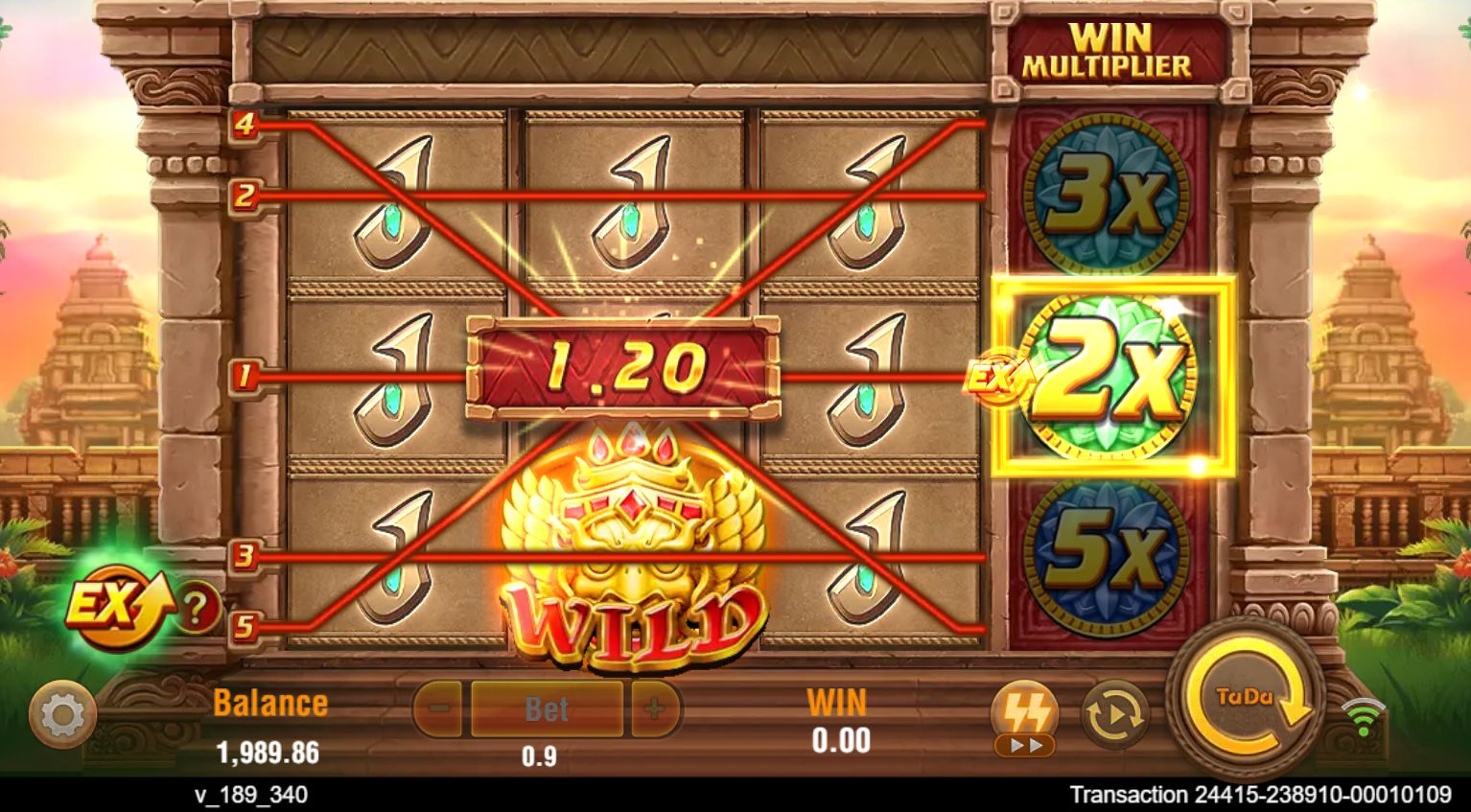
Supplemental spin 69 highlights all five J paylines, with Wild completing the bottom row. The 1.20 shown is the combined base award; the central 2× produces a final payout of 2.40 demo credits. This frame is still in the payout sequence.
Wild can substitute for a paying symbol. Supplemental spin 22 completed a green-gem line with a Wild in the middle. At the normal stake of 0.60 credits, the line award was 1.44; the central 5× produced 7.20. The visible 10× above and 1× below the frame played no part in the calculation.
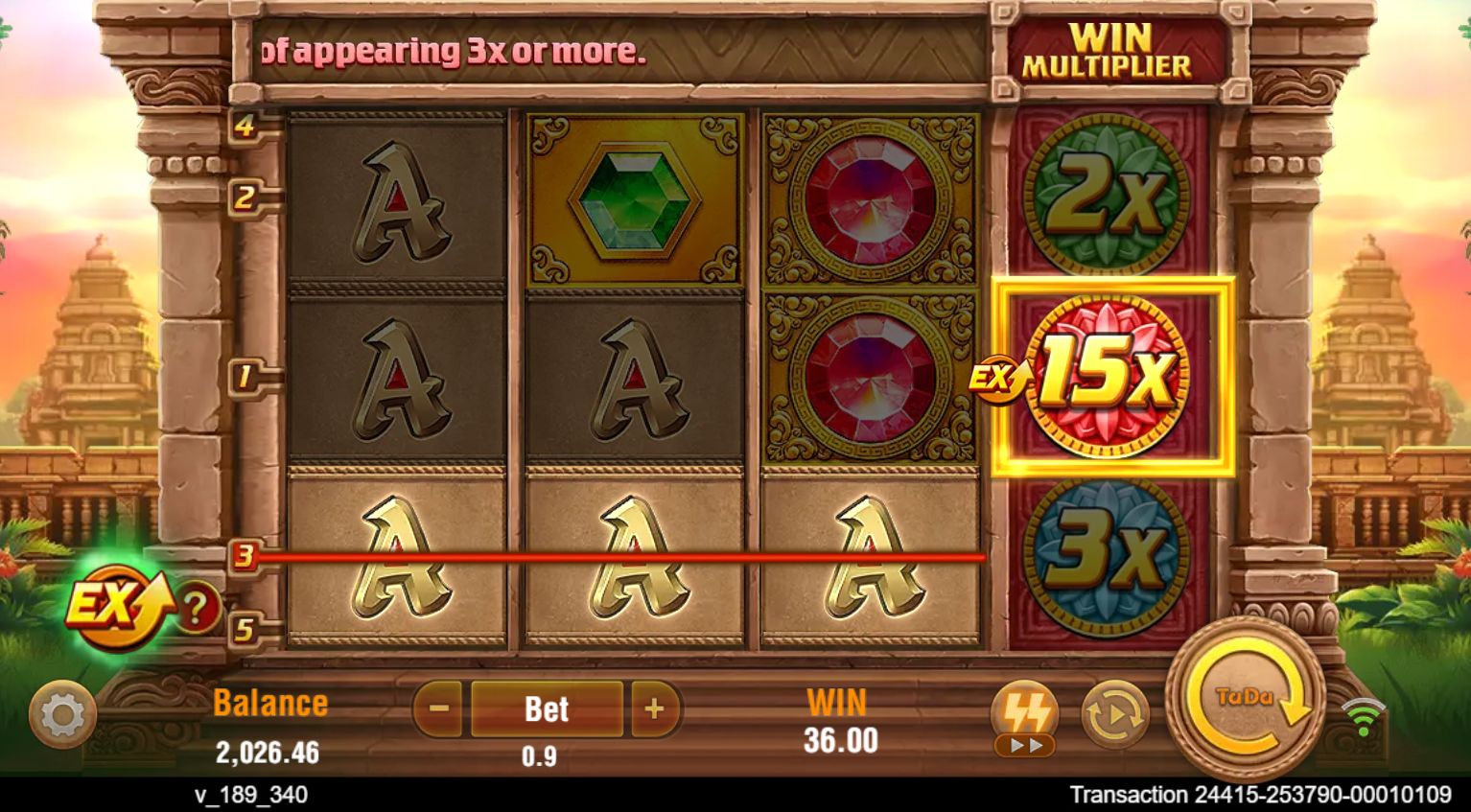
When more than one line wins, add their base awards before applying the multiplier. In supplemental EX spin 71, A symbols completed the bottom row and the descending diagonal. Each line paid 1.20 at the normal 0.60 stake, giving (1.20 + 1.20) × 15 = 36.00 credits. Both lines belong to one round, even when the game highlights them separately.
A paying spin can still reduce the balance. Supplemental spin 12 used Wild to complete a J line, paying 0.24 with a 1× multiplier after a 0.60 stake. Its net result was −0.36. WIN reports the payout; subtract the actual spin cost to find the gain or loss.
4 The multiplier reel and the real effect of Extra Bet
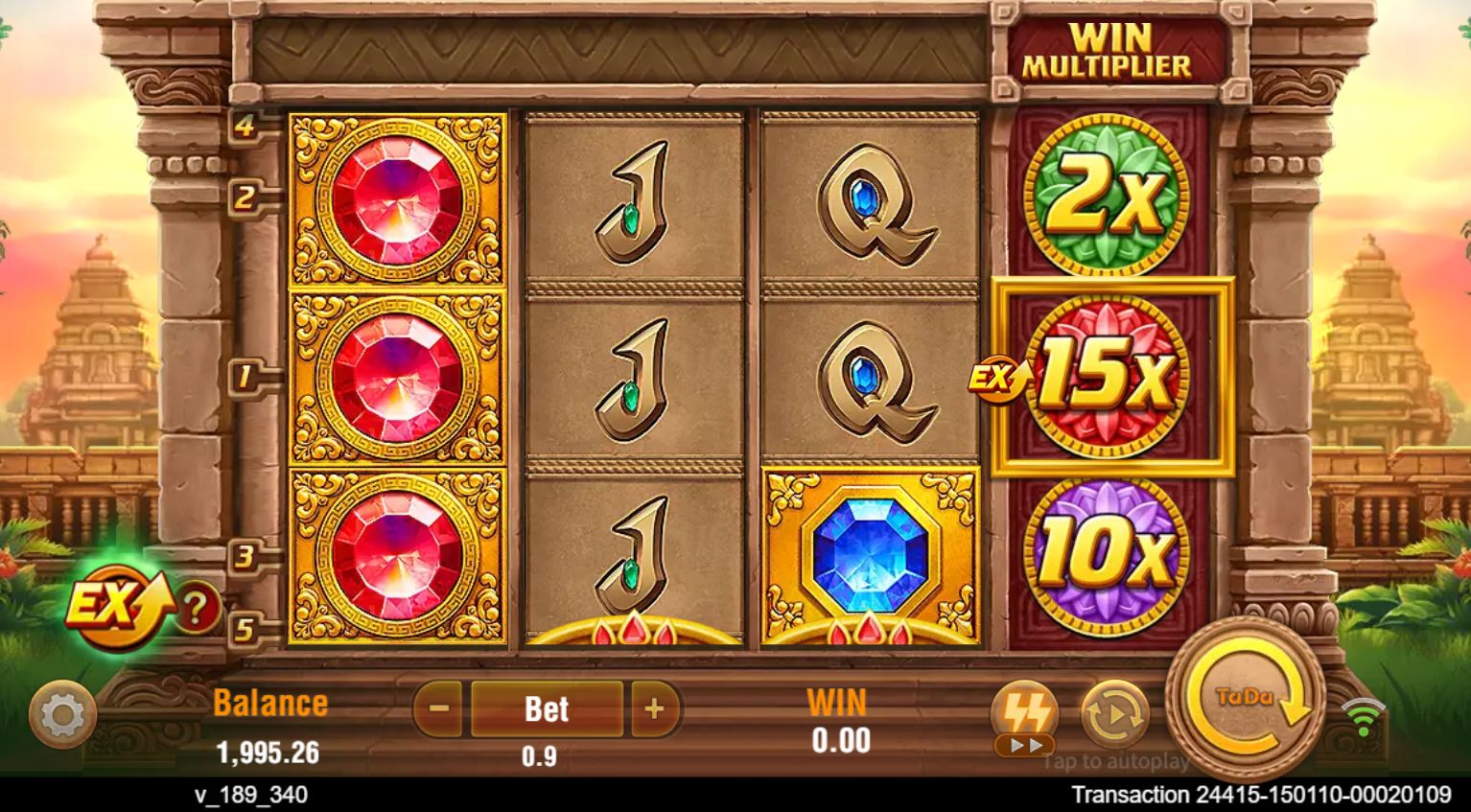
Ordinary mode uses six possible multiplier values: 1×, 2×, 3×, 5×, 10× and 15×. Only the one in the center frame applies. It multiplies the payout earned by the main grid; it does not pay by itself. Supplemental EX spin 55 landed a central 15× with WIN 0.00: the grid had no qualifying line. Three red gems stacked on the first reel did not form a left-to-right payline.
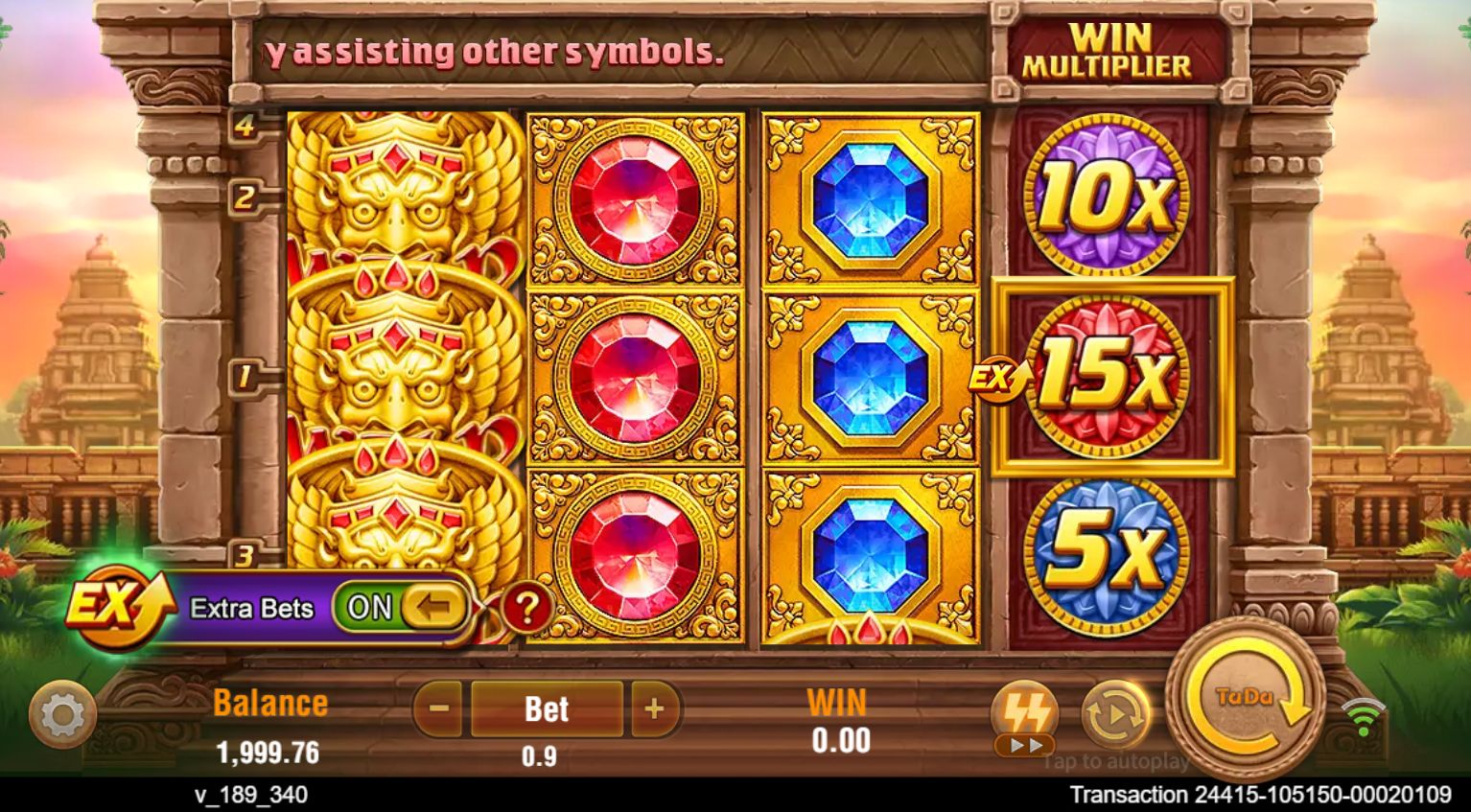
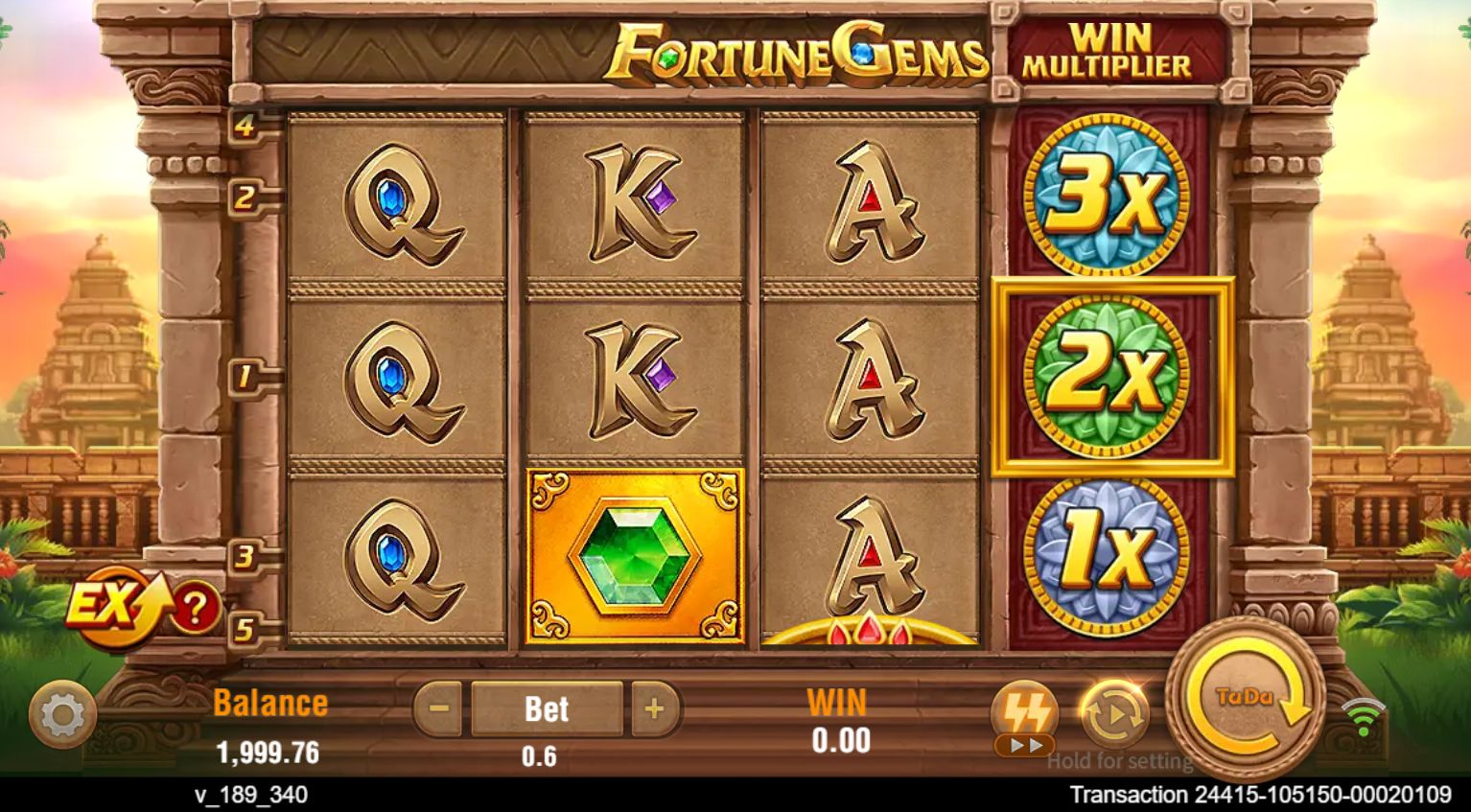
Extra Bet adds 50% to the normal stake and removes 1× from the multiplier reel. The help also says that higher multiplier symbols become more likely, without publishing the underlying probabilities or the size of the increase. At the test’s normal stake of 0.60, enabling EX raised the displayed spin cost to 0.90. Switching the setting itself left the balance unchanged: the higher amount is charged when the next spin is played.
The first screenshot below shows EX on, with a displayed cost of 0.90 demo credits.
The second screenshot shows ordinary mode at 0.60 credits. Both screens show Balance 1,999.76 and WIN 0.00: switching EX changed the next spin’s cost without starting another spin.
EX retains the normal stake’s paytable. Paying 0.90 does not make each base line award 50% larger than it was at 0.60. The A lines in spin 71 still started at 1.20 each, and a J line still started at 0.24. The extra charge buys the changed multiplier setup.
The last EX round in the original sample illustrates the consequence. Wild–J–J formed the top line and paid 0.24 × 2 = 0.48 credits. Against the 0.90 charge, that left a loss of 0.42. The minimum 2× applies to the line award, not to the money spent.
EX applies to regular spins. It does not purchase entry to a bonus round, and the inspected help and menus contain no Scatter-triggered free spins or Buy Bonus option.
5 RTP volatility and the cost of a session
This page lists 97% RTP. Provider materials describe multiple configurations, while the captured help for build V_189_340 does not identify the active one. The tests therefore do not independently confirm 97% for that build; check the game information supplied with the version you play.
RTP concerns long-run payouts relative to stakes, not the percentage of a starting balance a session will return. A losing run does not make a recovery due. The AskSpinner Slot Simulator is a companion to this discussion; the results in the next section come from Fortune Gems itself, not the simulator.
JILI’s official entry for the original Fortune Gems classifies volatility as Low–Medium and lists a maximum win of 375×. This is the provider’s classification; our short samples cannot measure the game’s underlying volatility. Low–Medium still allows substantial losses in a short session. The 375× overall payout limit is also different from the 15× maximum value on the special reel: the latter multiplies the underlying line awards.
In the inspected configuration, the help lists normal stakes from 0.20 to 200 credits and an EX maximum cost of 300. Its maximum payout of 75,000 matches 375 times the highest normal stake of 200. Those limits apply to the inspected demo configuration.
For a fixed normal stake, EX consumes 50% more credits per spin. At 0.60, fifty ordinary spins cost 30.00 credits, while fifty EX spins cost 45.00. That extra 15.00 is committed regardless of the results. Use the actual deductions when setting a session budget; the unchanged payout basis can otherwise make EX look cheaper than it is.
Sources: JILI’s Fortune Gems specifications and the captured in-game rules and payout information.
6 What two demo samples show
We recorded two separate 100-spin samples on 2 October 2026, each with fifty ordinary spins followed by fifty EX spins in the original Fortune Gems, build V_189_340. Both used a normal stake of 0.60 credits and an actual EX cost of 0.90. The first sample has verified batch totals. A second, supplemental sample records every spin’s cost, settled payout and before-and-after balance; that is the source of the three charts.
Supplemental sample with complete per round records
All amounts are demo credits.
Measure | Ordinary | Extra Bet | Combined |
|---|---|---|---|
Completed spins | 50 | 50 | 100 |
Actual cost per spin | 0.60 | 0.90 | Mixed |
Total spin cost | 30.00 | 45.00 | 75.00 |
Settled payouts | 35.76 | 82.80 | 118.56 |
Net result from spins | +5.76 | +37.80 | +43.56 |
Observed sample return | 119.20% | 184.00% | 158.08% |
Observed sample return is total settled payouts divided by actual spin costs. The combined result is 118.56 ÷ 75.00 = 158.08%. It uses both modes’ actual costs, including the EX surcharge; it is not the simple average of their two percentages.
Reading the balance chart
The balance chart shows the settled wallet amount after each spin, with breaks where the demo restarted. After spin 42, the balance reset from 2,006.00 to 2,000.00. After spin 83, it reset from 2,051.66 to 2,000.00. These were separate demo-session adjustments of −6.00 and −51.66, not losses on spins 43 and 84.
That distinction explains why the wallet ended below its starting point even though the recorded spins returned more than they cost. It moved from 2,000.00 to 1,985.90: the +43.56 net result from spins minus 57.66 in resets equals the −14.10 wallet change. Connecting the balance across those resets, or charging them to individual spins, would misrepresent what happened.
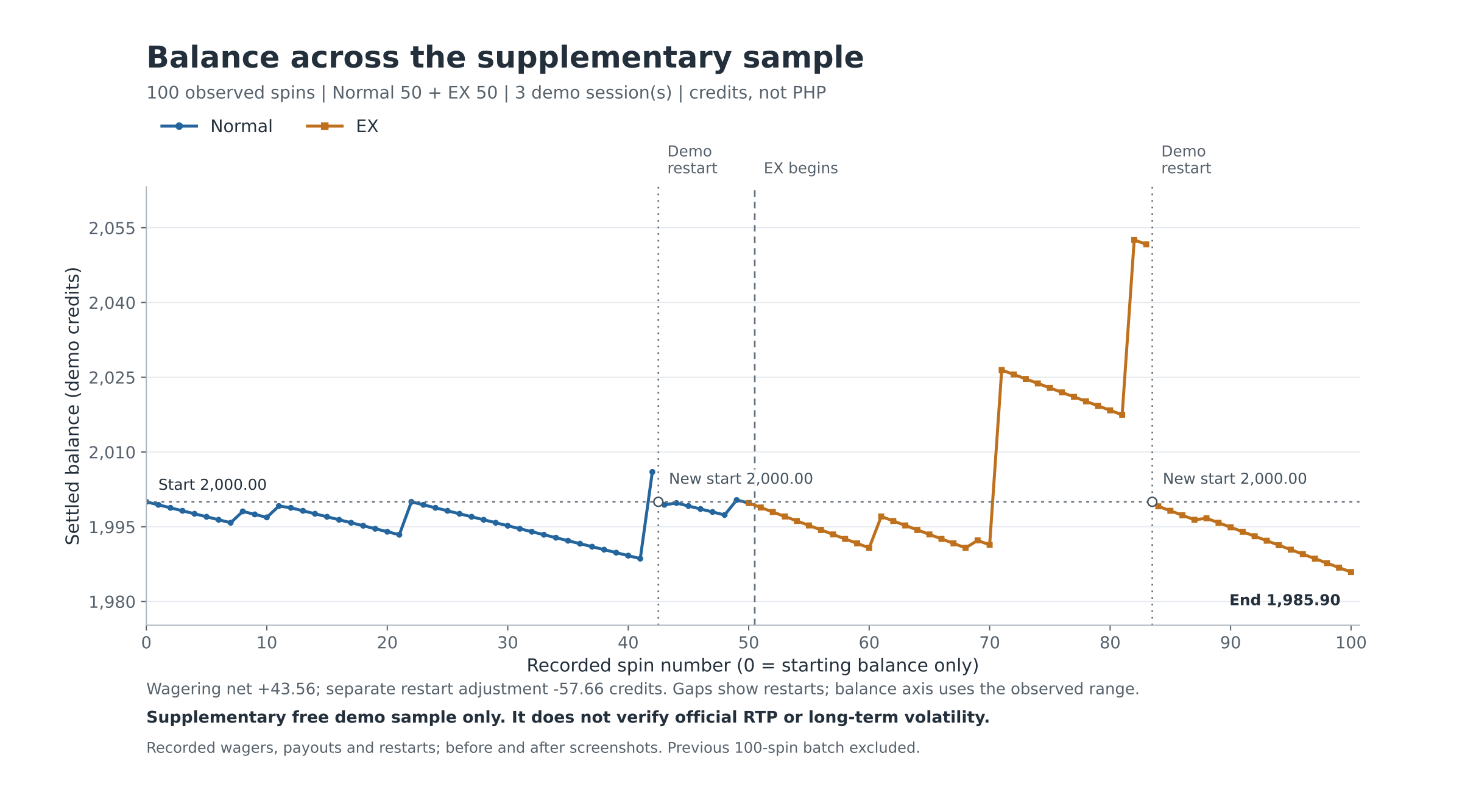
Figure 4. Supplemental sample only: fifty ordinary spins at 0.60 credits and fifty EX spins at 0.90. Gaps after spins 42 and 83 mark demo resets of −6.00 and −51.66. The +43.56 net result from spins and −57.66 reset adjustments reconcile to the −14.10 wallet change. The balance axis shows the observed range.
Reading the cumulative return chart
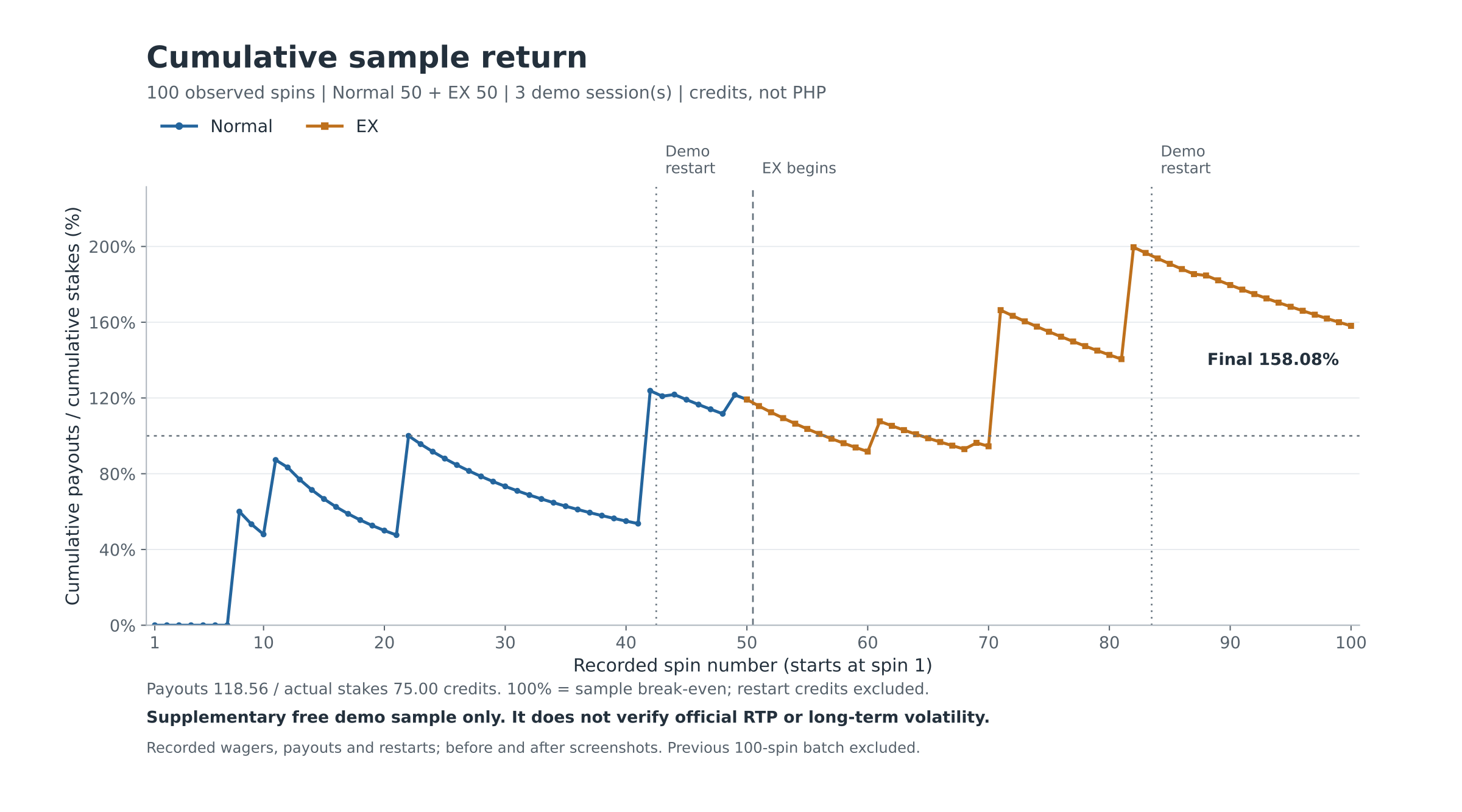
Figure 5. The curve accumulates payouts and actual spin costs from spin 1; the EX-coloured section still includes the first fifty ordinary spins. Its final 158.08% is the combined sample return, not EX’s separate 184.00%. Demo resets are excluded. The 100% line marks sample break-even, not theoretical RTP.
The cumulative-return chart carries every recorded payout and stake forward from spin 1. Its colour changes when EX begins at spin 51, but the calculation does not restart. The orange endpoint of 158.08% includes the preceding fifty ordinary spins. EX considered separately returned 184.00%, as shown in the table; that is a different denominator from the cumulative curve. The chart’s 100% reference line means sample break-even, not theoretical RTP.
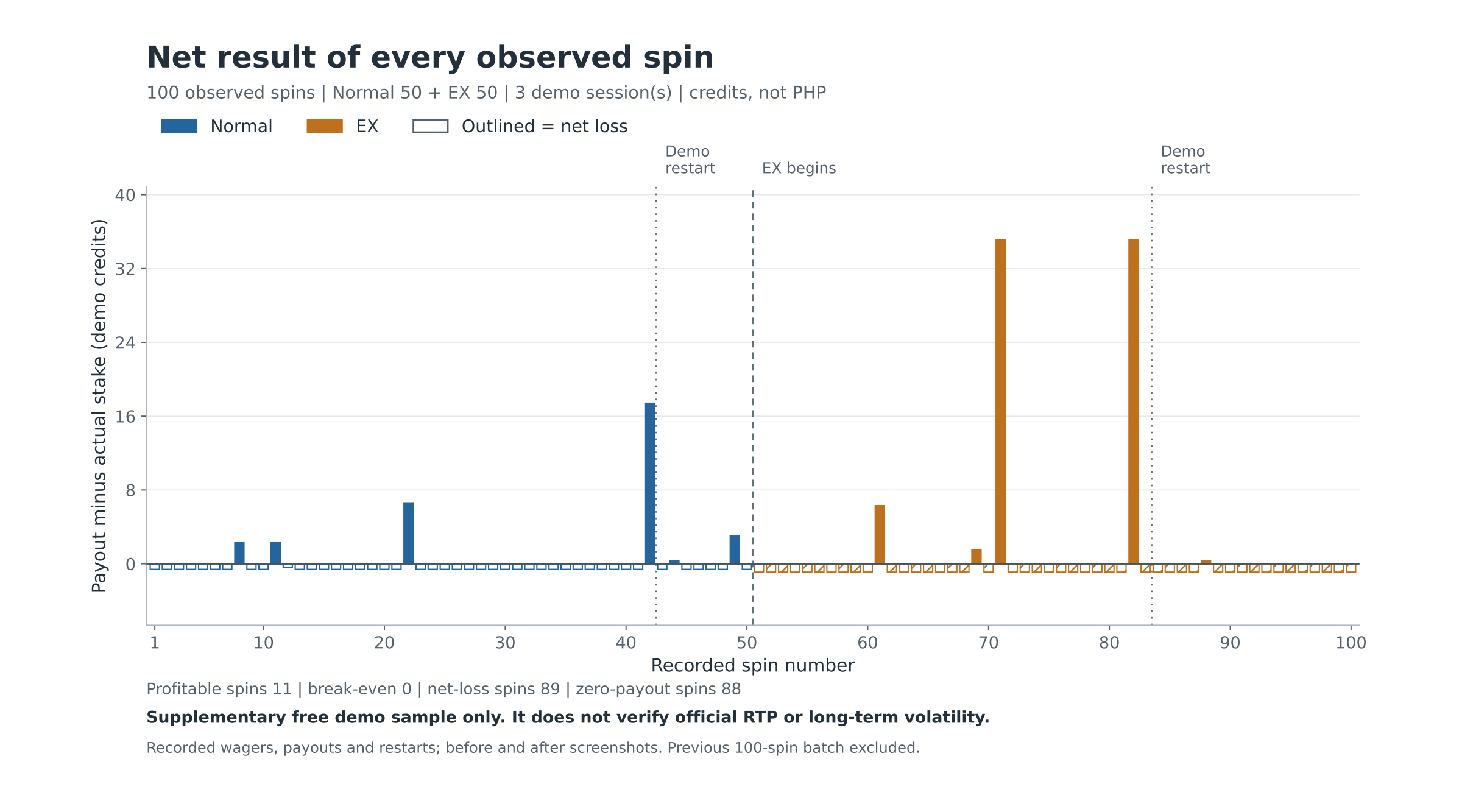
Two payouts did much of the work. Spins 71 and 82 each returned 36.00, together accounting for 60.73% of the sample’s 118.56 payout total. The first came from two A lines multiplied by 15; the second from all five green-gem lines multiplied by 5. Their jumps are prominent on both the balance and return charts.
Reading the per spin net result chart
Only twelve of the hundred spins paid anything. Eleven finished above their own cost; the other was spin 12’s 0.24 payout against a 0.60 stake. The remaining 88 paid zero, producing 89 net-losing spins overall and no break-even rounds. Each 36.00 EX payout created a net gain of 35.10 after its 0.90 charge. The chart makes the concentration clear: the sample finished ahead on spin results despite most individual rounds losing credits.
Keeping the earlier sample in view
The original sample produced a markedly different result at the same stated stakes. Its payouts are derived from verified starting and ending balances plus total spin costs, rather than a complete per-round ledger.
Two independent samples compared
Sample and mode | Spins | Cost | Payout | Net spin result | Observed sample return |
|---|---|---|---|---|---|
Original ordinary | 50 | 30.00 | 15.36 | −14.64 | 51.20% |
Original EX | 50 | 45.00 | 7.68 | −37.32 | 17.07% |
Original total | 100 | 75.00 | 23.04 | −51.96 | 30.72% |
Supplemental ordinary | 50 | 30.00 | 35.76 | +5.76 | 119.20% |
Supplemental EX | 50 | 45.00 | 82.80 | +37.80 | 184.00% |
Supplemental total | 100 | 75.00 | 118.56 | +43.56 | 158.08% |
The original wallet fell from 2,000.00 to 1,948.04. Its 30.72% sample return and the later 158.08% are both part of the record. Neither validates or disproves the listed theoretical RTP, and the reversal between the two EX batches cannot establish an advantage for that mode. These are short, sequential observations. The charts cover only the supplemental hundred spins; there is no reconstructed 200-spin curve.
7 The verdict and how Fortune Gems compares
The small grid is Fortune Gems’ strongest design choice. Five fixed paths are easy to trace, and the framed multiplier leaves little doubt about which value applies. The weak point is the award presentation: the counting animations attract attention while the more important cost and final payout sit in the bottom bar.
Ordinary and EX share the same line rules and normal-stake paytable. Their differences are concentrated in price and the multiplier reel.
Ordinary mode compared with Extra Bet
Question | Ordinary mode | Extra Bet |
|---|---|---|
Cost at a normal 0.60 stake | 0.60 credits | 0.90 credits |
Available multiplier values | 1×, 2×, 3×, 5×, 10×, 15× | 2×, 3×, 5×, 10×, 15× |
Basis of line payouts | Normal stake | Normal stake, excluding EX surcharge |
Can a spin return zero? | Yes | Yes |
Can a paying result return less than its cost? | Yes, observed 0.24 from 0.60 | Yes, observed 0.48 from 0.90 |
Separate bonus round purchased? | No purchase involved | No; EX supplements the regular spin |
Long-run value established by this test? | No | No |
Fortune Gems 2 is the closer comparison if you want to retain the original’s compact format while adding a wheel feature. Super Ace changes the structure more substantially, with a larger board, ways-based wins and consecutive winning eliminations. The following comparison uses the providers’ published descriptions; only the original Fortune Gems was played for this review.
Fortune Gems compared with Fortune Gems 2 and Super Ace
Feature | Fortune Gems | Fortune Gems 2 | Super Ace |
|---|---|---|---|
Winning format | 3×3 grid; five fixed paylines | 3×3 grid; five paylines | Five columns and four rows; 1,024 ways |
Core mechanic | The active central reel multiplier applies to winning line payouts | A wheel symbol in the center of the special reel triggers Lucky Wheel | Consecutive winning eliminations build multipliers; eliminated Golden Cards become Golden Jokers |
Bonus structure | No separate bonus round in the inspected build | Lucky Wheel adds a wheel feature | Free Games use doubled multipliers |
Extra-cost option | EX adds 50%, removes 1× and keeps the normal-stake payout basis | EX adds 50%, removes 1× and upgrades the wheel | An extra-cost option was not verified in the reviewed sources |
Practical difference | Focuses on reading a line payout and its multiplier | Keeps a similar small-grid format while adding a wheel event to follow | Requires following elimination sequences and changing multipliers across a larger board |
The Fortune Gems 2 sources describe an EX wheel upgrade, but do not establish a higher wheel-trigger probability. Super Ace’s extra-cost options remain unverified.
Comparison sources: JILI’s original Fortune Gems specifications, TaDa’s Fortune Gems overview, JILI’s Fortune Gems 2 features, TaDa’s Fortune Gems 2 wheel description and JILI’s Super Ace features.
For the original game, ordinary mode keeps the charge lower at the same normal stake. EX removes 1×, but costs 50% more without increasing base line awards. The available probability information and these short tests do not establish whether that premium buys better long-run value.
Fortune Gems is a compact choice for someone who wants to follow individual line results without learning a branching bonus system. Its appeal rests on the multiplier reveal; its chief caveat is the EX surcharge. The 0.48 return from a 0.90 EX spin captures the trade-off better than the “at least 2×” label does. Treat the game as paid entertainment, not an income source. The findings cover demo mechanics, interface layout and recorded outcomes. Real-handset usability, sound quality, forced-disconnection recovery and casino deposit or withdrawal services were not assessed.
Fortune Gems by JILI FAQs
Answers to common questions about Fortune Gems by JILI.
Fortune Gems by JILI Reviews
 No Player Reviews Yet
Played Fortune Gems by JILI? Share your experience with other players.
 Write A Review