
Wild Bounty Showdown by PG SOFT
Play Wild Bounty Showdown by PG SOFT In Demo Mode
by PG SOFT




 ScatterScatter
- 3 trigger 10 free spins
- Anywhere on reels
- Extra Scatter adds 2
- Free spins start ×8
 WildWild
- Never substitutes Scatter
- No separate payout row
- Substitutes ordinary symbols
- Gold-frame conversion
 Paying SymbolJ
- 3–6 consecutive reels
- Starts on reel 1
- Wild can substitute
- Coefficients 1/2/3/5
 Paying SymbolQ
- 3–6 consecutive reels
- Starts on reel 1
- Wild can substitute
- Coefficients 1/2/3/5
 Paying SymbolK
- 3–6 consecutive reels
- Starts on reel 1
- Wild can substitute
- Coefficients 2/4/6/10
 Paying SymbolA
- 3–6 consecutive reels
- Starts on reel 1
- Wild can substitute
- Coefficients 2/4/6/10
 Paying SymbolWhiskey Bottle
- 3–6 consecutive reels
- Starts on reel 1
- Wild can substitute
- Coefficients 5/10/15/20
 Paying SymbolCowboy Hat
- 3–6 consecutive reels
- Starts on reel 1
- Wild can substitute
- Coefficients 5/10/15/20
 Paying SymbolRevolver
- 3–6 consecutive reels
- Starts on reel 1
- Wild can substitute
- Coefficients 8/15/20/30
 Paying SymbolBandit
- 3–6 consecutive reels
- Starts on reel 1
- Wild can substitute
- Coefficients 10/20/30/50
Game Themes

 ThemeWestern Games
 40 Games

Wild Bounty Showdown by PG SOFT Expert Review


Updated:
Here you can find detailed review information about Wild Bounty Showdown by PG SOFT.
I would choose Wild Bounty Showdown when I have time to follow a developing cascade rather than skim a quick result.
What I liked
✅ A gold-framed hat becoming a Wild as the multiplier doubles makes consecutive wins feel connected; that matters more to me than the Western dressing.
✅ Fixed 3,600 ways give the board a consistent layout and a clear counting rule.
✅ Free spins beginning at ×8 bring a meaningful change of pace.
✅ Portrait keeps the key controls together.
What I didn’t like
❌ Round awards, the running display and final TOTAL WIN need separate reading; plenty of small payouts still leave the spin behind.
❌ Six unequal-height reels make the screen busy and demand more attention than a small fixed-line slot.
❌ Longer award sequences slow the experience, and Turbo only promises shorter main-game reel animation.
❌ A short landscape window leaves a narrow board, and three server interruptions broke up the recorded demo.
❌ The more interesting results can be separated by long quiet stretches.
1. What makes Wild Bounty Showdown worth a look?
PG SOFT builds this Western-themed slot around six reels, a fixed 3,600 ways to win and collapsing symbols. The reels show 3, 4, 5, 5, 4 and 3 positions. Winning symbols disappear, new ones fall in, and the same paid spin continues while further combinations form. Gold frames appear on the middle two reels; a framed symbol that contributes to a win becomes a Wild on the next cascade. The multiplier starts at ×1 in the main game and doubles after a winning round.
The free-spin feature changes the starting point: every free spin begins at ×8. Three Scatter symbols award ten free spins. In the recorded demo, one paid spin naturally triggered that feature and the complete result paid 39.84 on a 0.60 bet. That is a useful look at the feature in action, not a promise about how frequently it will arrive.
Paid spin 20 at normal speed: a 13.1-second video without audio. It includes the actual settled-screen hold after the reels stop; the reels do not spin for the entire clip. This spin paid 0.00 on a 0.60 bet.
Philippine search interest: Ahrefs estimated 2,400 monthly searches for “wild bounty showdown” and 4,700 for “wild bounty showdown demo” in the Philippines, checked on 5 October 2026. These are estimated average monthly query volumes, not numbers of players, current users or expected visits to this page. The queries overlap in intent, so their volumes should not be added together as a unique audience.
When the demo on this page is available, use it to get comfortable with the gold frames, multiplier and final win display before deciding whether the game is for you. Check the bet amount before the first spin and again after a reload. This review concerns PG SOFT’s game; a similarly named app should not be assumed to be its official release.
2. Read the screen before pressing Spin
The hanging multiplier sign is the most useful part of the presentation. It makes the current cascade value easy to locate, while the gold frames tell you which symbols can leave a Wild behind. The bandit, revolver, hat and bottle keep the Western theme readable, although the taller middle reels can feel crowded when several symbols light up together.
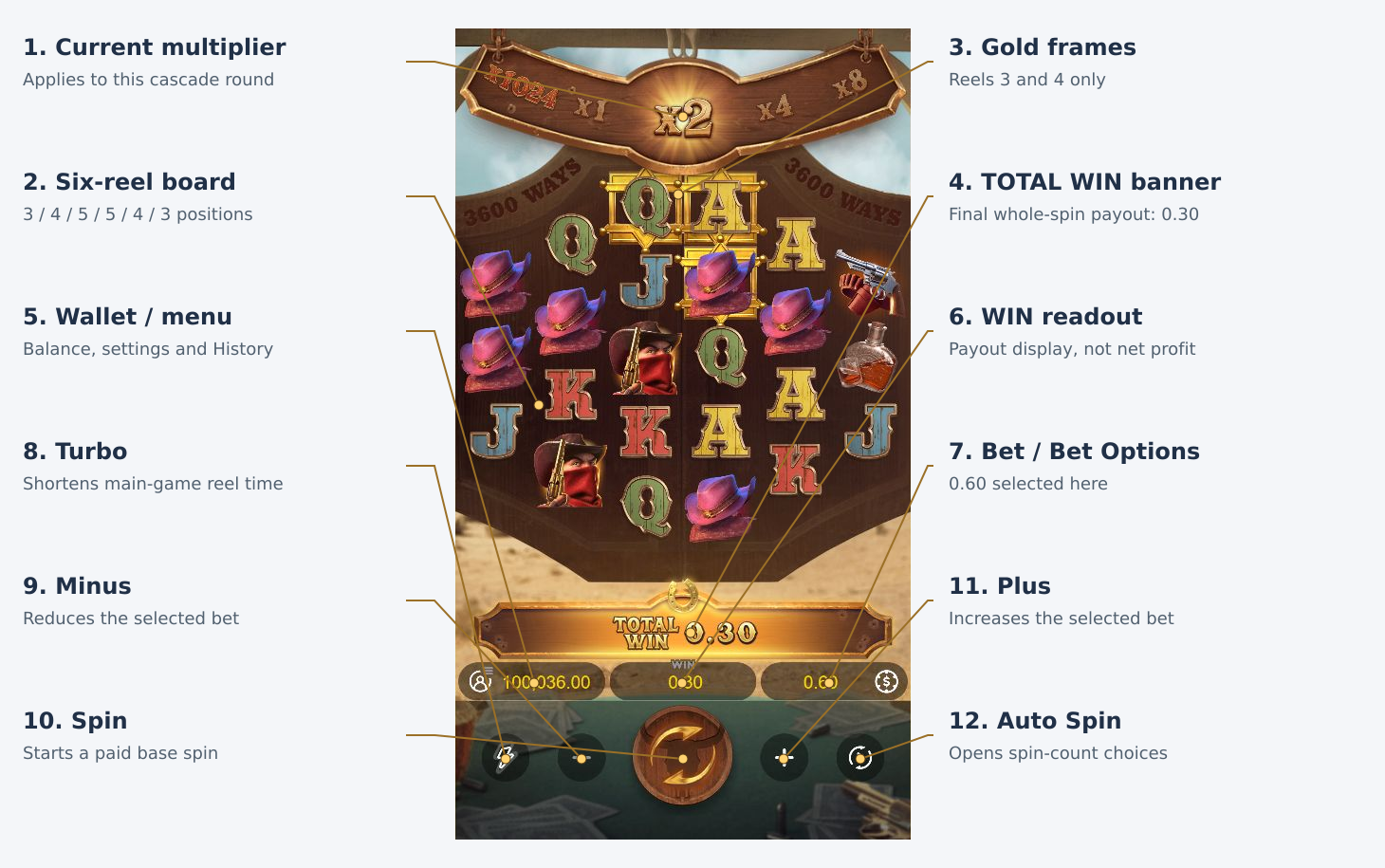
The complete playable surface after spin 100, with external labels. The original full browser view was 1920 × 855. The displayed ×2 belongs to this completed cascade; a new main-game spin starts again at ×1.
Current multiplier: the central value on the hanging sign applies to the current round within the spin. Nearby values show the progression, not several multipliers applied together.
Six-reel board: read matching ordinary symbols from the leftmost reel across consecutive reels. The different heights create the fixed 3,600-way layout.
Gold frames: only reels 3 and 4 can carry them. A frame becomes useful when its symbol participates in a win.
TOTAL WIN banner: wait for the final amount. Here it is 0.30 for the whole spin, which is below the 0.60 cost.
Wallet and menu: the left readout shows the demo balance and opens the settings area, including Paytable, Rules and History.
WIN readout: a payout display. A positive number does not by itself mean the spin made a profit.
Bet and Bet Options: the right readout is the amount selected for the next paid spin. It opens the size, level and total-bet controls.
Turbo: reduces main-game reel animation time. It does not change the paytable or guarantee a shorter feature celebration.
Minus: reduces the selected bet. Read the new total before spinning.
Spin: starts at the current bet. Wait for the previous feature screen to finish before using this area again.
Plus: increases the selected bet. The resulting total matters more than the size setting on its own.
Auto Spin: opens a choice of spin counts. The captured panel offered 10, 30, 50, 80 and 1,000 spins.
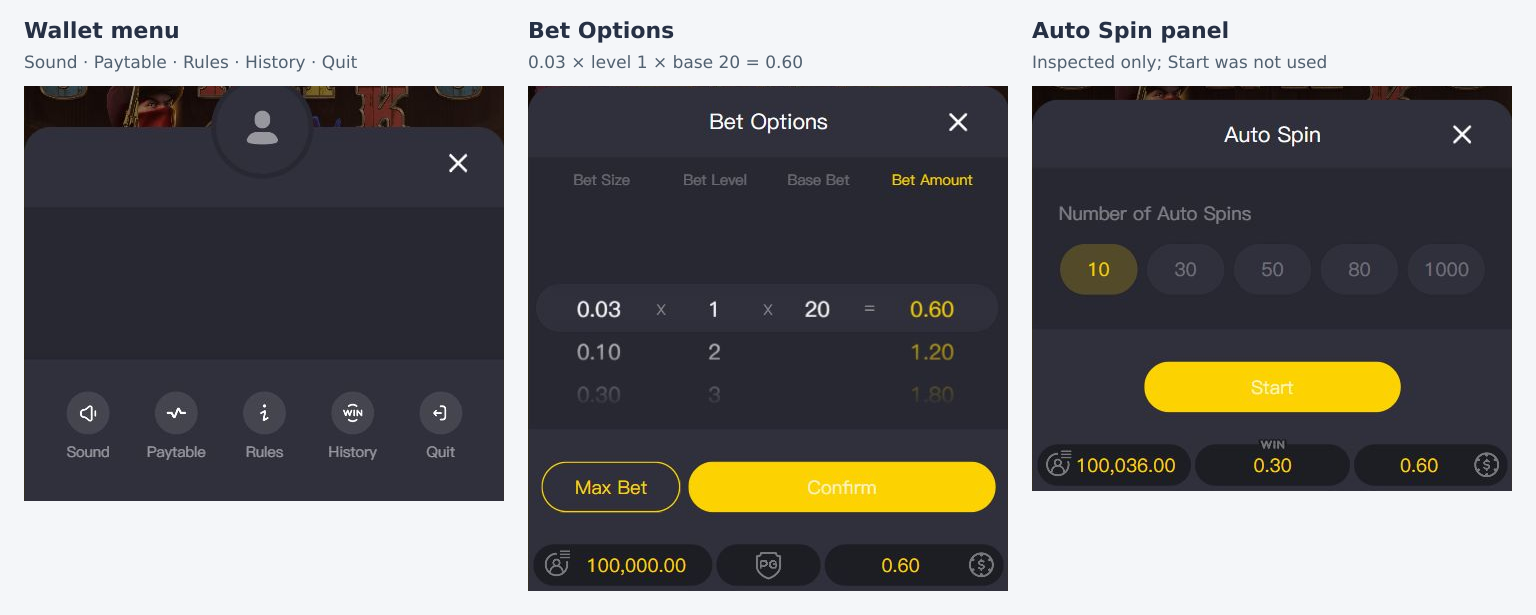
Three separately opened panels from the demo. Bet Options shows Size 0.03 × Level 1 × Base Bet 20 = 0.60. Auto Spin was opened for inspection, but no automatic batch was started. The Sound switch exists; audio quality was not assessed.
Portrait works better than a short landscape window
I would keep this game upright. In a 390 × 844 desktop viewport simulation, the board, money row and spin controls remained visible, and Bet Options could be opened. At 844 × 390, the game kept its narrow portrait stage in the centre instead of making full use of the width. That makes the symbols and amounts noticeably smaller.
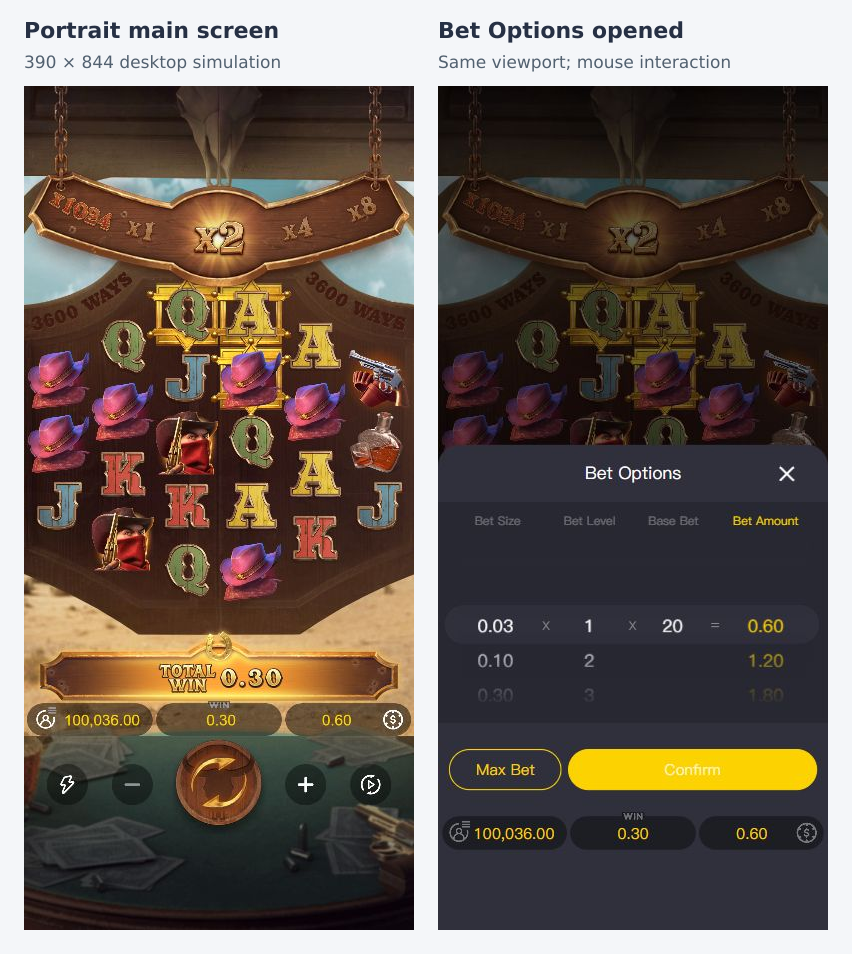
Portrait: 390 × 844, first on the main screen and then with Bet Options open. Both are desktop simulations with a mouse, not physical-phone or touch tests.
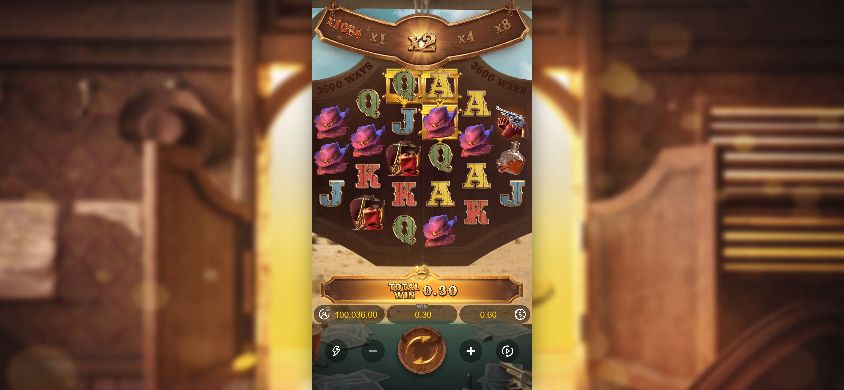
Landscape: 844 × 390. The complete screenshot keeps its original aspect ratio; the board remains a narrow vertical stage.
Those screenshots support a layout judgment only. They do not establish iPhone playback, touch accuracy, Philippine mobile-network performance or real-device battery use.
3. How the 3,600 ways and payout values work
The layout gives 3 × 4 × 5 × 5 × 4 × 3 = 3,600 possible six-reel ways. A particular win needs the same ordinary symbol, with any valid Wild substitutions, on at least three consecutive reels starting from reel 1. Its actual number of winning ways is the product of the matching counts on those reels. The game does not pay every possible way on every spin.
For example, two matching symbols on each of the first three reels produce 2 × 2 × 2 = eight ways. The Help’s illustration uses a three-reel coefficient of 10, giving 10 × 8 = 80 before the bet-size, bet-level and active-multiplier conversion. At Size 0.03, Level 1 and ×1, that illustrated pattern would pay 80 × 0.03 = 2.40 demo units. This is a rule example, not another spin in the recorded sample.
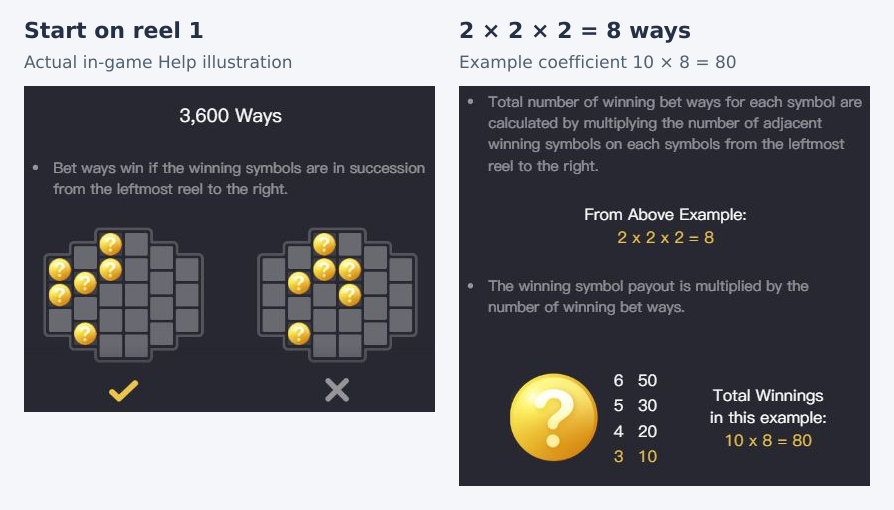
The in-game example distinguishes left-to-right consecutive matching from a similar-looking pattern that starts too late. Its 80 is a paytable calculation before applying Bet Size and Bet Level.
Use this payout formula: paytable coefficient × Bet Size × Bet Level × winning ways × current round multiplier. Add the awards from different winning combinations and subsequent cascades to get the whole-spin payout. Wild substitutes for ordinary symbols, but never for Scatter.
A short paytable comparison helps put the numbers in perspective. The following values are coefficients for matching 3 / 4 / 5 / 6 consecutive reels. The last column converts just one three-reel way at the sample’s Size 0.03, Level 1 and ×1. The complete paid spin still costs 0.60.
Ordinary symbol | 3 / 4 / 5 / 6-reel coefficients | One 3-reel way at sample settings |
|---|---|---|
Red-masked bandit | 10 / 20 / 30 / 50 | 0.30 |
Revolver | 8 / 15 / 20 / 30 | 0.24 |
Pink-purple hat; whiskey bottle | 5 / 10 / 15 / 20 each | 0.15 each |
A; K | 2 / 4 / 6 / 10 each | 0.06 each |
Q; J | 1 / 2 / 3 / 5 each | 0.03 each |
That last column explains why a winning animation can accompany a net loss. A single three-reel revolver way pays 0.24 at these settings. Against the 0.60 spin cost, it leaves a net loss of 0.36 unless another combination or cascade adds more. The number 8 beside that revolver combination is not eight times the whole bet.
4. Gold frames, doubling multipliers and free spins
A winning frame sets up the next cascade
Gold frames can appear around ordinary symbols on reels 3 and 4, excluding Wild and Scatter. If a framed symbol is involved in a win, it transforms into a Wild at the next round after the new symbols cascade down. Simply landing a gold frame does not award a payout or an immediate free spin.
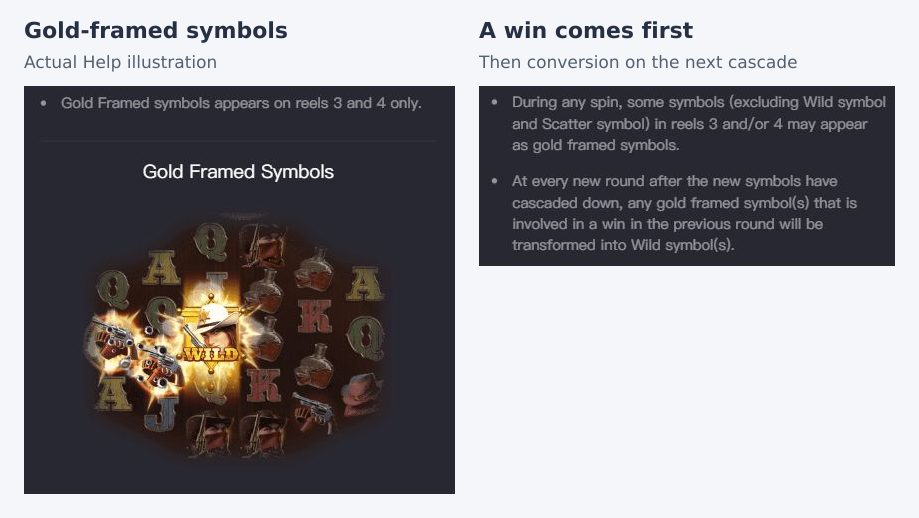
The Help shows where frames appear and when they convert. The transformation depends on the framed symbol having taken part in a win.
Each main-game spin starts at ×1. After a winning round pays and new symbols fall, the multiplier doubles: ×1, ×2, ×4, ×8 and so on, up to the stated ×1,024 limit. The larger value applies to the next winning round within that spin. It does not keep growing across unrelated paid spins, and a high value displayed on a board with no new win pays nothing by itself.
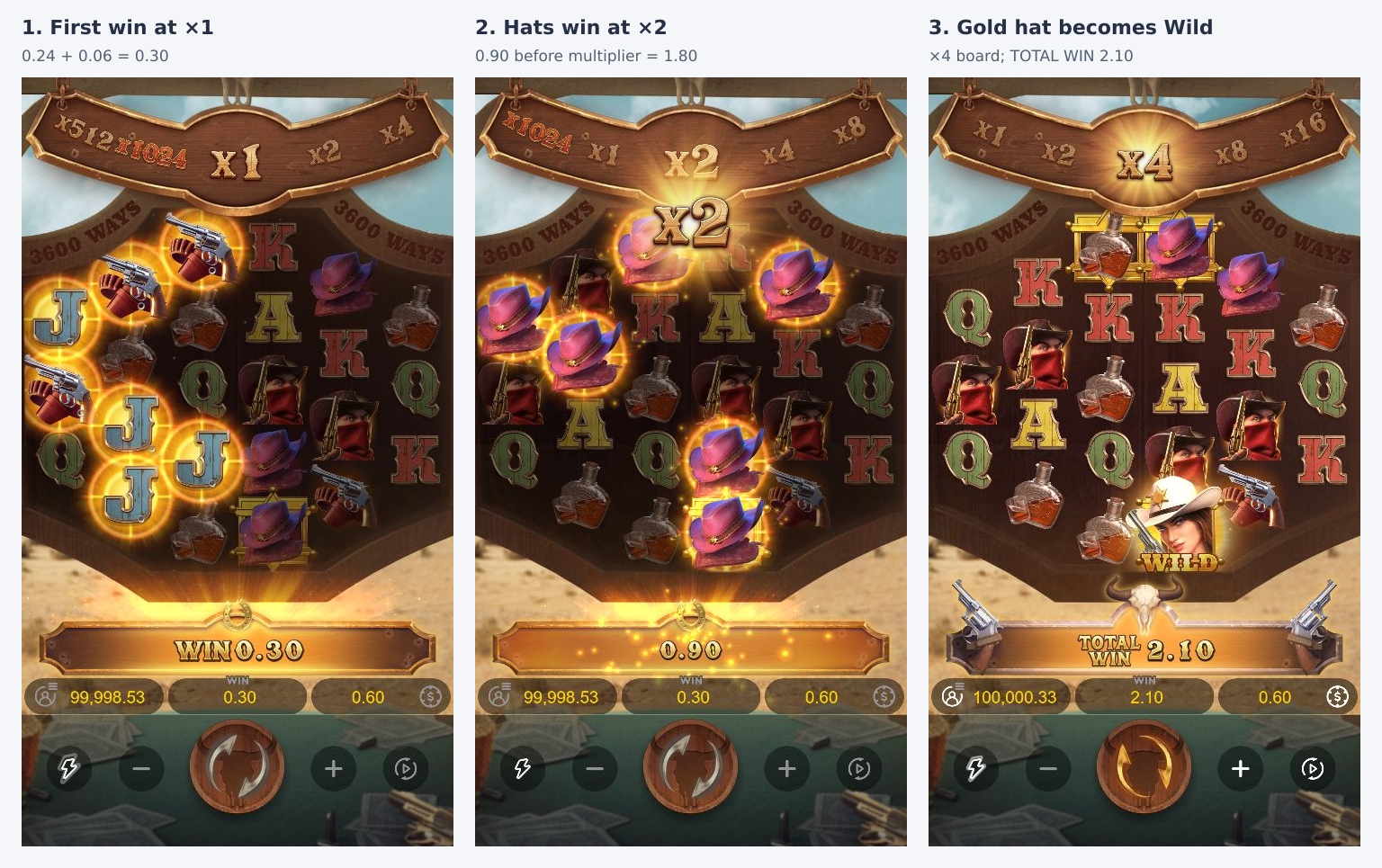
Spin 14: the first round pays 0.30, the second pays 1.80, and the final ×4 board adds no further award. The gold-framed hat on reel 4 becomes a Wild. Whole-spin payout: 2.10; paid cost: 0.60; net gain: 1.50.
This is the sequence that best sells the game to me. You can see the multiplier lift while a particular symbol changes into something useful for the next board. In spin 14, the second round had two five-reel hat ways: coefficient 15 × Size 0.03 × Level 1 × two ways = 0.90, then ×2 = 1.80. The final 2.10 combines that with the first round’s 0.30. The ×4 at the end did not multiply the already completed total again.
Free spins start higher, but each one starts afresh
Three Scatters anywhere on the reels trigger ten free spins; each extra Scatter adds two. The triggered feature keeps the bet size and bet level of the paid spin. Every free spin begins at ×8, then its multiplier doubles after winning cascades. The rules allow retriggers, although none was observed in this sample.
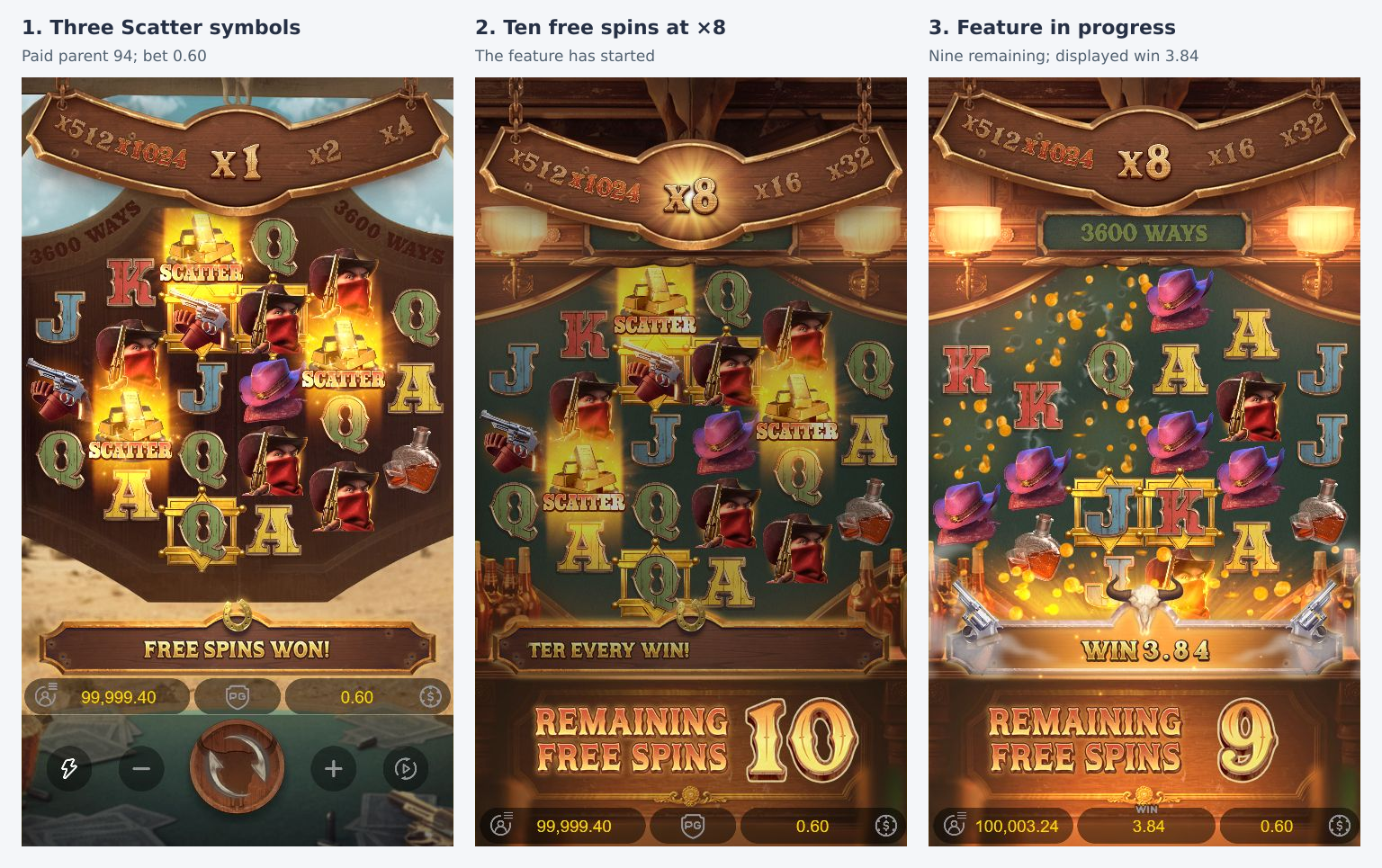
Paid spin 94 naturally triggered the feature. The three pictures show the trigger, ×8 starting state and an intermediate 3.84 display. That intermediate amount is part of the feature, not a second final payout.
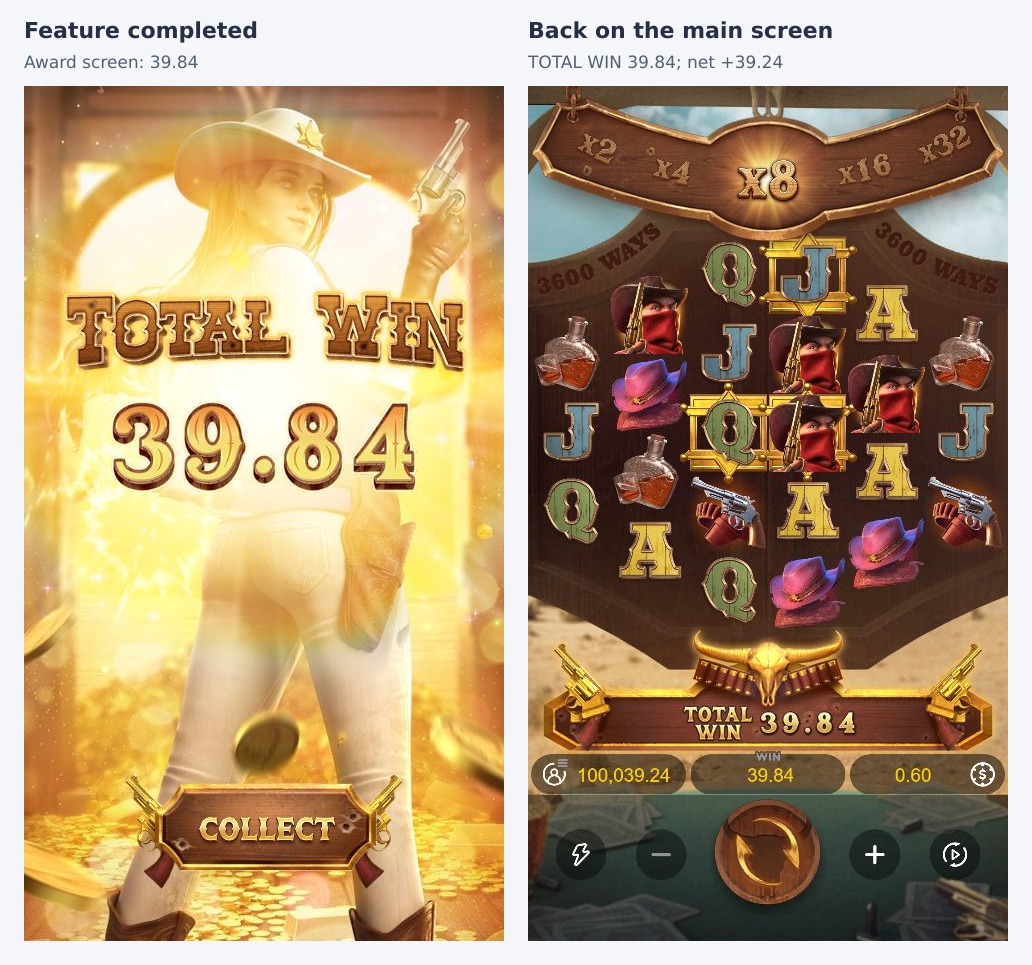
All ten free spins finished. Both the end screen and the returned main board show 39.84; the parent’s net gain is 39.84 − 0.60 = 39.24.
The feature has more room to turn a modest combination into a substantial award because it starts at ×8. It also brings longer pauses and celebrations. For my taste, the build-up works best when you have time to follow it rather than trying to fit a session into a short break.
Does this version have a Bonus Buy?
No usable Feature Buy or EX control was found in the captured demo’s main screen, opened settings, Bet Options, Auto panel or inspected Help. All 100 paid entries here are ordinary base spins. PG SOFT’s 2025 Game Information document does describe Feature Buy, so it would be wrong to say that the game never has one. It would also be wrong to quote a purchase price for this demo or present a bought feature as tested. Check the version actually available to you.
5. Bet costs, RTP and the two different multiplier limits
The recorded setup uses Size 0.03 × Level 1 × Base Bet 20, giving a 0.60 total cost per paid spin. Base Bet 20 is a pricing factor; it is not the number of ways. No additional charge is made for the cascades or naturally awarded free spins inside that paid parent.
Item | Captured demo | PG SOFT document / interpretation |
|---|---|---|
Paid sample setting | 0.03 × 1 × 20 = 0.60 | Demo units; currency was not independently identified |
Bet range | 0.60–180.00; Size 0.03–0.90 and Level 1–10 | 2025 PDF lists default EUR 0.20–100, a different configuration |
Theoretical RTP | Current configuration not independently confirmed | 96.75% in the supplier’s 2025 document |
Volatility | A 100-spin sample cannot establish it | High, the supplier’s label in that document |
Round multiplier | Main game begins ×1; free spins begin ×8 | Doubles after wins, with a ×1,024 limit |
Total maximum win | Rules state 5,000× Bet Amount | Separate from the round multiplier; the spin or free-spin feature ends at the limit |
Feature Buy / EX | No usable entry found; neither tested | Feature Buy is documented in the PDF; availability differs |
The official document, Version 1.0.r3, is the source for 96.75% RTP, High volatility and the 5,000× maximum. Its update date is printed as 08/07/2025. That document version is not a verified build number for the demo, and its euro-denominated default bet range should not be relabelled as the demo’s range or as Philippine pesos.
RTP describes a long-run theoretical payout relationship. It cannot tell you what the next hundred spins will return. Likewise, ×1,024 is the ceiling on the cascade multiplier, while 5,000× is the total-win cap relative to the complete bet. Neither limit was reached in this test. At a 0.60 bet, 5,000 × 0.60 equals 3,000 demo units as a rule-based ceiling, not an observed payout.
For a separate illustration of how short runs can diverge from a long-run return, try AskSpinner’s slot simulator. It is an educational tool; it does not reproduce Wild Bounty Showdown’s undisclosed reel model or predict its next result. Set a spending and time limit before playing for money, and never increase the bet to recover an earlier loss.
6. What happened in 100 paid demo spins?
The sample was recorded on 6 October 2026 in GMT+8, equivalent to 5 October UTC, using free demo credits. It contains 100 completed paid base spins at 0.60 each: 99 with Turbo enabled and spin 20 at normal speed for the video. Each paid spin includes its complete cascades and any triggered free spins. The ten free spins inside parent 94 do not become ten extra paid observations.
Measure | Recorded result | What it means |
|---|---|---|
Completed paid spins | 100 | All at 0.60; one naturally triggered free-spin feature included |
Total cost | 60.00 | Actual paid-parent costs |
Total payout | 105.03 | Final whole-parent payouts, without adding interim displays again |
Net result | +45.03 | 105.03 − 60.00 |
Sample return | 175.05% | 105.03 ÷ 60.00 × 100; not theoretical RTP |
Spins with a payout | 36 | 13 profitable, 3 exactly break-even and 20 below their cost |
Spins with zero payout | 64 | Each loses the 0.60 paid cost |
Largest whole-parent payout | 39.84, spin 94 | The complete naturally triggered feature; net +39.24 |
The net gain was heavily concentrated in parent 94. Its 39.24 net contribution accounts for about 87% of the aggregate gain. The other 99 spins still finished 5.79 ahead on 59.40 of cost, so the feature did not turn an otherwise losing aggregate into a winning one. Neither observation makes this a repeatable profit plan.
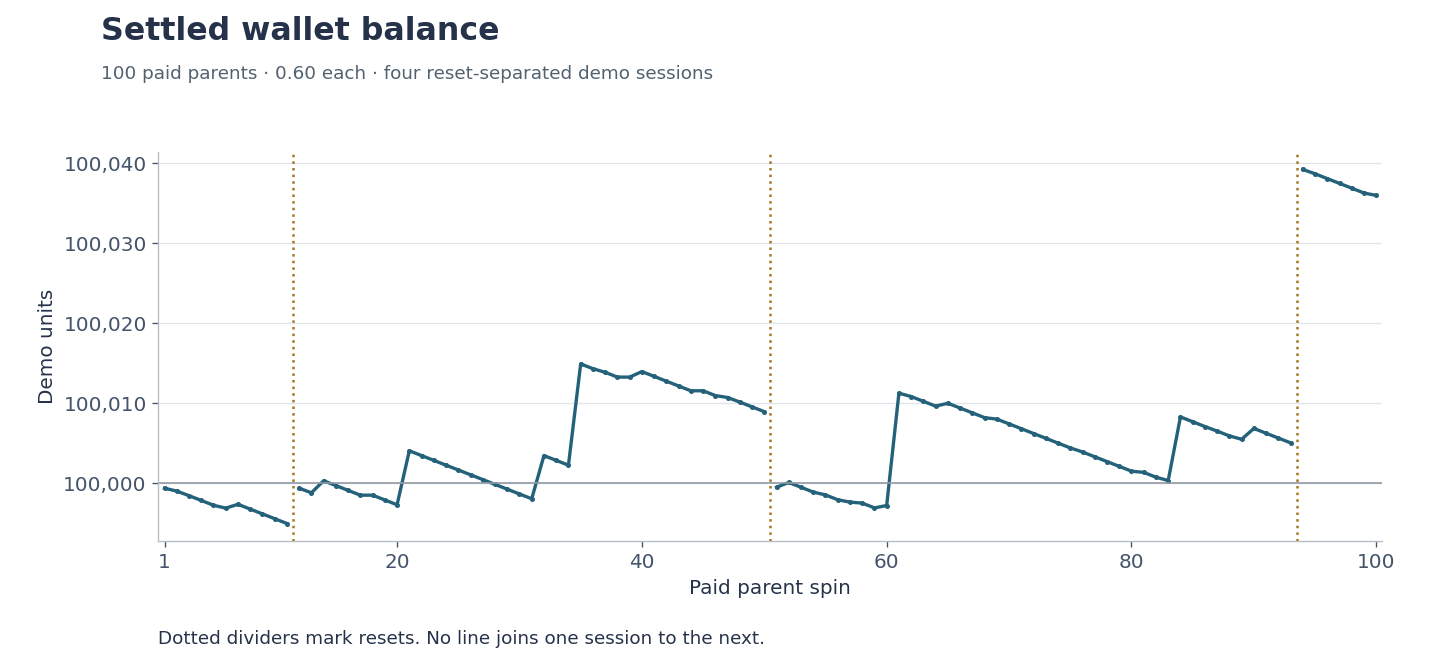
Actual wallet balance after each paid parent. Four sessions are drawn separately; the reload resets between spins 11/12, 50/51 and 93/94 are not wins or losses.
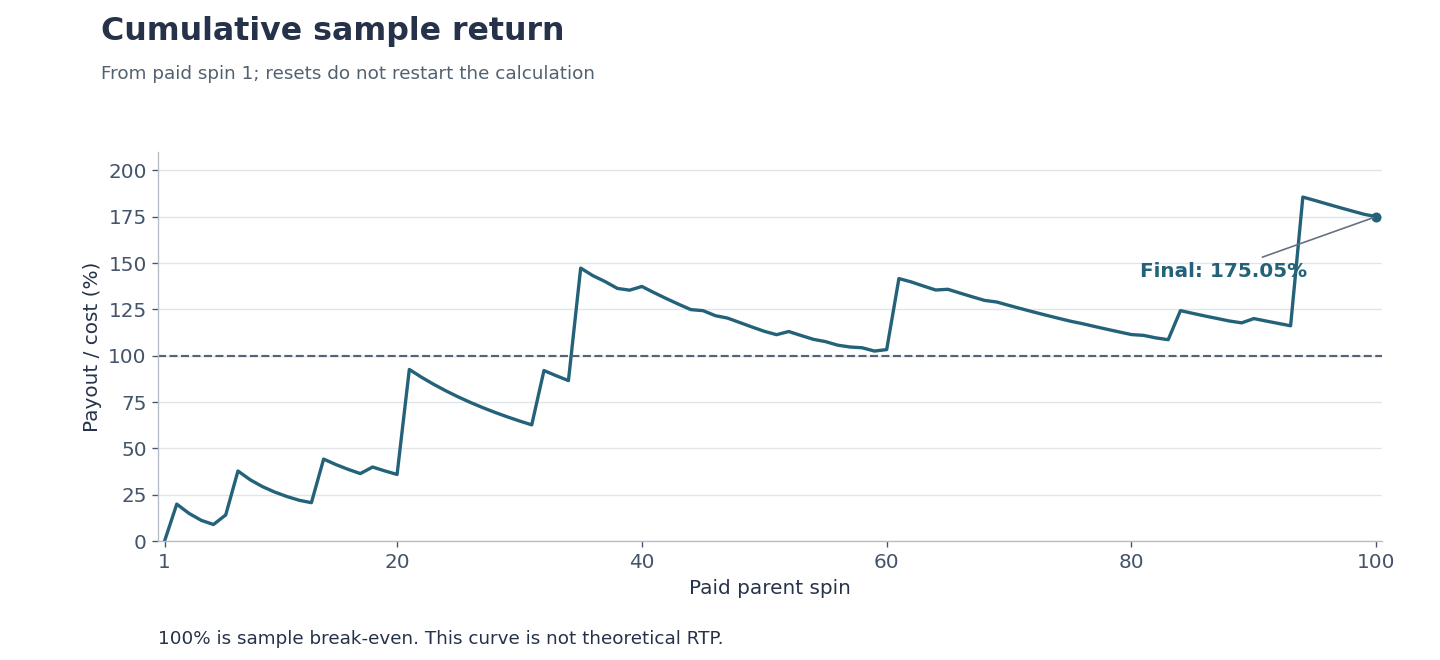
Cumulative sample return from the first paid spin: final payouts ÷ actual costs. The 100% line is sample break-even, not a theoretical-RTP benchmark. The running calculation continues across wallet resets.
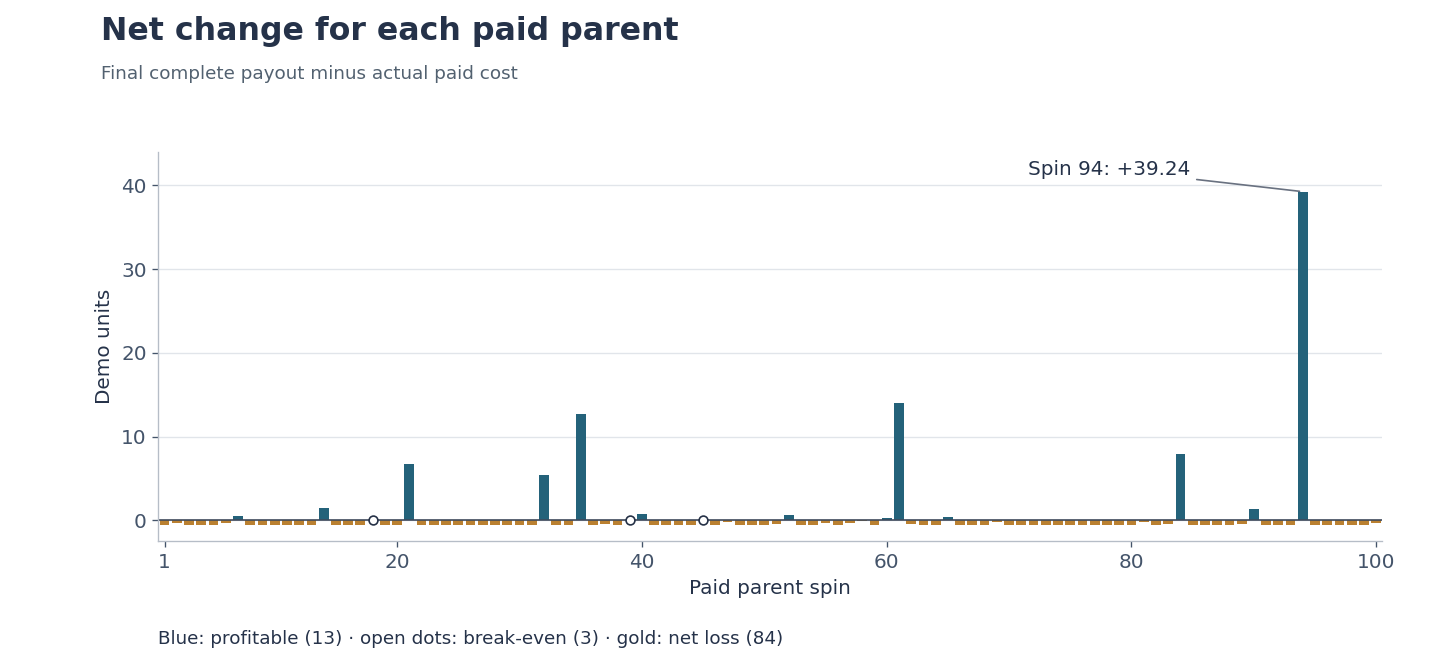
Net change per paid parent, including all its cascades and free spins. Positive bars exceed the cost; zero marks break even; negative bars lose money despite any smaller payout.
Read the interruptions alongside the results
Three demo-server requests failed without a confirmed settlement and were excluded rather than assigned an invented loss. Reloading reset the displayed wallet to 100,000 and cleared its visible History. The resulting four sessions contain 11, 39, 43 and 7 paid spins, with net results of −5.01, +8.97, +5.07 and +36.00. Their sum gives +45.03. Simply subtracting the very first wallet from the final one would miss the intervening resets.
Spin 95 also needs a clear qualification: a late click intended for the previous feature’s Collect button landed after the main screen had returned, starting another paid spin. It really cost 0.60 and paid 0.06, so it remains in the ledger as an unplanned input with a net loss of 0.54. This is a good practical reason to let the result screen settle and recheck the control before clicking.
What I take from this sample is how easily a payout can look better than it is. There were 36 paying spins, yet only 13 made a net profit and 84 of the 100 lost money after their cost. The final positive total came from a small number of larger results. A short, interrupted demo sample can illustrate that uneven experience; it cannot establish long-run hit rates, prove fairness or predict a real-money session.
7. Verdict: rewarding to follow, less comfortable to skim
Compared with Fortune Tiger by PG SOFT: the useful choice is how much developing board action you want to follow. The comparison below uses the captured rules for each game, rather than ranking them by a lucky sample or the size of a headline maximum.
Decision point | Wild Bounty Showdown | Fortune Tiger |
|---|---|---|
Ordinary result structure | Six reels; fixed 3,600 ways; collapsing wins | 3 × 3 reels; five fixed paylines |
What changes during the feature | Winning gold frames become Wild; winning cascades double the multiplier | A randomly triggered feature selects one ordinary symbol; matching symbols and Wilds stay as additional ones land during respins |
Multiplier condition | Starts ×1 in main spins or ×8 in free spins, doubling within that spin | ×10 when all reel symbols are involved in a win |
Who I would point toward it | Players who enjoy following cascades, transformation timing and a separate Scatter feature | Players who prefer a smaller board, fixed lines and a more concentrated respin idea |
Editorial score: 7.5/10. The combination of gold-frame Wilds and a clearly displayed doubling multiplier is strong enough to give Wild Bounty Showdown its own identity. I would choose it over a simpler fixed-line game when I want to watch a sequence develop. The dense board, smaller landscape presentation and lengthy feature pace keep it from being my first choice for quick, low-attention play.
Start with the smallest comfortable demo setting, read the final total against the full cost, and decide whether that rhythm appeals to you. The 175.05% sample return is a description of this recorded run; the mechanics and readability are the better reasons to decide whether to spend time with the game.
Wild Bounty Showdown by PG SOFT FAQs
Answers to common questions about Wild Bounty Showdown by PG SOFT.
Wild Bounty Showdown by PG SOFT Reviews
 No Player Reviews Yet
Played Wild Bounty Showdown by PG SOFT? Share your experience with other players.
 Write A Review