
Wild Ace by JILI
Play Wild Ace by JILI In Demo Mode
by JILI Games



 Other SymbolGold Showdown
- Free-spin feature
- After 2+ winning cascades
- Extra spins depend on combos
- No reel-symbol cash payout
 Other SymbolSilver Showdown
- Free-spin feature
- After 2+ winning cascades
- Adds one free spin
- No reel-symbol cash payout
 ScatterScatter
- Main-game reels 2–5
- 3+ trigger free spins
- Eight initial free spins
- Not replaced by Wild
 WildCrown Wild
- Substitutes except Scatter
- All five reels
- 5 Wilds: 1 at Bet 1
- 3/4-Wild awards unlisted
 WildGolden A Wild
- Substitutes except Scatter
- 11 winning cascades
- Resets after the spin
- 5 Wilds: 1 at Bet 1
 WildGolden K Wild
- Substitutes except Scatter
- 8 winning cascades
- Resets after the spin
- 5 Wilds: 1 at Bet 1
 WildGolden Q Wild
- Substitutes except Scatter
- 5 winning cascades
- Resets after the spin
- 5 Wilds: 1 at Bet 1
 WildGolden J Wild
- Substitutes except Scatter
- 2 winning cascades
- Resets after the spin
- 5 Wilds: 1 at Bet 1
 Paying Symbol8
- 3+ adjacent reels
- Starts on reel 1
- Dynamic bet-based amounts
- Five pay 0.30 at Bet 1
 Paying Symbol9
- 3+ adjacent reels
- Starts on reel 1
- Dynamic bet-based amounts
- Five pay 0.30 at Bet 1
 Paying SymbolClubs
- 3+ adjacent reels
- Starts on reel 1
- Dynamic bet-based amounts
- Five pay 0.30 at Bet 1
 Paying SymbolDiamonds
- 3+ adjacent reels
- Starts on reel 1
- Dynamic bet-based amounts
- Five pay 0.30 at Bet 1
 Paying SymbolHearts
- 3+ adjacent reels
- Starts on reel 1
- Dynamic bet-based amounts
- Five pay 0.30 at Bet 1
 Paying SymbolSpades
- 3+ adjacent reels
- Starts on reel 1
- Dynamic bet-based amounts
- Five pay 0.30 at Bet 1
 Paying SymbolJ
- 3+ adjacent reels
- Starts on reel 1
- Dynamic bet-based amounts
- Five pay 0.75 at Bet 1
 Paying SymbolQ
- 3+ adjacent reels
- Starts on reel 1
- Dynamic bet-based amounts
- Five pay 0.75 at Bet 1
 Paying SymbolK
- 3+ adjacent reels
- Starts on reel 1
- Dynamic bet-based amounts
- Five pay 0.75 at Bet 1
 Paying SymbolA
- 3+ adjacent reels
- Starts on reel 1
- Dynamic bet-based amounts
- Five pay 0.75 at Bet 1
Wild Ace by JILI Expert Review


Updated:
Here you can find detailed review information about Wild Ace by JILI.
1. A poker slot built around longer cascades
Wild Ace makes its best case when a winning sequence keeps going. J, Q, K and A can turn into Wilds as the COMBO count rises, so there is something useful to watch after the first match. I like that visible progression. The trade-off is that you have to follow several different numbers: the current combo, the accumulated WIN, and, in free spins, a multiplier that applies only to later wins.
What I liked
✅ The familiar poker ranks and suits are easy to distinguish, and Bet, WIN and Balance stay in predictable places.
✅ Golden Card progress and the COMBO counter make the changing board understandable. The recorded ordinary spins show both the J and Q thresholds.
✅ The Buy Bonus menu updates the price when the bet or quantity changes, making the commitment easy to check before starting.
What I didn’t like
❌ The paytable changes with the selected bet, while the WIN display can keep counting before the balance is credited. Both need careful reading.
❌ Free-spin multipliers and the Ace Showdown countdown add rules that are easy to miss at speed.
❌ The narrow landscape layout makes the text and controls noticeably smaller than portrait.
This is Wild Ace by JILI / TaDa Gaming, product 181, recorded in build v_112_11 on 6 October 2026. It is a 5-reel, 4-row slot with 1,024 fixed ways. This review keeps it separate from Super Ace, Super Ace Deluxe and their other relatives. The official product page lists March 2023 as its publication month; the June 2025 announcement concerns its Italian market launch.
Our recorded demo comprises 50 ordinary spins at Bet 1 and one separate Buy Bonus costing 38.50. The ordinary spins returned 42.70; the purchase returned 21.15. These are demo units, with no confirmed currency symbol, rather than peso or real-money results.
A 13-second clip of ordinary spin 1 at Normal speed, including the moment before input and the settled-board dwell. WIN 0.00; the balance moves from 2,000.00 to 1,999.00. The reels are not moving for the full 13 seconds.
If the demo is available above, try it on this page.
Philippine search interest. Ahrefs, queried for the Philippines on 6 October 2026, returned about 700 monthly searches for “wild ace”, 200 for “wild ace demo” and 150 for “wild ace jili”. These are estimated searches over its latest known 12-month window, not player counts. The terms overlap and should not be added together.
2. Reading the screen and using the controls
The dark table and pale playing cards give the board a clear contrast. The gold Wilds stand out without changing where you look for the money: WIN sits below the reels, with Balance below the controls. I prefer watching the top progress strip and then checking the final WIN, rather than treating every flash of gold as a separate payout.
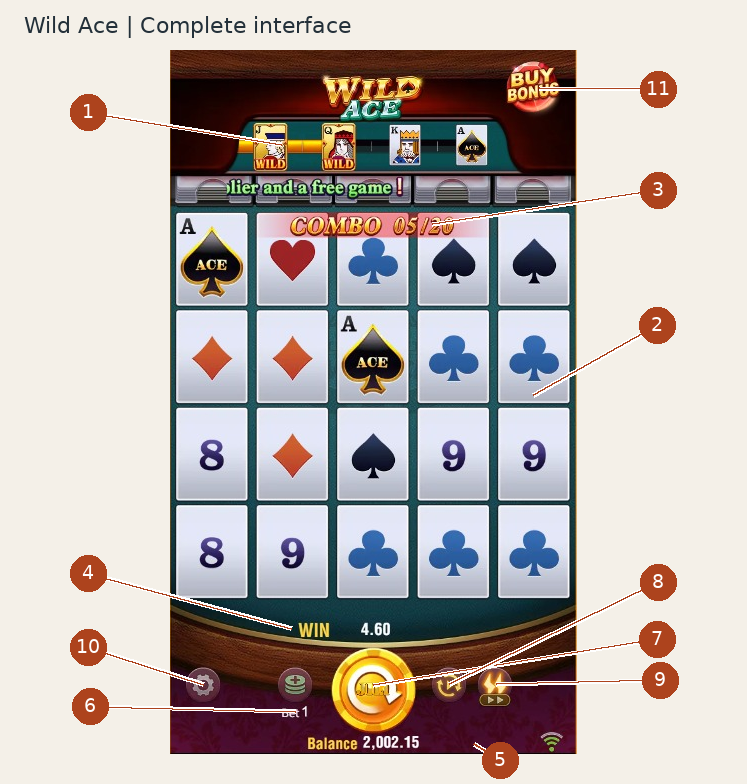
Spin 5: COMBO 05/20, WIN 4.60 and Balance 2,002.15. These are the values visible in this frame.
Golden Card progress: the J/Q/K/A strip shows the rank conversion ladder. Here J and Q already have golden Wild appearances.
Reel grid: five reels and four rows supply 1,024 possible ways, not 1,024 selectable paylines.
COMBO: 05/20 describes progress within this spin. It is not the number of paid spins completed.
WIN: the accumulated award display. During animations, wait for the finished result before treating it as final.
Balance: the wallet readout, separate from WIN. A display update and the final credit need not occur together.
Bet: opens the stake selector; this picture shows 1.
Spin: the large central JILI button starts a spin at the chosen stake.
Auto Spin: holds the automatic-spin controls. Long-pressing opened the settings in this session.
Turbo / Super Turbo: the lightning control changes speed. The double-lightning state shown here matches the separately captured Super Turbo confirmation.
Option: the lower-left gear opens the menu containing rules and sound-related controls.
Buy Bonus: the upper-right entry opens the separate purchase menu. Its cost must be checked there.
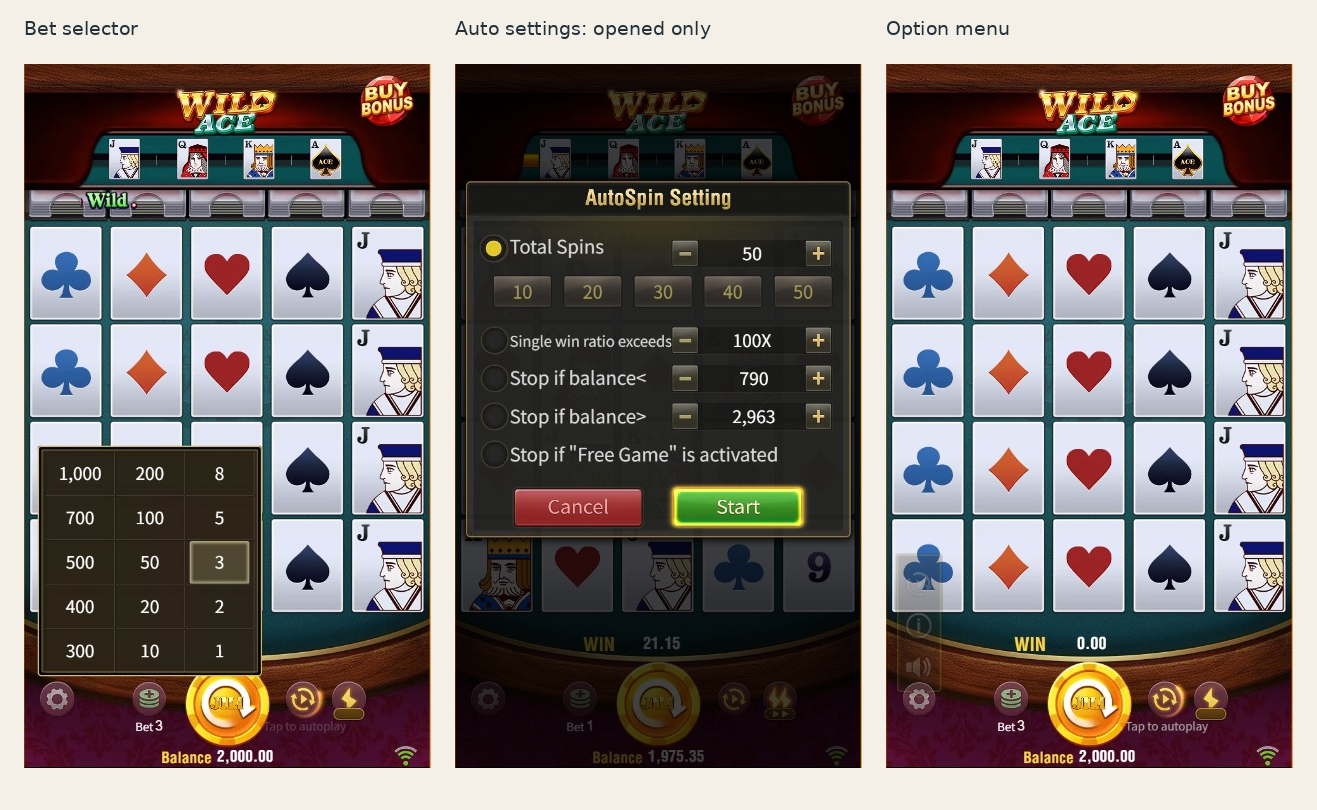
Three opened panels. The Auto screen shows a count of 50, a 100× single-win condition, balance thresholds of 790 and 2,963, and a stop-on-Free-Game option. They were inspected and cancelled, not run as a successful stop-condition test.
The captured Bet menu runs from 1 to 1,000. All 50 manual ordinary spins retained Bet 1, and the game returned to Bet 1 after the purchase. Help describes double-tapping Turbo for Super Turbo, plus keyboard/reel input subject to the operator and jurisdiction. The sample itself used Normal for spin 1 and Super Turbo for spins 2–50; its spins were started individually.
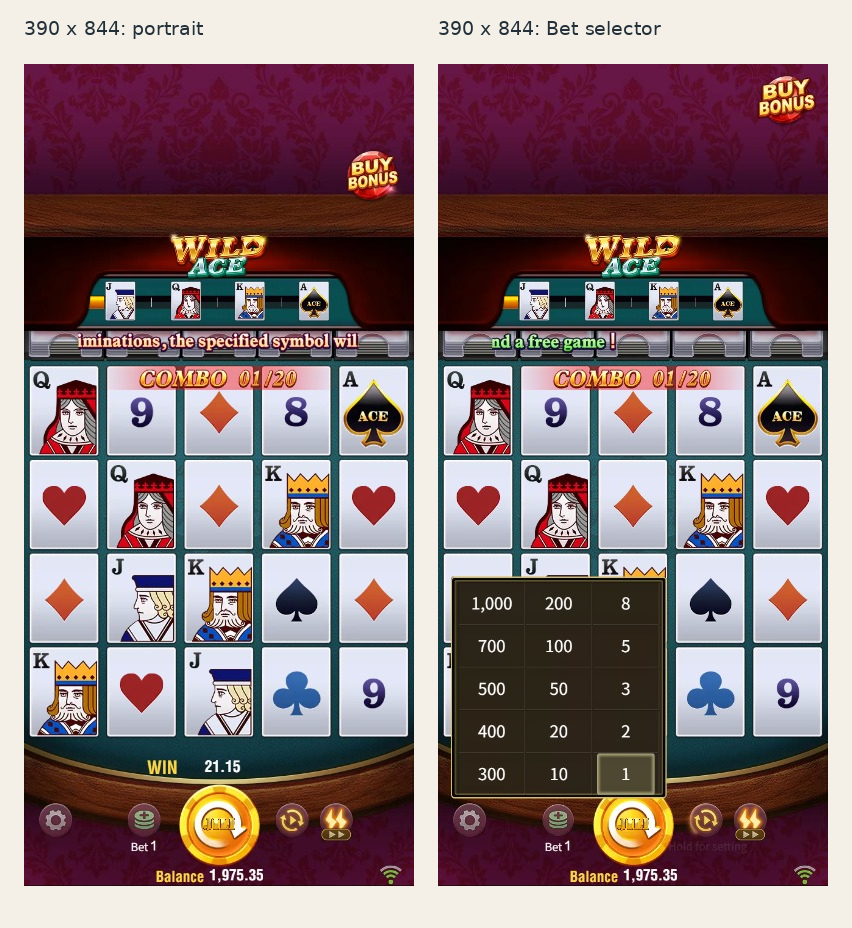
390 × 844 portrait simulations: the grid, balance and stake list remain readable.
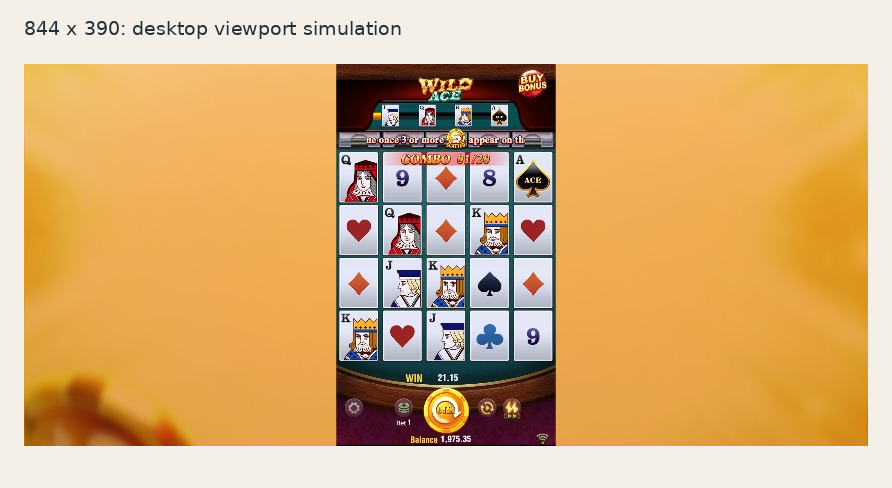
844 × 390 landscape simulation: the game keeps a central upright stage, leaving smaller text and controls.
I would use portrait for reading the feature. These captures come from desktop viewport simulation, so they establish layout rather than physical-phone touch performance or Philippine network quality. The video contains no audio track, so it does not support a sound-quality judgment.
3. How the 1,024 ways pay
A winning ordinary-symbol match starts on the leftmost reel and continues through at least three adjacent reels. The matching symbols can occupy different rows. Four possible positions on each of five reels give 4 × 4 × 4 × 4 × 4 = 1,024 possible ways; an actual result normally pays on only a subset of them. Each way pays its highest qualifying award, and simultaneous winning ways add together.
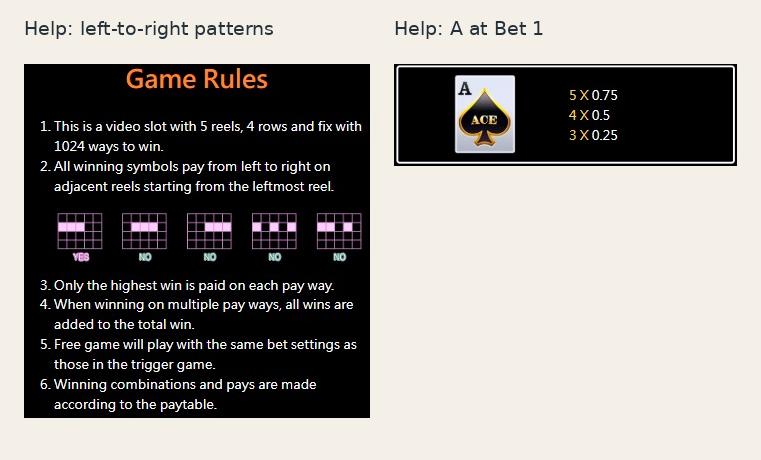
Rule illustrations from the recorded Help, not a newly played result. The valid example starts on reel 1; isolated or gapped matches do not qualify.
For a simple arithmetic example, two A symbols on reel 1, one on reel 2 and three on reel 3 would form 2 × 1 × 3 = 6 three-reel ways. At Bet 1, six such A ways pay 6 × 0.25 = 1.50, provided they do not extend into higher-paying four- or five-reel matches. This is an explanatory arrangement, not an extra result added to the recorded sample.
The separate symbol atlas on this page lists the full payouts and symbol functions. The examples here show how ways and the dynamic paytable work in practice.
The Help table displays amounts for the selected bet. Its “5 X 0.75” row means a five-symbol award of 0.75, not 5 × 0.75. At Bet 3, the A/K/Q/J amounts become 0.75 / 1.50 / 2.25. Do not multiply the displayed amount by the bet again.
Golden J, Q, K, A and the crown are five Wild appearances. Wild substitutes for everything except Scatter and can appear on all reels. The gold coin Scatter appears on reels 2–5 in the main game; at least three trigger the initial eight free spins. Help lists no ordinary cash award for Scatter. Two Scatters, or even two visible crown Wilds, do not guarantee a paying result.
After a win, the paying symbols disappear, remaining cards fall and new cards enter from above. This continues until there is no new win. Help caps a spin at 20 winning cascades; reaching that cap ends the drops and settles the round. The complete cascade award is credited after the sequence finishes.
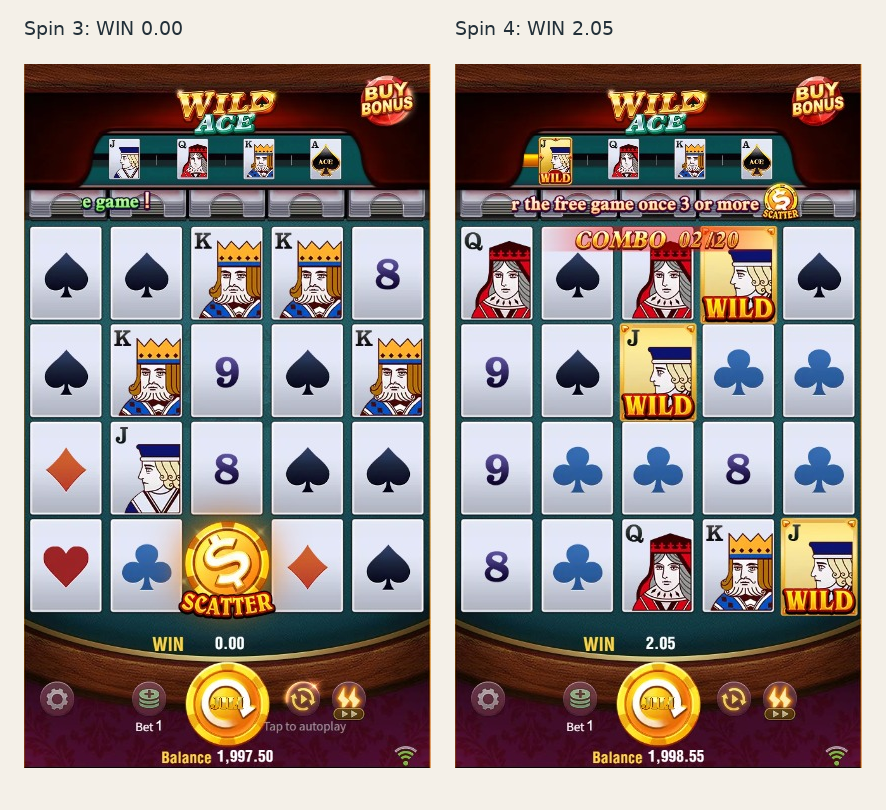
Two separate ordinary spins at cost 1 each: spin 3 pays 0.00, net −1.00; spin 4 pays 2.05, net +1.05. The displayed award and net change are different measures.
4. Golden Cards, free spins and the actual Buy Bonus
Golden Cards follow the combo count
Within one spin, the second winning cascade turns J into Golden Wild; the fifth adds Q, the eighth K and the eleventh A. The converted ranks remain Wild until that spin ends. This is a rank-by-rank progression, and it resets for the next spin.
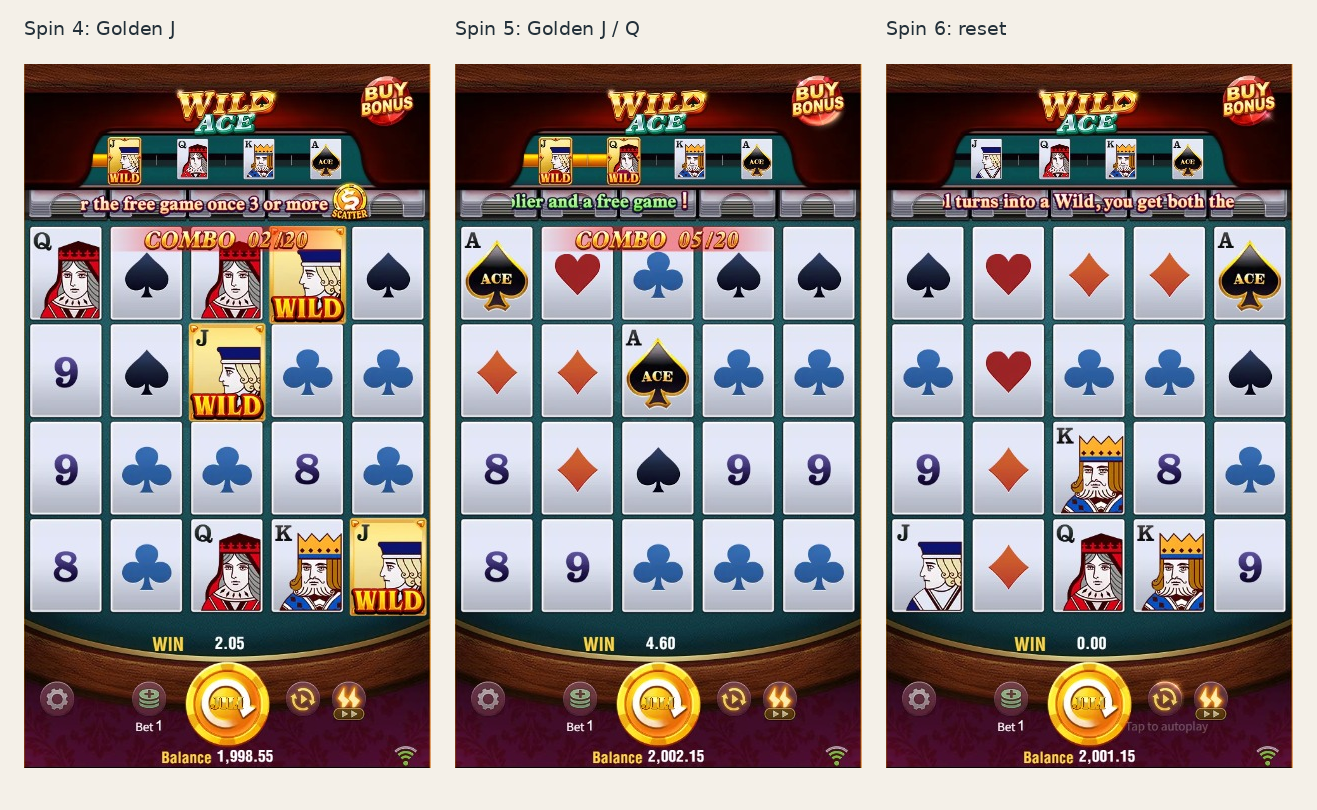
Spin 4 reaches the J threshold; spin 5 shows both J and Q at COMBO 05/20; spin 6 shows the ordinary progress-strip appearances again. These are successive separate spins, not three frames from one spin.
The ordinary sample reached a maximum of six winning cascades. It therefore supports the observed J and Q progression, while the K/A thresholds and the 20-cascade ceiling remain Help rules rather than limits reached in this sample.
Free-spin multipliers affect later wins
Three or more main-game Scatters start eight free spins at the triggering bet settings. Within each free spin, reaching 2 / 5 / 8 / 11 winning cascades raises the multiplier for subsequent wins to ×2 / ×3 / ×4 / ×5. It resets after that free spin. A newly reached multiplier is not applied retroactively to the earlier accumulated WIN.
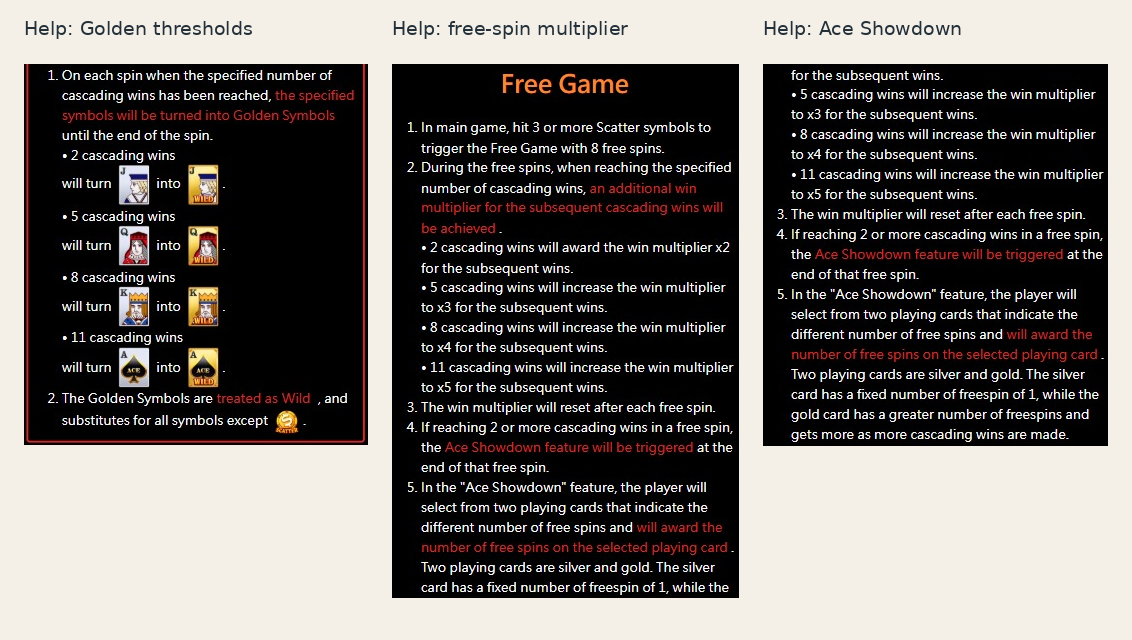
The recorded Help separates rank conversion from the free-spin multiplier and extra-spin rules.
A free spin with at least two winning cascades leads to Ace Showdown when that spin ends. Help describes a choice between a silver card, worth one extra spin, and a gold card, worth more according to the combo performance. It does not provide a complete gold-card increment table.
One purchase, one final award
The purchase menu was first checked at Bet 1 / Quantity 2, showing a total of 77, then Bet 2 / Quantity 1, also showing 77. Those were previews. The actual purchase was restored to Bet 1 / Quantity 1: 38.50.
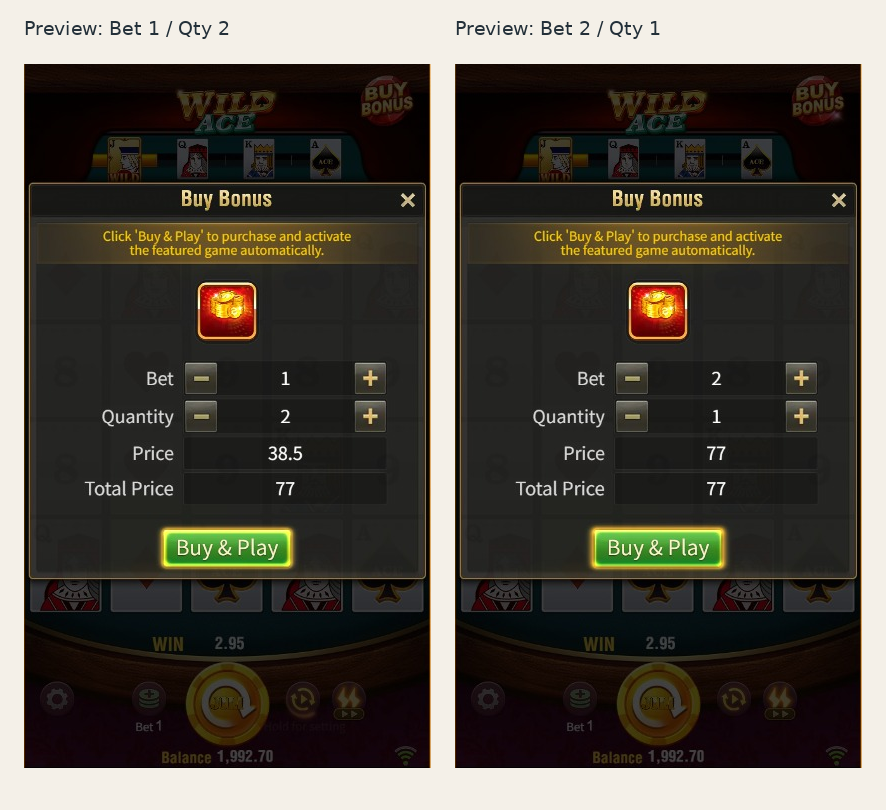
Two price previews, not two additional purchases.
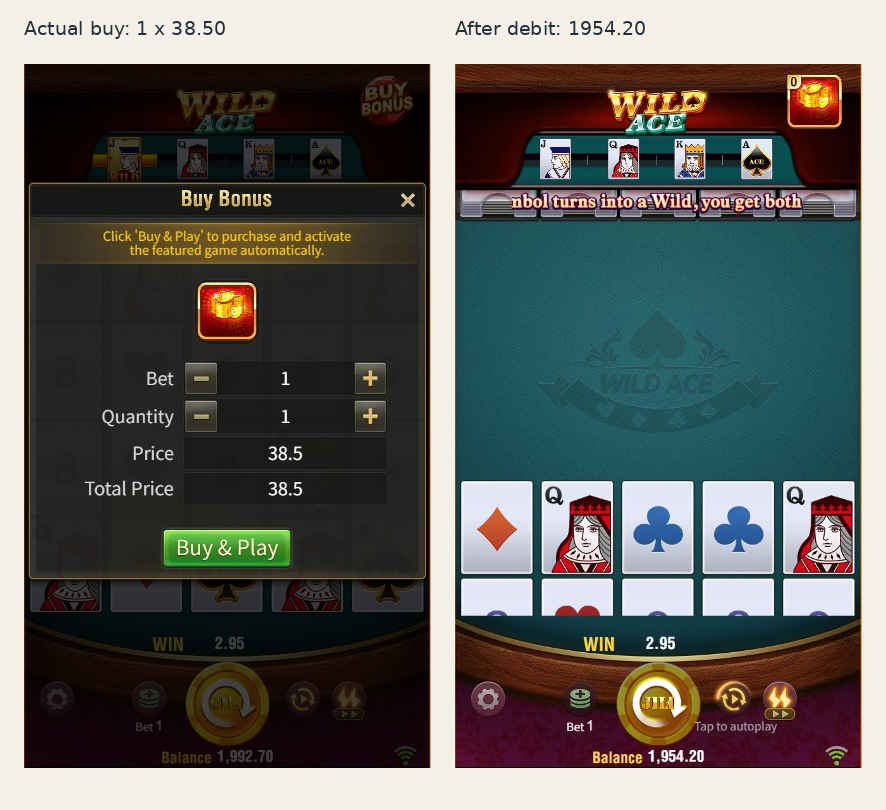
The actual confirmation and debit. The old WIN 2.95 briefly remains on screen after purchase; it belongs to the preceding ordinary spin and is not part of the purchased award.
The purchase begins with visible cascades. The later feature-entry screen shows three Scatters, FREE SPIN 8 and accumulated WIN 15.45, while Balance remains 1,954.20. A 10.325-second gap between saved screenshots prevents reconstruction of every preceding drop or rank conversion. The entry animation also displays Q×3, K×4 and A×5; that presentation alone does not prove that every multiplier was used.
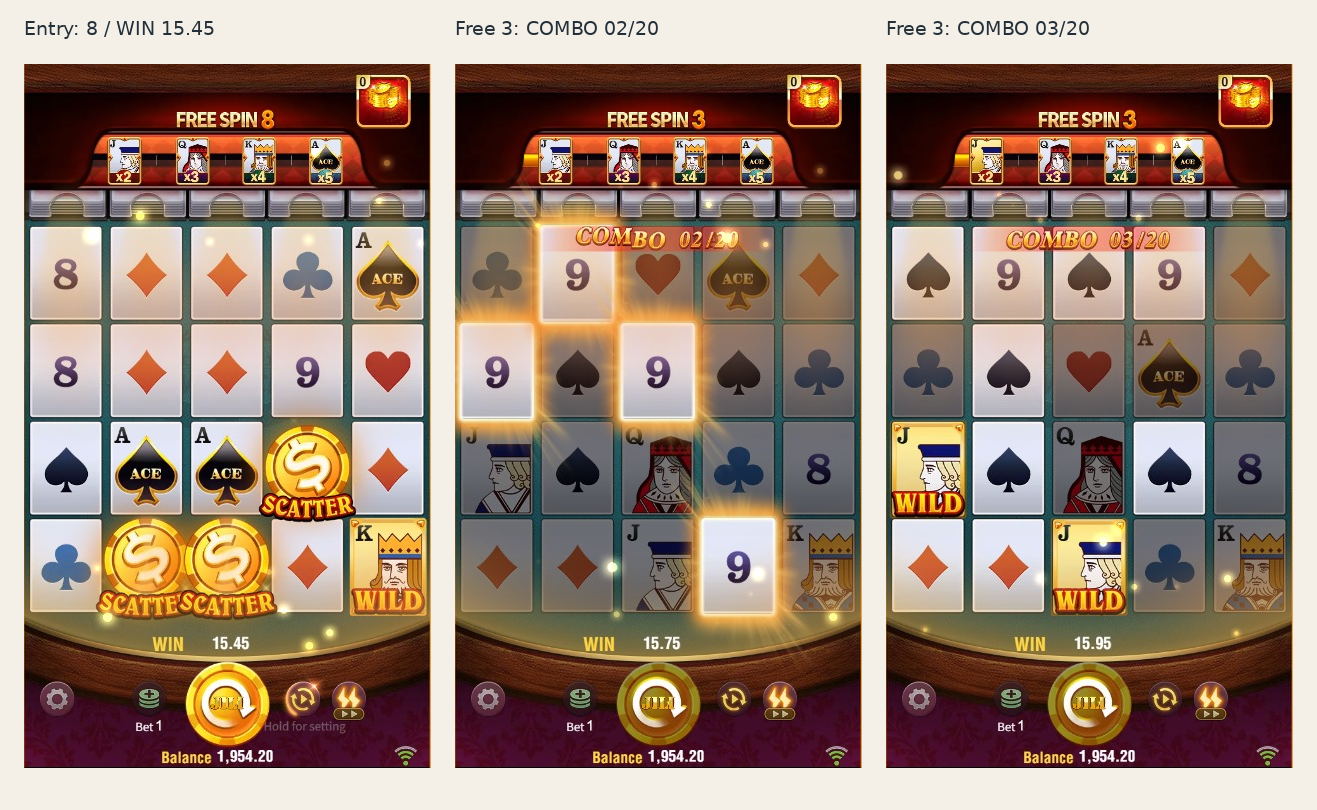
Visible entry and free-spin states. Later frames at FREE SPIN 3 show COMBO 02/20, Golden J and COMBO 03/20; WIN progresses through 15.75 and 15.95 toward 19.95.
After one press of Spin at the eight-spin entry, the game advanced on its own. At Ace Showdown, the operator did not choose a card. The recorded countdown ran, the cards turned, and the left silver card awarded +1 spin; the counter moved from 3 to 4 with WIN still 19.95. The right gold card displayed +3, but it was not the awarded result and does not establish a universal gold-card value.
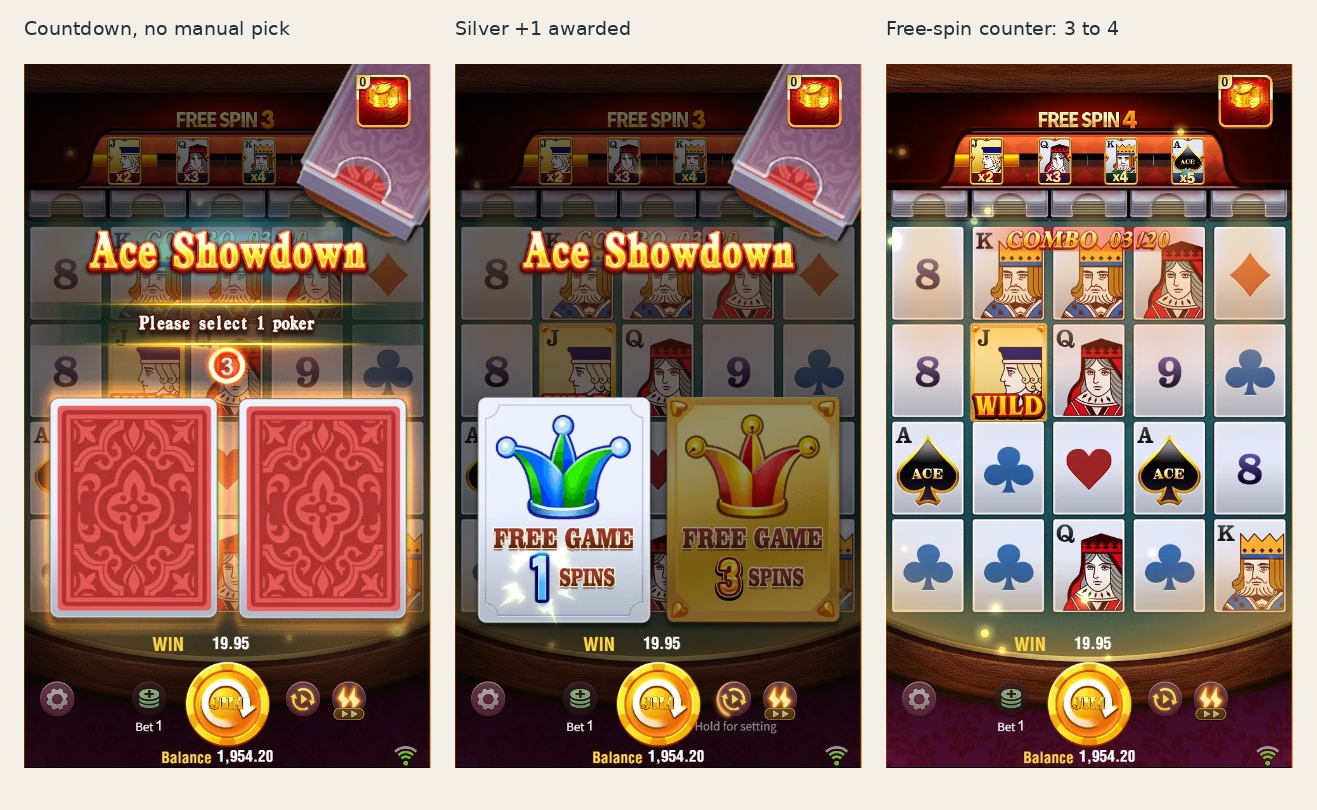
Actual countdown outcome: silver +1 without a manual selection. Help’s player-choice description and this timeout flow are distinct observations.
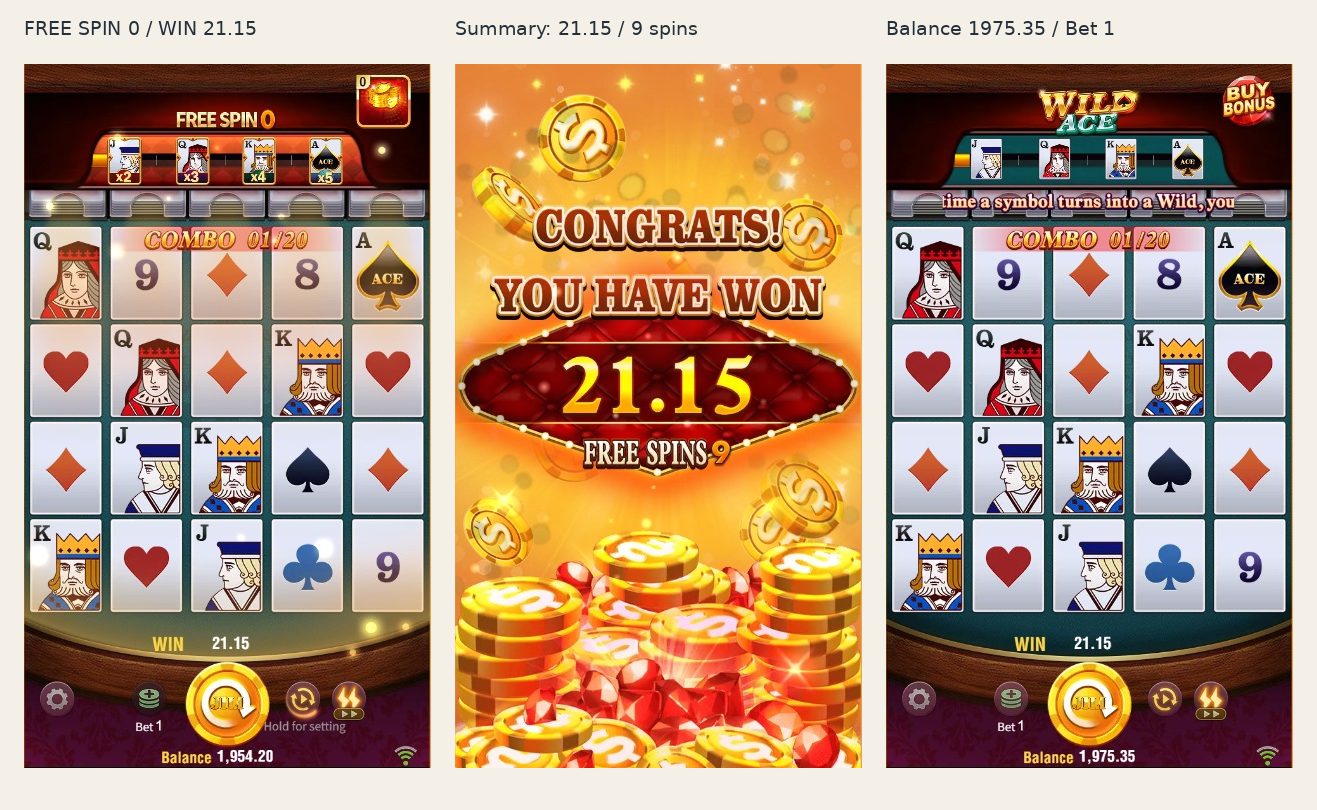
Final board, completed feature summary and returned main screen. The summary is 21.15 over nine free spins; the ending balance is 1,975.35.
The final 21.15 already includes the entry WIN 15.45. The purchase net is 21.15 − 38.50 = −17.35. The saved process is a series of discrete screenshots, so it does not supply nine complete free-spin payout rows. We can check the purchase total and the visible +1 event without inventing those missing intermediate settlements.
5. Costs, RTP and conflicting specifications
Mode | Recorded setting | Cost | How to read it |
|---|---|---|---|
Ordinary | Bet 1 | 1 per paid spin | All cascades settle within that spin |
Buy Bonus | Bet 1, Quantity 1 | 38.50 | One complete purchased feature |
Buy preview | Bet 1 × Quantity 2, or Bet 2 × Quantity 1 | 77 displayed | Settings checked only; neither was purchased |
Help gives a 1–1,000 bet range and prices each purchased feature at 38.5 × the bet selected in the Buy menu. Quantity can run up to 99; total price is unit price × quantity. Subsequent purchases require another Spin input or Auto Spin, and the sequence ends at zero remaining quantity. Buying a feature is a separate, substantially larger commitment than one ordinary spin.
The purchase rules say the bet cannot be changed, nor remaining purchases actively cancelled, before the sequence finishes; they separately say a disconnect or browser closure cancels remaining quantity. The original bet is restored at the end. These are Help terms, not tested refund or recovery promises. No EX extra-bet control was found in the inspected main screen, menus or full Help.
The current Help does not state an RTP. The official Game Sheet prints Total 97.05%, but its Main 78.83% plus Bonus 19.22% equals 98.05%. That one-percentage-point conflict is present in the source. Neither figure can be confirmed as this running demo’s RTP from these materials.
Source | Maximum multiplier | Other relevant specification |
|---|---|---|
Current v_112_11 Help | 10,000× | Maximum payout 10,000,000; Bet 1–1,000; currency unspecified |
JILI / TaDa product page | 1,000× | JILI labels volatility LOW-MED |
Official Game Sheet | 1,500× | LOW-MED; EUR 0.1–100; conflicting RTP figures |
10,000× | Describes medium volatility and the Italian launch |
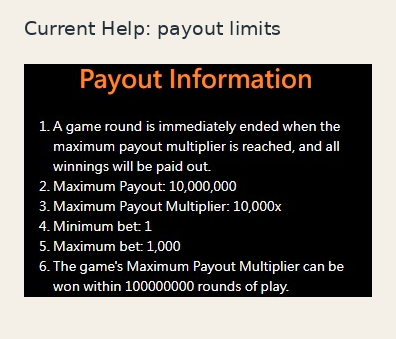
Limits shown by the recorded build. The round ends immediately at its maximum multiplier.
Matching one number across sources does not establish that the full configurations match. The cause of these differences is unresolved. Help also contains a statement about obtaining the maximum multiplier within 100,000,000 rounds; this is not a measured frequency or a waiting-time promise. Supplier volatility labels describe their stated specifications; 50 spins cannot validate a long-run volatility category.
For a separate illustration of how cost and short-run variation interact, the slot simulator is useful. It does not reproduce Wild Ace’s undisclosed game mathematics.
6. What the 50 ordinary spins actually returned
The full ordinary sample is 50 completed paid spins from 6 October 2026 at Bet 1. Each row uses the complete settled award after any cascades. The 13-second clip is spin 1 within those 50, not an extra paid spin. The independent purchase follows them and is excluded from all three charts below.
Measure | 50 ordinary spins | One separate BUY |
|---|---|---|
Cost | 50.00 | 38.50 |
Total payout | 42.70 | 21.15 |
Net change | −7.30 | −17.35 |
Starting → ending balance | 2,000.00 → 1,992.70 | 1,992.70 → 1,975.35 |
Sample return | 85.40% | 54.94% |
Paid events with any payout | 18 / 50 | 1 / 1 |
Net-positive paid events | 12 / 50 | 0 / 1 |
Net-negative paid events | 38 / 50 | 1 / 1 |
The ordinary spins include 32 zero-award results and six awards smaller than the cost. There were no break-even spins. The largest award, 10.75 on spin 46, produces a net gain of 9.75 for that spin. The longest zero-award run is eight spins, 38–45; the longest net-loss run is eleven, 35–45. These describe this particular run, not odds for the next spin.
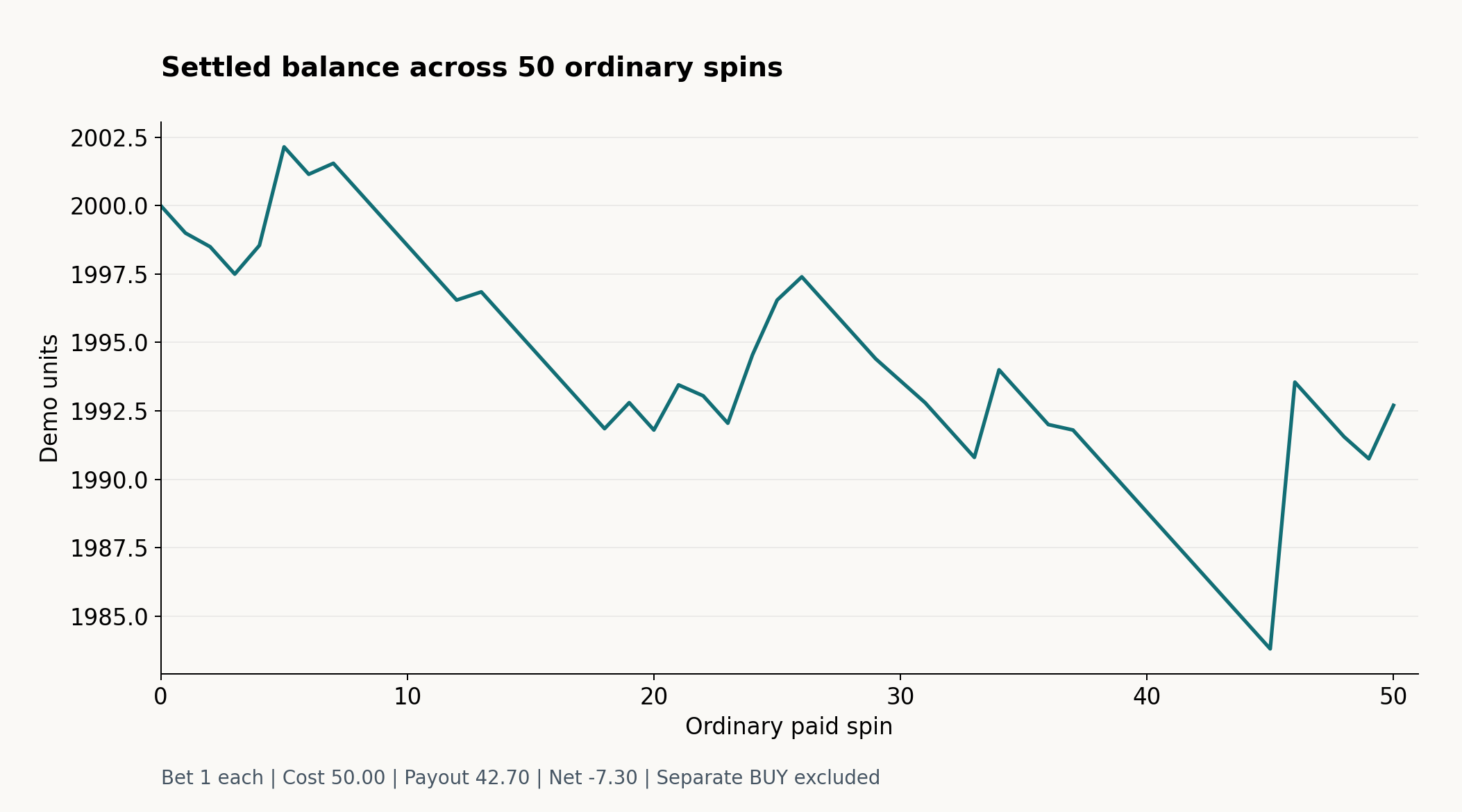
Settled balance, including the starting point. Every plotted step comes from the recorded ledger; the separate BUY is not added.
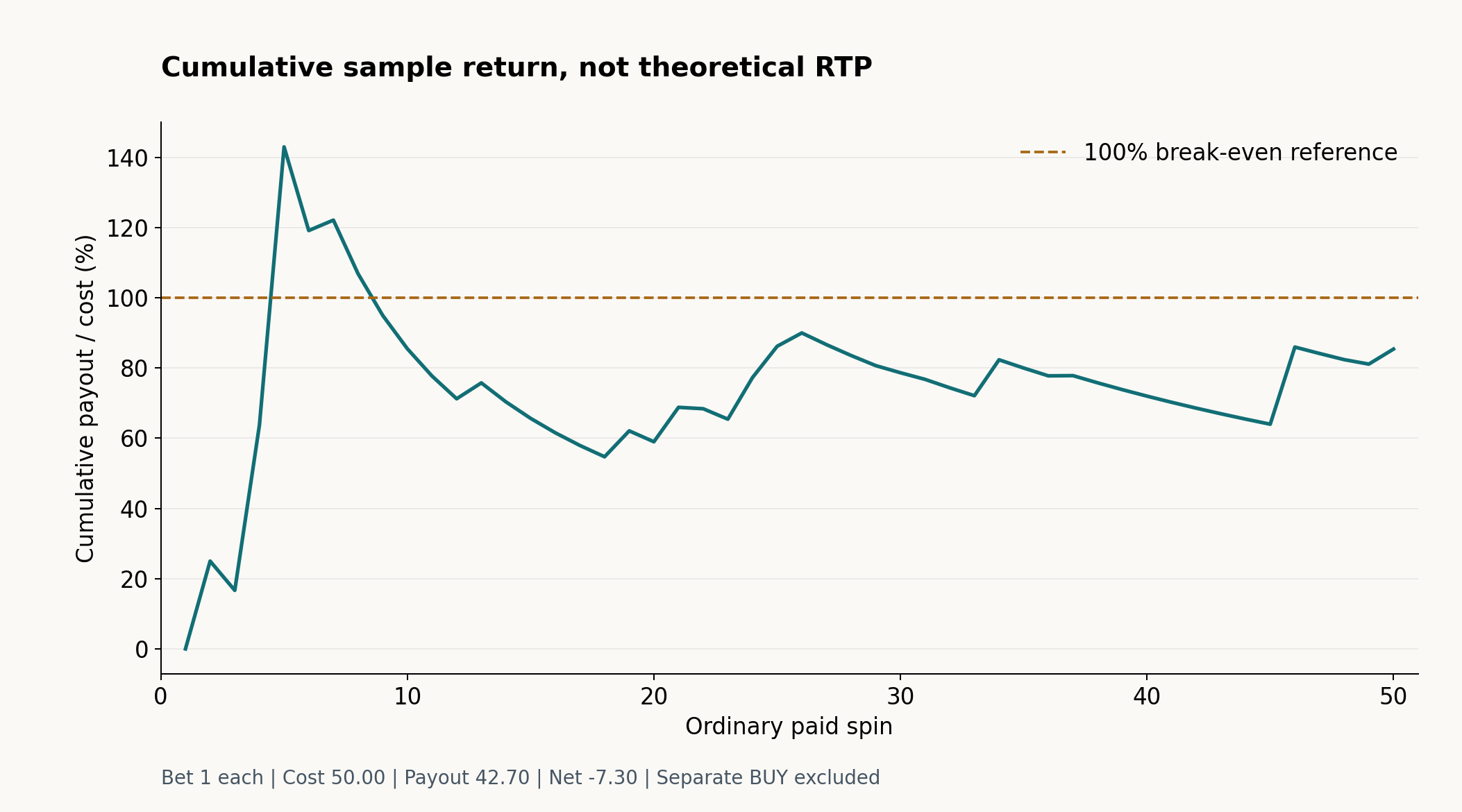
Cumulative payout ÷ cumulative actual cost, from spin 1. The 100% line is a break-even reference; 85.40% is the sample return, not theoretical RTP.
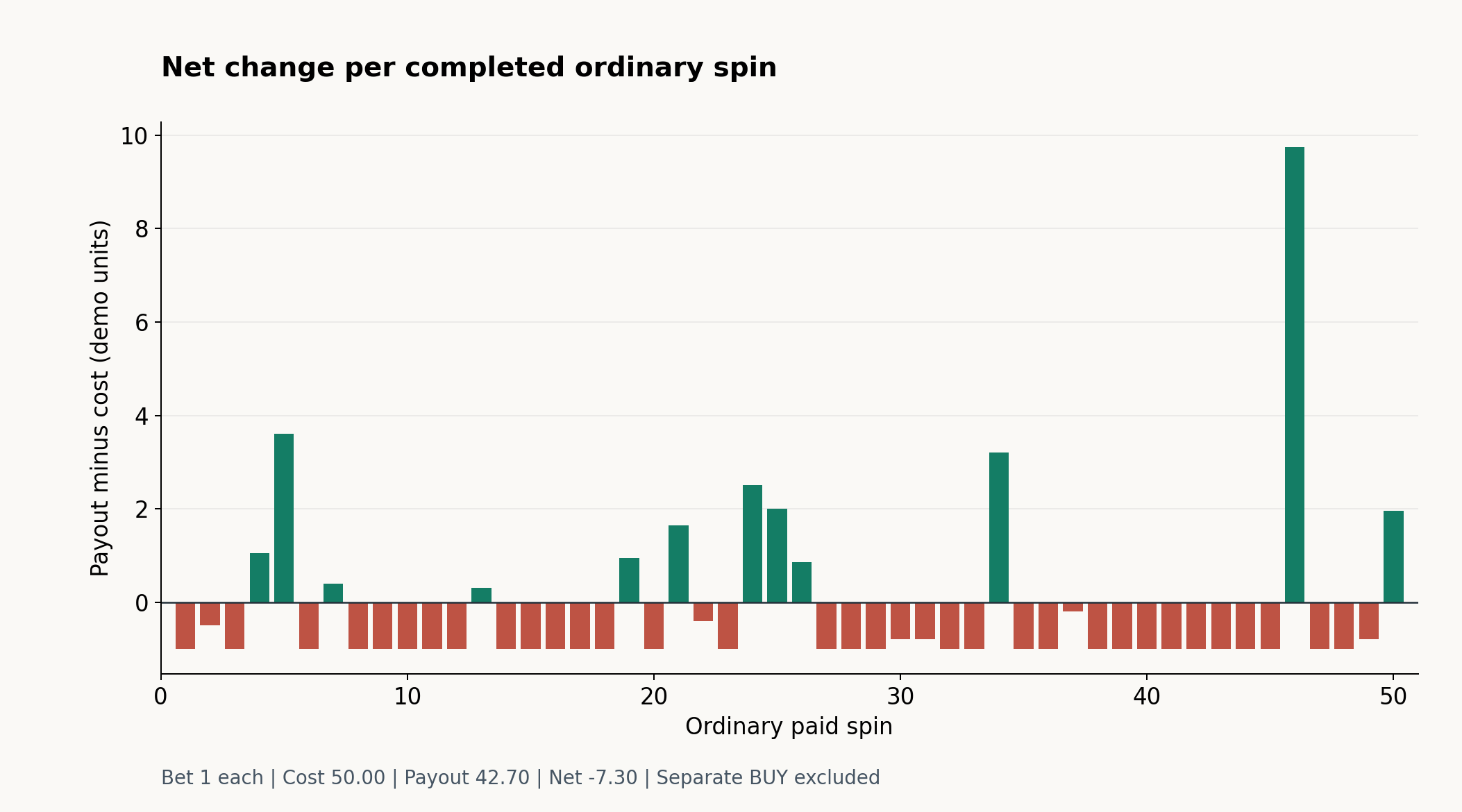
Each bar is the complete spin payout minus its cost of 1. Positive award messages can still produce negative bars.
The result I find most useful is the difference between the 18 paying spins and the 12 profitable ones. A small win can extend the animation without restoring the stake. Spin 46 is also a clear reminder that one larger result can change the shape of a short session without explaining its long-term outlook.
A refresh of the same temporary demo link after completion produced MSG103. That records one failed refresh; it does not establish a general game-performance or network defect. Help’s malfunction and interrupted-game settlement clauses likewise do not prove what caused or would resolve that session response.
7. My verdict and the closest comparisons
I would give Wild Ace 7.5/10 for readable progression and an interesting connection between cascades, rank conversion and extra spins. I would choose ordinary play first to learn those changes at a comfortable pace. The purchase menu makes its price clear, but its extra commitment does not make the outcome safer or more predictable.
Comparison point | Wild Ace, product 181 | Classic Super Ace, recorded build v_189_0008 |
|---|---|---|
Board and wins | 5 × 4; 1,024 ways | 5 × 4; 1,024 ways |
Golden mechanic | J/Q/K/A become Wild at 2/5/8/11 winning cascades in a spin | A winning Golden symbol on reels 2–4 becomes a Joker in its original position |
Initial free spins | 8, with Ace Showdown extra-spin opportunities | 10; its recorded rules include a different retrigger structure |
Purchase entry | Buy Bonus at 38.5 × selected bet | No BUY or EX entry in the inspected build |
Who it suits | Players who want a visible rank ladder and extra-spin card reveal | Players who prefer watching Golden positions turn into Jokers |
The Super Ace comparison uses the earlier completed review, not another playthrough for this article. Its different stake and sample size are not grounds for ranking either game’s profitability. If you prefer tile imagery, Mahjong Ways by PG SOFT offers another 1,024-ways cascade structure: winning gold-plated tiles can become Wilds and a multiplier ladder advances through drops. That is a useful mechanical contrast with Wild Ace’s rank thresholds.
For me, Wild Ace is worth trying if the changing board is the attraction. A straightforward slot with fewer counters will be easier to read at a glance. Here, slowing down enough to distinguish later-win multipliers, accumulated awards and final credits makes the game much more understandable.
Wild Ace by JILI FAQs
Answers to common questions about Wild Ace by JILI.
Wild Ace by JILI Reviews
 No Player Reviews Yet
Played Wild Ace by JILI? Share your experience with other players.
 Write A Review