
Captain’s Bounty by PG Soft
Play Captain’s Bounty by PG Soft In Demo Mode
by PG SOFT



 ScatterScatter
- 3 award 10 free spins
- Anywhere on reels
- Each extra adds 5
- Retrigger in rules
 WildWild
- Replaces paying icons
- No own cash table
- Never replaces Scatter
- Reels 2–4 only
 Paying SymbolQ
- 3/4/5: 3/10/50
- Leftmost-reel start
- Size × Level basis
- Wild may substitute
 Paying SymbolK
- 3/4/5: 4/15/75
- Leftmost-reel start
- Size × Level basis
- Wild may substitute
 Paying SymbolA
- 3/4/5: 5/20/100
- Leftmost-reel start
- Size × Level basis
- Wild may substitute
 Paying SymbolBottle
- 3/4/5: 10/25/200
- Leftmost-reel start
- Size × Level basis
- Wild may substitute
 Paying SymbolCompass Book
- 3/4/5: 15/50/500
- Leftmost-reel start
- Size × Level basis
- Wild may substitute
 Paying SymbolHook
- 3/4/5: 20/100/1000
- Leftmost-reel start
- Size × Level basis
- Wild may substitute
 Paying SymbolPirate
- 3/4/5: 50/250/2500
- Leftmost-reel start
- Size × Level basis
- Wild may substitute
Captain’s Bounty by PG Soft Expert Review


Updated:
Here you can find detailed review information about Captain’s Bounty by PG Soft.
1. A pirate slot that gets better when a win keeps going
Captain’s Bounty by PG Soft is at its most appealing when the same paid spin keeps opening up: hooks disappear, another line forms, and the wheel above the reels moves to a larger multiplier. I like that the escalation is easy to follow. Its five-reel, three-row board and 20 fixed lines give the colourful pirate theme a fairly straightforward game underneath.
What I liked
✅ The visible multiplier wheel gives each cascade a clear sense of progress; spin 35 carried one stake through six rounds.
✅ Twenty fixed line diagrams and detailed History calculations make it possible to explain exactly why a result paid.
✅ The pirate, treasure chests and parrot Scatters are easy to tell apart, and the portrait layout keeps the stake close to Spin.
✅ Free spins lift the whole multiplier ladder, giving the bonus a clear connection to the base game.
What I didn’t like
❌ Landscape kept a narrow upright stage, with noticeably smaller money labels and buttons.
❌ The Bet Options column headings are small and low contrast, despite the importance of checking Size, Level and total stake.
❌ A paid line or a glowing multiplier can still end below the spin’s cost. Several small awards need careful reading.
❌ A demo reload restored the 12.00 default stake and Normal speed, so resuming required another check of the controls.
The required first 50 paid spins returned 11.40 from 30.00 staked, a loss of 18.60 demo units and a 38.00% sample return. A further 16 spins had already been recorded; keeping all 66 gives 30.87 returned from 39.60 staked, a loss of 8.73 and a 77.95% sample return. The free-spin feature occurred in the additional observations, on paid spin 66. Neither short sample estimates long-term RTP.
Actual Normal-speed spin 3, captured in a silent 12.84-second clip. It includes the spin and the real pause afterward. It ended with no payout and a 99,998.20 demo balance.
Philippine search interest. Ahrefs data queried for the Philippines on 6 October 2026 estimates 10 monthly searches each for “captain’s bounty”, “captains bounty” and “captains bounty demo”. These are separate keyword estimates, not player counts or live traffic, and overlapping variants should not be added together. The apostrophe variants “captain’s bounty demo”, “captain’s bounty slot” and “captain’s bounty pg” each returned an explicit zero in that query.
Try it on this page: if the game panel offers the demo, use its virtual credits here and check Bet Amount before spinning. This review concerns PG Soft’s Captain’s Bounty, identified as game 54 in the captured demo.
2. Reading the screen and setting the stake
The oversized captain and wooden multiplier wheel suit the treasure-hunt theme, while hooks, compass books and bottles give the reel board a distinct silhouette. The wheel also earns its space: it tells you which stage of the current cascade you are watching. I find the portrait arrangement much easier to read than the landscape version.
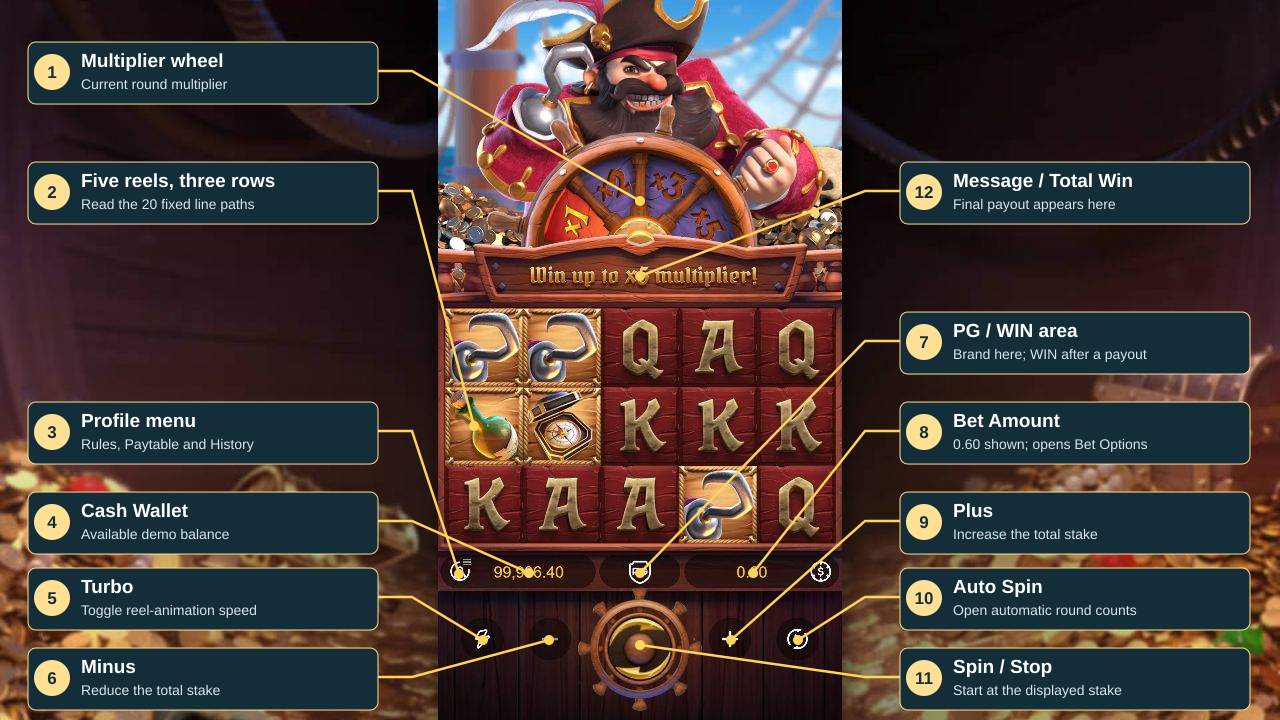
The actual main screen after spin 6: 0.60 total stake and a 99,996.40 wallet. Numbers identify real controls and display regions.
Multiplier wheel: The selected section shows the current round multiplier. Ordinary rounds progress through ×1, ×2, ×3 and ×5.
Five reels and three rows: Read the matching appearances against the 20 fixed line paths, starting at the leftmost reel.
Profile menu: Open the wallet and the Sound, Paytable, Rules, History and Quit entries.
Cash Wallet: The available demo balance is separate from the amount being staked on a spin.
Turbo: Toggle the shorter reel animation. The sample used Turbo for 65 spins and Normal for spin 3.
Minus: Reduce Bet Amount, then check the new total before starting.
PG / WIN area: This captured idle screen shows the PG brand mark. After a paying result, the centre can show WIN. The mark is not a Help button.
Bet Amount: The current total is 0.60. This entry opens Bet Options, where Size and Level determine the stake.
Plus: Increase Bet Amount. A larger stake changes the amount at risk.
Auto Spin: Open the available automatic round counts; starting a batch is a separate action.
Spin / Stop: Start at the displayed stake. The Rules describe stopping Auto and revealing a spinning result sooner through the same control area.
Message / Total Win: The wooden strip carries messages and, after a winning sequence, Total Win. Read the final payout before subtracting the stake.
The opened controls explain the cost
The initial Bet Options panel showed Size 0.30 × Level 2 × 20 lines = 12.00. Selecting Size 0.03 and Level 1 reduced the proposed total to 0.60. The later main screen confirms that it was applied. In a normal uninterrupted session, the next manual spin retained that setting.
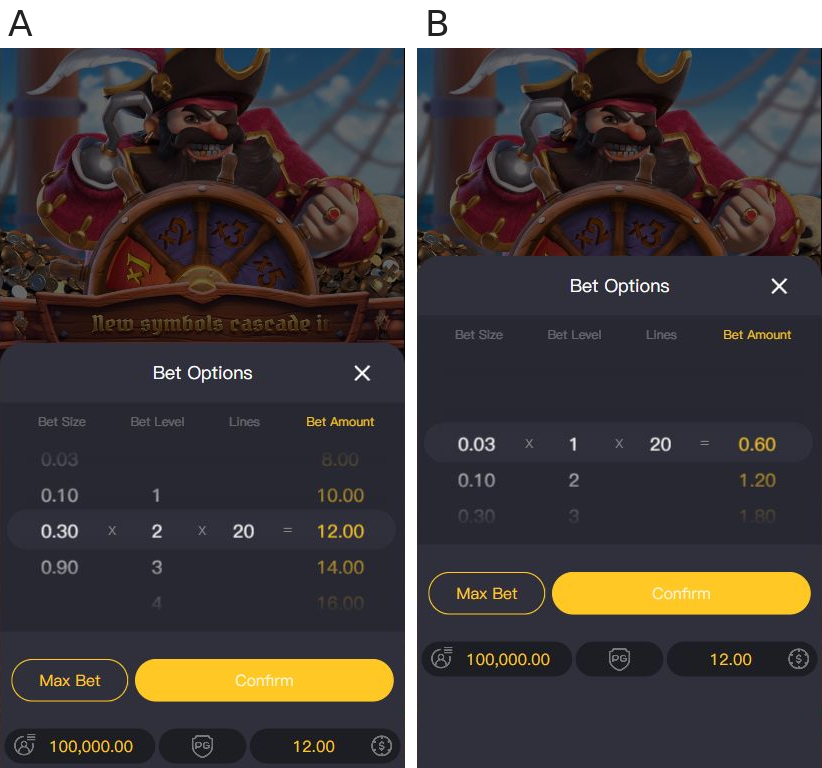
A: Initial default: 12.00. The actual panel includes Max Bet and Confirm. B: Selected minimum: 0.03 × 1 × 20 = 0.60. Confirming and checking the main-screen total completes the change.
The Auto panel offered 10, 30, 50, 80 and 1,000 spins. It was opened for inspection; the recorded sample was not an Auto batch. The Profile menu is useful for learning the game because Paytable, Rules and History sit together. Sound was visible, but there was no listening test.
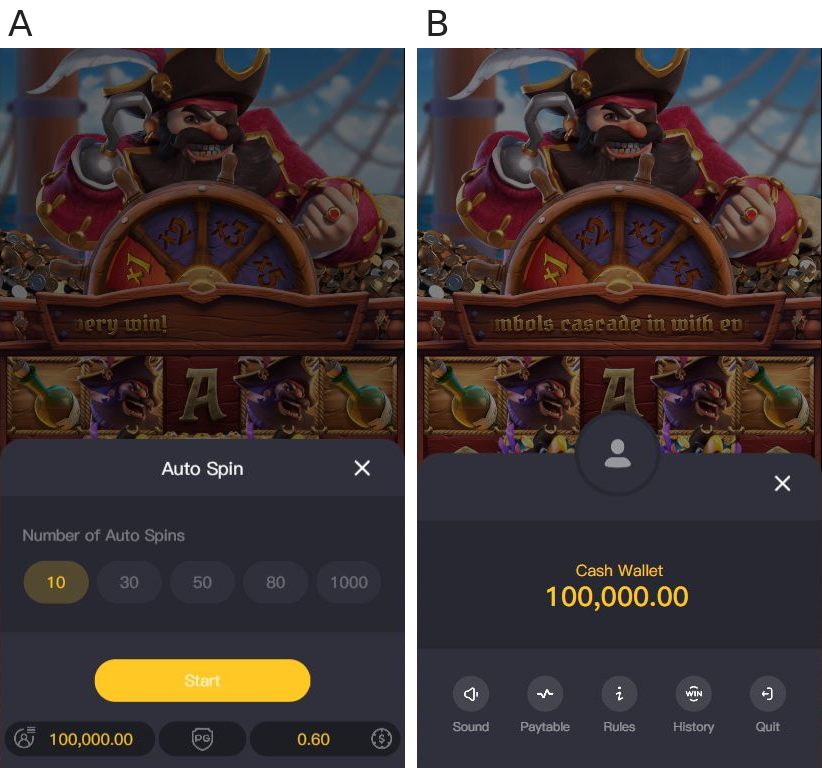
A: Actual Auto choices, with 10 selected and Start visible. Opening the panel does not demonstrate an executed batch. B: The actual opened Profile menu. Use History to inspect settled amounts and individual cascade rounds.
Portrait and landscape
At 390 × 844, the wallet, selected stake and main controls remained distinguishable. The Bet Options headings were less comfortable: small text and weak contrast slow down a check that should be effortless. Rules could be read with internal scrolling. At 844 × 390, the game stayed in a central portrait strip about 219 pixels wide, making the same controls much smaller. I would keep this game upright.
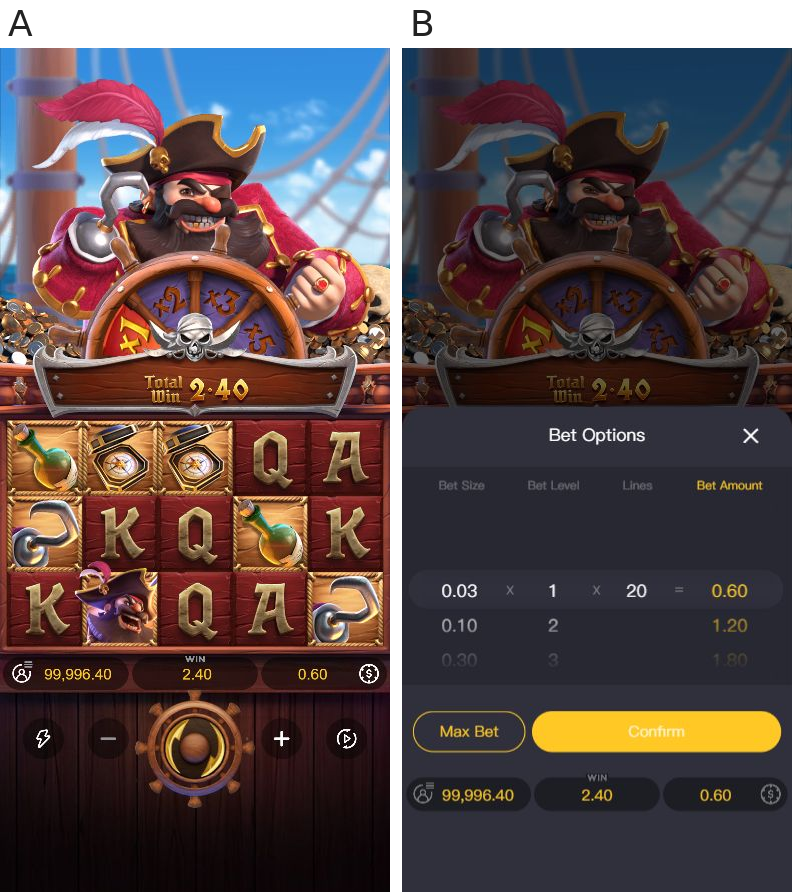
A: 390 × 844: the full captured portrait viewport, with the 0.60 stake readable. B: 390 × 844: the opened bet panel, including the small column headings.
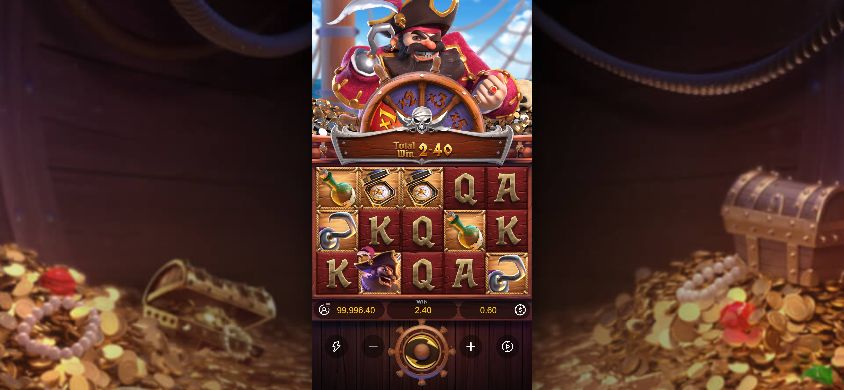
844 × 390: the game stays upright rather than spreading its controls across the width. These are desktop viewport simulations; a physical phone, touch input and a Philippine mobile network were not tested.
3. Twenty lines and the payout unit that matters
A win needs three, four or five matching appearances in succession along a fixed line, beginning on the leftmost reel. Each line pays its highest qualifying combination; awards from different lines are added. Wild can replace any ordinary paying appearance, but not Scatter, and it appears only on reels 2, 3 and 4.
The Help diagrams below contain all 20 paths. For example, line 01 crosses the middle row throughout. Line 07 runs bottom–bottom–middle–bottom–bottom; only its consecutive match from the left counts. A matching appearance elsewhere on the board does not extend that line.
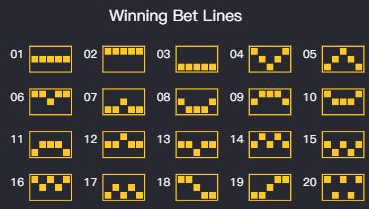
The current in-game Paytable’s complete 20-line diagram, cropped from the actual Help capture.
Reading the paytable. The following values are coefficients for one line. Multiply by Bet Size × Bet Level, then by the current round multiplier. They are not multiples of the total 20-line stake. Picture names describe the visible artwork where Help gives no formal name.
Appearance | 3 in line | 4 in line | 5 in line |
|---|---|---|---|
Pirate | 50 | 250 | 2500 |
Metal hook | 20 | 100 | 1000 |
Compass book | 15 | 50 | 500 |
Green bottle | 10 | 25 | 200 |
A | 5 | 20 | 100 |
K | 4 | 15 | 75 |
Q | 3 | 10 | 50 |
At the tested Size 0.03 and Level 1, a three-hook line at ×1 pays 20 × 0.03 × 1 × 1 = 0.60. A three-Q line at ×1 pays just 0.09. That small award is below the whole spin’s 0.60 cost, which is why a winning animation does not always mean the balance increased. Wild and Scatter have no separate cash coefficients printed in this Help; that is different from assigning them a zero payout value.
Spin 10 makes the line calculation concrete
Round 1 paid three hook lines: 07, 15 and 19. Each paid 0.60, giving 1.80 for that round. The expanded line 07 calculation shows the exact 0.03 × 1 × 20 × 1 = 0.60 formula. Although a Wild was visible on reel 3, top row, none of those three winning paths used it.
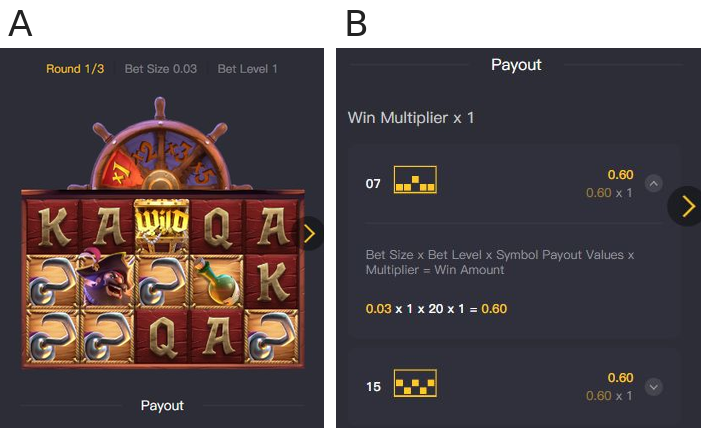
A: Spin 10, round 1: the hook matches paid on lines 07, 15 and 19. The visible top-row Wild was outside those awarded matches. B: The actual expanded line 07 formula.
4. Following cascades into free spins
After a round pays, its winning appearances disappear. Icons above fall into the gaps, and new ones enter. Any further win is settled as another round of the same paid spin. The ordinary ladder starts at ×1, rises to ×2 and ×3, and reaches ×5 for the fourth round and all later rounds. The cascade stops when no winning combination remains.
A Wild helps only when its position completes a line
Spin 10’s second round put A–A–Wild across the first three middle-row positions on line 01. This time the Wild participated: 5 × 0.03 × 1 × 2 = 0.30. Line 12 paid another 0.30 from three actual A icons, without the Wild. Round 3 reached ×3 but paid nothing, so the complete spin ended at 1.80 + 0.60 + 0 = 2.40. After its 0.60 stake, the net gain was 1.80.
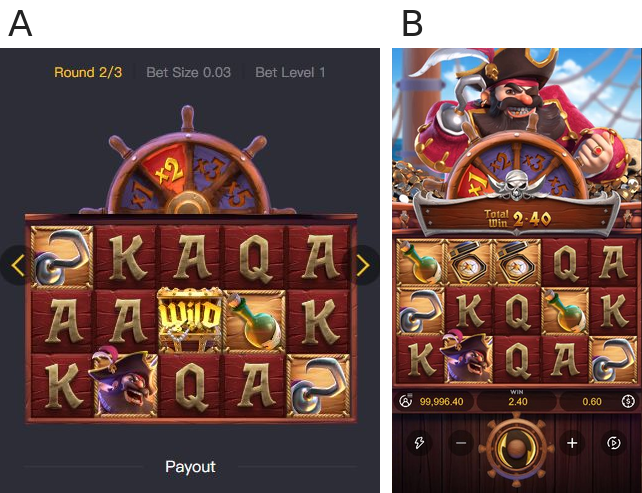
A: Round 2: Wild contributes to line 01. Line 12 is a separate A match, so its payout is added once. B: Settled result: 2.40 payout and a 99,996.40 wallet. All three rounds belong to one 0.60 paid spin.
Six rounds on one stake
Spin 35 is the clearest example of why I enjoy the cascade ladder. It kept paying after reaching ×5, instead of ending at the first top-multiplier result. The six actual rounds were:
Round | Multiplier | Round payout | New stake |
|---|---|---|---|
1 | ×1 | 1.20 | 0.60 |
2 | ×2 | 0.60 | 0 |
3 | ×3 | 0.90 | 0 |
4 | ×5 | 1.20 | 0 |
5 | ×5 | 0.45 | 0 |
6 | ×5 | 0 | 0 |
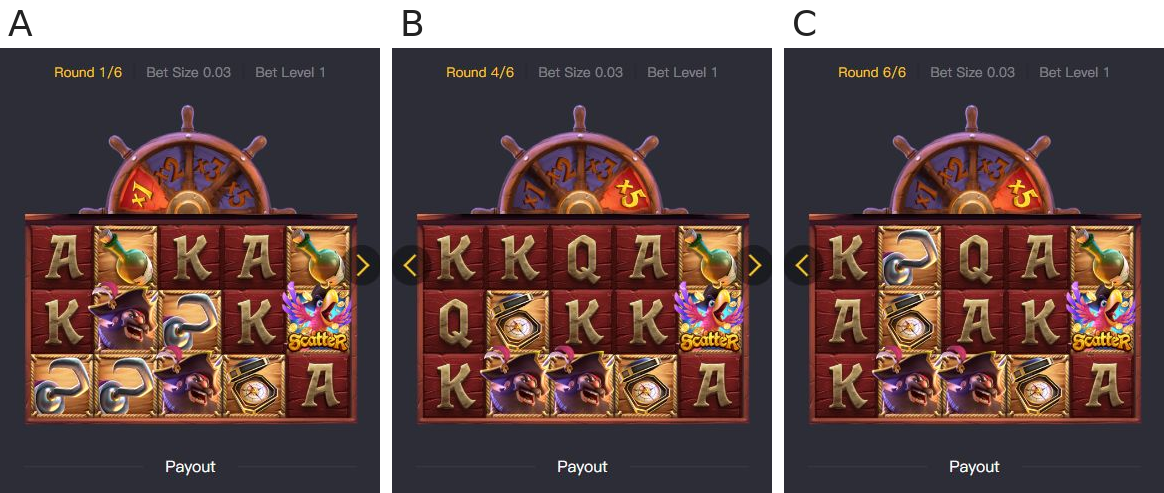
A: The start: round 1 at ×1. Winning positions clear before the next board. B: Round 4: ×5 has been reached. This round paid 1.20. C: Round 6: still ×5, but no additional award. The multiplier alone does not produce a payout.
The total was 4.35, or 7.25 times the 0.60 stake, for a 3.75 net gain. I like the visible build-up here more than a single unexplained win counter: the extra rounds and their contribution can be followed individually.
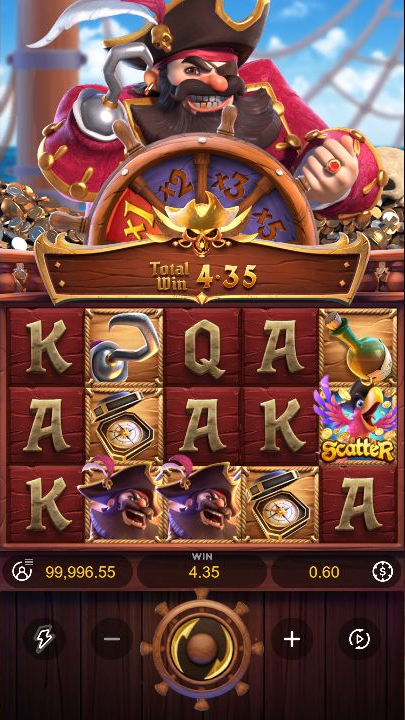
Spin 35’s final main screen: the six rounds total 4.35.
The captured ten-free-spin feature
Three Scatter parrots anywhere award 10 free spins, with five extra for each additional Scatter. The feature uses the triggering Size and Level and raises the ladder to ×3, ×6, ×9 and ×15. Help allows retriggers; none was documented in this sample.
Paid spin 66 landed three Scatters: the top position on reel 1 and the bottom positions on reels 4 and 5. The award screen gave 10 free spins. Actual progress captures show ×3 and ×6. The ×9 and ×15 steps are verified rules and award-screen information, rather than claimed observed round results.
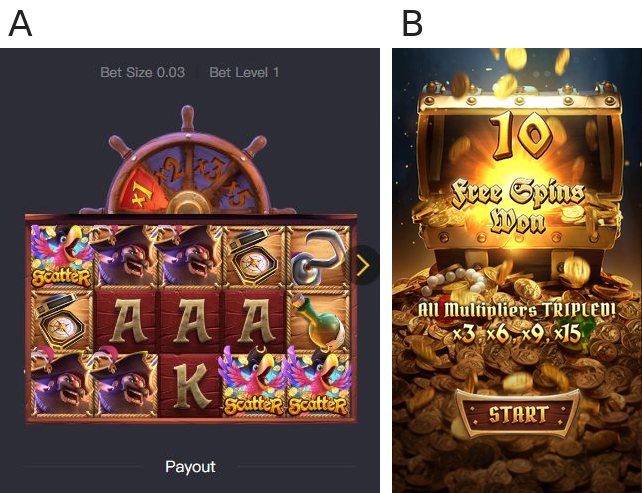
A: The actual trigger board: three Scatters. B: The next stage: 10 free spins awarded, with the ×3/×6/×9/×15 ladder shown.
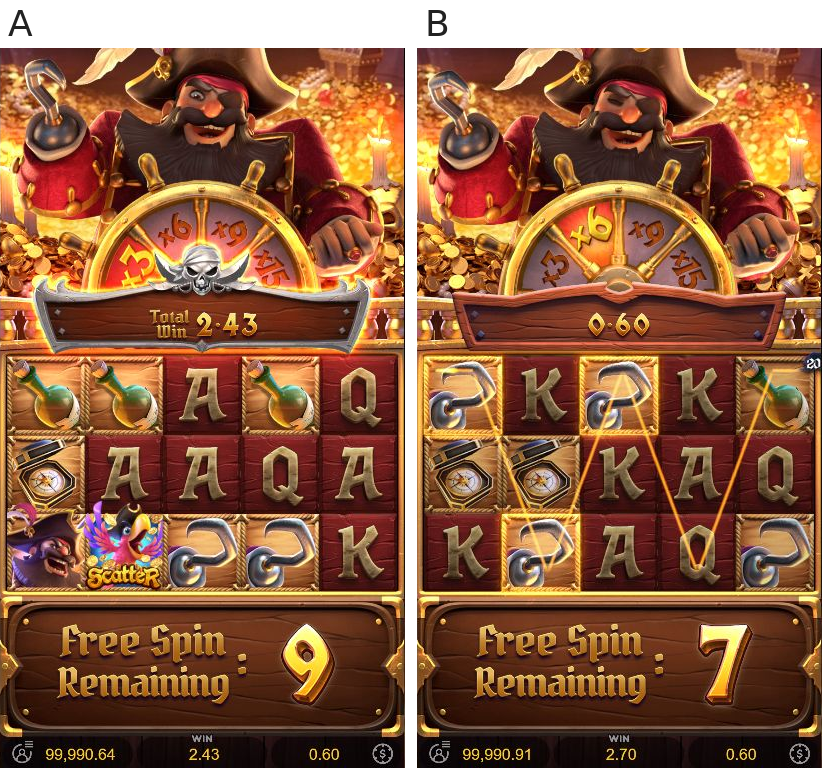
A: An intermediate ×3 stage: Total Win 2.43. It is not the final payout. B: An intermediate ×6 stage with seven spins remaining. The 0.60 line amount and 2.70 cumulative WIN are different measures.
The completed paid spin returned 10.62, including its feature. Its wallet moved from 99,988.81 to 99,998.83 after a 0.60 stake, giving a 10.02 net gain. The final main screen, parent History record and independent wallet readings agree. The trigger round and the first round of the first free spin (Free Spin 1/10, Round 1/3) were fully captured, but the other free-spin rounds were not fully recorded after a display and re-entry problem. That limits the detailed feature account without changing the verified whole-spin amount.
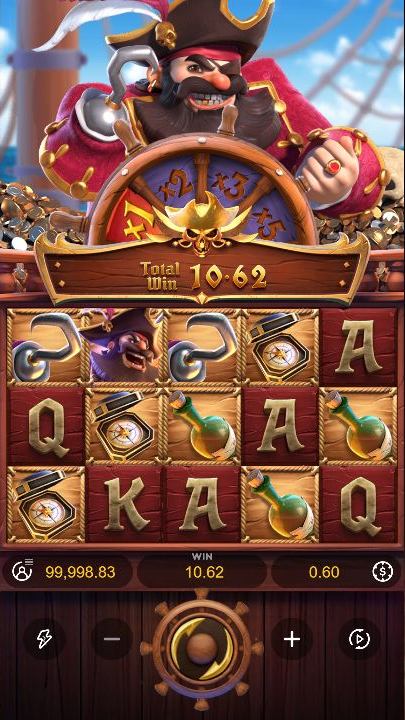
Back in the ordinary game: final payout 10.62. Count this complete result once, not once again for each progress screen.
5. Actual costs, official RTP and limits
All 66 recorded paid spins cost 0.60 virtual demo units. The current Help permits Size 0.03–0.90 and Level 1–10 across 20 fixed lines, giving an ordinary range of 0.60–180.00 by calculation. Only the 0.60 minimum was actually staked; the maximum was not played. No verified currency code was shown, so these figures should not be read as Philippine pesos.
Measure | Value and evidence |
|---|---|
Paid cost in this sample | 0.03 × 1 × 20 = 0.60 per paid spin |
Default after reload | 12.00; checked and reset to 0.60 before further paid input |
Line-payout basis | Coefficient × Bet Size × Bet Level × round multiplier |
Official RTP | 96.15%, declared by PG Soft; current running configuration unverified |
Official volatility | Medium, supplier label |
Official maximum win | 30,000× total bet, supplier headline |
Official simulation maximum exposure | 4,796× in the supplier’s one-billion-spin simulation; a different statistic |
Bonus buy / EX | No usable control in the inspected main screen, Profile, Bet, Auto or complete Help |
PG Soft’s product page and its current game-information PDF declare 96.15% RTP. The PDF splits that into 65.70% from the main game and 30.45% from free spins. These are components of the same published model, not selectable return settings. The captured Help does not list RTP, and the running build was not identified.
The PDF’s 4,796× maximum exposure from a billion simulated spins and the product’s 30,000× maximum-win headline describe different measures. Neither is a result from this review. The current PDF is printed version 1.0.r608; its update date does not establish a release date or identify the demo build.
I found no usable Bonus Buy or EX entry in the inspected version. That gives readers a clear expectation for this demo, while other versions may differ. The slot simulator can help illustrate how stake size and sample length change a budget’s path; it does not reproduce Captain’s Bounty’s undisclosed reel mathematics.
6. What the first 50 spins and 16 extra observations showed
These were free-demo spins recorded on 5 October 2026 UTC, with the game’s History displaying 6 October at GMT+8. There were 65 Turbo spins and one Normal spin, number 3; Turbo was restored after filming. Cascade rounds and free spins are included in the result of their originating paid spin, rather than counted as extra paid attempts.
The first 50 spins form the required chronological sample. Spins 51–66 remain as additional recorded observations, bringing the retained total to 66. They are shown separately so the feature on spin 66 cannot be mistaken for a result from the first 50 or silently used to improve that sample.
Measure | Required first 50 | All 66 retained |
|---|---|---|
Paid spins | 50 | 66 |
Total cost | 30.00 | 39.60 |
Total payout | 11.40 | 30.87 |
Net change | −18.60 | −8.73 |
Sample return | 38.00% | 77.95% |
Spins with a payout | 10 | 16 |
Net-profitable spins | 3 | 6 |
Break-even spins | 2 | 2 |
Net-losing spins | 45 | 58 |
Zero-payout spins | 40 | 50 |
Sixteen of the 66 spins paid something, but only six produced a net gain. Two broke even and 58 lost money after the stake. The longest run of zero payouts within a single verified session was 12; separate sessions are not joined to manufacture a longer run. Spin 66’s 10.62 payout materially improved the closing figure, illustrating how unstable a short sample can be.
Wallet resets are not winnings
The first session contained spins 1–21, starting at 100,000.00 and ending at 99,992.44 after 12.60 cost and 5.04 payout. A server-request failure occurred on the next attempted spin. Its eventual debit and payout could not be established, so that old attempt is excluded. The valid new spin 22 belongs to a second session, which started at 100,000.00 and covered 45 spins through number 66: 27.00 cost, 25.83 payout and a 99,998.83 ending wallet.
Reload also restored the 12.00 stake and Normal speed; both were reset before resuming. A later display and re-entry problem occurred while retrieving free-spin details after sampling. Its cause remains unverified, and the new wallet shown then is excluded from these results. The charts break the wallet line at the actual session boundary and keep a single cumulative financial total across the 66 verified spins.
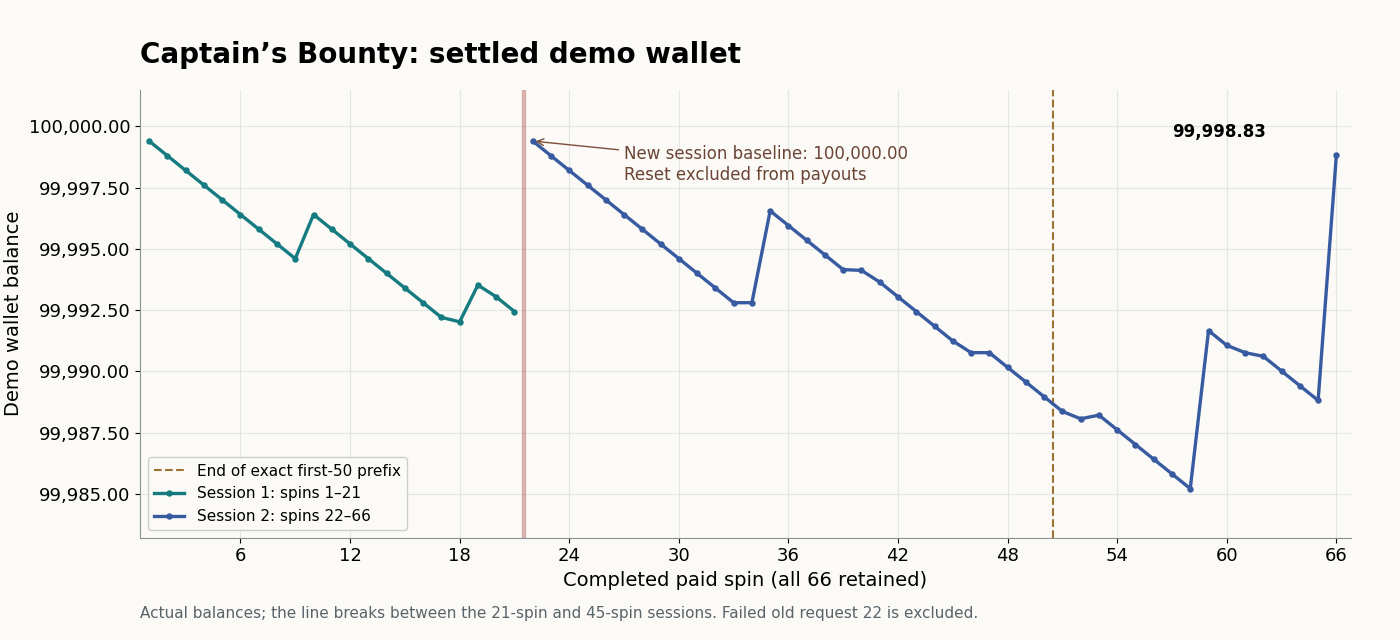
Settled wallet balances. The discontinuity before valid spin 22 is a session reset, not a payout. The first-50 boundary is marked.
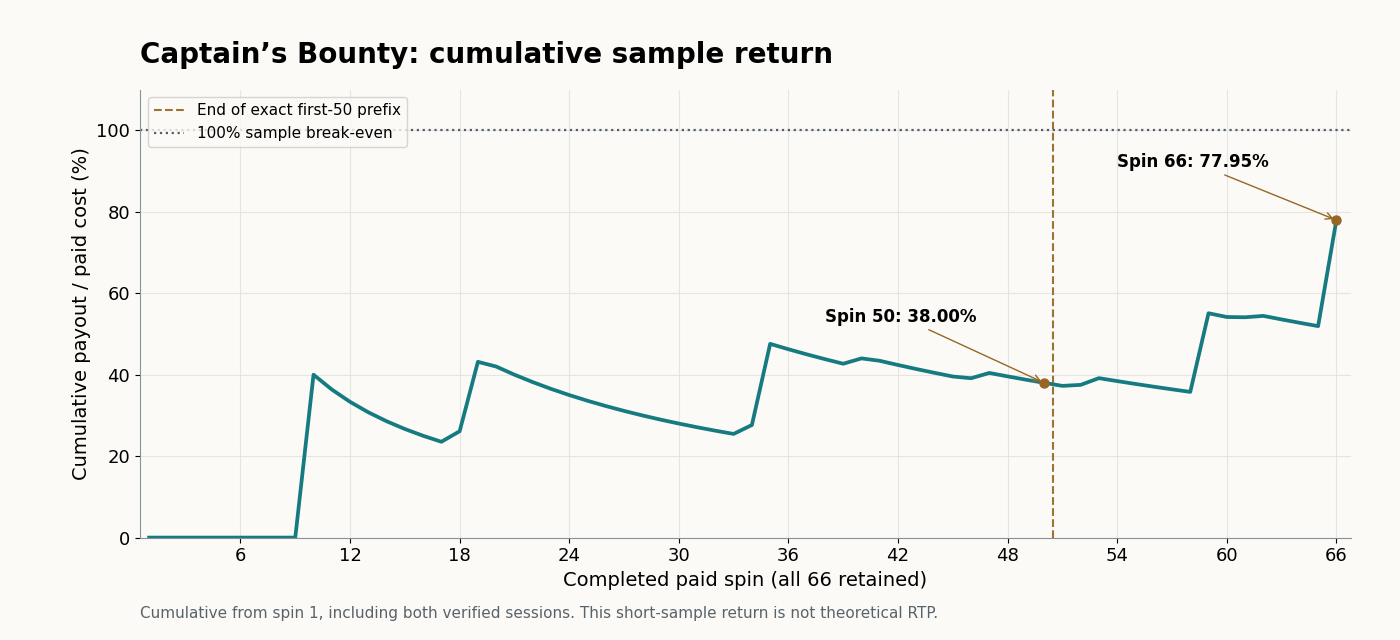
Cumulative payout ÷ cumulative paid cost, starting at spin 1. The 100% reference means sample break-even; it is not the published RTP.
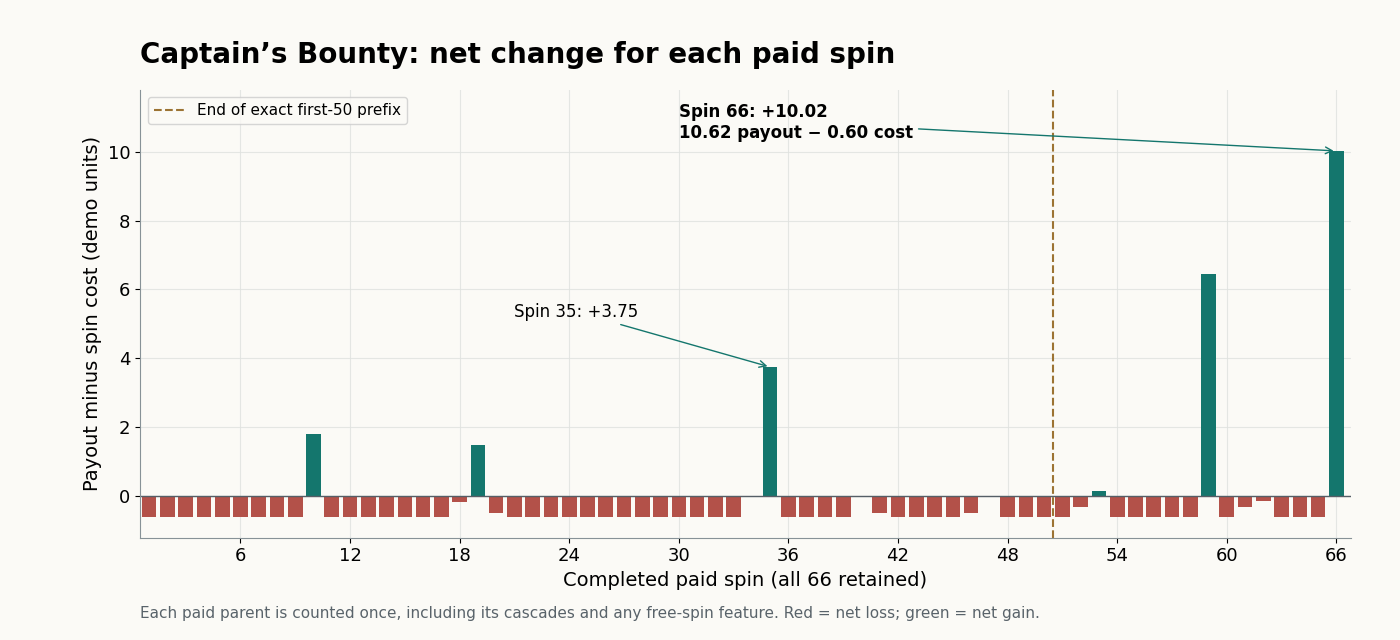
Per-spin payout minus the actual 0.60 cost. Each cascade or free-spin feature is settled under its paid parent once.
The test used a Windows 11 desktop and the Codex in-app browser, mainly at 1280 × 720. Its precise Chromium version was not established. The separate small-screen captures are viewport emulation, and the clip has no audio track. The sample is useful for explaining controls, payouts and interruptions; it cannot verify the official long-term return or volatility.
7. My verdict and a useful comparison
My rating: 7.5/10. Captain’s Bounty works for me as a readable cascade slot with a well-connected free-spin feature. The multiplier wheel gives the pirate scene a practical job, and the six-round example shows the appeal better than a maximum-win claim. I would choose it for learning how fixed lines, falling appearances and increasing multipliers combine.
The experience is less comfortable if you prefer landscape play or want the bet controls to be instantly legible. The reload changing a 0.60 stake back to 12.00 also makes a fresh check essential when resuming this demo. My score reflects those design and usability tradeoffs; the short-sample loss is not a scoring formula.
Mahjong Ways is a useful comparison because both games use cascades and the same ordinary multiplier ladder, while their matching and Wild systems differ. The comparison below follows the captured Help for each game.
Dimension | Captain’s Bounty | Mahjong Ways |
|---|---|---|
Board | 5 reels × 3 rows | 5 reels × 4 rows |
Winning structure | 20 fixed lines | 1,024 fixed ways |
Ordinary multipliers | ×1 / ×2 / ×3 / ×5 | ×1 / ×2 / ×3 / ×5 |
Wild treatment | Substituting Wild on reels 2–4 | Winning gold appearances transform into Wild |
Three-Scatter award | 10 free spins | 12 free spins |
Free-spin multipliers | ×3 / ×6 / ×9 / ×15 | ×2 / ×4 / ×6 / ×10 |
Best reason to choose it | Follow named line paths and their individual awards | Explore ways combinations and gold-to-Wild changes |
I would start with Captain’s Bounty if the aim is to understand why a particular line paid, then try Mahjong Ways for its transforming gold appearances. Twenty lines and 1,024 ways are calculation structures, so their counts alone do not rank win probability or expected return. Captain’s larger free-spin multiplier labels also need to be read alongside its different trigger award and paytable.
For a first demo session, set the stake deliberately, watch a few rounds at Normal speed, and use History after a cascade to connect each award to the matching line. Check the final Total Win against the whole spin’s cost, especially after a small award or a reload. That is the most useful way to decide whether this pirate game’s pacing suits you.
Captain’s Bounty by PG Soft FAQs
Answers to common questions about Captain’s Bounty by PG Soft.
Captain’s Bounty by PG Soft Reviews
 No Player Reviews Yet
Played Captain’s Bounty by PG Soft? Share your experience with other players.
 Write A Review