
DJ Boom Boom by FA CHAI
Play DJ Boom Boom by FA CHAI In Demo Mode




 Other SymbolGolden symbol
- Only on reels 2–5
- Same regular-symbol award
- Winning elimination → WILD
- Random multiplier frame
 Other SymbolMultiplier frame
- Collected on next win
- Winning frame gains +1X
- Scoring multiplier resets 1X
- Frames persist in free games
 ScatterSCATTER
- 3+ → 10 free games
- 3–6 entry symbols → frames
- 3+ in feature → +5 games
- 50 free-game cap
 WildWILD
- Substitutes other symbols
- Does not replace SCATTER
- Golden win turns to WILD
- Transformation stays in place
 Paying SymbolGreen J
- Left-to-right matches
- 3–6 adjacent reels
- Awards at total bet 0.40
- Golden version: same awards
 Paying SymbolBlue Q
- Left-to-right matches
- 3–6 adjacent reels
- Awards at total bet 0.40
- Golden version: same awards
 Paying SymbolPurple K
- Left-to-right matches
- 3–6 adjacent reels
- Awards at total bet 0.40
- Golden version: same awards
 Paying SymbolRed A
- Left-to-right matches
- 3–6 adjacent reels
- Awards at total bet 0.40
- Golden version: same awards
 Paying SymbolGreen-gold music watch
- Left-to-right matches
- 3–6 adjacent reels
- Awards at total bet 0.40
- Golden version: same awards
 Paying SymbolBlue-gold microphone
- Left-to-right matches
- 3–6 adjacent reels
- Awards at total bet 0.40
- Golden version: same awards
 Paying SymbolMagenta headphones
- Left-to-right matches
- 3–6 adjacent reels
- Awards at total bet 0.40
- Golden version: same awards
 Paying SymbolRed-orange speaker
- Left-to-right matches
- 3–6 adjacent reels
- Awards at total bet 0.40
- Golden version: same awards
DJ Boom Boom by FA CHAI Expert Review


Updated:
Here you can find detailed review information about DJ Boom Boom by FA CHAI.
Overview
Golden-to-Wild changes and retained frames give DJ Boom Boom a strong sense of continuity, while four clearly priced buy options are easy to compare. Multiple counters and a small landscape play area make faster sessions harder to read.
DJ Boom Boom is at its best when you follow a gold-framed position through the next cascade. A winning Golden symbol becomes a Wild, and the frame can keep contributing as the board changes. That continuity gives its music-stage theme a satisfying mechanical hook. It also asks for attention: the frame values, large multiplier and rolling WIN display do not all mean the same thing.
What I liked
✅ Golden symbols, Wilds and persistent frames give the continuing reel action a visible explanation.
✅ The four Buy Feature choices state their cost and starting-frame count clearly, making their different entry conditions easy to compare.
What I didn’t like
❌ Multiplier, COMBO and payout counters change together; it is easy to read an intermediate animation as the final result.
❌ Landscape keeps a small upright play area, so the labels and controls have less useful space than in portrait.
1. DJ Boom Boom at a glance
DJ Boom Boom is a 3,600-ways cascading slot from FA CHAI, also branded FC. Its six-reel arrangement uses music equipment, bright letters and a headphone-wearing character. Winning combinations can lead to further cascades within the same paid spin. The feature to understand first is the Golden symbol: it links ordinary wins to Wilds and multiplier frames.
FA CHAI’s DJ Boom Boom product page, captured on 6 October 2026, gives a release date of 14 January 2026. The reviewed free-demo build is e14ae79, game ID 22092. The date of that test is separate from the release date.
Philippine search interest
Ahrefs returned 350 estimated average monthly Philippine searches for “dj boom boom”, 700 for “dj boom boom demo” and 20 for “dj boom boom slot”, queried on 8 October 2026. These cover Ahrefs’ latest known twelve months, whose exact endpoints were not returned. The bare-name results mix the FA CHAI game with music and DJs, so 350 is not a clean measure of this slot’s popularity. The modifier queries are more specific, but Ahrefs returned no saved SERP for either “demo” or “slot”. Searches are not unique players, and overlapping keyword totals should not be added.
2. Reading the screen and controls
The purple-blue stage places a tall playing area in the centre. Gold backgrounds distinguish eligible Golden states, the turntable carries WILD lettering, and gold frames carry multiplier values. Below the reels, BALANCE, WIN and TOTAL BETS are the three amounts to read together. The notification banner above the board is not this spin’s payout.
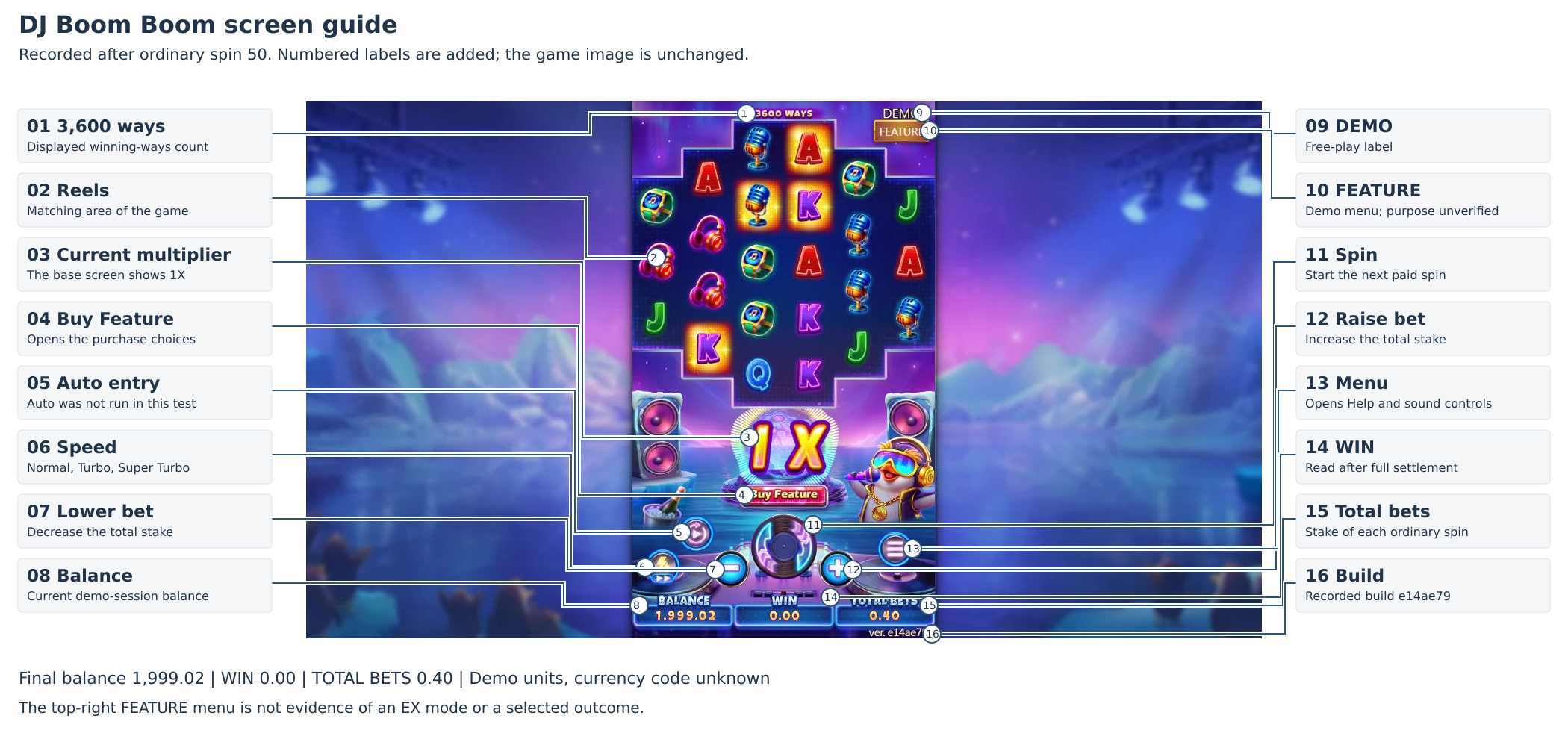
The settled screen after ordinary spin 50: balance 1,999.02, WIN 0.00 and total bet 0.40. Amounts are demo display units.
3,600 ways: displayed ways count.
Reels: the area used for matching symbols.
Current multiplier: 1X in this settled base screen.
Buy Feature: opens purchase options.
Auto: visible entry; no auto batch was run.
Speed: Normal, Turbo and Super Turbo.
Minus: lowers total bet.
Balance: remaining demo-session funds.
DEMO: identifies free play.
FEATURE: an unverified demo menu, not established EX.
Spin: starts the next paid spin.
Plus: raises total bet.
Menu: Help and sound controls.
WIN: the payout display, read after settlement.
TOTAL BETS: ordinary-spin stake.
Build: e14ae79 in the lower-right corner.
Use the minus and plus buttons to choose the total bet before spinning. A separate check raised it from 0.40 to 0.80; the next manual spin retained 0.80 without another adjustment. That is same-session retention, not a promise that a refresh or another device will retain it. The menu opens Help and the sound control. The sound icon changed off and on, but no listening test supports an audio-quality judgement.
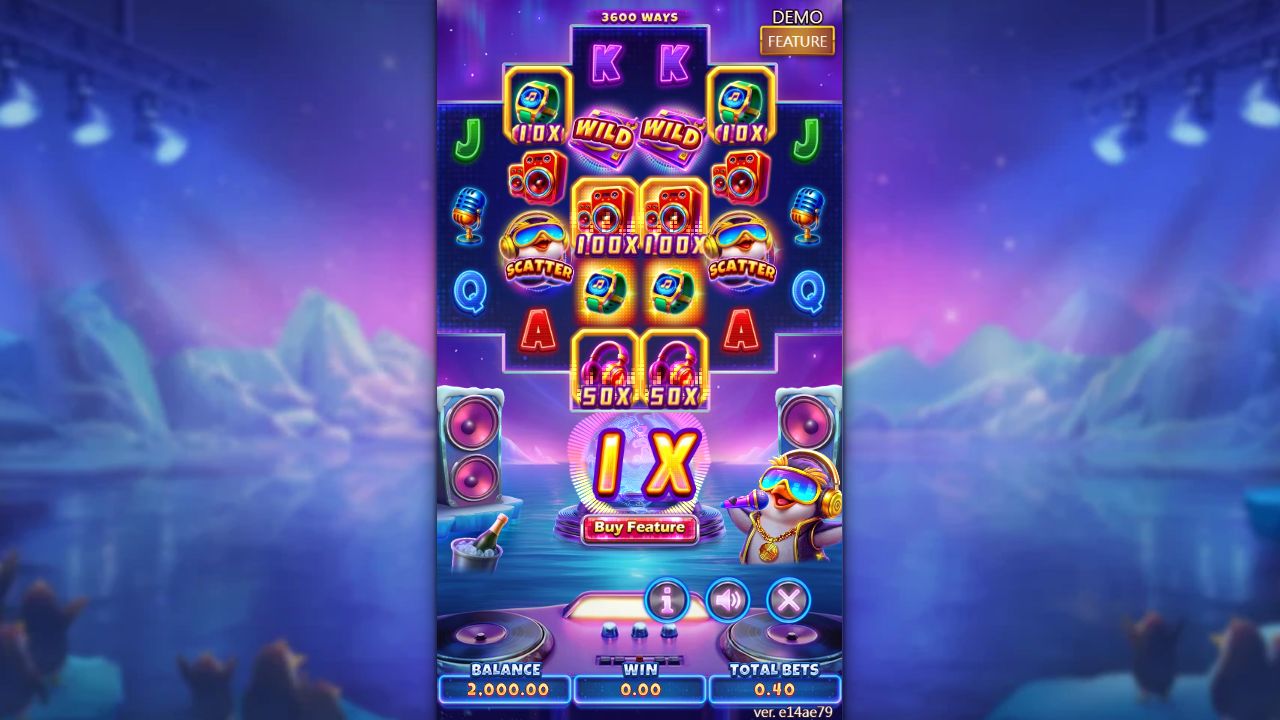
The menu was opened to inspect Help and sound controls. Auto was not run.
The speed control cycles through Normal, Turbo and Super Turbo. The 50-spin ordinary sample used Super Turbo; Normal gives a clearer view of the frame mechanics, as the clip below shows. A purchased feature may pause at an introduction with START. BUY 02 waited there in manual mode until START was pressed; Help’s ten-second auto-start statement applies to Auto mode.
A silent excerpt from BUY 01 at Normal speed. Free Game 1/10 moves into 2/10 and another cascade; the purchase’s final settlement is outside the clip.
Portrait and landscape layout
In the 390 × 844 portrait viewport simulation, the board, bottom amounts and Buy Feature quotations remained readable. At 844 × 390, the game kept its upright layout in the middle, shrinking the labels and controls. The following captures are desktop viewport simulations, not physical-phone or touch tests.

Portrait simulation: main board, then the purchase menu opened and cancelled. The preset opening board is not a recorded random win.

Landscape simulation retains the same upright design with less space for the controls.
3. How the ways and final payouts work
The Help rules award matching combinations on adjacent reels from left to right. The ordinary paytable lists three- through six-reel matches, and WILD substitutes for symbols other than SCATTER. Ways are formed by qualifying symbols on consecutive reels rather than by following a fixed drawn payline. A simple counting illustration is one matching symbol on reel one, two on reel two and one on reel three: 1 × 2 × 1 = 2 three-reel ways. That illustrates the rule, not an extra played result.
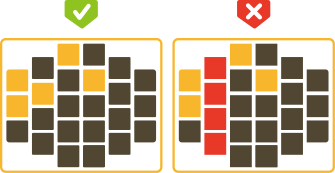
Provider Help illustration. This explains a rule, not a captured winning spin.
The full symbol cards carry the individual awards. Their captured paytable basis is a total bet of 0.40: those displayed amounts must not be read as a guaranteed whole-spin payout or silently relabelled as a payout per unit stake. Golden versions use the same matching and awarding rules as their ordinary counterparts.
A paid spin can contain several eliminations and refills. Wait until that sequence ends, then compare the final payout with the actual cost. Ordinary spin 3 paid 0.08 against a 0.40 stake: 0.08 − 0.40 = −0.32 net. It is a paying spin, but it did not recover its stake. A zero-cost cascade is not another paid spin.
4. Golden symbols and frames that stay in play
Golden symbols appear only on reels 2–5. When one is eliminated in a win, it becomes WILD in the same position and randomly grants a multiplier frame. That position is worth watching on the next board. Ordinary spin 20 recorded this continuing action and finished at WIN 15.60 with 12X still visible on screen.
Help separates the frame from the accumulated multiplier used for scoring. A frame is collected during the next winning combination; each win uses the current accumulated multiplier, which then resets to 1X. Frames in winning combinations gain another 1X after scoring. In the base game, frames remain until there is no winning combination. The frame remaining on a reel does not mean the large accumulated multiplier has failed to reset.
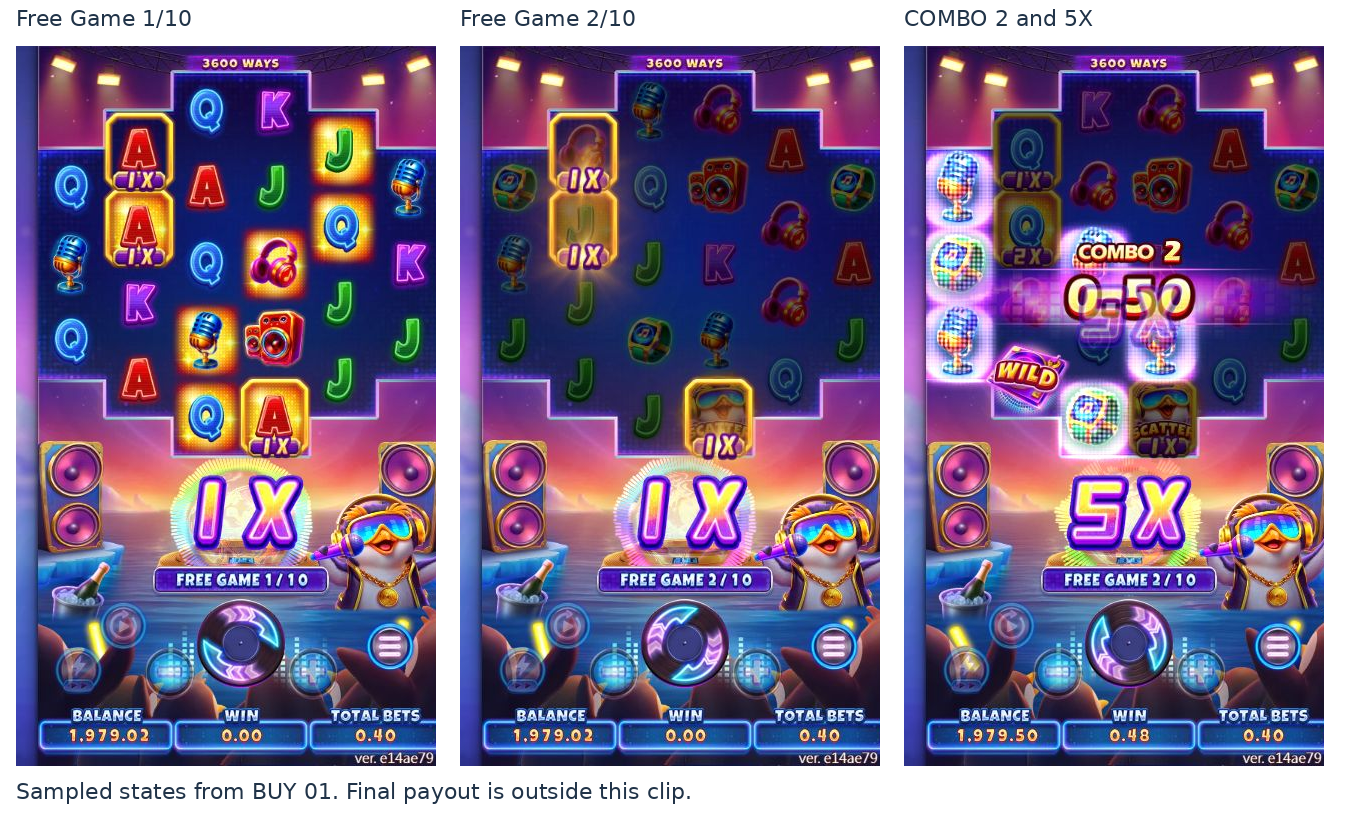
The same feature sequence moves from Free Game 1/10 to 2/10. The last sampled view shows COMBO 2 and 5X; its changing counter is not the final purchase payout.
Free games and starting-frame choices
Three or more SCATTERs trigger ten free games. Three, four, five or six entry SCATTERs correspond to three, four, five or six starting frames; all four entries start with ten games. The 3–6 figure is a frame count, not a fixed starting multiplier. During free games, the frames stay until the series ends. Help says another three or more SCATTERs add five games, with fifty as the overall cap. Natural entry, retrigger and the fifty-game cap were not demonstrated in this test.
Buy Feature offers four starting-frame choices. At total bet 0.40 their actual prices were 20.00, 24.00, 30.00 and 40.00, corresponding to 50×, 60×, 75× and 100× the total stake. All four purchases were completed once. Their free spins and cascades belong to their purchased parent series and are not charged again in the ledger.

BUY 01: 20.00 paid, ten free games starting with three frames, then a final 19.58 payout. The entry screen is a static introduction; the video shows later play.
The supplier also lists Progressive Jackpot among product features. The captured complete Help does not explain its runtime rules and no jackpot event was recorded, so this review cannot attach a tested jackpot outcome to the feature. No EX entry was found in the inspected build. The separate FEATURE demo menu was opened but none of its three options was selected.
5. RTP and what each option actually costs
FA CHAI’s captured product specification lists 96.5% RTP, Medium High volatility and a Max Multiplier of 5000X. These are supplier labels. The complete demo Help did not display an RTP value, so the running build’s exact RTP configuration remains unverified. The 5000X field is retained as “Max Multiplier”; this sample did not demonstrate that limit, and it should not be renamed as a verified session maximum.
RTP describes a theoretical long-run payout proportion, not a target for an individual visit. The ordinary 50-spin sample returned 19.02 from 20.00 of stakes, or 95.10%. That number is only its sample return. Its proximity to 96.5% does not validate the supplier figure or show that the game will balance a player’s losses.
Mode / option | Cost at 0.40 total bet | Starting frames | Recorded payout | Recorded net |
|---|---|---|---|---|
Ordinary spin | 0.40 | Depends on the spin | Varies | Payout − 0.40 |
BUY 01 / 50× | 20.00 | 3 | 19.58 | −0.42 |
BUY 02 / 60× | 24.00 | 4 | 45.64 | +21.64 |
BUY 03 / 75× | 30.00 | 5 | 6.60 | −23.40 |
BUY 04 / 100× | 40.00 | 6 | 484.08 | +444.08 |
At this stake, one 50× purchase costs as much as all fifty ordinary spins. Four purchases cost 114.00 and returned 555.90, but the first three together lost 2.18; BUY 04’s 484.08 payout dominated the total. One result per option cannot tell you which option has better expected value. More starting frames are an entry condition, not a guarantee of recovering a higher price.
The maximum selectable stake and full coin-value range were not established. Amounts throughout this review are the demo’s displayed units, with no verified currency code; they are not labelled Philippine pesos. Check the stake and feature price in the version you open before using real money. Set an entertainment budget you can lose without affecting essential spending and do not chase a sample’s big result.
The AskSpinner slot simulator can help illustrate how repeated stakes and uneven returns affect a budget. It is a general model, not a reproduction of DJ Boom Boom’s unpublished mathematics or a way to predict its next result.
6. What the recorded session showed
The recorded free-demo session on 6 October 2026 UTC contains fifty ordinary spins at 0.40, four completed feature purchases and two later manual spins at 0.80. Every parent event has a settled payout and matching before/after balance. Free sub-spins and cascades stay inside their parent event. The ordinary sample remains separate from the purchases and stake checks.
Scope | Events | Cost | Payout | Net |
|---|---|---|---|---|
Ordinary fixed-stake sample | 50 | 20.00 | 19.02 | −0.98 |
Purchased feature series | 4 | 114.00 | 555.90 | +441.90 |
0.80 stake-retention checks | 2 | 1.60 | 0.12 | −1.48 |
Reconciled session | 56 | 135.60 | 575.04 | +439.44 |
The ordinary sample started at 2,000.00 and ended at 1,999.02. Nine of its fifty spins paid something, but only four paid more than their stake. Spin 20 returned 15.60, about 82.02% of the sample’s total payout, and lifted the balance from 1,993.30 to 2,008.50. The result is concentrated in one spin; neither the count of paying spins nor the largest award describes an expected future session.
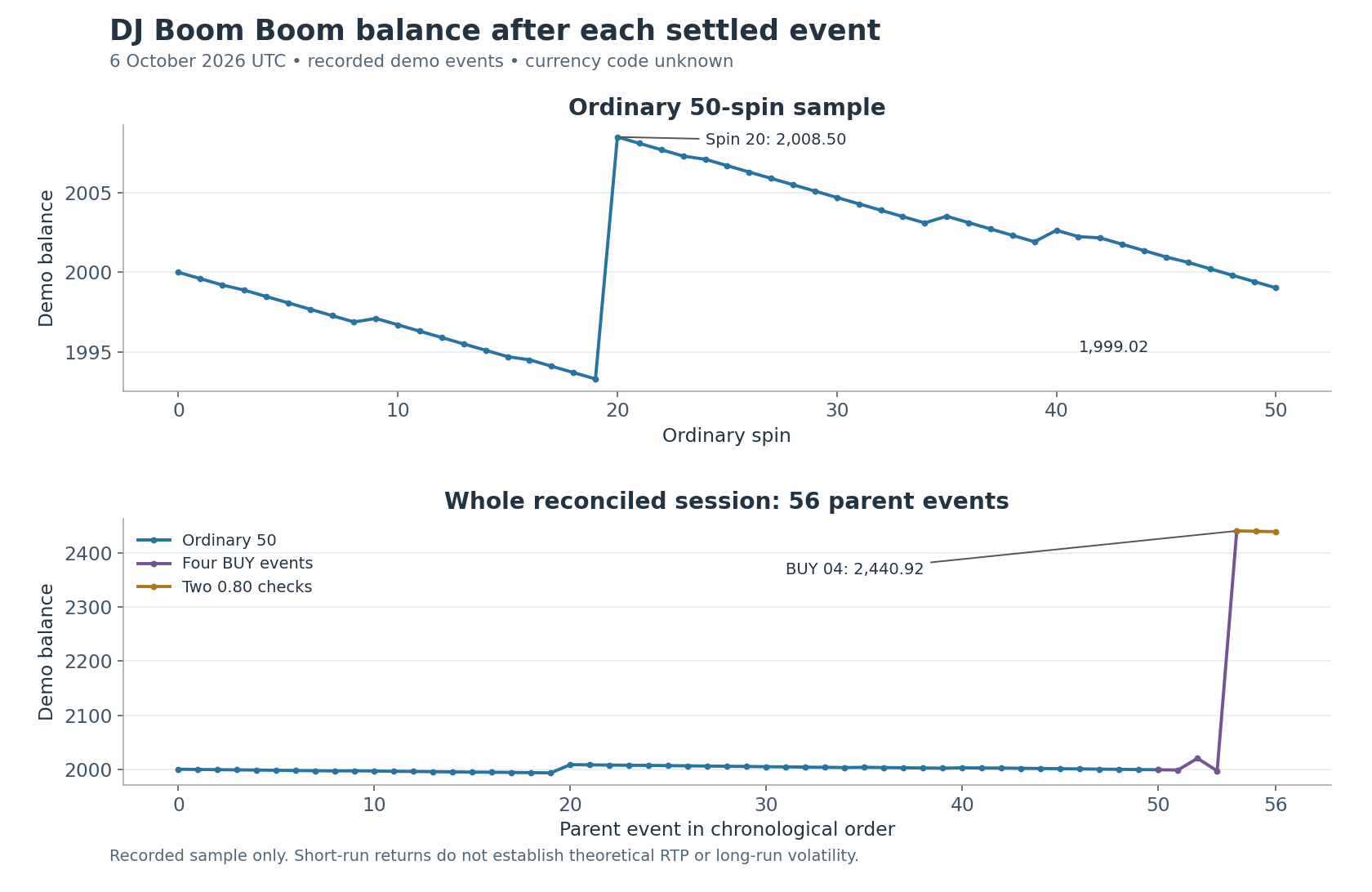
The upper panel isolates the ordinary sample. The lower panel retains all four BUY events and both 0.80 checks; the last recorded balance is 2,439.44.
Cumulative sample return means cumulative payout divided by cumulative cost from the start of the displayed series. After spin 20, the ordinary series was at 206.25%; after spin 50, it was at 95.10%. The full session ended at 424.07% because the BUY payouts are included. Those two denominators answer different questions and must not be compared as separate game RTPs.
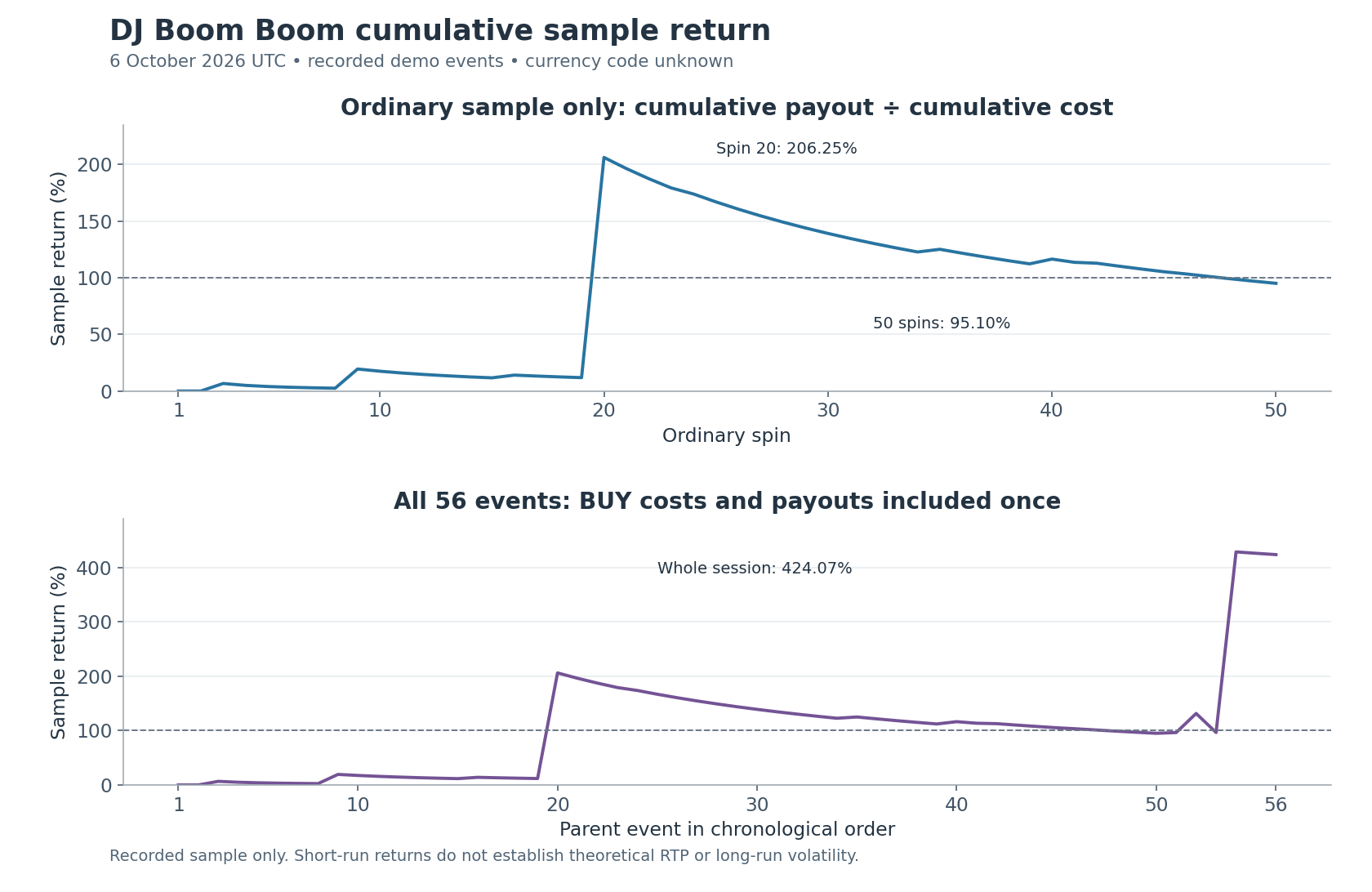
The dashed 100% line marks sample break-even. Both curves are recorded payout-to-cost ratios, not estimates of theoretical RTP.
Net result subtracts the actual cost from the final payout. The chart keeps the four purchased series in a separate panel so their much larger stakes do not hide ordinary-spin changes. Forty-one ordinary spins paid zero and therefore lost 0.40 each. The two 0.80 checks lost 1.48 together after BUY 04, taking the balance from 2,440.92 to 2,439.44.
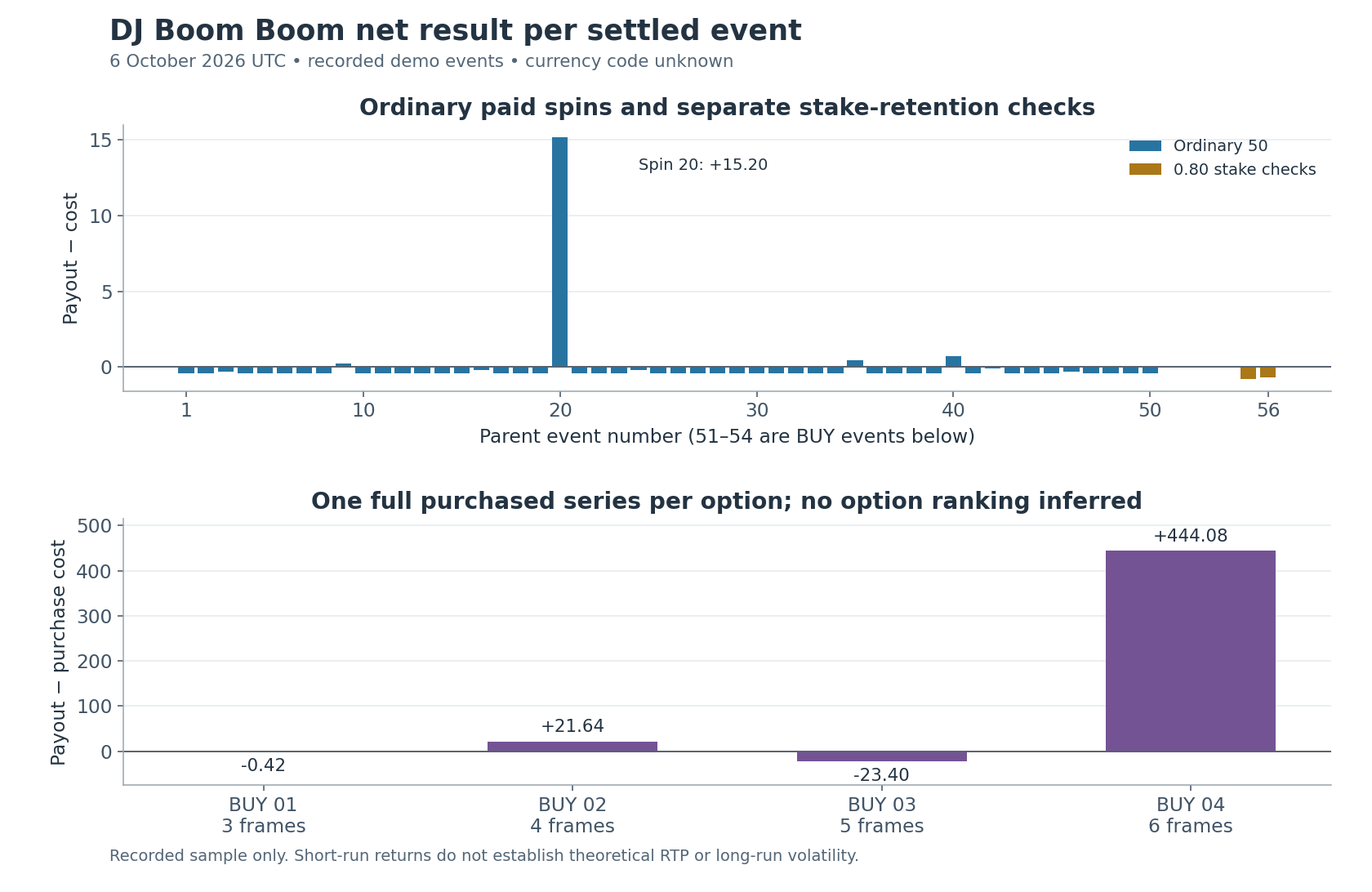
The ordinary spin 20 net is +15.20. BUY 04’s +444.08 belongs to one completed purchased series, not an ordinary spin or a predicted feature return.
Scope matters when reading this evidence. All 56 recorded financial parent events settled; there is no unfinished event folded into these totals. The initial entry error cleared after one reload, which is not a test of recovering an interrupted paid round. Natural feature entry, retrigger, the fifty-free-game cap, physical-phone controls and audio performance remain outside the demonstrated outcomes. The sampled video covers only part of BUY 01.
7. Verdict and a useful comparison
The strongest reason to choose DJ Boom Boom is its positional continuity. A frame that survives the next board gives you something concrete to follow, and the distinction between frame growth and the large scoring multiplier rewards learning the rules. I would start at Normal speed until those two displays feel separate; faster animation is a preference, not a better-return setting.
Design question | DJ Boom Boom by FA CHAI | Mahjong Ways 2 by PG SOFT |
|---|---|---|
Winning layout | 3,600 ways across six reels | 2,000 ways across five reels |
What a winning Golden symbol changes into | WILD in place, with a randomly granted multiplier frame | WILD on the following cascade round |
Multiplier structure | Persistent frame positions and a resetting scoring multiplier | Base-game ladder of 1×, 2×, 3× and 5× |
Feature-purchase choice in the reviewed build | Four prices with three to six starting frames | No usable BUY control observed |
Best fit | Following persistent positions and comparing feature entry conditions | Following a more compact multiplier ladder |
Mahjong Ways 2 is a useful comparison because both turn winning gold symbols into Wilds, but their multiplier systems ask you to watch different things. This is a comparison of captured designs, not matched-condition profitability or speed testing. More purchase choices are useful only if you want them; they are not automatically a quality advantage.
Expert rating: 7.8/10. DJ Boom Boom earns that judgement through its visible Golden-to-Wild progression, readable feature quotations and satisfying frame persistence. Simultaneous result displays and the small landscape play area are the main usability compromises. This is a subjective design-and-use score with moderate confidence, not a return forecast, player-rating average or certification of untested devices. The unusually large fourth BUY payout does not add points.
DJ Boom Boom by FA CHAI FAQs
Answers to common questions about DJ Boom Boom by FA CHAI.
DJ Boom Boom by FA CHAI Reviews
 No Player Reviews Yet
Played DJ Boom Boom by FA CHAI? Share your experience with other players.
 Write A Review