
Fortune Gems 4 by RSG
Play Fortune Gems 4 by RSG In Demo Mode




 WildFortune Gems 4 by RSG - WILD
- 50 line units
- Substitutes symbols
- Split 2×/3×
- 3 in a line
 Paying SymbolFortune Gems 4 by RSG - J
- 3 in a line
- 4 line units
- Split 2×/3×
- Left to right
 Paying SymbolFortune Gems 4 by RSG - Q
- 3 in a line
- 10 line units
- Split 2×/3×
- Left to right
 Paying SymbolFortune Gems 4 by RSG - K
- 3 in a line
- 12 line units
- Split 2×/3×
- Left to right
 Paying SymbolFortune Gems 4 by RSG - A
- 3 in a line
- 16 line units
- Split 2×/3×
- Left to right
 Paying SymbolFortune Gems 4 by RSG - Green Gem
- 3 in a line
- 20 line units
- Split 2×/3×
- Left to right
 Paying SymbolFortune Gems 4 by RSG - Blue Gem
- 3 in a line
- 30 line units
- Split 2×/3×
- Left to right
 Paying SymbolFortune Gems 4 by RSG - Red Gem
- 3 in a line
- 40 line units
- Split 2×/3×
- Left to right
Fortune Gems 4 by RSG Expert Review


Updated:
Here you can find detailed review information about Fortune Gems 4 by RSG.

Official Fortune Gems 4 promotional artwork from RSG.
The most interesting part of Fortune Gems 4 is watching one split symbol change several winning lines. The grid is just three rows by three columns, but the calculation continues after the reels stop: a symbol can split into two or three, then the wheel on the right multiplies the line wins. It has more to offer someone who enjoys following a combination than someone who simply wants to keep spinning.
This game is from Royal Slot Gaming, or RSG. The ‘4’ does not make it a sequel to JILI/TaDa’s Fortune Gems 3.
What I liked
✅ The five lines and central multiplier have clear roles and are easy to find once the spin settles.
✅ I like the way splits visibly develop, including in ordinary mode without enabling EX.
✅ Portrait keeps the main amounts and controls together, with everyday functions easy to find.
What I didn’t like
❌ Multi-line splits become harder to follow when celebration overlays cover the grid.
❌ EX costs 50% more per spin, and there are no verified probabilities here to judge its long-term value.
❌ Landscape shrinks the game into a narrow column; reopening also resets some settings.
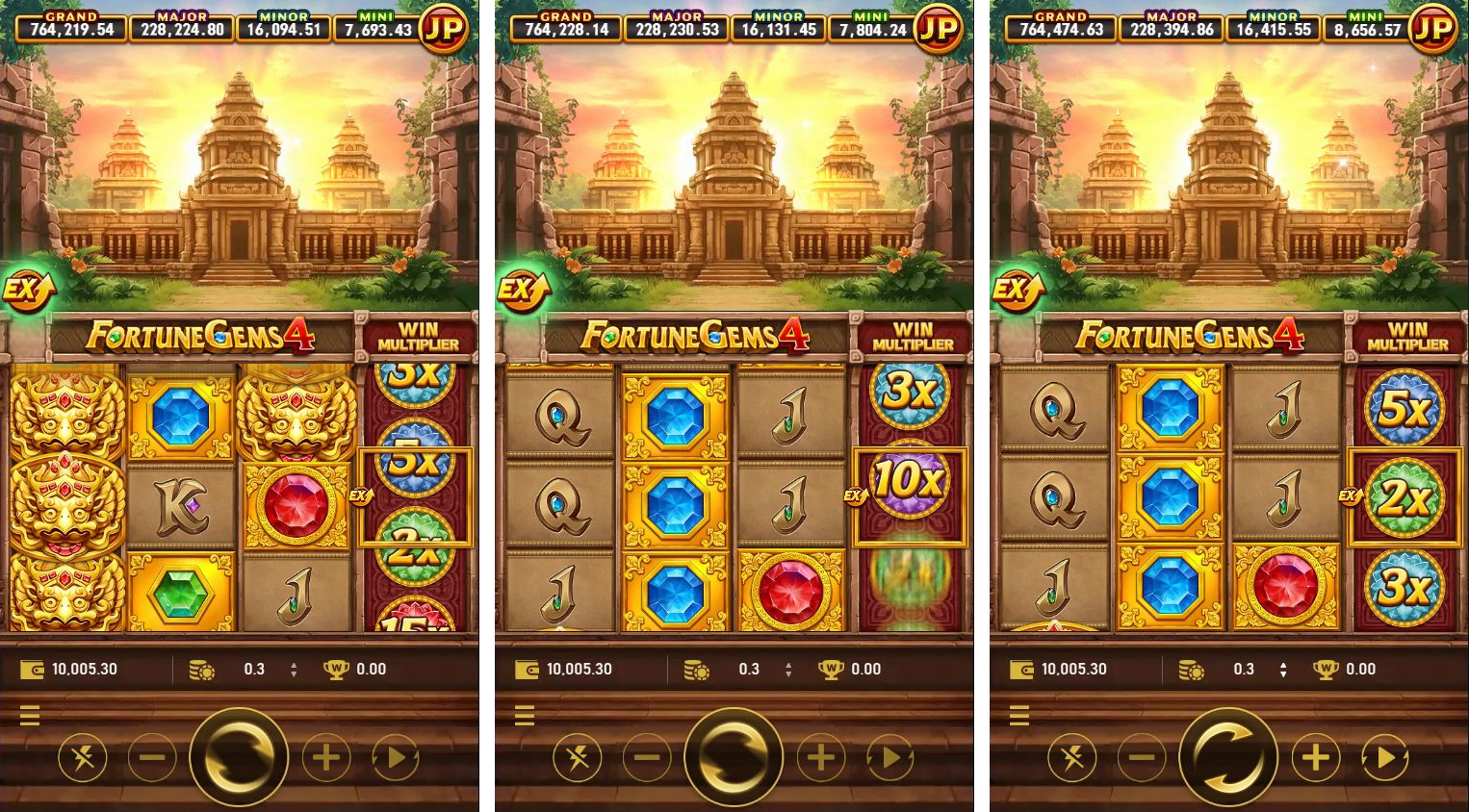
An EX spin at Normal speed, including the view after the reels stop. This silent 10-second sequence was assembled from real screenshots in chronological order; a playable MP4 is also included.
Play the demo on this page
To see how the splits and wheel work together, play the demo here on this page. Check the EX toggle after choosing your stake. All test amounts in this review are demo units.
Philippine searches show clear interest in the demo
Ahrefs Philippine data checked on 4 October 2026 estimated average monthly search volumes of 200 for ‘fortune gems 4’ and 150 for ‘fortune gems 4 demo’. The demo query suggests that finding a page where the game can be tried is an important part of the interest around its name.
Search query | Estimated average monthly searches in PH |
|---|---|
fortune gems 4 | 200 |
fortune gems 4 demo | 150 |
These are raw search-volume estimates, not visits to this site, and the two figures should not be added together. For a reader, the useful next step is to confirm that this is the RSG game, then use the demo on this page to understand splits and EX. Search interest says nothing about the game’s returns.
Portrait suits this interface better
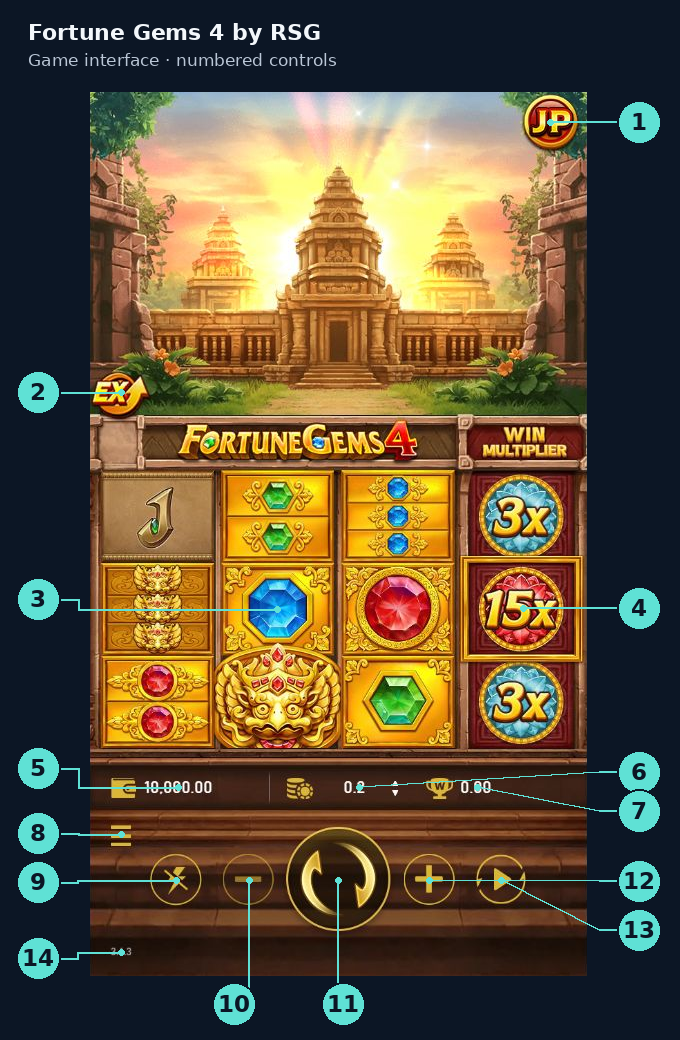
Fortune Gems 4’s opening screen before the recorded spins. The framed central multiplier shows 15×; WIN is 0.00. Numbered callouts identify the reel area and controls.
JP button. The jackpot entry at the top right.
Extra Bet. EX adds 50% to the ordinary stake.
Main grid. Three reels and three rows; five fixed lines.
Central multiplier. Read the framed centre value; 15× here.
Balance. Available demo credits: 10,000.00.
Bet selector. Open the stake selector; 0.20 shown.
WIN. Payout display; 0.00 on this opening screen.
Options. Open the menu for Help and settings.
Speed control. The lightning icon changes spin speed.
Decrease bet. Move down one stake setting.
Spin. Start a spin at the selected stake.
Increase bet. Move up one stake setting.
AutoSpin. Open the automatic-play control.
Build label. Version 3.6.3 appears at the lower left.
The temple, gold borders and red, blue and green gems give the game a recognisable look. On desktop, it sits in a central portrait-shaped area, with the balance, stake and WIN beneath the grid. The EX indicator is easy to spot. You can switch between Normal and Turbo speed; all 100 spins in the main sample were played manually on Turbo. The stake stayed the same when moving to the next spin in the same session.
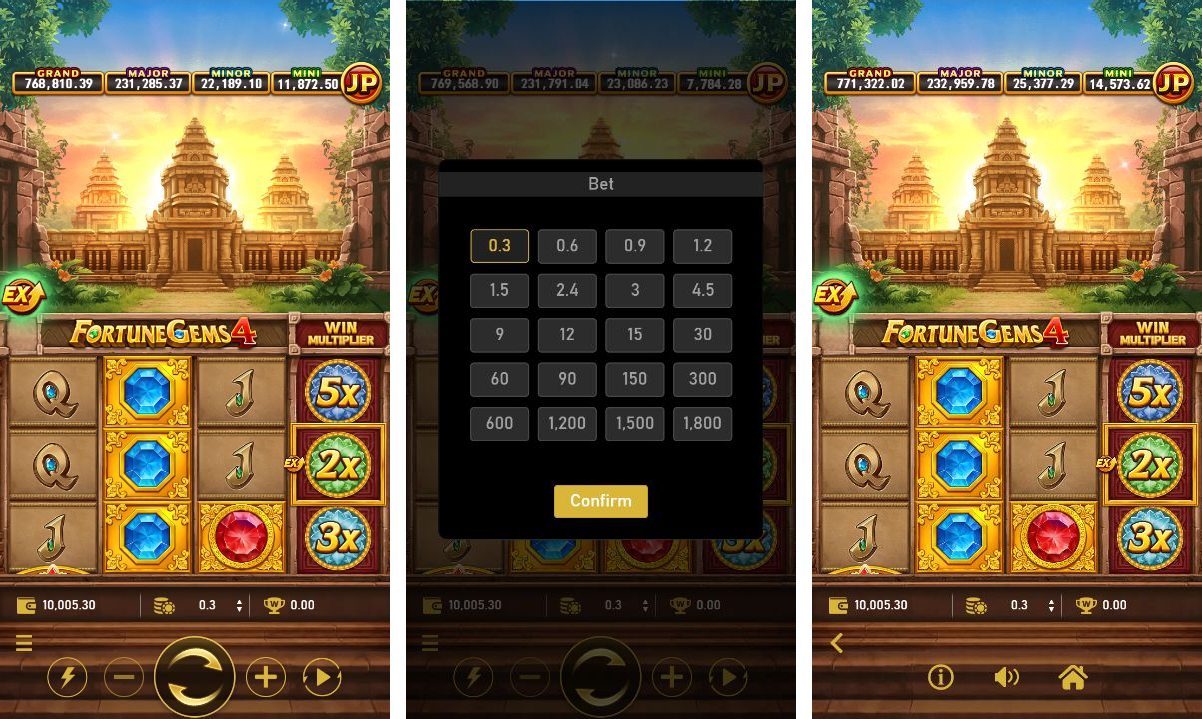
The main screen, stake selector and menu in a desktop browser simulating a 390 × 844 portrait viewport.
In the portrait simulation, the main amounts and the spin, plus/minus, speed and Auto controls were legible. The stake selector, menu and scrollable Help also opened successfully.
Auto offers 10, 20, 50, 100, 250, 500 or unlimited spins, with stop conditions for a single-spin payout, profit, loss and a jackpot. We opened it, checked the options and cancelled without running an automatic sequence. There is a useful range of settings, although their actual stopping behaviour still needs a separate test.
Check your settings after reopening
After the 100-spin test and one extra spin for the video, a Code35 error forced the game to close during our interface checks. On reopening, the balance of 10005.30 was retained, but the stake reset to 0.2, EX switched off and speed returned to Normal. The settled balance survived; some settings did not. I would check the stake and EX toggle after reopening. The cause of the error is unconfirmed, and no spin was being settled when it occurred.
Landscape keeps the game in a narrow column
At an 844 × 390 landscape viewport, the game kept its narrow portrait proportions, leaving empty space on both sides and making the symbols and amounts noticeably smaller. We could open and confirm the stake selector with a mouse, but reading values and clicking precisely took more effort. I would use portrait for this game, particularly when counting split symbols.

A desktop browser simulating an 844 × 390 landscape viewport. The empty space on either side is part of the actual game layout.
The five lines decide whether a spin pays
The three columns on the left form the winning combinations; the fourth column on the right supplies the multiplier. The five fixed paylines are the top, middle and bottom horizontal lines, plus two diagonals. A combination starts on the leftmost reel and runs across all three adjacent reels. Only the highest-paying combination on each line is paid. Three matching symbols stacked vertically do not form an extra payline.
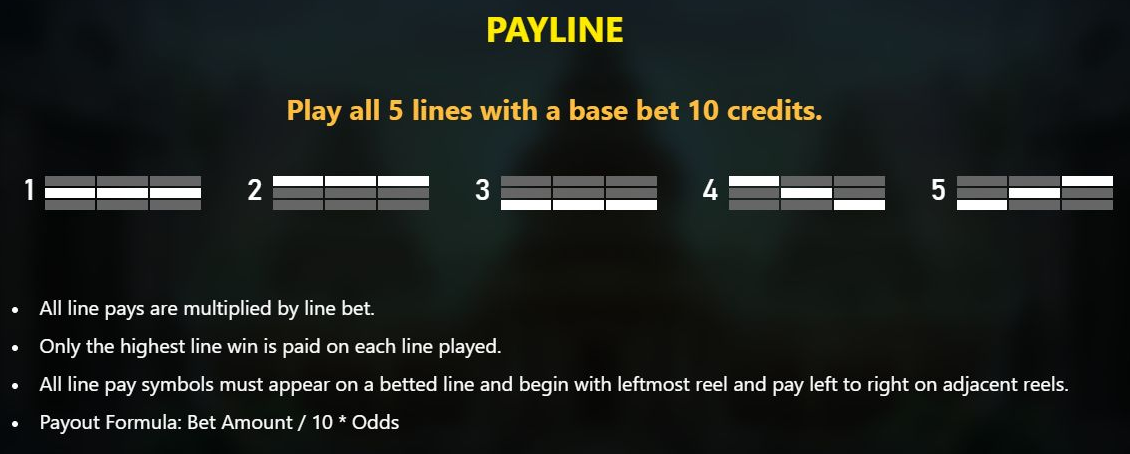
The five fixed paylines and base payout rules shown in the game’s Help.
The gold beast-mask WILD substitutes for regular paying symbols to complete a line. You can find each symbol’s base value in the symbol guide on this page. The key is understanding what those values mean: the red gem’s 40 in Help is not 40 times the full stake. In ordinary mode, one base line win is calculated as stake ÷ 10 × symbol value.
At the ordinary stake of 0.2 used in our test, the base calculation unit is 0.02. An unsplit red-gem line starts at 0.02 × 40 = 0.80. That amount is then multiplied by the split factor for that particular line and the wheel’s central multiplier. Calculate each winning line separately, then add them together.
Only the wheel’s centre position counts
Help lists wheel values of 1×, 2×, 3×, 5×, 10× and 15×. Only the value inside the central frame applies; the numbers partly visible above and below are neighbouring positions. Without a qualifying win on the main grid, even a high wheel value has no line payout to multiply.
I like how easy this is to read once everything settles. The main grid and multiplier each have their own space, so you know where to look. It gets harder when splits and several line wins happen together: glowing symbols, the wheel and the payout overlay all compete for attention.
A split affects the lines that pass through it
Two or three copies of the same symbol in one cell give a qualifying winning line through that cell a 2× or 3× factor. If several cells split on the same winning line, their factors multiply. Help illustrates this with a red-gem line containing two copies, three copies and one copy: the combined split factor is 2 × 3 × 1 = 6×.
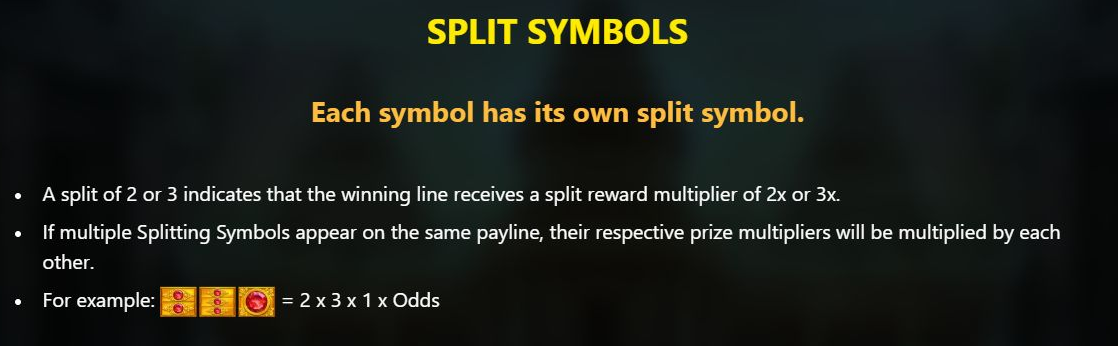
The split example in Help. Three-way splits are explicitly described in the rules; the actual winning examples selected for this review show two-way splits.
Ordinary spin 46 makes the rule easy to follow. The J in the middle-right cell split into two, giving the middle horizontal line a 2× split factor. A second win on the upward diagonal did not pass through that cell, so its factor stayed at 1×. The wheel’s central value was 1×, and the final WIN was 0.24.
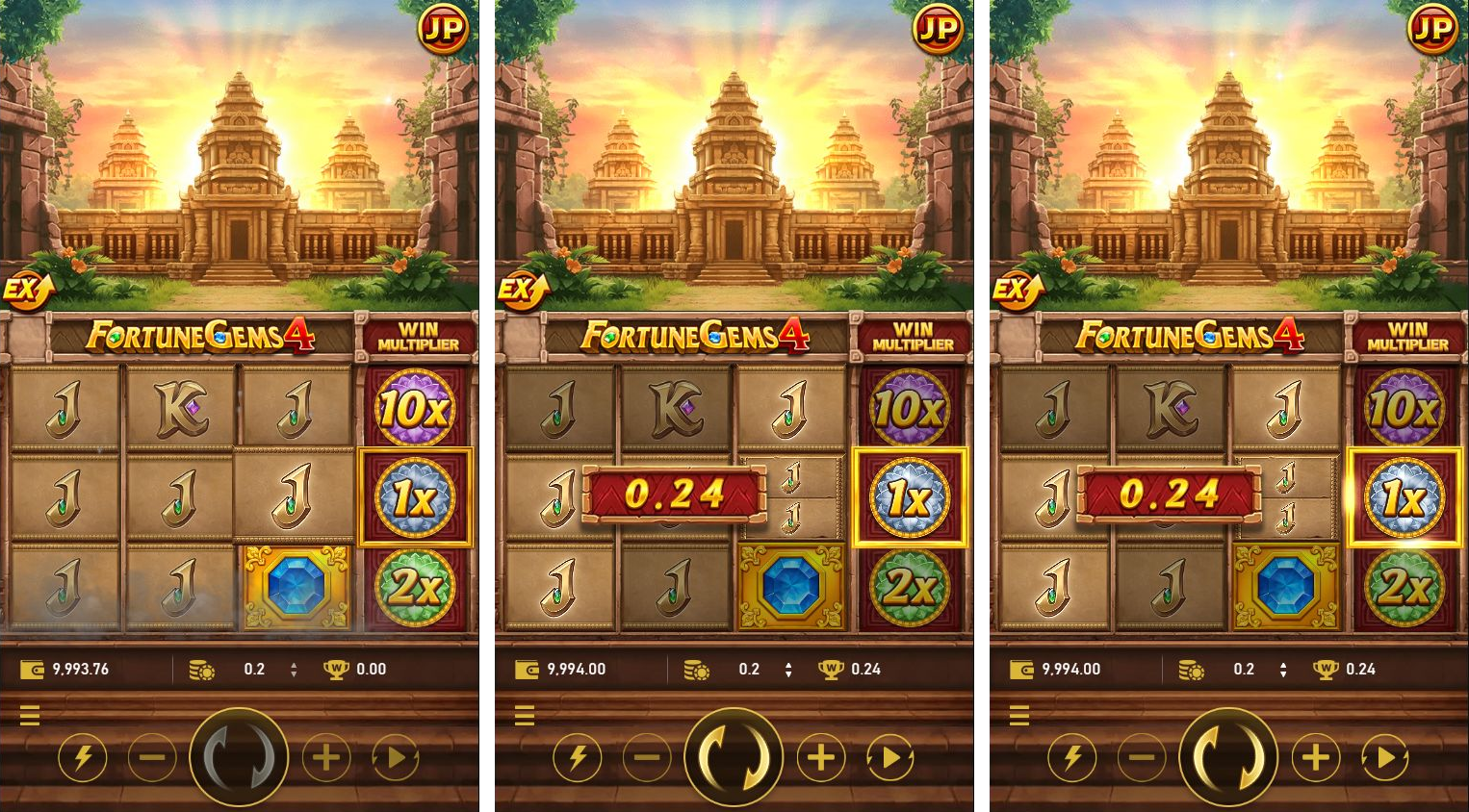
Ordinary spin 46, from left to right: one J in the middle-right cell after the reels stop, two Js in the same cell after the split, and the final WIN of 0.24.
Together, the two lines paid 0.02 × 4 × (2 + 1) × 1 = 0.24. The spin cost 0.20, leaving a net gain of 0.04. This small win explains more than a screen full of flashing lights: splits can happen in ordinary mode, and their effect depends on which winning lines they touch.
Split WILDs follow the same line-by-line rule. EX spin 27 produced five K lines. The double WILD in the top-centre cell doubled only the top horizontal line; the other four lines kept their original factors. With a central 3× multiplier, the total payout was 4.32. Counting each line separately avoids mistaking that busy screen for five doubled wins.
How one spin paid 16.00
The largest payout in our test came on EX spin 35, or spin 85 overall. The red gem in the centre split into two, while WILDs in the top-right and middle-right cells completed two red-gem lines. The wheel’s central value was 5×. The split red gem sat on both the middle horizontal line and the upward diagonal, giving each a 2× split factor.

From left to right: the single red gem after the reels stop, the SUPER WIN 16.00 counting screen, and the final settled result. The last frame shows WIN 16.00 at the bottom and a balance of 10008.66.
Winning line | Calculation | Payout |
|---|---|---|
Middle horizontal | 0.02 × 40 × 2 × 5 | 8.00 |
Upward diagonal | 0.02 × 40 × 2 × 5 | 8.00 |
Both lines combined | 8.00 + 8.00 | 16.00 |
A blue gem at the top also split into two, but it did not complete a blue-gem line and contributed nothing to this payout. Something similar happened on EX spin 9: a green gem in the bottom-right cell split, but the final 1.44 came from three K lines. Counting split cells alone will not explain the win.
This spin cost 0.30 and added 15.70 to the balance. Its 16.00 payout was about 53.33 times the actual spin cost. The 5× on the right is a line-win multiplier, so those figures use different starting amounts. BIG WIN and SUPER WIN are celebration and counting stages for the same spin, not additional payouts.
I have mixed feelings about this sequence. The split red gem and WILDs stand out, and the combination is easy to recognise. The counting overlay obscures the grid, though. For understanding a complicated win, the settled result is more useful than the changing total during the animation.
What EX changes, and what it costs
EX adds 50% to the base stake per spin and raises the wheel’s minimum central multiplier to 2×. We used a base stake of 0.2: ordinary mode charged 0.2, while switching on EX displayed and charged 0.3. Help also says EX increases the chance of higher multiplier values, but gives no probabilities for individual values.
The available stake range needs to be read in the active mode. The EX Bet panel we inspected had 20 fixed levels, from 0.3 to 1,800; our EX spins used the lowest, 0.3. We actually played ordinary mode at 0.2, but did not separately verify its maximum. These are demo units, not confirmed Philippine peso amounts.
Paying 50% more does not also raise the base line win by 50%. The EX formula divides the displayed stake by another 1.5. At these settings, ordinary 0.2 ÷ 10 and EX 0.3 ÷ 10 ÷ 1.5 both give 0.02. The change is in the wheel’s minimum value and multiplier distribution; you cannot simply put 0.3 into the ordinary-mode formula.
I would treat EX as an option rather than my default. A qualifying line win starts with at least a 2× wheel multiplier, but a spin with no payout also costs more. The stronger EX result in this short test is not enough for me to recommend leaving it on.
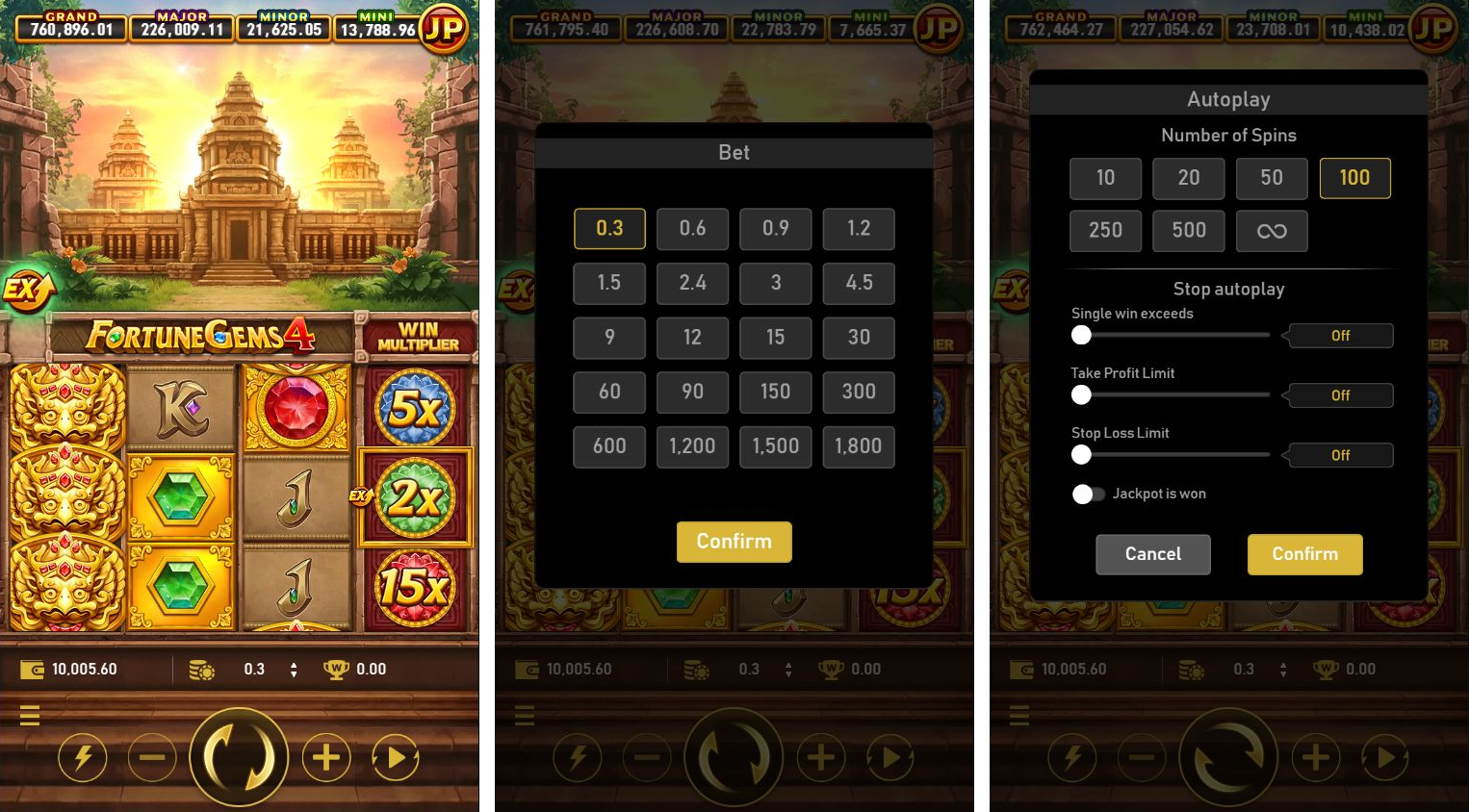
Three views of the same desktop game area: the four JP tiers, the EX stake selector, and Auto settings. These show the controls; no automatic spins were started.
JP displays four jackpot tiers
The expanded JP panel lists GRAND, MAJOR, MINOR and MINI, with displayed amounts that change over time. Auto also includes a ‘Jackpot is won’ stop option. These confirm that a jackpot interface exists, but do not establish eligibility, trigger probabilities or how a jackpot is awarded. We did not record a JP win.
I would not make JP the main reason to choose this game. Its clearest appeal is the combination we could observe and explain: five lines, splits and the central wheel. No BUY BONUS entry appeared in the main screen, menus, Help, JP, Bet or Auto areas we inspected.
RTP and the test sample
The listing retains 96.50% RTP, but we did not independently confirm that value in the official RSG material and complete Help checked for this review. The 122.40% return recorded across our 100 spins is the sample’s payouts divided by its actual stakes, a separate measure from theoretical RTP.
One large payout changed the 100-spin result
We played 50 ordinary spins followed by 50 EX spins. Total cost was 25.00 and total payouts were 30.60, for a net gain of 5.60. The balance started at 10000.00 and ended at 10005.60. That looks like a good result, but much of the session was quiet.
Mode | Spins | Actual cost | Payouts | Net result |
|---|---|---|---|---|
Ordinary | 50 | 10.00 | 3.20 | −6.80 |
EX | 50 | 15.00 | 27.40 | +12.40 |
Total | 100 | 25.00 | 30.60 | +5.60 |
Of the 100 spins, 21 paid something, 17 paid more than their cost and 79 paid zero. The longest run without a payout lasted 17 spins, from spin 5 through spin 21. Only eight ordinary spins paid. Switching to EX did not immediately reverse the decline either: the balance reached 9990.72 after spin 76.
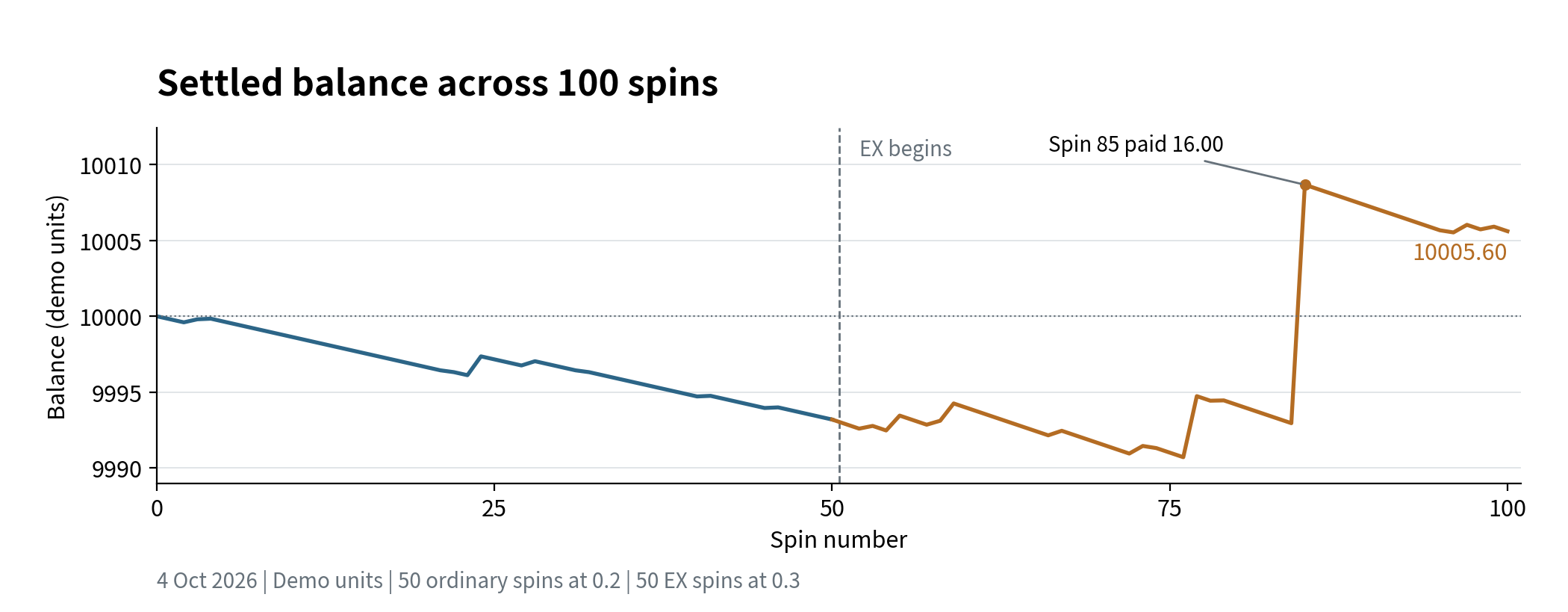
Settled balance after each spin. EX begins at spin 51; the 16.00 payout on spin 85 produces the largest jump. The vertical axis uses the observed balance range to make the changes visible.
Spin 85 accounted for about 52.3% of all payouts. Removing only that spin’s net gain from the total leaves the other 99 spins at −10.10 combined. This shows how heavily the sample depended on one result; it does not predict the next sequence of spins.
What stands out to me is the rhythm: a long stretch without a payout, then one spin that rewrites much of the result. Someone who likes frequent small wins may find this particular session quiet. If you enjoy following an occasional complicated combination, it is easier to see why the split animation takes so much of the screen.
Read payouts alongside the cost of each spin
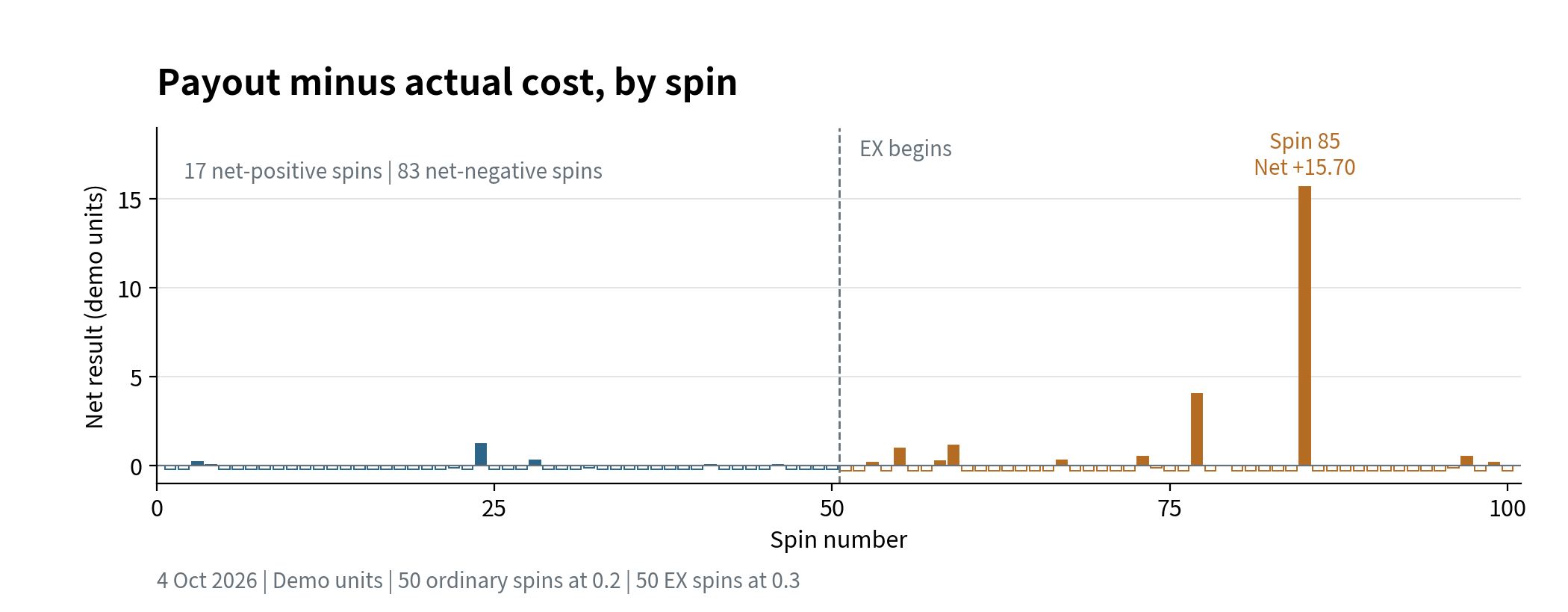
Each bar is the spin’s payout minus its actual cost: 0.2 in ordinary mode and 0.3 in EX. There were 17 net gains and 83 net losses.
A payout does not necessarily cover the spin’s cost. Of the eight ordinary spins with a payout, six produced a net gain. Of the 13 EX spins with a payout, 11 produced a net gain. Those counts explain a falling balance more clearly than the number of times WIN appears.
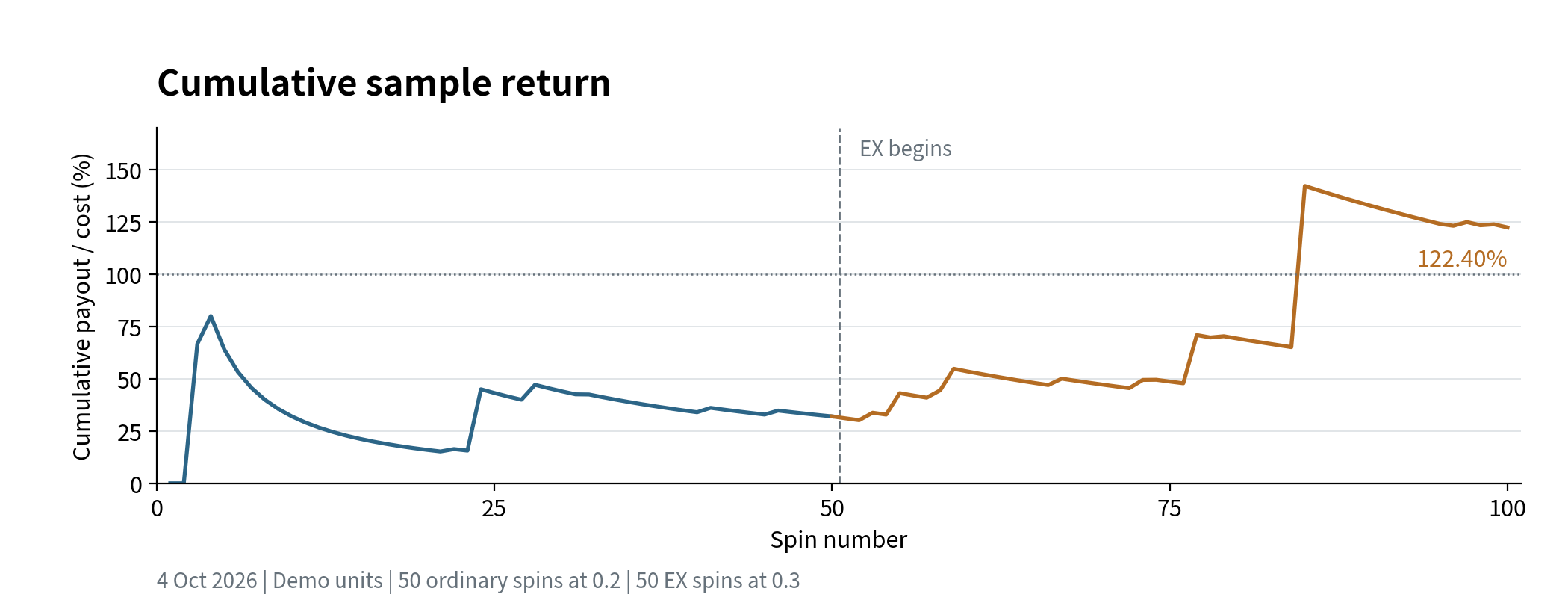
Cumulative payouts divided by cumulative cost, ending at 122.40% after 100 spins. This is the observed return for this sample, not the game’s theoretical RTP.
The observed returns were 32.00% for the ordinary group and 182.67% for EX. We switched modes in sequence rather than alternating randomly, and the sample is too small to compare long-term performance. EX’s higher result mainly reflects the 16.00 payout within that part of the test.
To see how the same budget can move through runs without a payout and occasional wins, try our slot simulator. It helps illustrate short-term variation; it does not reproduce Fortune Gems 4’s actual mathematical model.
Comparing Fortune Gems 3 starts with the provider
The names are close, and both games have a three-by-three grid, five lines, split symbols and a wheel on the right, so a comparison with Fortune Gems 3 feels natural. But these are games from two different providers, RSG and JILI. Rules found in this RSG build’s Help cannot automatically be applied to the JILI game.
For a closer look at the other provider’s approach, read our Fortune Gems 3 by JILI review and compare its splits, EX cost and pace of play.
Comparison | Fortune Gems 4 | Fortune Gems 3 |
|---|---|---|
Provider identified in our checks | RSG | JILI |
Shared structure | 3 × 3 main grid, five lines, splits and a central wheel multiplier | 3 × 3 main grid, five lines, splits and a central wheel multiplier |
EX cost | 50% above the base stake | 50% above the base stake |
EX description in the Help checked | Explicit minimum of 2× | Emphasises a higher chance of high multiplier values |
Speed options observed | Normal and Turbo | Also has Super Turbo |
Jackpot interface | Four JP tiers observed | RSG’s JP rules do not carry over |
Officially published maximum win | 10,100× | 10,125× |
I would not rank it above Fortune Gems 3 simply because its name contains ‘4’, or use their similar maximum-win figures to choose between them. RSG’s version clearly explains EX’s minimum 2× and gives JP its own entry point. What makes me pause and watch is how a split affects different lines. If you already know JILI’s split mechanic, that familiarity may also make this game feel less fresh.
If you like a simple grid with an extra layer to watch, Fortune Gems 4 is worth trying in the demo. Its most interesting detail is how one split cell can affect different winning lines. I would start in ordinary mode to learn the grid, then decide whether I enjoy the changes EX makes to the wheel. Neither our sample profit nor the official 10,100× figure would be my reason to choose it.
How we tested
Tested on 4 October 2026 in RSG’s free demo, build 3.6.3, using a Windows 11 laptop browser at a 1254 × 884 desktop viewport. The main sample was 50 ordinary spins and 50 EX spins, all played manually on Turbo. One additional EX spin at Normal speed was captured for the video and excluded from the statistics. The amounts before and after each spin were checked against the original screenshots. Mobile views were simulated in a desktop browser; physical touchscreens, Philippine network conditions and sound were not tested. Official RTP, JP probabilities and long-term volatility remain unverified.
Sources
RSG’s official Fortune Gems 4 product page
RSG’s official game-code directory
JILI’s official Fortune Gems 3 product page
Mechanics are described from Help in the tested RSG build and actual screenshots. The product links are for checking sources; the demo stays on this page. For adults who meet the legal age requirement where they live. Demo results do not predict future returns.
Fortune Gems 4 by RSG FAQs
Answers to common questions about Fortune Gems 4 by RSG.
Fortune Gems 4 by RSG Reviews
 No Player Reviews Yet
Played Fortune Gems 4 by RSG? Share your experience with other players.
 Write A Review