
Gates of Olympus by Pragmatic Play
Play Gates of Olympus by Pragmatic Play In Demo Mode


 Other SymbolRed orb
- Multiplier class 2×–500×
- Orb values add together
- Applies to tumble win
- No fixed colour value
 Other SymbolPurple orb
- Multiplier class 2×–500×
- Orb values add together
- Applies to tumble win
- No fixed colour value
 Other SymbolBlue orb
- Multiplier class 2×–500×
- Orb values add together
- Applies to tumble win
- No fixed colour value
 Other SymbolGreen orb
- Multiplier class 2×–500×
- Orb values add together
- Applies to tumble win
- No fixed colour value
 ScatterZeus Scatter
- 4+ award 15 free spins
- 4/5/6 pay 3/5/100×
- Anywhere on the board
- Free: 3+ add 5 spins
 Paying SymbolBlue gem
- 8+ anywhere
- 8–9: 0.25× bet
- 10–11: 0.75× bet
- 12–30: 2× bet
 Paying SymbolGreen gem
- 8+ anywhere
- 8–9: 0.4× bet
- 10–11: 0.9× bet
- 12–30: 4× bet
 Paying SymbolYellow gem
- 8+ anywhere
- 8–9: 0.5× bet
- 10–11: 1× bet
- 12–30: 5× bet
 Paying SymbolPurple gem
- 8+ anywhere
- 8–9: 0.8× bet
- 10–11: 1.2× bet
- 12–30: 8× bet
 Paying SymbolRed gem
- 8+ anywhere
- 8–9: 1× bet
- 10–11: 1.5× bet
- 12–30: 10× bet
 Paying SymbolGoblet
- 8+ anywhere
- 8–9: 1.5× bet
- 10–11: 2× bet
- 12–30: 12× bet
 Paying SymbolRuby ring
- 8+ anywhere
- 8–9: 2× bet
- 10–11: 5× bet
- 12–30: 15× bet
 Paying SymbolHourglass
- 8+ anywhere
- 8–9: 2.5× bet
- 10–11: 10× bet
- 12–30: 25× bet
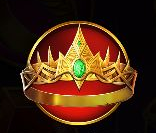 Paying SymbolCrown
- 8+ anywhere
- 8–9: 10× bet
- 10–11: 25× bet
- 12–30: 50× bet
Game Themes

 ThemeGreek Mythology Games
 32 Games

Gates of Olympus by Pragmatic Play Expert Review


Updated:
Here you can find detailed review information about Gates of Olympus by Pragmatic Play.
1. A clear counting game with a longer wait for the result
Gates of Olympus by Pragmatic Play is most enjoyable when one win opens space for another. The original game fills a six-column, five-row board with gems and gold ornaments, then pays for matching symbols anywhere on it. I like being able to follow the count and the running tally without tracing lines. The trade-off is patience: the growing WIN counter can look finished while a tumble is still going.
What I liked
✅ Matching eight symbols anywhere is easy to understand, and the left-hand tally makes a long tumble readable.
✅ The crown, hourglass, ring and coloured gems have distinct shapes as well as colours.
✅ Spin 5 carried one $0.20 stake through five paying tumbles, with a clear $0.83 final result.
✅ The multiplier rules give the base game and free spins a connected idea: add the relevant orb values, then apply the multiplier to the win.
What I didn’t like
❌ Normal speed spends time presenting each tumble; I would use it to learn the game rather than to rush through spins.
❌ The left-hand $0.25 Double Chance offer sits beside a $0.20 actual stake, so the active cost needs a deliberate check.
❌ In the two usable portrait-size captures, the game and Help text occupy a small area and are uncomfortable to read.
❌ A paying animation can still leave a loss. Spin 4 paid $0.10 against a $0.20 cost.
The 50 recorded ordinary spins returned $7.02 from $10.00 staked, a $2.98 loss in free-demo credits. No free-spin feature triggered, so my judgment of its pacing stops at the base game. This is the original Gates of Olympus, announced in February 2021, with an individual multiplier ceiling of 500× and a total win cap of 5,000×. Gates of Olympus 1000 is a separate game.
This silent 10-second sequence follows part of Normal-speed spin 5, assembled from sequential screenshots. It ends during the tumble at WIN $0.15; the separate settled screenshot confirms the final $0.83.
Philippine search interest. Ahrefs data queried for PH on 6 October 2026 estimates 800 monthly searches for “gates of olympus”, 350 for “gates of olympus demo” and 100 for “gates of olympus slot”. These are keyword estimates, not player counts or this website’s traffic. Overlapping terms should not be added together.
Try the demo on this page. Check the game title and the active BET at the bottom before starting. All dollar figures in this review are the captured demo’s USD-denominated virtual credits, not Philippine pesos or real-money results.
2. Finding the controls and reading the screen
The purple temple and Zeus figure give the board a strong visual identity, but the useful design detail is the separation between the board, the award list and the money bar. During a longer tumble, the list tells you which symbol groups have paid. I watch that and the settled balance rather than treating every number change as another payout.
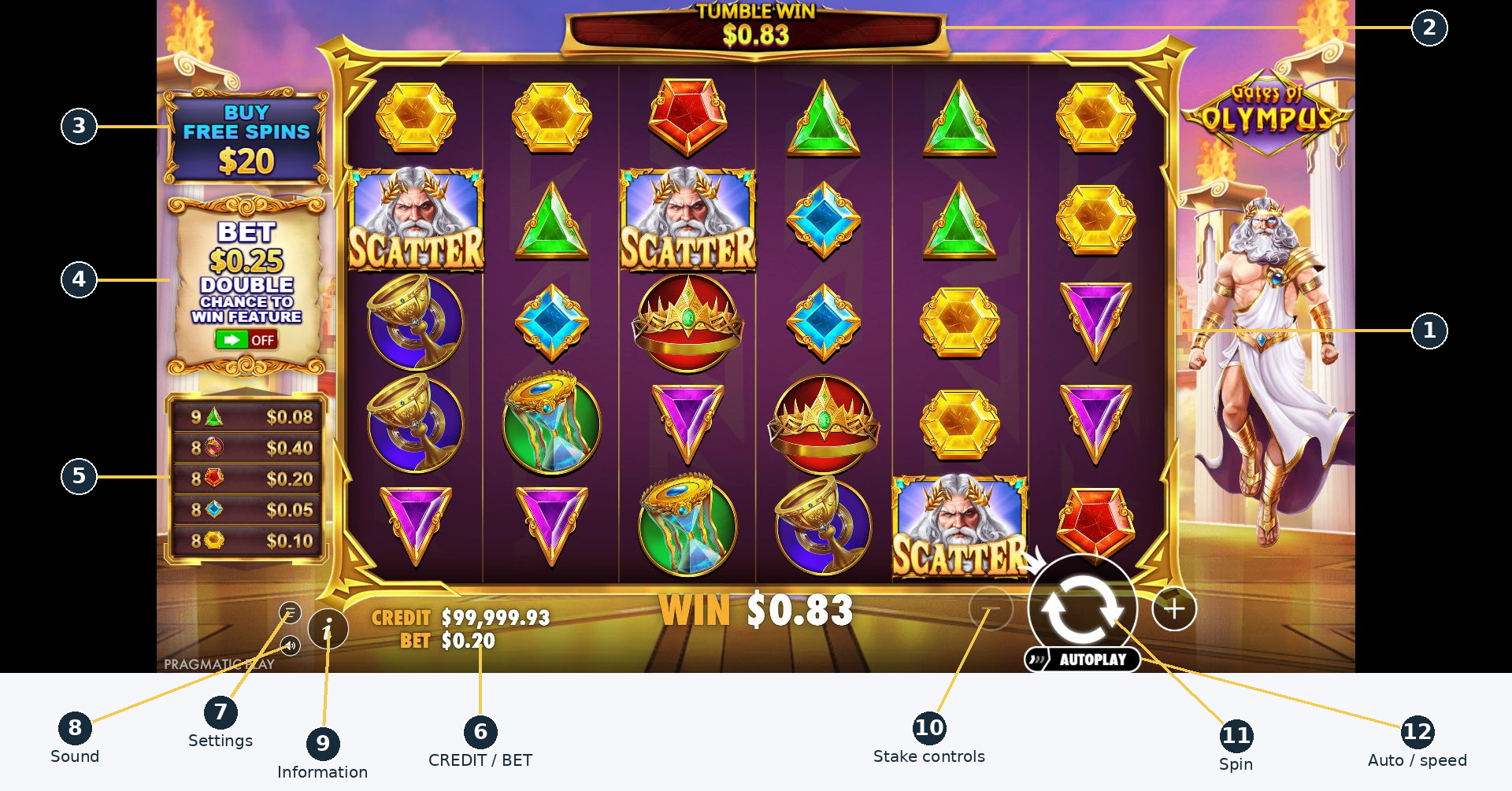
Spin 5 after settlement: WIN $0.83, CREDIT $99,999.93 and BET $0.20. The image retains the complete captured screen.
Six-by-five board: Count each ordinary symbol type across the whole screen; matching symbols need not touch.
TUMBLE WIN: The running total above the board. Wait until the complete sequence settles.
BUY FREE SPINS: The inspected offer is $20 at a $0.20 base stake. It was not purchased.
Double Chance: The offer shows BET $0.25 with the switch OFF. It is not the active cost in this screenshot.
Award tally: The five listed awards belong to the same paid spin, not five new stakes.
CREDIT and BET: Available balance and the currently active total stake. These are the values to check before spinning.
Settings menu: Opens settings including the stake, ambient music, Sound FX and introductory screen.
Sound: Toggles sound and music. The recording contains no audio and I have not assessed its quality.
Information: Opens the paytable and rules, including payout counts, multiplier conditions and costs.
Minus and plus: Change the stake and open Bet controls. Check TOTAL BET after a change.
Spin: Starts a spin at the active stake. Its moving state does not mean the result has settled.
Autoplay and speed area: Opens the automatic-play settings; the speed options include Normal, Quick and Turbo.
The opened panels are worth a look
The selected Bet panel shows BET 1 × COIN VALUE $0.01 × BET MULTIPLIER 20 = TOTAL BET $0.20. The wording “20×” here is part of the stake calculation, not evidence of 20 winning lines. The Autoplay panel showed Turbo selected, Quick unselected, Skip Screens selected and a proposed batch of 100. That panel does not mean 100 spins were executed: the reviewed ledger contains 50 manually recorded spins.
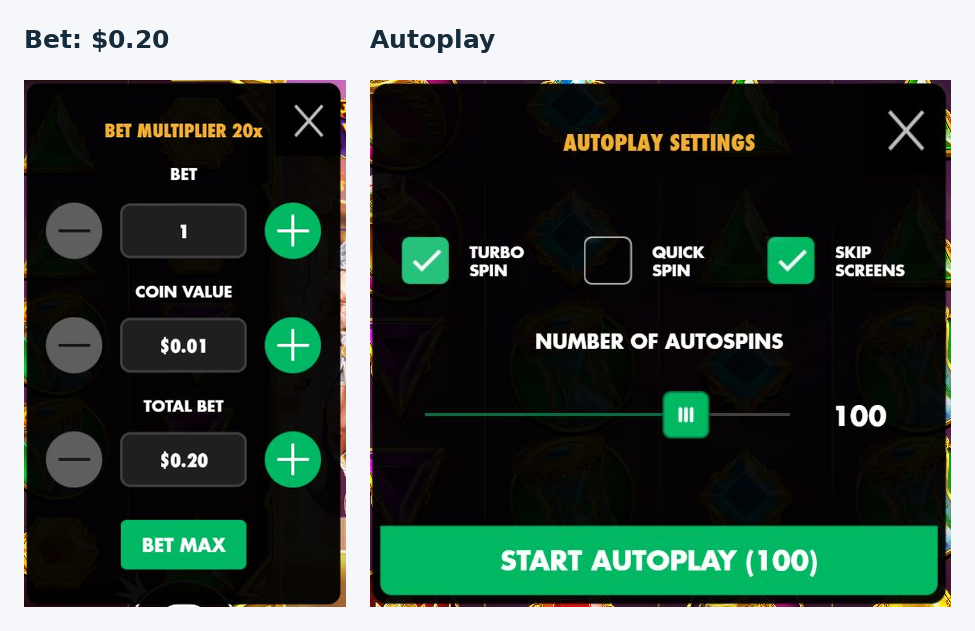
Left: the selected $0.20 stake. Right: the inspected speed and Autoplay options. Both panels are crops of real screenshots, with the original proportions retained.
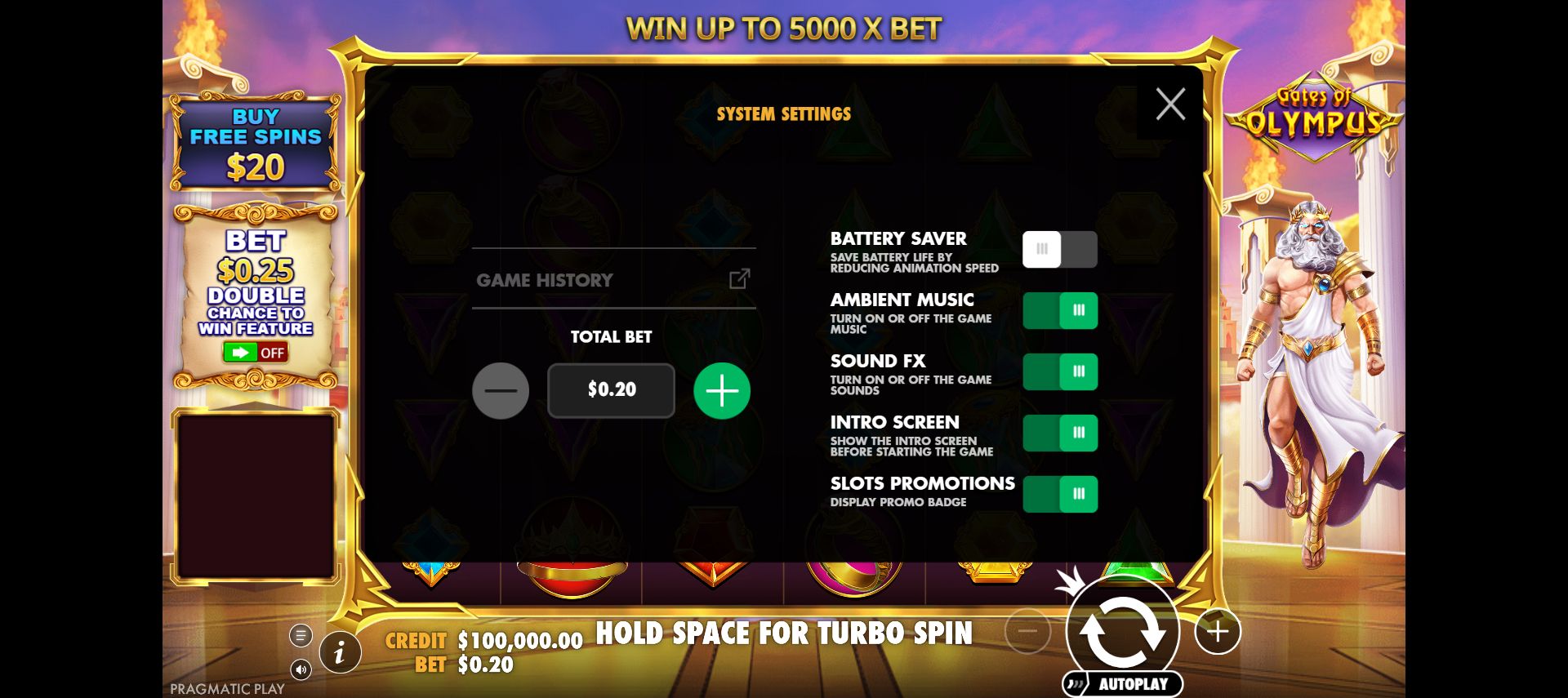
The opened settings panel. Visible switches establish that the options exist; they do not establish how the audio sounds.
Portrait-size reading
At the captured 360 × 800 size, the board stays horizontal within a narrow portrait image, leaving large black areas above and below. The 390 × 844 Help-open capture shows the same practical problem: small text in a compact central area. Help was opened successfully, but reading it at that size is awkward.
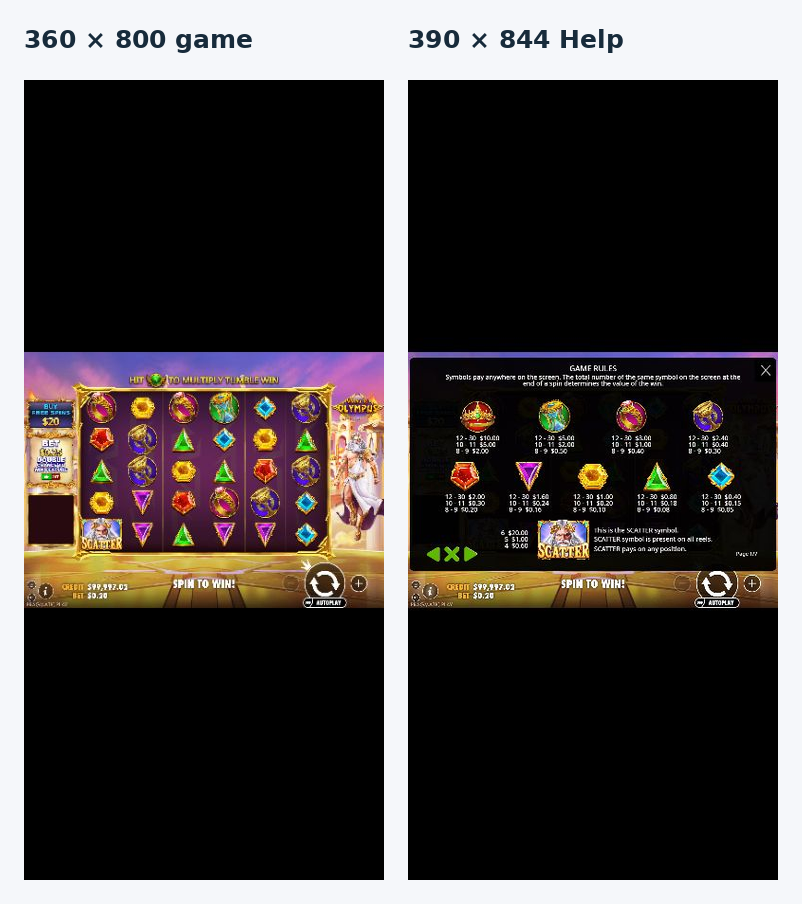
Left: 360 × 800 game view. Right: 390 × 844 Help view. These desktop-size previews show small text; they do not establish how the game feels on a physical phone.
3. Counting a win anywhere on the board
Ordinary symbols pay in three count bands: 8–9, 10–11 and 12–30. Count one appearance across all 30 positions, then use its band in the paytable. There is no leftmost-reel requirement or fixed line to follow. Different winning symbol types pay together. The current Help lists nine ordinary paying appearances, one Zeus Scatter and four coloured multiplier-orb appearances; it does not define a Wild substitution symbol.
Reading the displayed paytable. The values below are the actual displayed awards at the ordinary $0.20 stake with Ante OFF. They are cash-style demo amounts, not “coins per line”.
Appearance | 8–9 | 10–11 | 12–30 |
|---|---|---|---|
Crown | $2.00 | $5.00 | $10.00 |
Hourglass | $0.50 | $2.00 | $5.00 |
Ruby ring | $0.40 | $1.00 | $3.00 |
Goblet | $0.30 | $0.40 | $2.40 |
Red gem | $0.20 | $0.30 | $2.00 |
Purple gem | $0.16 | $0.24 | $1.60 |
Yellow gem | $0.10 | $0.20 | $1.00 |
Green gem | $0.08 | $0.18 | $0.80 |
Blue gem | $0.05 | $0.15 | $0.40 |
For example, eight blue gems pay $0.05, one quarter of the $0.20 stake. Eight rings pay $0.40, twice that stake. A small award is still a paying result, even when it does not cover the cost. Scatter is separate: the current paytable shows 4 / 5 / 6 Scatters paying $0.60 / $1.00 / $20.00 at this stake, wherever they appear.
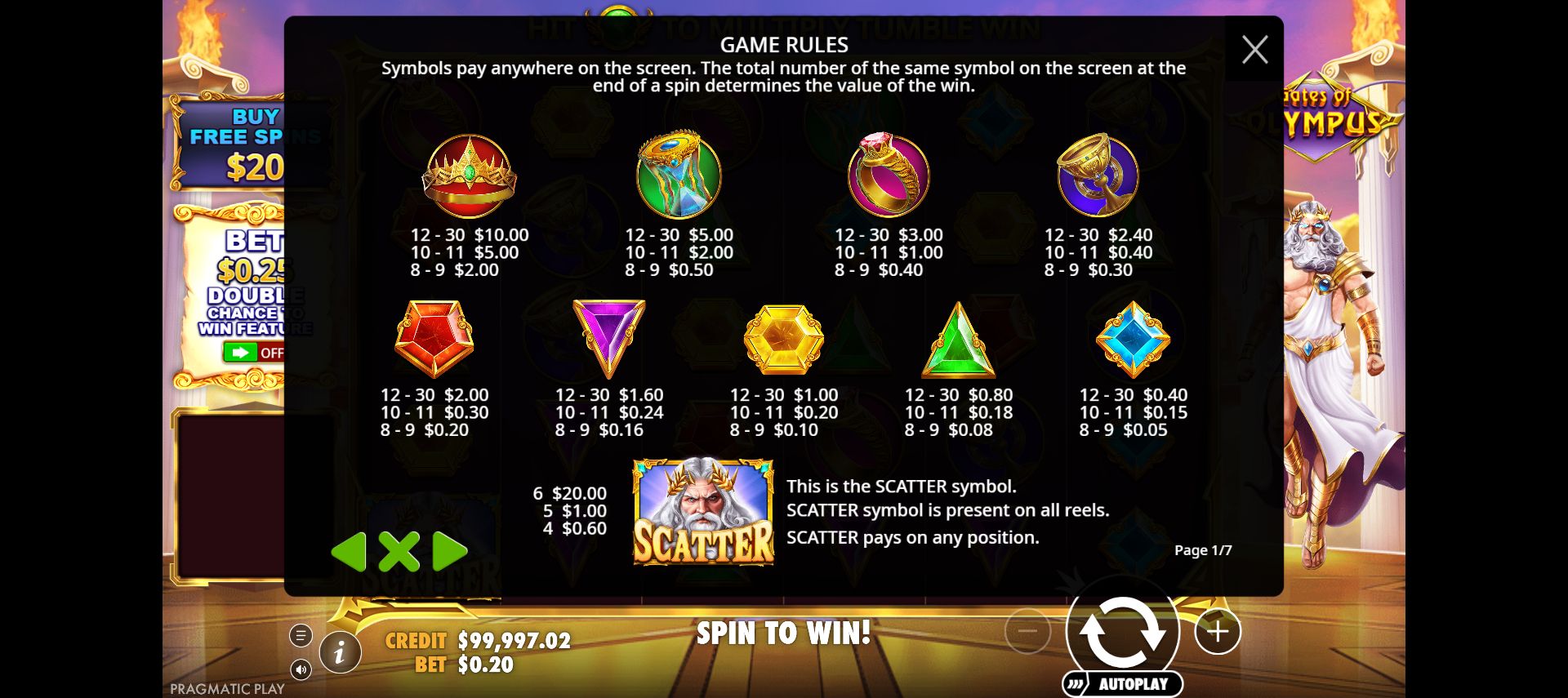
Current Help page 1 of 7, captured at BET $0.20 and Double Chance OFF. Picture names describe the visible artwork.
4. Following tumbles and understanding the multiplier
After a win, the paying symbols disappear, the remaining symbols fall and new ones fill the gaps. Another qualifying group pays as part of the same spin. The sequence continues until no further winning combination forms, with the total credited after the sequence is complete.
Spin 5 shows why the final counter matters
The process screenshot shows $0.15 after the first two awards: eight yellow gems paid $0.10 and eight blue gems paid $0.05. The separate final screenshot records three more awards: eight red gems paid $0.20, eight rings paid $0.40 and nine green gems paid $0.08. Together, $0.10 + $0.05 + $0.20 + $0.40 + $0.08 = $0.83. This is one $0.20 spin, giving a $0.63 net gain.
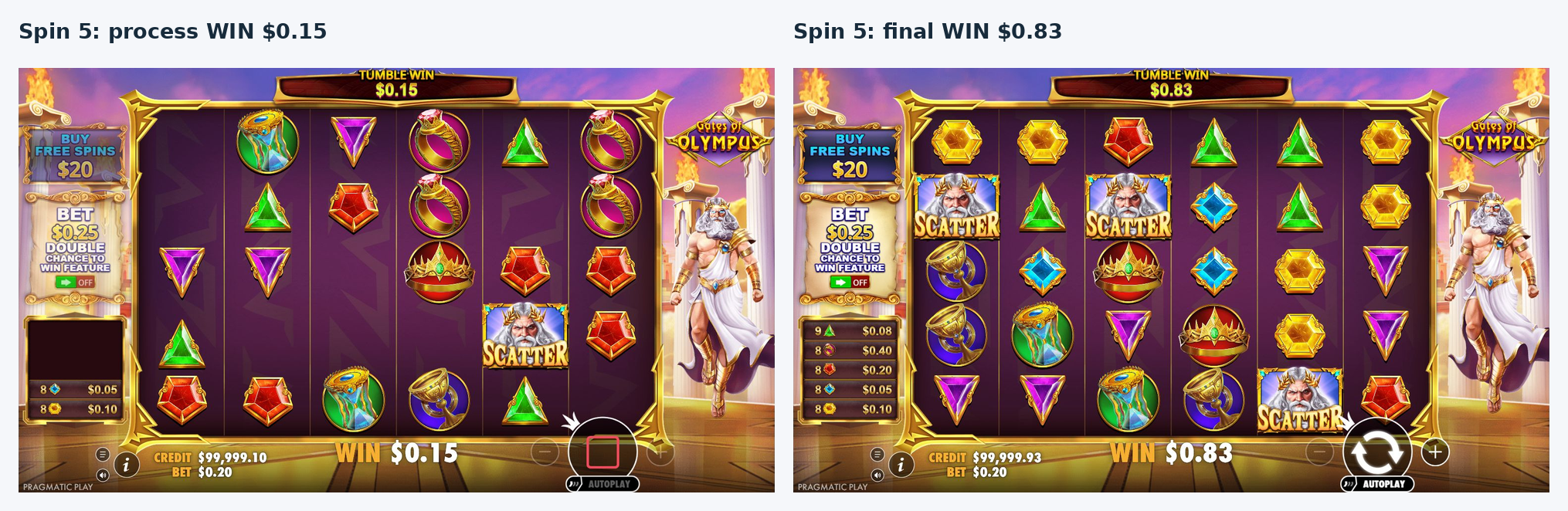
Left: a process frame at WIN $0.15 with the spin still running. Right: the settled $0.83 result and $99,999.93 balance. The final screenshot was taken after the video window; it is not presented as the clip’s last frame.
The final board also has three Scatters. That does not trigger the base-game free spins, which require at least four. It is a useful reminder to distinguish a visible special symbol from a completed feature trigger.
Orb values are added before multiplying the win
The current Help allows orb values of 2×, 3×, 4×, 5×, 6×, 8×, 10×, 12×, 15×, 20×, 25×, 50×, 100×, 250× and 500×. At the end of a tumble sequence, the on-screen multiplier values are added, then applied to the sequence win. A rule illustration: a $0.40 tumble win with relevant 2× and 5× orbs becomes $0.40 × (2 + 5) = $2.80, rather than $0.40 × 2 × 5. This example explains the rule; it did not occur in the 50-spin sample. Orb colour alone has not been verified as a fixed multiplier value.
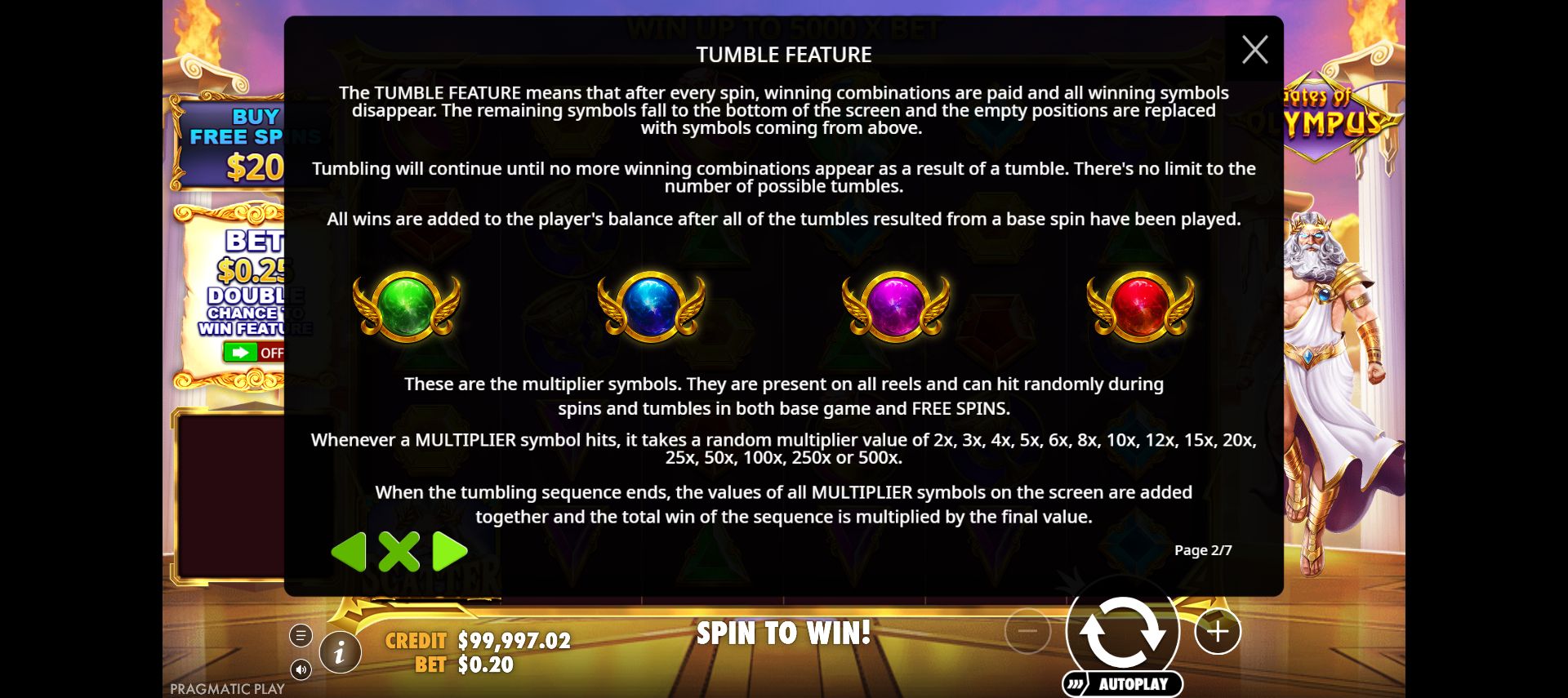
Help page 2 of 7. No orb-assisted final payout was confirmed in the recorded 50 spins.
Free spins carry a total multiplier
Four or more Scatters award 15 free spins. During the feature, an orb’s value joins the accumulated multiplier when that spin produces a win. A later winning spin with a new multiplier uses the accumulated total. Three or more Scatters during free spins add five more spins. This is the Help rule, not a feature sequence observed in the sample.
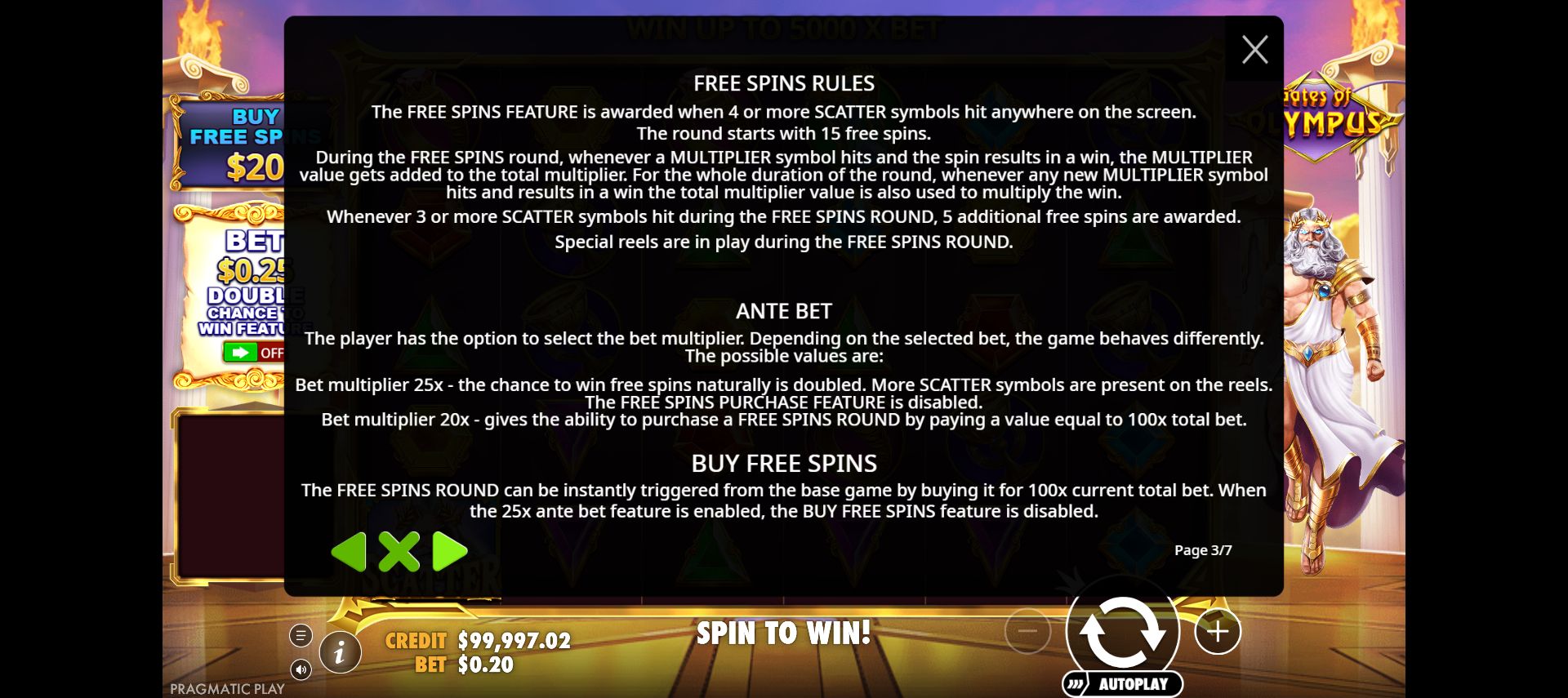
Help page 3 of 7. The free-spin feature did not trigger naturally, and neither paid Ante play nor a feature purchase was recorded.
5. The active cost, RTP and limits
The ordinary stake used throughout the test was $0.20. Double Chance would raise it by 25% to $0.25 at that setting. Its Help describes a doubled chance of naturally triggering free spins through more Scatters on the reels; it does not promise a feature on the next spin. BUY FREE SPINS was offered at 100 times the current ordinary total bet, or $20 here, and is disabled with Double Chance enabled.
Mode | Displayed cost at this setting | What was actually checked |
|---|---|---|
Ordinary, Ante OFF | $0.20 per spin | 50 completed spins |
Double Chance / Ante | $0.25 per spin | Rule and OFF-state offer only; no paid spins |
Buy Free Spins | $20 per purchase | Price and rule only; no purchase |
Current Help states 96.50% theoretical RTP for ordinary play, Ante and buying free spins, and a $0.20–$300 betting range. The total award is capped at 5,000× the bet; reaching it ends the round and forfeits remaining feature play. That total cap is different from the largest single orb value of 500×.
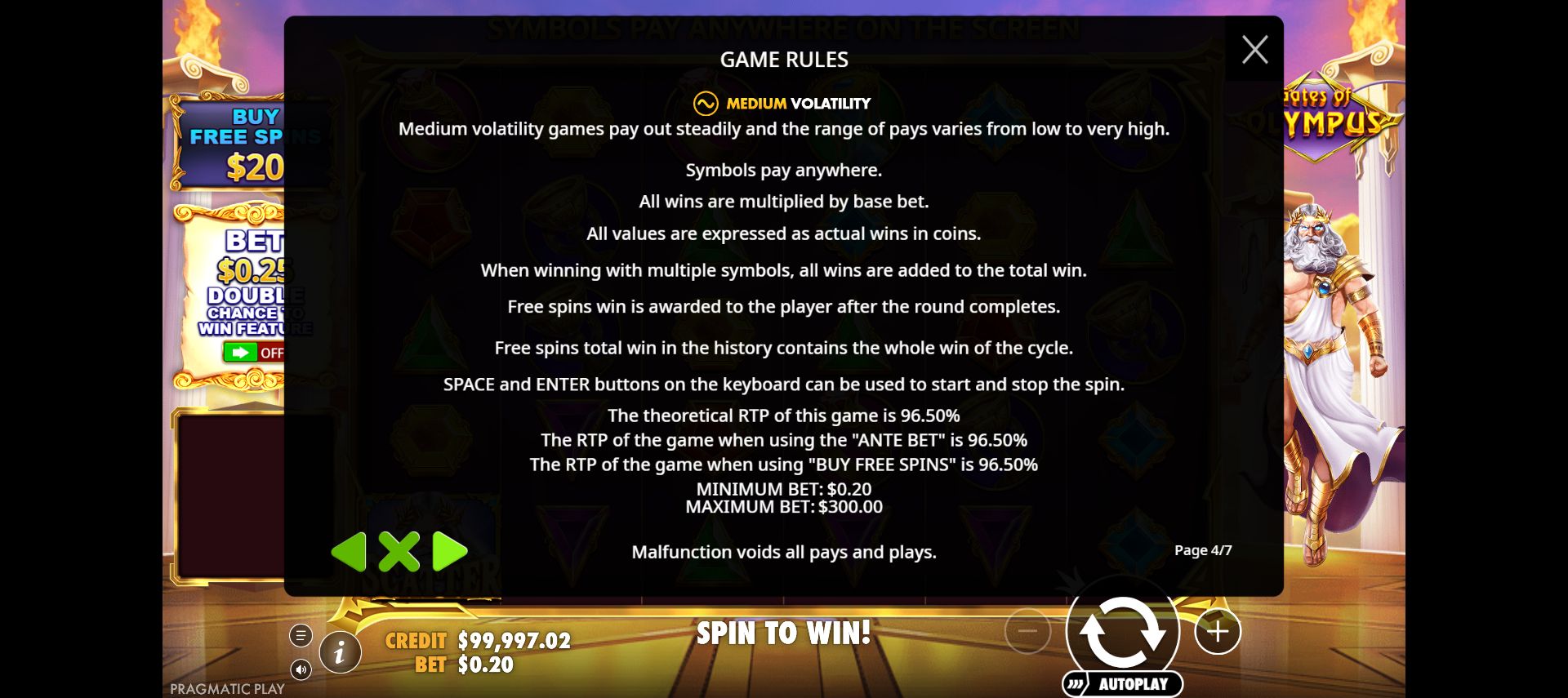
Help page 4 of 7 for the captured demo. Its label says MEDIUM VOLATILITY. The supplier’s February 2021 launch article described high volatility and also mentioned 20 paylines. Those historical descriptions conflict with this Help; this review uses the current pay-anywhere rules and preserves the volatility difference rather than claiming the short sample resolves it.
The sample’s 70.2% return is $7.02 divided by $10.00, not a replacement for the theoretical RTP. For a broader illustration of how stakes and outcomes can move a balance, the slot simulator is a separate learning tool; it does not reproduce this game’s unpublished mathematics or predict its next result.
6. What the 50 recorded spins actually returned
The sample was captured on 6 October 2026 in the original free demo, with Ante OFF throughout. Spins 2–5 used Normal speed; spin 1 and spins 6–50 used Turbo, giving 4 Normal and 46 Turbo spins. The video spin is included in those 50. Each row represents one completely settled paid spin, with all its tumbles counted once. There were no balance resets, free-credit adjustments, feature purchases or paid Ante spins.
Measure | Recorded result |
|---|---|
Paid spins | 50 |
Total cost | $10.00 |
Total payout | $7.02 |
Net change | −$2.98 |
Opening → closing balance | $100,000.00 → $99,997.02 |
Payout above zero | 15 / 50, or 30% |
Net-profitable spins | 8 / 50, or 16% |
Break-even spins | 1 |
Paying spins below their cost | 6 |
Zero-payout spins | 35 |
Longest zero-payout run | 7 spins |
Longest net-loss run | 10 spins |
Largest payout | Spin 45: $2.48, or 12.4× stake |
The distinction between a hit and a profit matters here: 15 spins paid something, but only eight increased the balance. Spin 45 contributed $2.48 of the $7.02 payout, which makes the ending especially sensitive to one result. Fifty spins are useful for explaining the recorded session, not for deciding which game pays more over the long run.
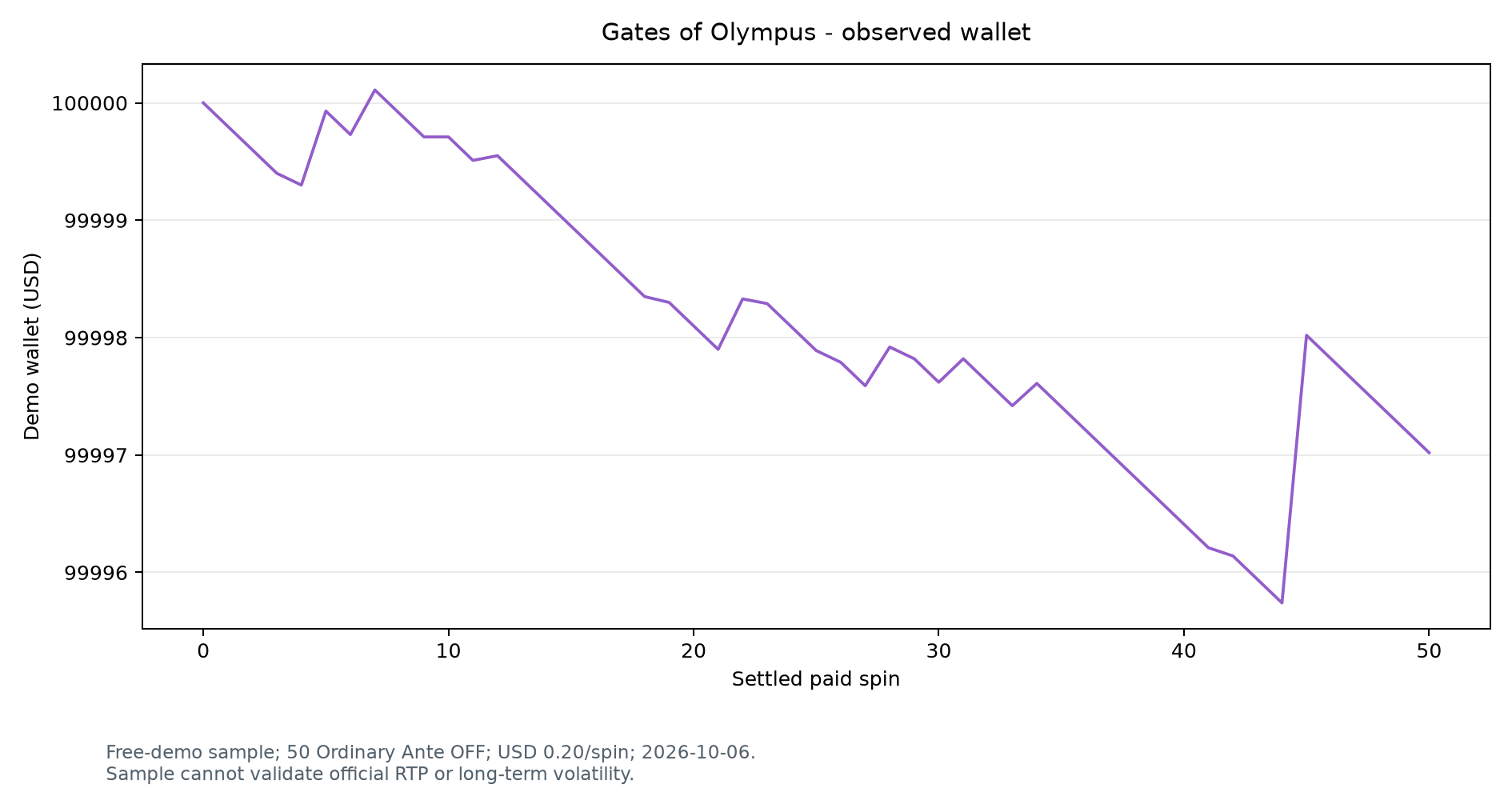
The balance chart uses every settled ledger row, starting at $100,000.00 and ending at $99,997.02. There are no reset gaps to bridge.
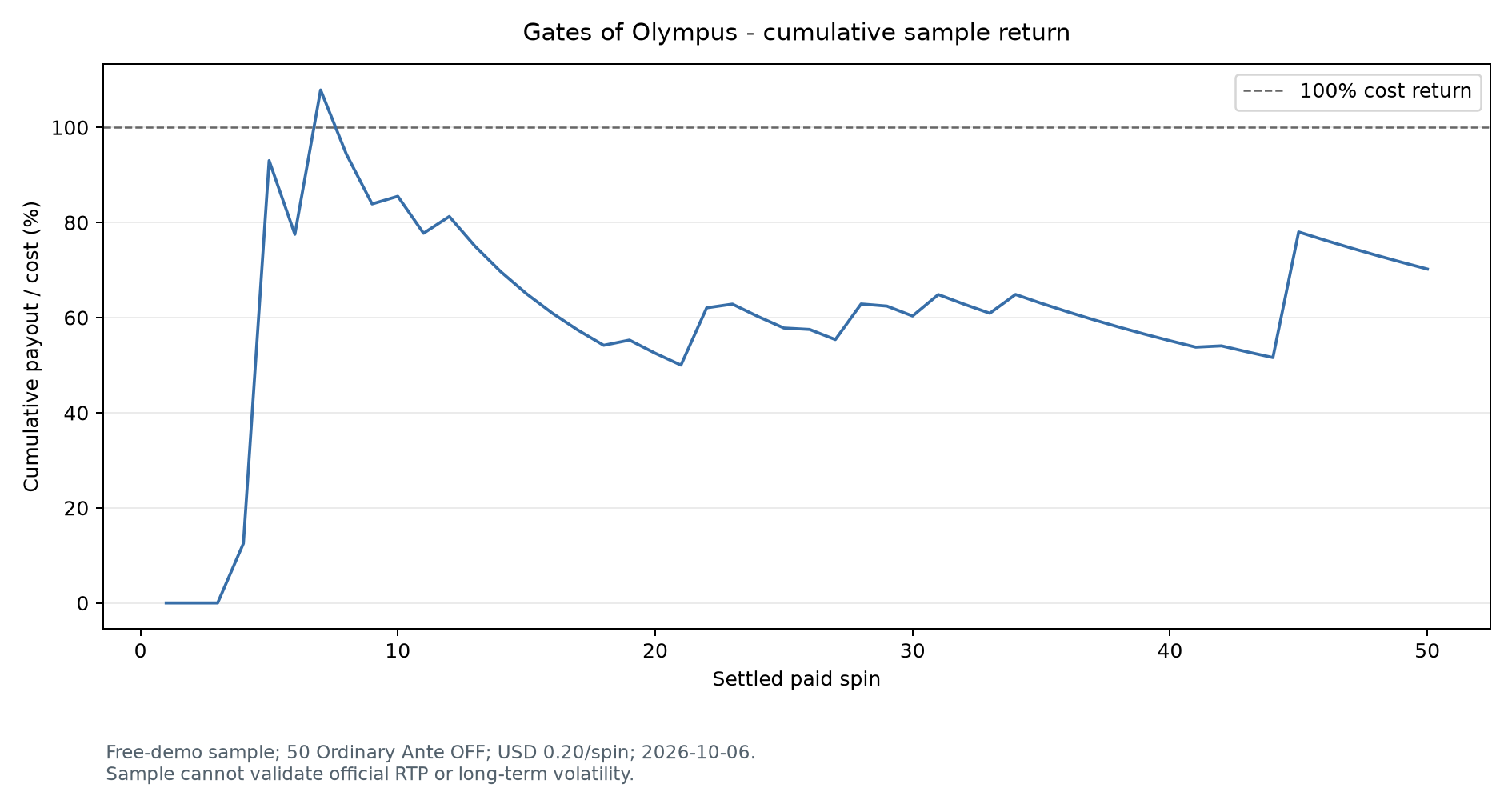
Cumulative sample return from spin 1 onward: total payout so far divided by total actual cost so far. The final point is 70.2%; 100% marks sample break-even, not the game’s theoretical RTP.
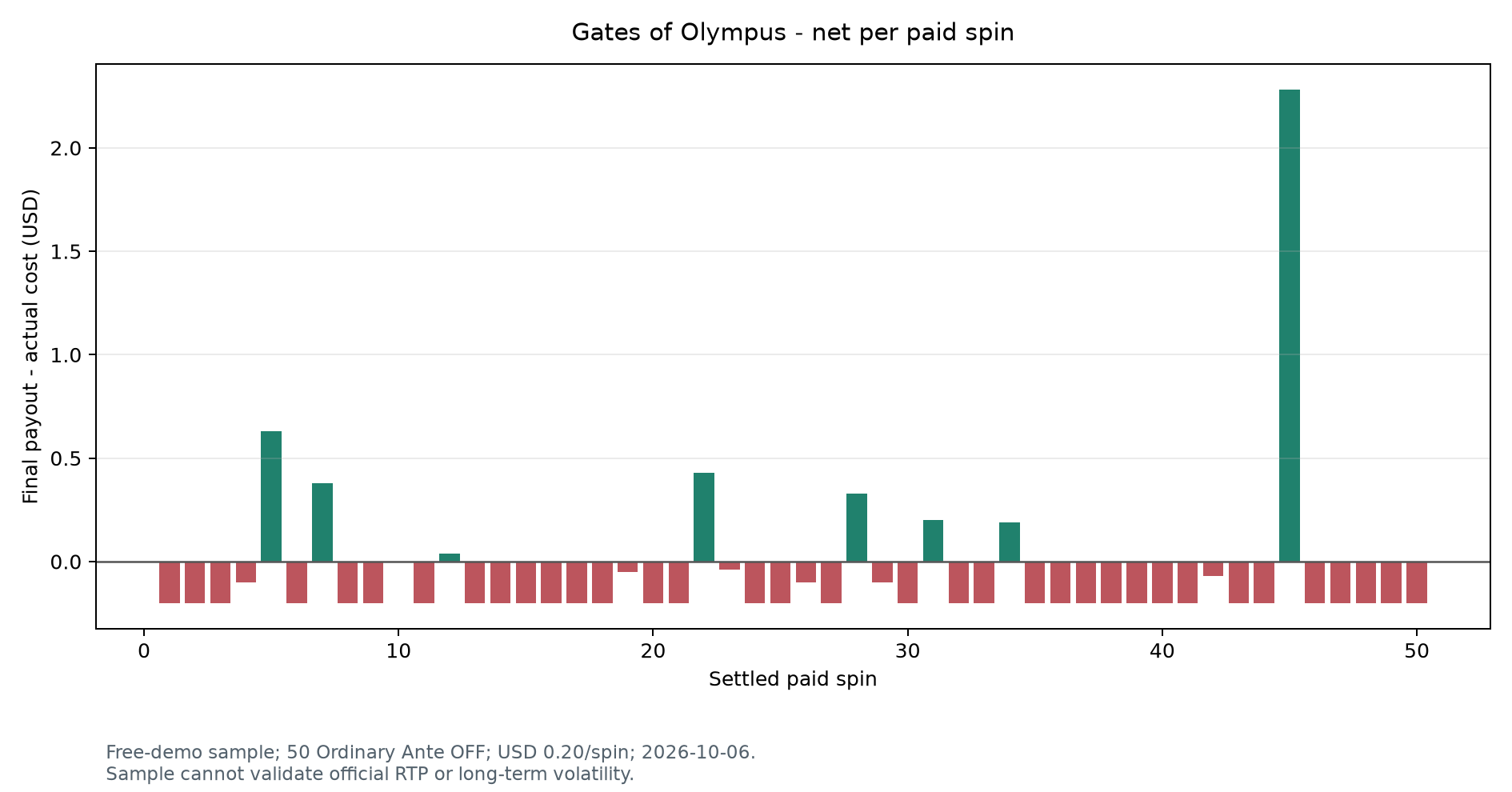
Each bar is final payout minus the $0.20 cost. A $0.10 payout therefore appears as −$0.10; spin 45’s $2.48 payout appears as +$2.28.
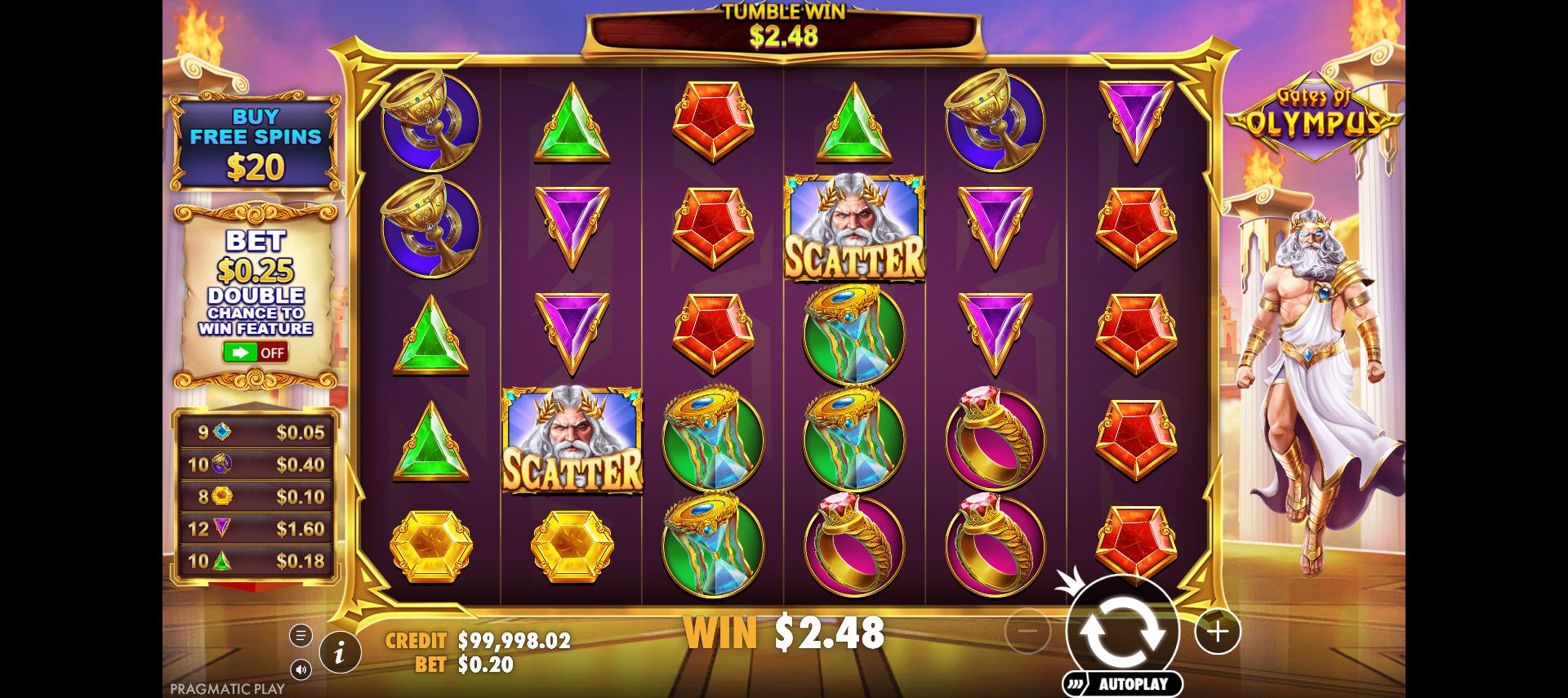
The largest recorded payout: spin 45, WIN $2.48. The screenshot supports this sample result, not the advertised maximum.
7. My verdict and which game to try first
My score: 7.5/10. I enjoy the readable counting rule and the way a tumble keeps one stake in play. The five awards in spin 5 explain its appeal better than the maximum-win headline. I would start in the ordinary demo at Normal speed, learn the tally and active stake, then decide whether the rhythm suits me. The small portrait text and easily confused cost labels keep the experience from feeling effortless. The score reflects those design choices, not the session’s loss.
Choice | How to read a result | Main feature difference | Best reason to compare |
|---|---|---|---|
Gates of Olympus original | Eight or more ordinary symbols anywhere | Random orbs up to 500×; 5,000× total cap | Learn the original count-and-tumble design |
Gates of Olympus 1000 | Same broad six-by-five tumble format | Supplier specifies orbs up to 1,000× and a 15,000× total cap | Check the exact edition before choosing a demo |
Mahjong Ways by PG Soft | Matching symbols on consecutive reels from the left, across 1,024 ways | Gold-plated winning symbols become Wild; cascades use a rising multiplier ladder | Try a more structured cascade with position and Wild changes |
The supplier’s Gates of Olympus 1000 announcement establishes those sequel limits; this review did not test the sequel. A higher maximum is not evidence of a better expected result. For a different way of following cascades, read the Mahjong Ways review.
If you want a board you can read by counting across the screen, the original Gates is a sensible demo to explore here. If your main interest is accumulated bonus multipliers, this review explains the rules but cannot give a first-hand verdict on that feature’s full pace. Keep any real-money play within a limit you can afford to lose; the demo and this short record do not provide a winning strategy.
Gates of Olympus by Pragmatic Play FAQs
Answers to common questions about Gates of Olympus by Pragmatic Play.
Gates of Olympus by Pragmatic Play Reviews
 No Player Reviews Yet
Played Gates of Olympus by Pragmatic Play? Share your experience with other players.
 Write A Review