
Leprechaun Riches by PG SOFT
Play Leprechaun Riches by PG SOFT In Demo Mode
by PG SOFT




 ScatterGold-pot Scatter
- Four award 15 spins
- Extra Scatter adds two
- Retriggers allowed
- Wild cannot substitute
 WildLeprechaun Wild
- Replaces ordinary tiles
- Excludes Scatter
- Reels 2–5 only
- Gold can split to 2–4
 Paying SymbolOrange 10
- 3–6 matching reels
- Coefficients 1–4
- Size × Level × Ways
- Large tile counts once
 Paying SymbolRed J
- 3–6 matching reels
- Coefficients 1–4
- Size × Level × Ways
- Large tile counts once
 Paying SymbolPurple Q
- 3–6 matching reels
- Coefficients 1–4
- Size × Level × Ways
- Large tile counts once
 Paying SymbolBlue K
- 3–6 matching reels
- Coefficients 4–10
- Size × Level × Ways
- Large tile counts once
 Paying SymbolGreen A
- 3–6 matching reels
- Coefficients 4–10
- Size × Level × Ways
- Large tile counts once
 Paying SymbolRound bread
- 3–6 matching reels
- Coefficients 6–15
- Size × Level × Ways
- Large tile counts once
 Paying SymbolBeer mug
- 3–6 matching reels
- Coefficients 6–15
- Size × Level × Ways
- Large tile counts once
 Paying SymbolHorseshoe
- 3–6 matching reels
- Coefficients 8–30
- Size × Level × Ways
- Large tile counts once
 Paying SymbolPurple pipe
- 3–6 matching reels
- Coefficients 10–40
- Size × Level × Ways
- Large tile counts once
 Paying SymbolClover
- 3–6 matching reels
- Coefficients 20–50
- Size × Level × Ways
- Large tile counts once
 Paying SymbolGreen hat
- 3–6 matching reels
- Coefficients 30–80
- Size × Level × Ways
- Large tile counts once
Leprechaun Riches by PG SOFT Expert Review


Updated:
Here you can find detailed review information about Leprechaun Riches by PG SOFT.
1. A cascade game for readers who enjoy watching a plan develop
Leprechaun Riches by PG SOFT suits players who enjoy following individual cascades on a six-reel board. The editorial rating is 7.5/10.
What I liked
✅ Silver → gold → separate Wilds gives a cascade a satisfying, readable two-stage progression.
✅ History exposes individual round cash and Ways, making a complicated sequence such as spin 4 explainable.
✅ The theme is consistent, and portrait controls were readable in the desktop simulation.
✅ Bet, Rules, Paytable and History have distinct, accessible controls.
What I didn’t like
❌ Both frame transformations need a qualifying win; a gold frame alone guarantees nothing.
❌ The busy board needs careful counting: a two-space tile initially counts once, then can split into two Wilds, making Ways easy to overcount at a glance.
❌ Landscape compressed the stage, while portrait showed a repeated Ways strip/background artifact.
❌ Reloading restored 12.00 instead of the chosen 0.60, requiring another stake check.
One actual Normal-speed spin, number 3, followed by settled idle time. The 18.064-second silent clip preserves its original variable timing. The opening Total Win 0.36 belongs to the preceding result; spin 3 itself paid zero.
Philippine search interest. An Ahrefs query for the Philippines on 5 October 2026 returned estimated monthly volumes of 40 for “leprechaun riches,” 20 for “leprechaun riches demo,” and 10 each for “leprechaun riches rtp” and “leprechaun riches slot.” These are keyword-search estimates, not player counts. “Leprechaun riches pg” explicitly returned 0; several other requested variants were missing, which is different from zero. The modest search volume makes a clear explanation of the game, demo and rules more useful than hype.
If the demo is available in the game panel on this page, try it here with virtual credits and check the displayed Bet before starting. The reviewed session used 0.60 demo units. Amounts in this review are not verified as Philippine pesos.
2. Read the screen before changing the stake
The green woodland backdrop, gold trim, hat, clover, pipe and beer mug give the game a coherent Irish-folklore theme. The colourful card ranks are easy to distinguish at desktop size; the harder task is noticing which large tiles have silver or gold borders. Start with Turbo off while learning those changes.
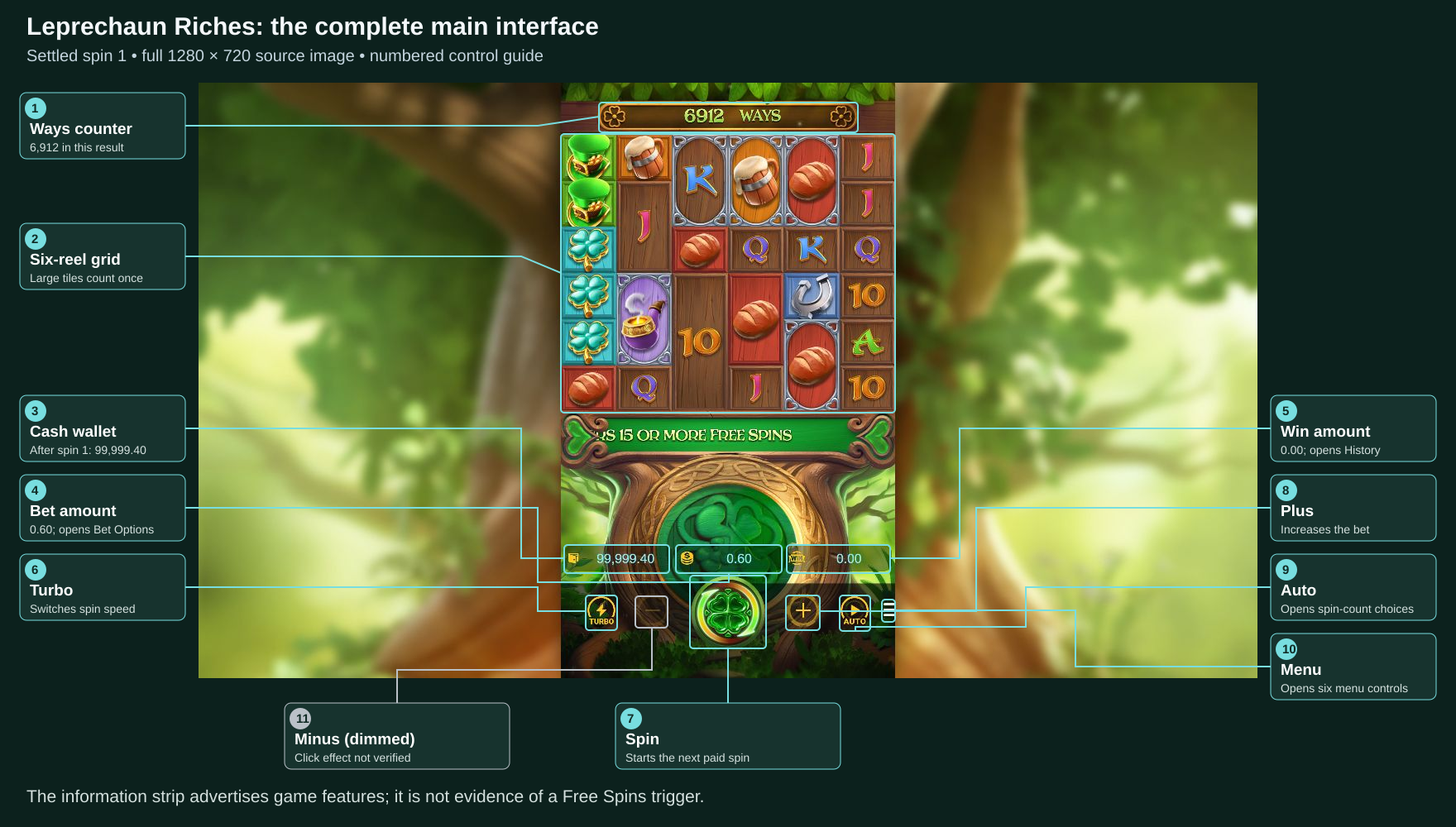
Spin 1 settled with wallet 99,999.40, Bet 0.60 and Win 0.00. English labels explain visible controls.
Ways: the current board’s Ways count. This settled screen shows 6,912; that figure is not the number of winning Ways on every result.
Six-reel board: read matching symbols from the leftmost reel. Some ordinary tiles on reels 2–5 cover several spaces but count as one entity.
Cash Wallet: the available demo balance, 99,999.40 after spin 1. Open it to inspect wallet information.
Bet: the total stake, here 0.60. This opens Bet Options with Size, Level and Amount selectors.
Win: payout information, here 0.00. It is not profit after subtracting the stake; the Help also identifies it as an entry to History.
Turbo: the lightning control shortens the main-game reel presentation. Only the normal/Turbo choice was observed.
Spin: the central clover button starts a spin at the current bet. The Help also documents stopping the reel animation.
Plus: increases the bet amount according to the Help. Recheck the number before spinning.
Auto: opens the count selector. Opening that panel is separate from running an Auto sequence.
Menu: opens Quit, Sound, Paytable, Rules, History and Close.
Minus: reduces the bet according to the Help. Its dark appearance in this screenshot is preserved; that screenshot alone does not verify that it is enabled.
Bet, Auto and menu panels
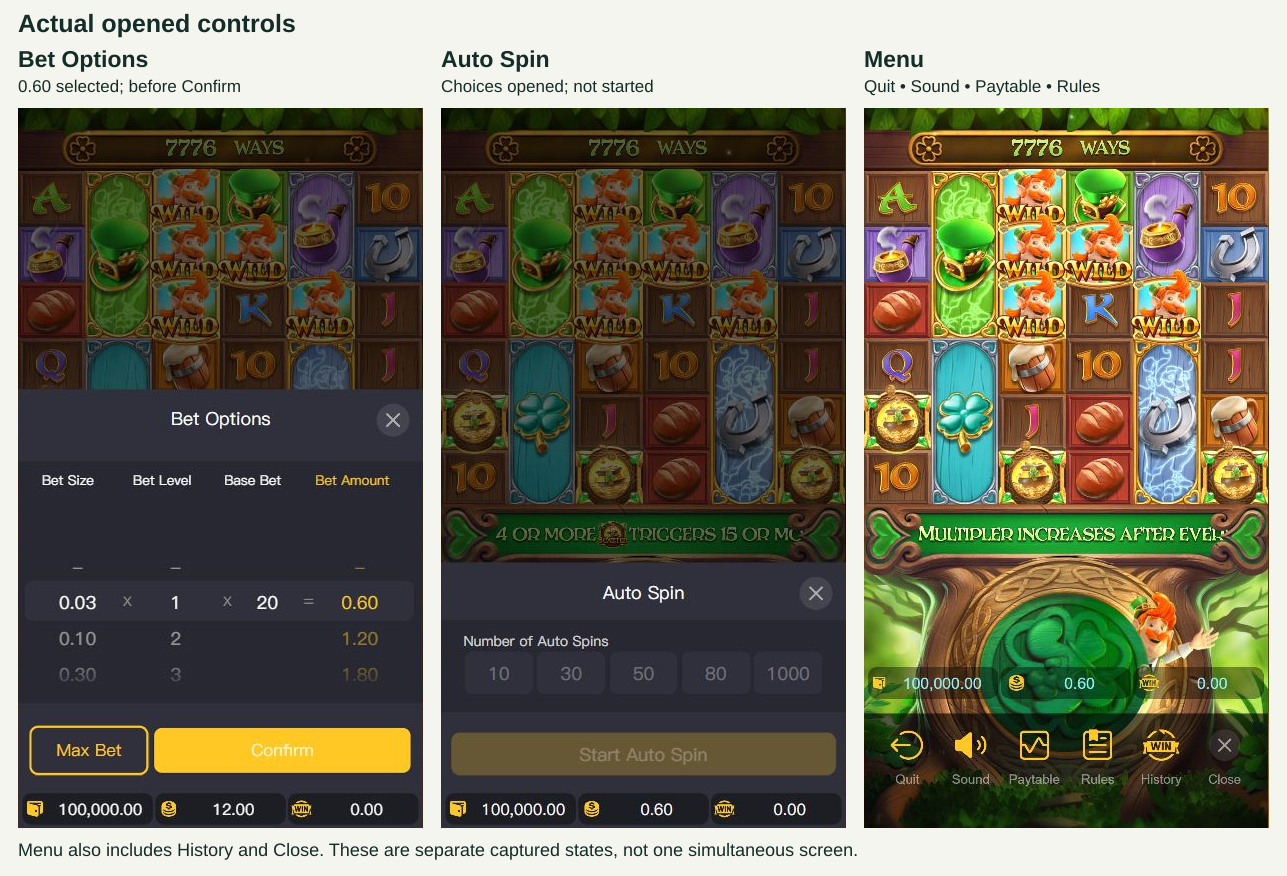
Three actual opened controls. Bet has Size 0.03 × Level 1 × Base 20 = 0.60 selected before Confirm; Auto lists 10, 30, 50, 80 and 1000 spins without an executed Auto run. Menu exposes Quit, Sound, Paytable, Rules, History and Close.
Bet Options separates Bet Size, Bet Level and Bet Amount, with a Max Bet shortcut. In the desktop panel shown above, 0.60 has been selected but not yet confirmed: the 12.00 visible behind it is the earlier stake. The confirmed sample stake was 0.60 throughout all 100 accepted spins. Within an active session, the next manual spin retained that setting; after a reload, the demo returned to 12.00 and had to be set back to 0.60.
The opened Auto panel offered 10, 30, 50, 80 or 1,000 spins and Start. The panel was opened and cancelled without testing a batch, so the panel does not establish that a stop limit ran successfully. Manual play was used for the recorded sample. The Help says a held Space key can continue spins on PC, so avoid leaning on it while checking a result.
The menu provides separate Paytable, Rules and History entries. The sound button was toggled from the speaker-wave state to a muted X and back. That verifies the visible switch response only; no audio audition or sound-sync assessment was made.
Portrait is easier to read, with an observed layout blemish
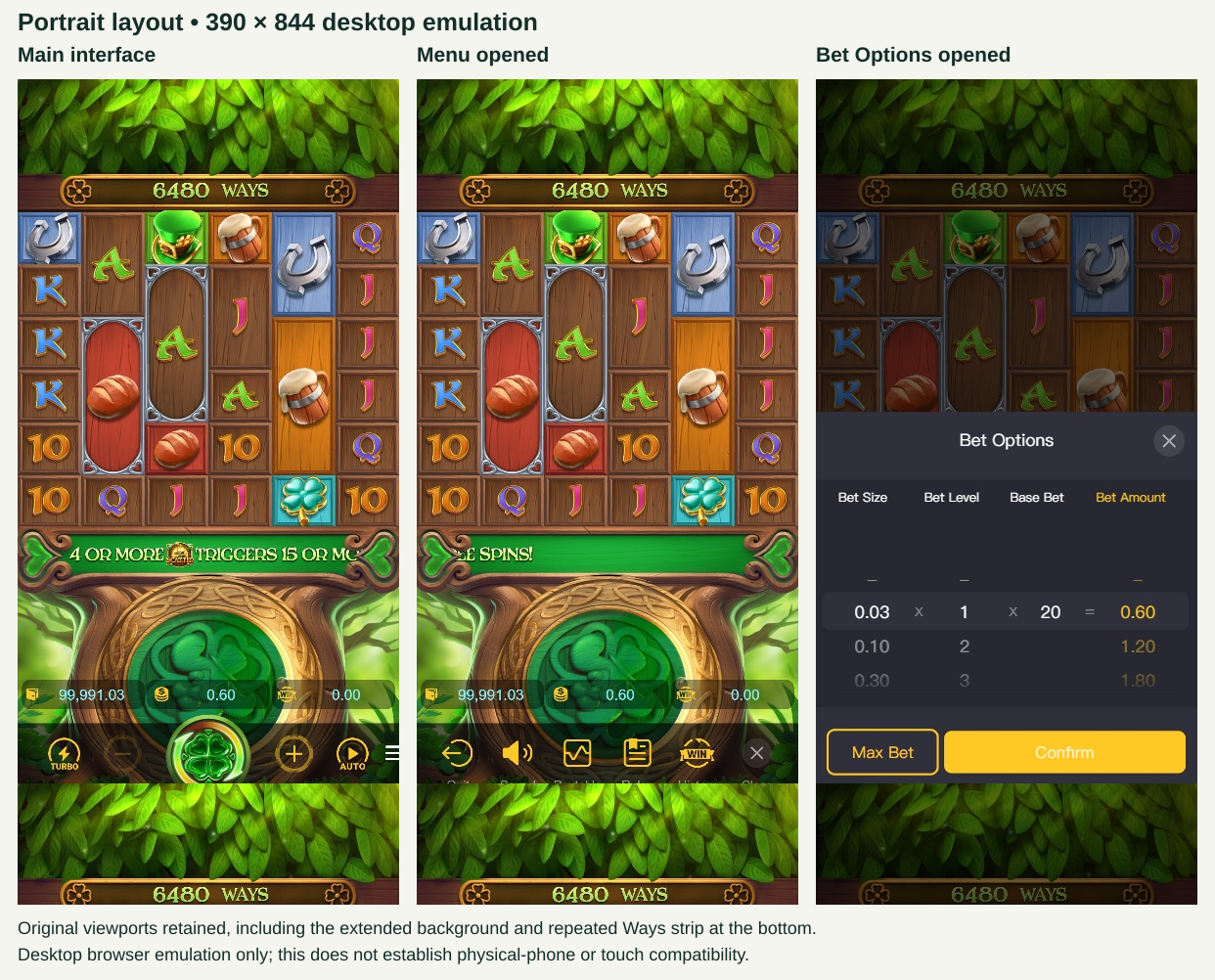
390 × 844 desktop-browser emulation. The repeated bottom Ways strip and extended background remain visible. Menu and Bet Options were opened; this is not a physical-phone or touch test.
The portrait views above came from a 390 × 844 desktop browser simulation, not a physical phone. The board, wallet, 0.60 stake and controls were readable, and both the menu and Bet Options were opened; confirming the current 0.60 setting worked. A repeated Ways strip and extended background appeared below the main game. That visible artifact matters, even though it does not establish how a particular handset will behave.
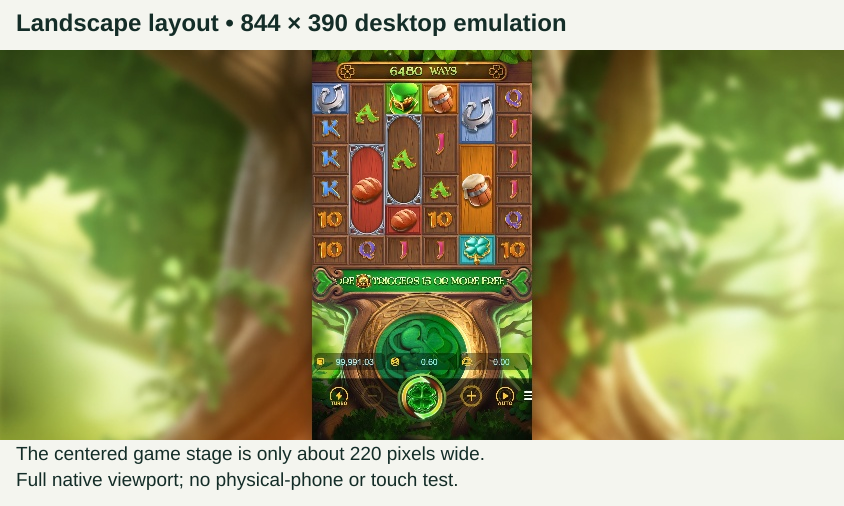
844 × 390 desktop emulation: the complete viewport shows a roughly 220-pixel-wide game stage, making text and controls smaller than in portrait.
At the simulated 844 × 390 landscape size, the game stayed in a narrow central stage, roughly 220 pixels wide. Amounts and buttons became noticeably smaller. The portrait view is easier to read when studying a result, but physical touch accuracy, iPhone playback and Philippine network performance remain untested. The desktop viewport was restored after these checks without adding spins to the sample.
3. Count the winning Ways, then apply the right bet unit
The current Help describes six reels, six rows and 576–46,656 Ways. A paying combination needs the same ordinary symbol on three to six consecutive reels beginning at the far left. You multiply the number of matching entities on each consecutive reel to find the winning Ways. Other simultaneous qualifying combinations are added.
Large ordinary tiles are the important exception to counting visible spaces. On reels 2–5, a tile may occupy two, three or four spaces, but it still counts as one symbol for the payout calculation. Wilds can substitute for ordinary symbols but never for Scatter, and appear only on reels 2–5.
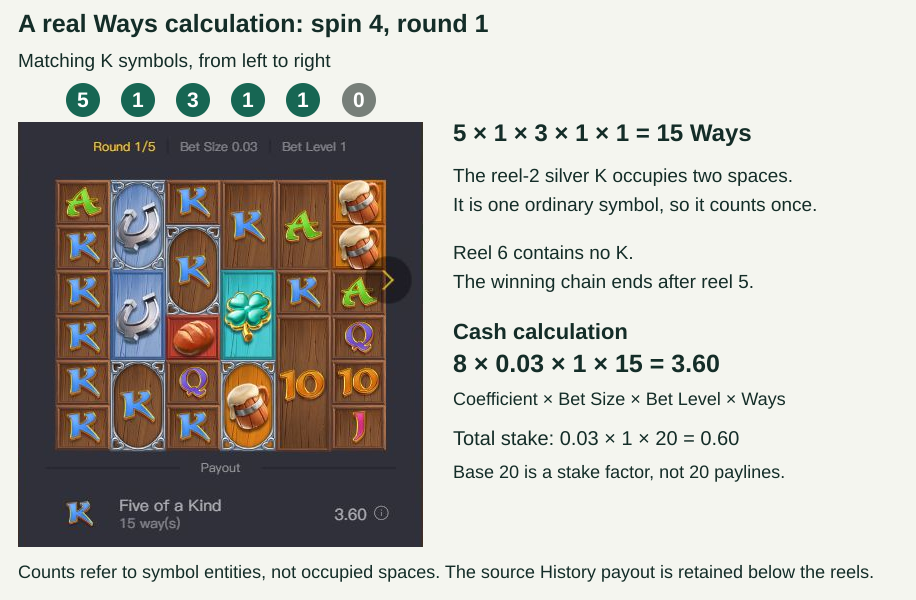
The first five reels contain 5 × 1 × 3 × 1 × 1 matching K entities, yielding 15 Ways. The two-space silver K on reel 2 counts once. K coefficient 8 × Size 0.03 × Level 1 × 15 Ways = 3.60.
In spin 4’s first History round, the K combination spans five reels with 5 × 1 × 3 × 1 × 1 = 15 Ways. The two-space silver K on reel 2 contributes one, not two. The five-reel K coefficient is 8, so at Size 0.03 and Level 1 the payout is 8 × 0.03 × 1 × 15 = 3.60 demo units. The screenshot’s actual cash award agrees with that calculation.
The total stake uses a different formula: Bet Size × Bet Level × Base 20. At the recorded setting, 0.03 × 1 × 20 = 0.60. Base 20 is a stake-conversion factor, not 20 fixed paylines. Multiplying a paytable coefficient directly by the full 0.60 would overstate the single-Way payout by a factor of 20.
A compact payout guide. These are the current Paytable’s raw coefficients for three, four, five and six matched reels. Multiply by Size × Level, then by the actual winning Ways. The full illustrated entries belong in the native game-information cards.
Appearance | 3 reels | 4 reels | 5 reels | 6 reels |
|---|---|---|---|---|
Green hat | 30 | 40 | 50 | 80 |
Clover | 20 | 25 | 30 | 50 |
Purple pipe | 10 | 25 | 30 | 40 |
Horseshoe | 8 | 15 | 20 | 30 |
Beer mug / bread | 6 | 10 | 12 | 15 |
A / K | 4 | 6 | 8 | 10 |
Q / J / 10 | 1 | 2 | 3 | 4 |
After each winning round pays, the winners disappear and the board refills from above. That can create further wins within the same paid spin. Spin 2 illustrates why payout and profit need separate labels: its two-Way, three-reel bread award paid 6 × 0.03 × 1 × 2 = 0.36. The following round had no win. Against the one 0.60 stake, the result was a net loss of 0.24 despite the winning animation.
4. Follow silver to gold to separate Wilds
Wilds-on-the-Way is a two-stage transformation. First, an eligible silver-framed ordinary tile must participate in a win. After the payout and refill, it changes into a randomly selected ordinary symbol with a gold frame. That gold-framed tile must itself participate in a subsequent win before the next refill changes it into two to four separate Wilds, according to the spaces it occupied.
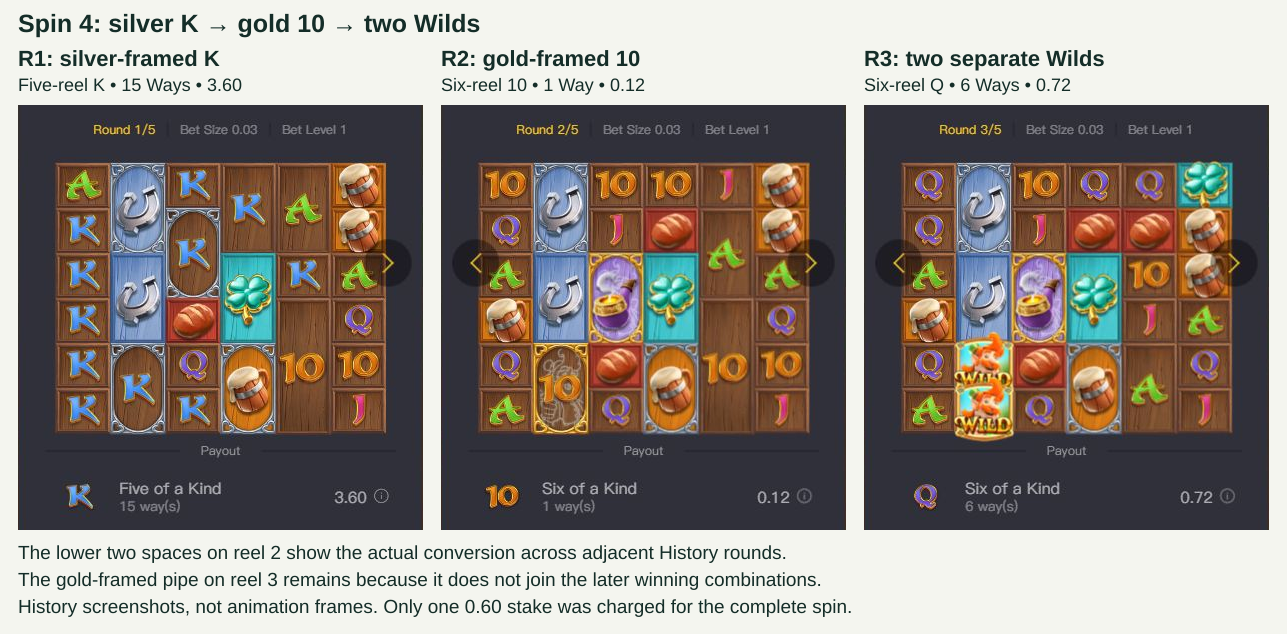
Spin 4, consecutive History rounds: R1 five-reel K pays 3.60; R2 six-reel 10 pays 0.12; R3 six-reel Q pays 0.72. The same lower two spaces of reel 2 progress from silver K to gold 10 to two Wilds.
Spin 4 shows this progression in adjacent static History rounds. The bottom two spaces on reel 2 contain a silver-framed K in Round 1, a gold-framed 10 in Round 2 and two individual Wilds in Round 3. These are actual recorded outcomes, not a reconstruction of the transformation animation.
Round | What the recorded result shows | Round payout |
|---|---|---|
1 | Five-reel K, 15 Ways; the two-space silver K participates | 3.60 |
2 | Six-reel 10, 1 Way; the same region is gold-framed 10 | 0.12 |
3 | Six-reel Q, 6 Ways; the two separate Wilds count individually | 0.72 |
4 | Three-reel J, 1 Way | 0.03 |
5 | No winning combination; the paid spin ends | 0.00 |
Whole spin | One 0.60 stake, five History rounds | 4.47; net +3.87 |
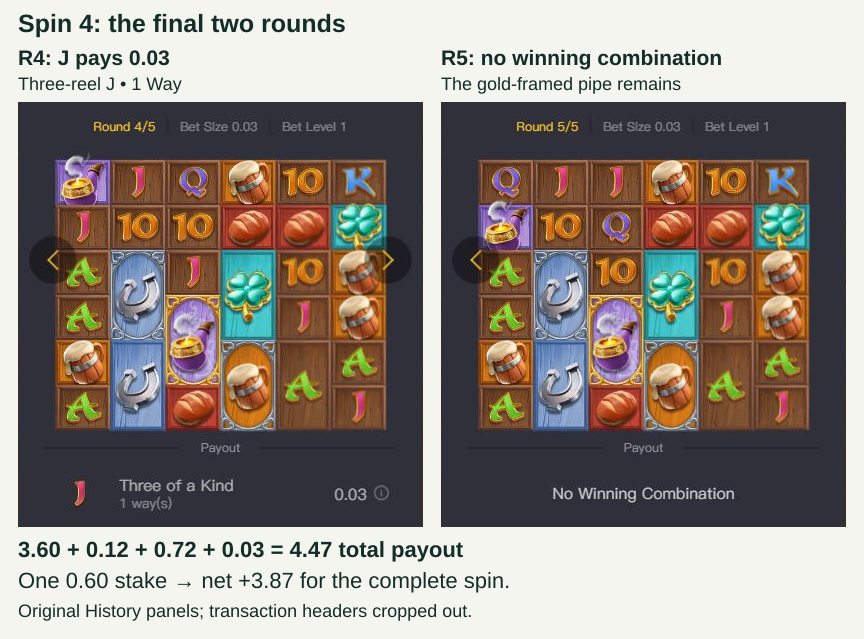
Spin 4 ends after R4 pays 0.03 and R5 shows no winning combination. All five rounds total 4.47 from one 0.60 stake, for net +3.87.
Round 3’s Q count is 3 × 2 × 1 × 1 × 1 × 1 = 6 Ways. The important change is that reel 2 now contributes two independent Wilds, where the earlier large tile counted once. The final wallet moved from 99,998.56 to 100,002.43, matching 4.47 in awards less the single 0.60 cost.
A frame is not a promise. Another silver K in that spin became a gold-framed pipe, but it did not participate in the next relevant win and stayed gold. A four-space gold-framed bread tile in spin 12 also remained when the following round had no win. The complete recorded example here produces two Wilds; the Help permits three or four, but this review does not present those larger conversions as observed animation.
Free Spins add a different kind of progression
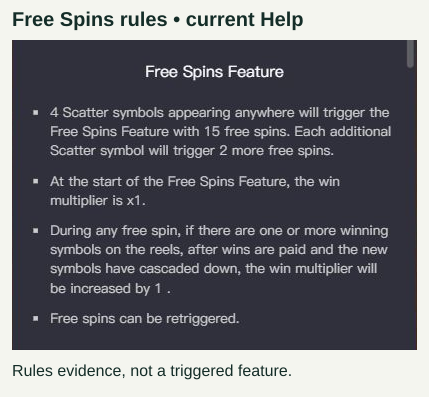
Current Help: 4 Scatters award 15 Free Spins; each extra Scatter adds 2. The feature starts at ×1 and the multiplier rises by 1 after a winning payout and refill. Retriggers are allowed. No natural Free Spins were observed in the 100-spin sample.
The Help awards 15 Free Spins for four Scatters anywhere, plus two more spins per additional Scatter. Free Spins can retrigger and use the Size and Level of the triggering spin. The feature starts at ×1; after a winning payout and refill, the multiplier increases by one. It does not rise simply because another free spin starts.
No natural Free Spins occurred in the 100 recorded paid spins, so the description above is rule-based. The captured Help does not state an explicit multiplier cap or clearly establish when it resets between different free spins. It also does not give the ordinary base game a rising multiplier. Importing a familiar multiplier ladder from another PG SOFT game would change the rules.
Why the official BUY image needs a version label
No usable BUY or EX entry was found in the recorded main screen, menu, Bet Options, Auto panel or complete Rules and Paytable. PG SOFT’s 2025 information sheet nevertheless includes an illustration showing Feature Buy at 2,000 with Bet 20. That picture implies 100× for the illustrated configuration, but it is not a current purchase quote. No feature was purchased, and the recorded 0.60 stake does not establish a current purchase price.
5. Keep the stake, supplier RTP and payout ceiling separate
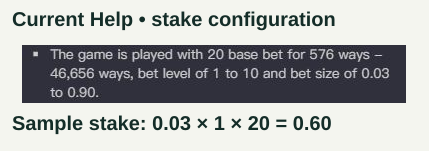
The observed Help uses Base 20, Level 1–10 and Size 0.03–0.90. At the sampled setting, Size 0.03 × Level 1 × Base 20 = 0.60.
Item | What the evidence supports | How to use it |
|---|---|---|
Recorded paid-spin cost | 0.60 demo units; 0.03 Size × 1 Level × 20 | Subtract once from the complete parent-spin payout |
Current Help limits | Size 0.03–0.90; Level 1–10; Base 20 | Formula-derived total range 0.60–180; only 0.60 was executed in the sample |
BUY / EX cost | No usable entry found in the inspected demo | Unavailable current price remains unknown, not zero |
Theoretical RTP | 97.35% on the official product page and 2025 PDF | Supplier’s long-run figure; current Help does not state RTP |
Volatility | Medium, the supplier’s label | Not a conclusion drawn from these 100 spins |
Advertised maximum win | 100,000× in the official product/PDF | Theoretical maximum, not an observed or likely session result |
Observed sample maximum | 10.95 payout in spin 21, equivalent to 18.25 times its stake | One recorded result; net gain was 10.35 |
The official product information is useful for specifications, but the running demo’s exact build and RTP configuration were not independently identified. The PDF’s 24 September 2025 update and version 1.0.r802 describe that document; they do not establish the current game build or the game’s original release date.
The PDF’s 75.00% main-game contribution plus 22.35% Free Spins contribution equals 97.35%. Those contributions are not two selectable RTP modes. Likewise, its 33.43% and 0.30% hit-rate entries add to 33.73%; the 0.30% label should not be silently rewritten as a measured chance of triggering Free Spins.
Its separate “Max Exposure” value of 9,893× is labelled as the result of a billion-spin simulation. The document also prints a 100,000× maximum win, using a different definition. Neither number should replace the other. The same sheet lists EUR default bets of 0.20–50 and separate Size values of 0.01, 0.05 and 0.1; an older 2020 sheet lists EUR 20 as its default maximum. Those configurations must remain separate from the current Help’s Size/Level ranges and unlabelled demo units.
For a simple way to explore how a fixed stake and variable payouts can affect a session, use the slot simulator. It can illustrate bankroll arithmetic; it does not reproduce Leprechaun Riches’ undisclosed reel model or predict its next spin. Set an affordable entertainment limit before any real-money play, and do not raise the stake to chase losses.
6. What the 100 settled demo spins actually returned
The recorded sample ran on 6 October 2026, about 04:19–05:06 Philippine time (5 October, 20:19–21:06 UTC). It contains 100 verified ordinary paid parent spins at 0.60 each, with 157 internal History rounds. Cascades stay within their original paid spin. The sample used Turbo for 99 spins and Normal for spin 3, so it cannot compare returns between speeds.
Measure | Recorded result |
|---|---|
Verified paid spins / internal rounds | 100 / 157 |
Total stake / total payout | 60.00 / 56.01 demo units |
Net result | −3.99 demo units |
Sample return | 93.35% = 56.01 ÷ 60.00 × 100 |
Spins with positive payout | 32; the other 68 paid zero |
Net-positive / break-even / net-negative | 15 / 1 / 84 |
Natural Free Spins observed | 0 in this sample |
The difference between 32 paying spins and 15 profitable spins is important. Sixteen spins returned something but less than their 0.60 cost, and one returned exactly the stake. Counting every payout as a financial win would make the session look better than it was.
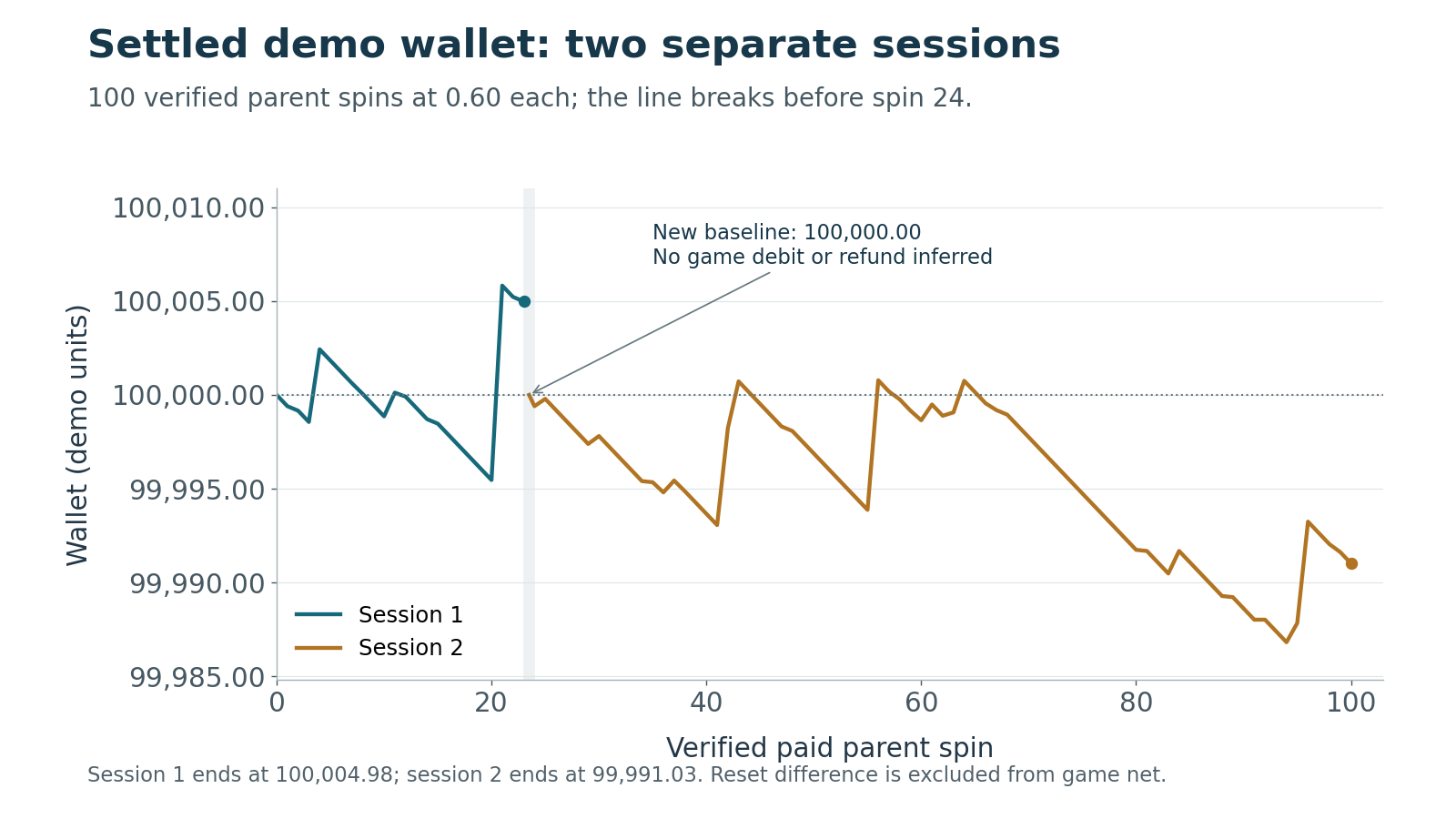
Balance after every verified paid parent spin. Each session starts from its independently observed 100,000.00 baseline; no line connects the reset. The narrow vertical scale reveals changes of a few demo units.
The wallet curve has a deliberate break. The first session covers spins 1–23: it began at 100,000.00 and ended at a last verified 100,004.98, with 13.80 staked and 18.78 paid. The second covers spins 24–100: a fresh 100,000.00 baseline ended at 99,991.03, with 46.20 staked and 37.23 paid.
After the first session’s 23 accepted spins, another request produced “Transaction Failed.” Its final award and wallet were unknown, so that request is excluded rather than assigned a zero payout. Reloading produced the new demo balance and a default stake of 12.00; 0.60 was selected again before continuing. The −4.98 difference between the last verified old wallet and the new baseline is neither a game loss nor a refund in the sample calculations. An empty History view in the new session did not prove permanent server-side deletion.
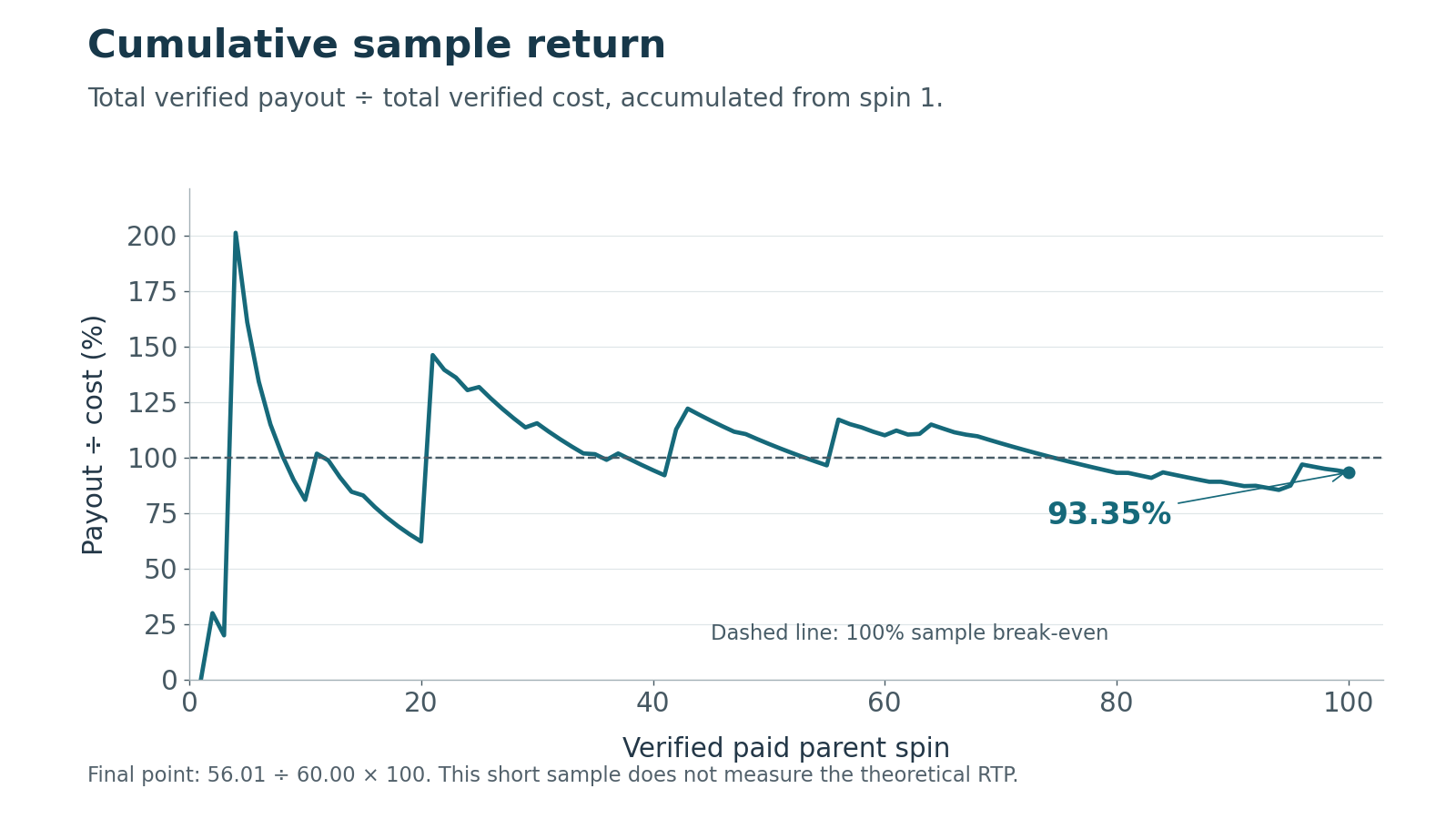
Sample return is accumulated from spin 1 across both sessions. The dashed line marks 100% break-even, not the supplier RTP.
The cumulative-return chart keeps all verified cost and payout from spin 1 onward, across both sessions. It ends at 93.35%. The dashed 100% line marks sample break-even; it is not a forecast or a test of the supplier’s 97.35% RTP. Early spikes are especially easy to overread because very little has been staked.
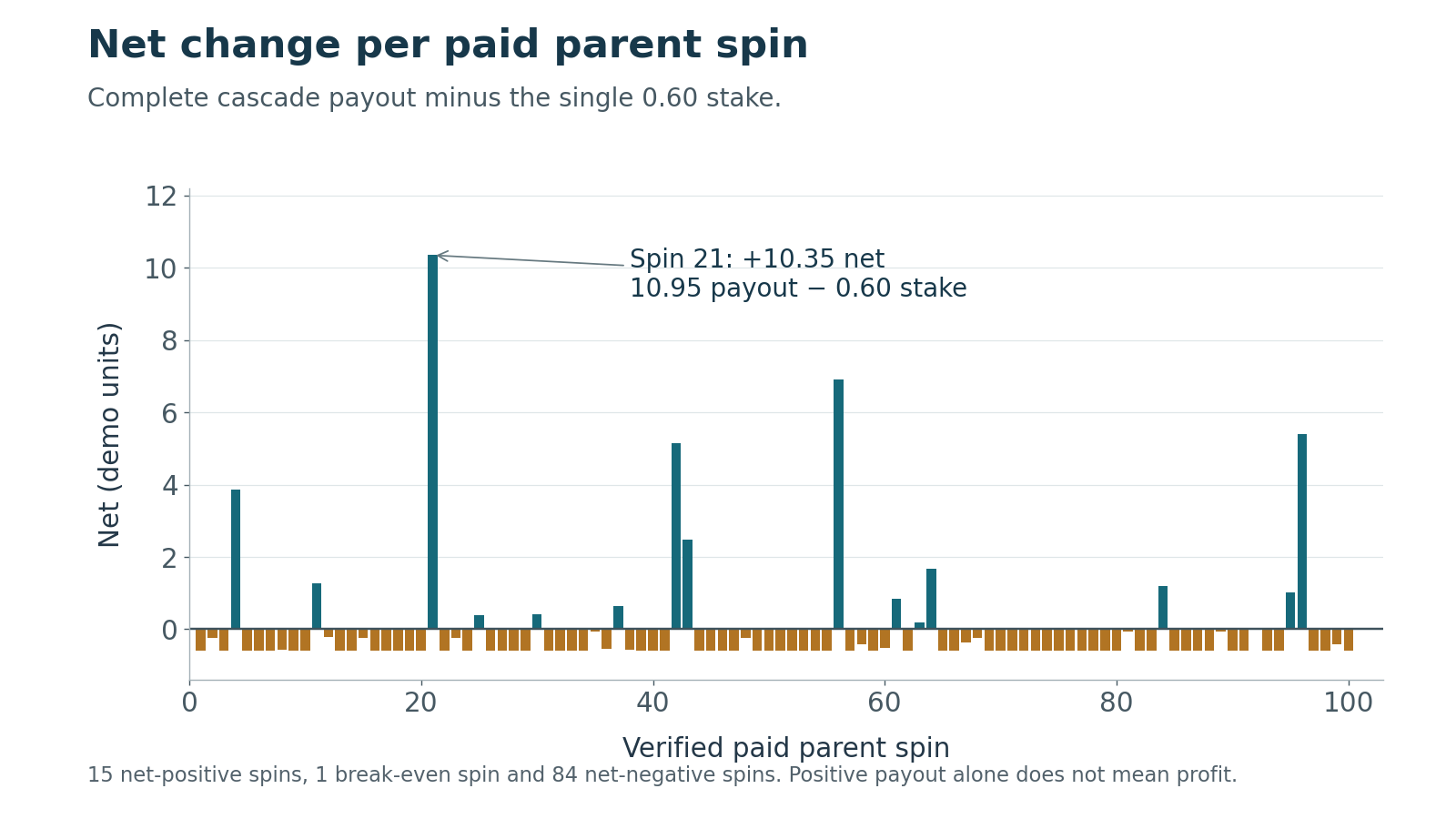
Every bar includes all cascade payouts within one paid spin. Blue bars are positive; ochre bars are negative. Spin 21 paid 10.95 for a net gain of 10.35.
The final chart shows each complete spin’s payout minus 0.60. Spin 21 supplied the largest positive change, +10.35, but many more spins finished below cost. The overall −3.99 is the sum of those individual net changes, not the difference between the very first and very last displayed wallet across a reset.
The early video records one real Normal-speed spin, number 3, followed by settled idle time. Its duration is 18.064 seconds with no audio track; the reels are not moving for that entire period. The 170 captured frames retain their variable timing and genuine holds. Turbo was restored 20.246 seconds after capture finished and before spin 4, rather than immediately. The clip shows presentation, not a speed-based advantage or a Free Spins feature.
7. The strengths, the compromises and the closest alternatives
I would choose Leprechaun Riches for the two-stage Wild idea. I would not choose it on the assumption that more visible Ways guarantee more frequent profit, or that the maximum-win headline describes an ordinary session. The 7.5 score reflects the mechanism, clarity and observed interface compromises, rather than whether this short sample finished up or down.
Game | Board and Wild progression | Multiplier distinction | Best fit |
|---|---|---|---|
Leprechaun Riches | Six reels; 576–46,656 Ways; winning silver tile becomes gold, then a winning gold tile splits into Wilds | Current Help specifies increasing multiplier in Free Spins | Following a two-stage change and changing entity counts |
Heist Stakes | Five reels; 720 fixed Ways; a Wild on reel 3 turns that whole five-space reel Wild | Help specifies a Free Spins increase after winning refill | A more direct full-reel transformation |
Mahjong Ways | Five reels; 1,024 fixed Ways; a winning gold-plated tile becomes Wild after refill | Normal ladder 1/2/3/5; Free Spins ladder 2/4/6/10 | A single conversion stage and explicit multiplier steps |
Wild Bandito | Five reels; 1,024 fixed Ways; winning gold-framed tiles become Wild after refill | Base-game multiplier starts at ×1 and rises after winning refill | Single-stage conversion with ordinary-spin multiplier progression |
These comparisons use each game’s captured Help. Different short sessions cannot rank their true trigger rates, long-run return or profitability.
Bottom line: the silver-to-gold transition is worth learning because it changes how the next board is counted. Start by reading one History sequence, keep payout separate from net result, and recheck the stake after any reload. If the on-page demo is available, use virtual credits to learn those details before deciding whether this style of slot appeals to you.
Leprechaun Riches by PG SOFT FAQs
Answers to common questions about Leprechaun Riches by PG SOFT.
Leprechaun Riches by PG SOFT Reviews
 No Player Reviews Yet
Played Leprechaun Riches by PG SOFT? Share your experience with other players.
 Write A Review