
Lucky Neko by PG SOFT
Play Lucky Neko by PG SOFT In Demo Mode
by PG SOFT




 ScatterScatter
- 4 trigger 10 spins
- +2 per extra Scatter
- Anywhere on reels
- Not replaced by Wild
 WildTorii Wild
- Reels 2–5 only
- Replaces non-Scatters
- Gold-frame conversion
- No listed own payout
 Paying Symbol10
- Pays on 3–6 reels
- Left-to-right Ways
- Wild can substitute
- Size × Level basis
 Paying SymbolJ
- Pays on 3–6 reels
- Left-to-right Ways
- Wild can substitute
- Size × Level basis
 Paying SymbolQ
- Pays on 3–6 reels
- Left-to-right Ways
- Wild can substitute
- Size × Level basis
 Paying SymbolK
- Pays on 3–6 reels
- Left-to-right Ways
- Wild can substitute
- Size × Level basis
 Paying SymbolA
- Pays on 3–6 reels
- Left-to-right Ways
- Wild can substitute
- Size × Level basis
 Paying SymbolMaki Sushi
- Pays on 3–6 reels
- Left-to-right Ways
- Wild can substitute
- Size × Level basis
 Paying SymbolNigiri Sushi
- Pays on 3–6 reels
- Left-to-right Ways
- Wild can substitute
- Size × Level basis
 Paying SymbolFolding Fan
- Pays on 3–6 reels
- Left-to-right Ways
- Wild can substitute
- Size × Level basis
 Paying SymbolLantern
- Pays on 3–6 reels
- Left-to-right Ways
- Wild can substitute
- Size × Level basis
 Paying SymbolDrum
- Pays on 3–6 reels
- Left-to-right Ways
- Wild can substitute
- Size × Level basis
 Paying SymbolLucky Cat
- Pays on 3–6 reels
- +2 per Cat
- Wild can substitute
- Size × Level basis
Lucky Neko by PG SOFT Expert Review


Updated:
Here you can find detailed review information about Lucky Neko by PG SOFT.
Lucky Neko is most interesting when a win changes the next board. A silver-framed symbol can turn gold, then become a Wild, while cats change the multiplier applied to paying combinations. I like being able to follow that chain in History. The trade-off is a busy screen: a large symbol, a cat multiplier and a bright win animation each need a different reading.
What I liked
✅ Silver-to-gold-to-Wild changes are easy to trace in History.
✅ Separate payout, cost and balance figures make small wins easier to judge.
✅ The recorded portrait layout keeps the main controls readable.
What I didn’t like
❌ Landscape compresses the tall board and makes numbers harder to read.
❌ Wilds and bright win animations can still end in a net loss.
❌ One recorded attempt failed with an unknown settlement; the PDF’s Buy feature was unavailable in the inspected interface.
1. What Lucky Neko offers
Lucky Neko is a PG SOFT slot built around six reels, variable Ways, cascading wins and a Japanese festival setting. A short additional reel sits above reels 2–5. Some symbols occupy more than one cell, so the board changes its shape without becoming a conventional set of fixed paylines. The current Help gives a range of 2,025–32,400 Ways.
The strongest reason to choose it is the interaction between transformations and multipliers. If you enjoy checking what changed between successive drops, there is plenty to follow. If you prefer a quick, uncomplicated line result, its large symbols and several layers of calculation may feel demanding. The 50 completed paid spins reviewed here show how the ordinary game behaves; they do not establish how often its Free Spins feature should occur.
If the demo module on this page is available, use that module to explore the controls and check the selected stake before spinning. This review does not confirm that the page’s current embedded demo loads on your device.
Philippine search interest
Ahrefs’ Philippines Google estimates retrieved on 6 October 2026 were 800 average monthly searches for “lucky neko demo”, 600 for “lucky neko”, 150 for “lucky neko slot” and 30 for “lucky neko free play”. These are keyword search estimates, not player counts or a forecast of visits to this page. The phrases overlap and should not be added together as unique demand.
The first Normal spin and its settled board in a 10-second clip. Reel movement occupies only part of the clip.
2. The screen and controls
Cherry blossoms, lanterns, sushi and torii gates give the game a distinct setting. The beckoning cat is a paying symbol and a multiplier mechanic; the torii gate is the Wild. That distinction matters more than the decorative theme when reading a result. The main board and extra upper reel dominate the screen, with balance and stake above a central spin button.
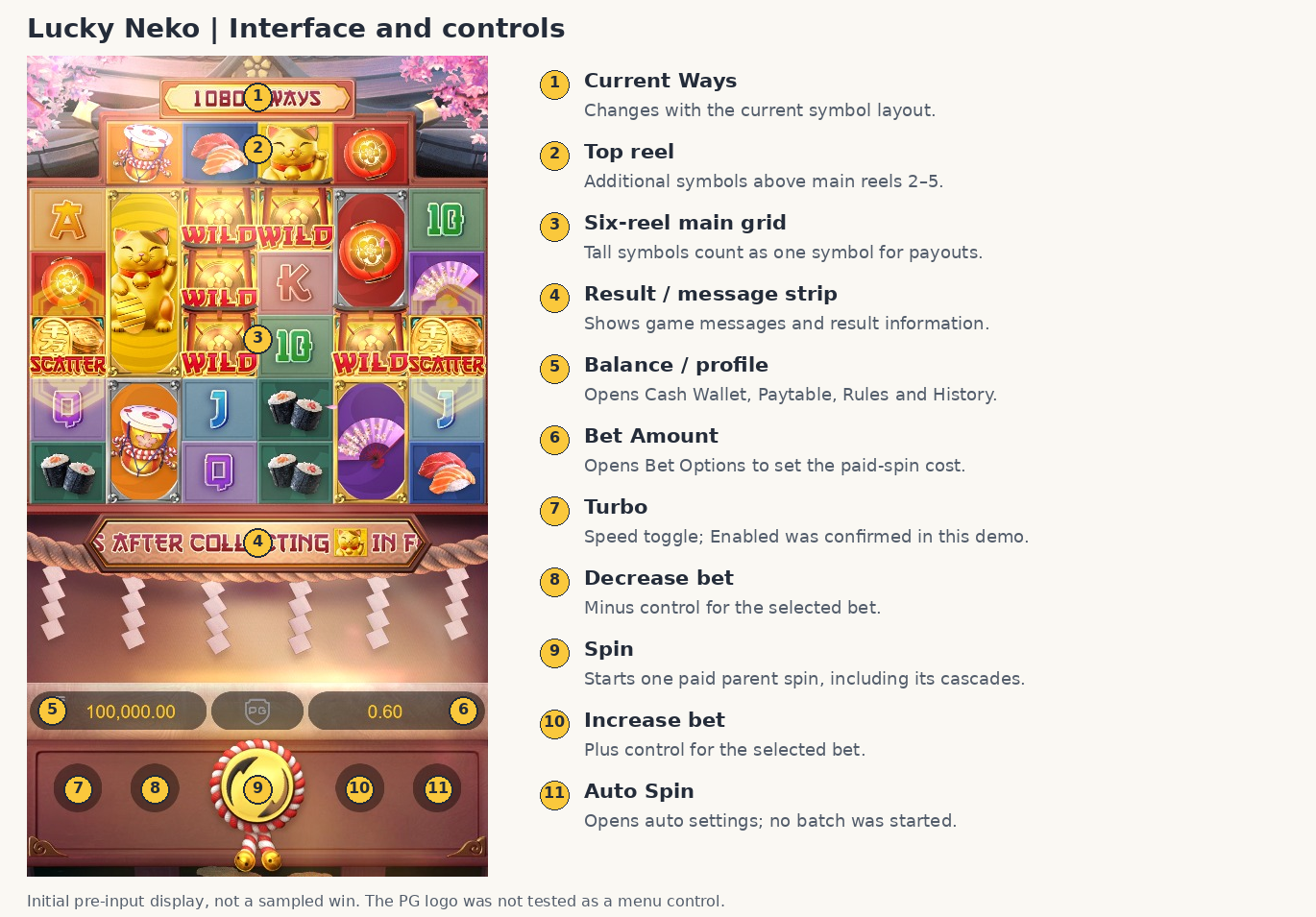
The complete pre-input interface. Its initial display of Wilds is an introductory board, not a recorded sample win. The numbered legend below explains the actual regions.
Current Ways: Changes with the current symbol layout.
Top reel: Additional symbols above main reels 2–5.
Six-reel main grid: Tall symbols count as one symbol for payouts.
Result / message strip: Shows game messages and result information.
Balance / profile: Opens Cash Wallet, Paytable, Rules and History.
Bet Amount: Opens Bet Options to set the paid-spin cost.
Turbo: Speed toggle; Enabled was confirmed in this demo.
Decrease bet: Minus control for the selected bet.
Spin: Starts one paid parent spin, including its cascades.
Increase bet: Plus control for the selected bet.
Auto Spin: Opens auto settings; no batch was started.
Opening the wallet exposes Cash Wallet, Sound, Paytable, Rules, History and Quit. The test used Paytable, Rules and History. The presence of a Sound control does not provide an audio-quality finding because the recorded evidence is silent.
Bet Options separates Bet Size from Bet Level. One retained panel shows the initial combination 0.30 × 2 × 20 = 12.00. The completed sample instead used 0.03 × 1 × 20 = 0.60 for every paid parent. After the interrupted session was restarted, the stake returned to a default of 12.00 and Turbo was off; both were checked and set again before any new counted spin.
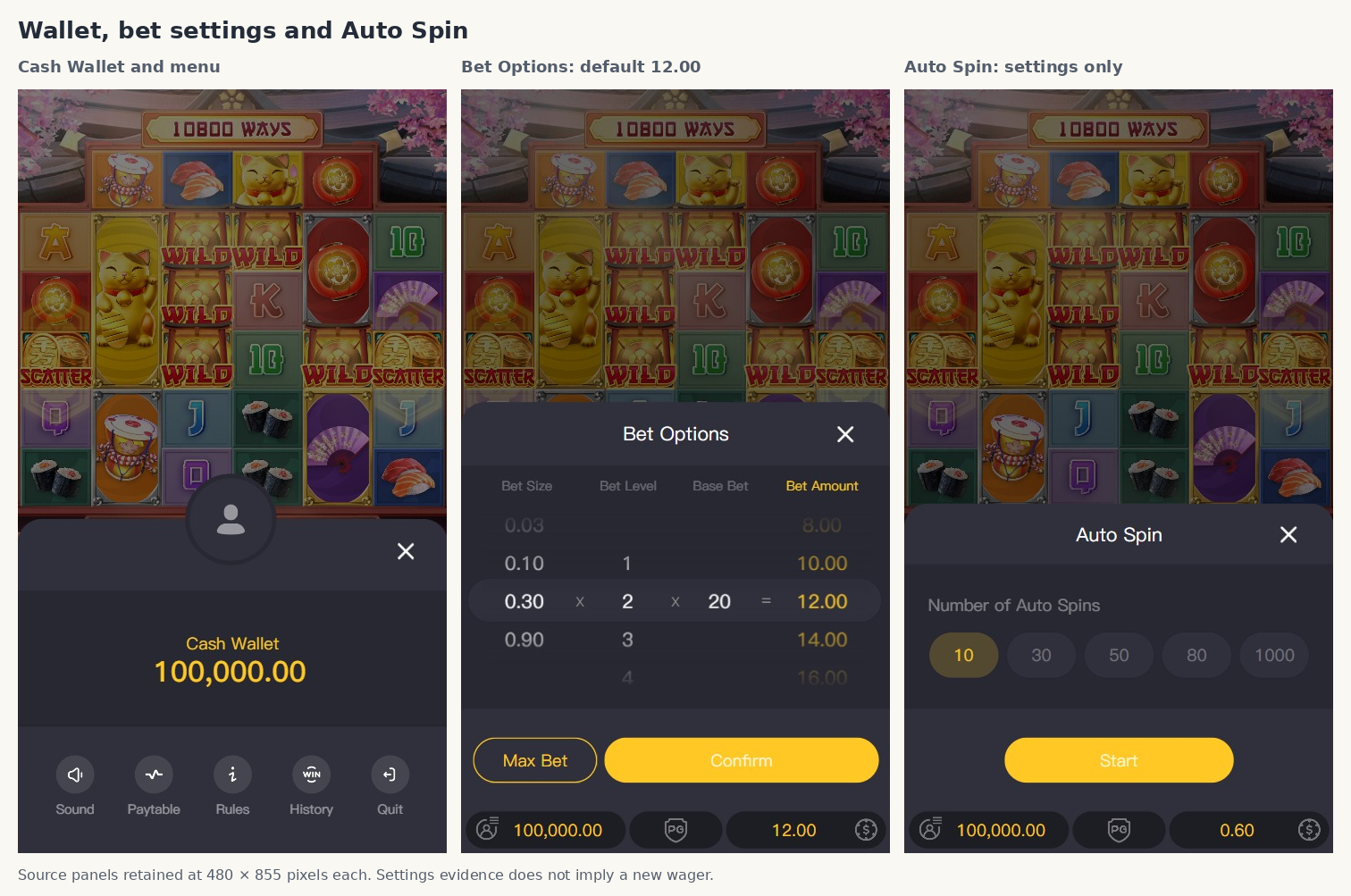
Actual opened controls. The Bet panel’s displayed 12.00 is a captured default, not the 0.60 sample stake. Auto was inspected without pressing Start.
Auto Spin offered 10, 30, 50, 80 and 1,000 spins in the captured panel. It was opened for inspection, then left unused. The sample was entered and checked one paid parent at a time: one Normal spin followed by 49 Turbo spins. Changing speed did not change the verified stake; it also gives no evidence that faster play improves the odds.
Portrait is easier to read in these viewport checks. At a simulated 390 × 844 desktop viewport, the wallet, stake and confirmation button remained clear. Bet Options was opened and confirmed, and the returned screen still showed 0.60. No additional spin was needed for that check.
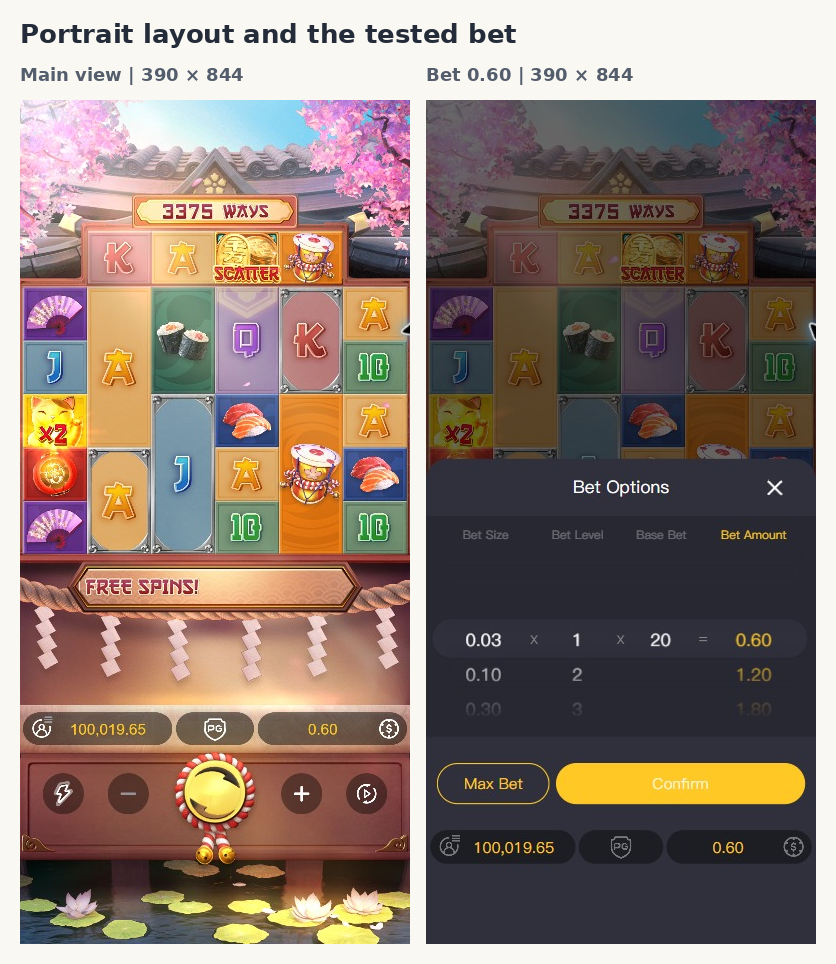
Portrait main view and Bet Options. These are desktop viewport checks, not physical-phone or touch testing.
At 844 × 390, the game kept its portrait shape in a central stage roughly 220 pixels wide. The surrounding scenery gained space while the useful numbers and buttons became smaller. That is why I prefer the portrait presentation for learning its rules. Neither this check nor the local video establishes performance on Philippine mobile networks.
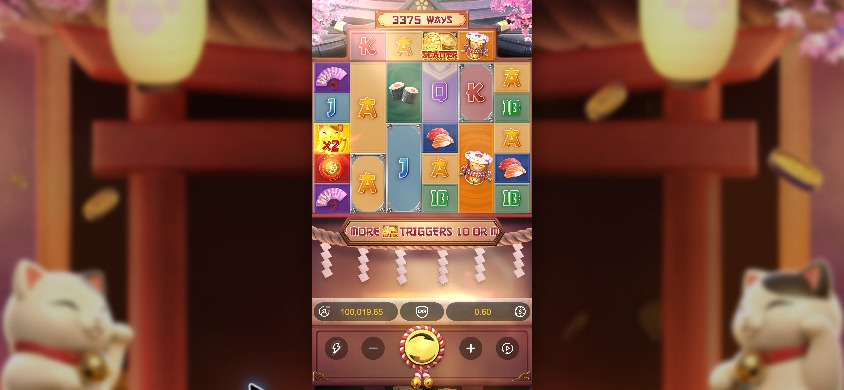
The landscape viewport preserves the tall board instead of spreading the controls across the full width.
3. How the Ways and payouts work
The current Help describes six main reels and five rows, with the additional reel above reels 2–5. A paying combination starts on the leftmost reel and continues across adjacent reels. The number of matching symbols on each participating reel is multiplied to obtain the winning Ways. Different qualifying symbol wins are then added.
A symbol that is two, three or four cells tall still counts as one symbol. Its drawn height is not a separate payout multiplier. The changing number of symbols is also why the Ways figure can change from one board to the next. Count matching symbols, not the number of squares that their artwork covers.
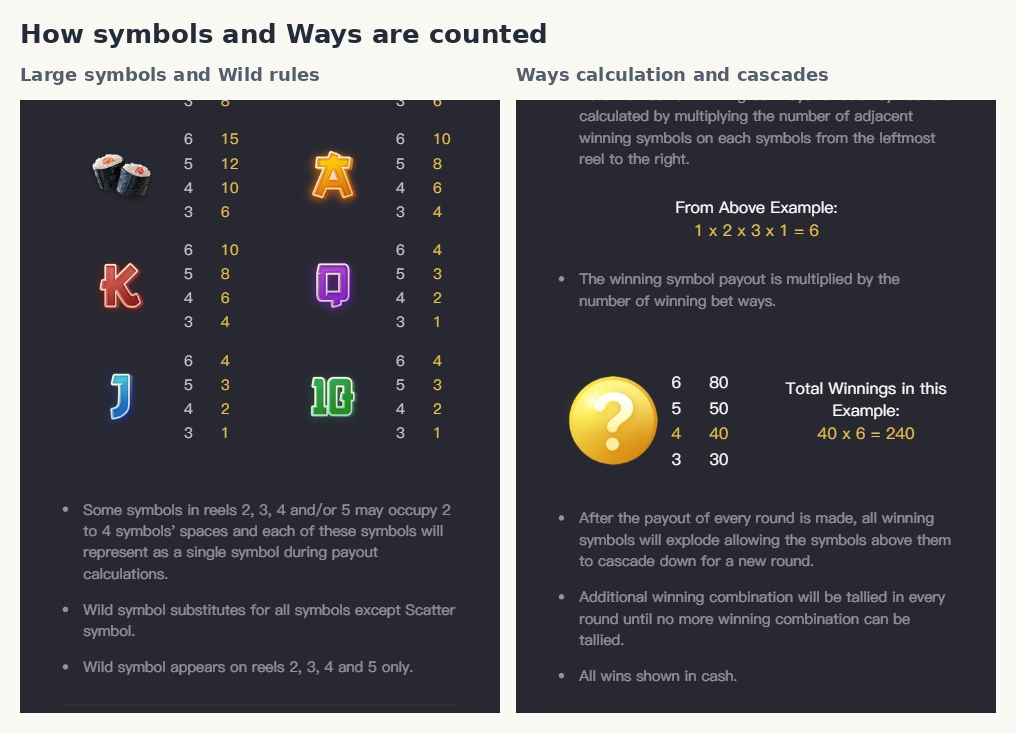
Current Help evidence for the Ways and large-symbol rules. Help illustrations explain the rules; they are not additional test results.
The paytable uses Bet Size and Bet Level, not the total stake. For an ordinary symbol combination, calculate Bet Size × Bet Level × symbol value × winning Ways, then apply a qualifying multiplier. The stake uses a separate base factor of 20. Multiplying a paytable value directly by the total 0.60 stake would overstate the base award.
Spin 6 is a useful small example. Its visible three-of-a-kind, one-Way award was 0.03 × 1 × 1 × 1 = 0.03. The paid parent cost 0.60, so its net result was −0.57. A payout occurred, but the wallet still fell. A zero-cost continuation did not create another paid sample.
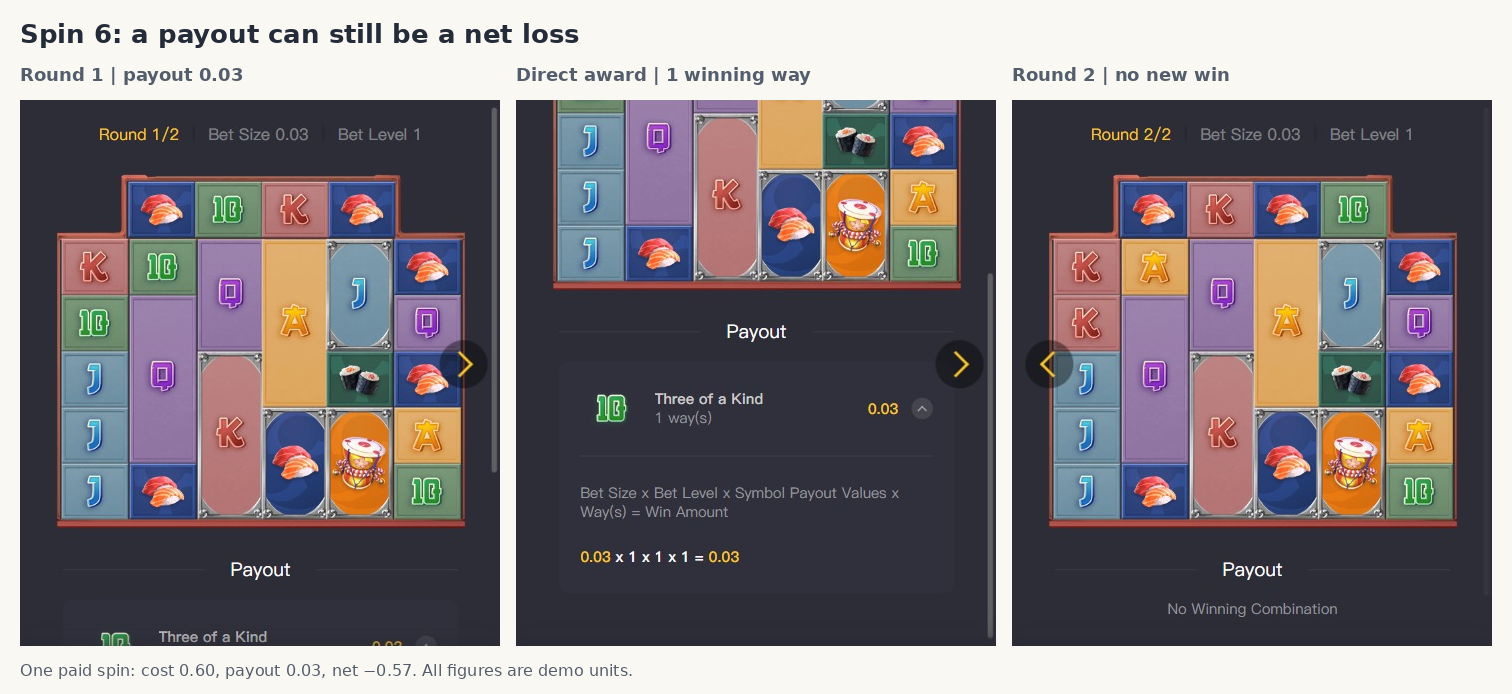
Spin 6: a 0.03 payout against a 0.60 parent cost, for a net loss of 0.57. The direct payout is counted once; the explanatory formula is not another prize.
The cat has the highest ordinary paytable values, followed by the drum, lantern, fan, sushi and card ranks. The complete symbol cards keep each image and its 3–6-reel values together. The short comparison below focuses on roles that can otherwise be confused.
Appearance | What it does | Important condition |
|---|---|---|
Cat | Pays as an ordinary symbol and contributes to the Cat multiplier | It is not the Wild; its ordinary prize still needs a qualifying Ways combination. |
Silver or gold frame | Carries a symbol through the transformation sequence | The framed symbol must participate in a win for the next transformation. |
Torii Wild | Substitutes for symbols other than Scatter | It appears on reels 2–5 and does not itself guarantee a paying board. |
Scatter coin | Triggers Free Spins | Four anywhere award 10; each additional Scatter adds two. |
The torii-gate Wild’s substitution range is a rules statement, while the recorded transformation example below shows one actual use of that mechanism. Keeping those two kinds of evidence separate prevents a dramatic-looking board from becoming an invented win.
4. Silver frames, cats and continuing wins
One paid parent can change several times
Winning symbols disappear and new symbols fall into the gaps. The game evaluates the next board until no new winning combination remains. Only the first step of each ordinary paid parent in this sample cost 0.60; its ordinary cascade continuations showed Bet 0.
Wilds-on-the-Way applies to large ordinary symbols on reels 2–5. When a silver-framed symbol participates in a win, it changes into a randomly selected ordinary symbol, excluding Wild and Scatter, with a gold frame for the next round. If that gold-framed symbol wins, it becomes a Wild on the following board.
Spin 14 demonstrates Wilds-on-the-Way particularly well. A silver-framed Q participated in the first win. The same position then became a gold-framed fan. After that fan won, it became a Wild on the third board. The first two rounds paid 0.06 and 0.48, while the final board showed No Winning Combination.
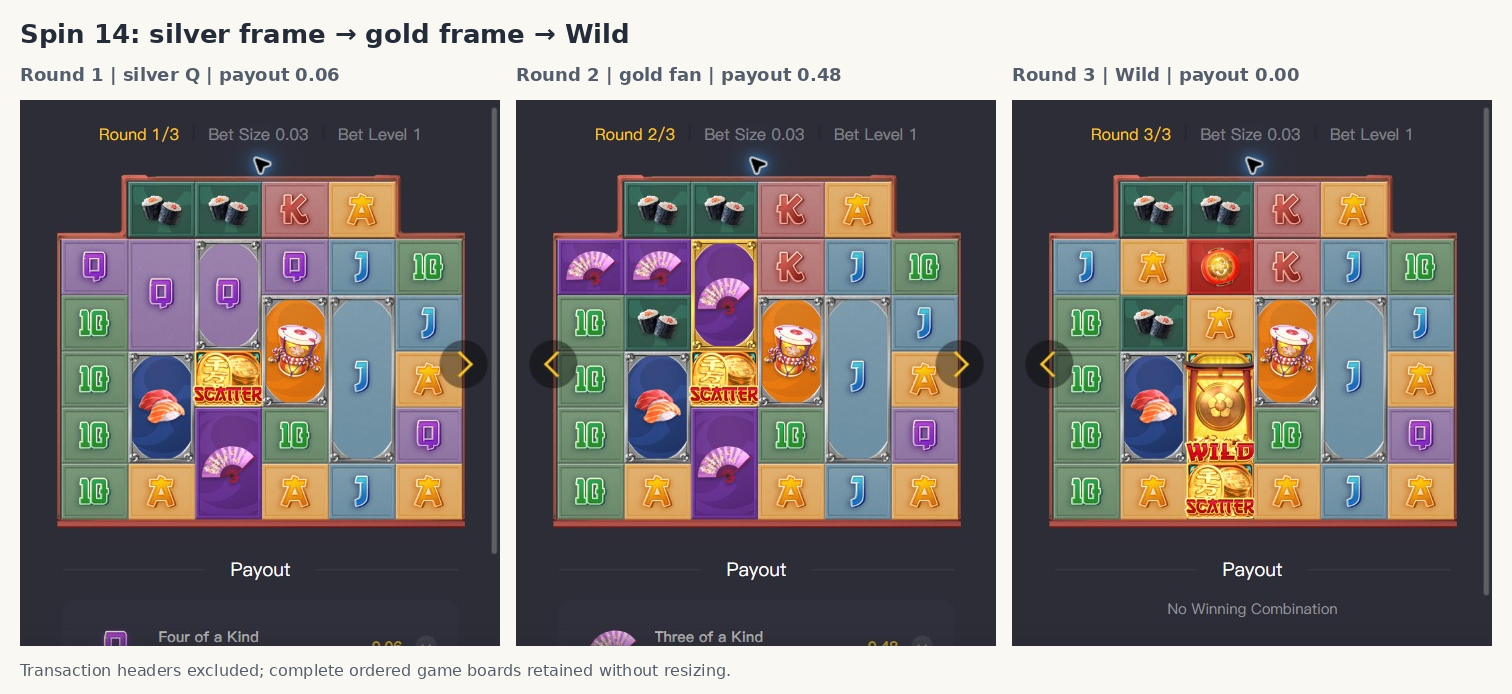
Spin 14 in order: 0.06, 0.48 and 0.00 payout. The 0.54 parent payout was 0.06 below its 0.60 cost. The final Wild did not create a winning combination.
That sequence is the appeal of the feature: a successful framed symbol can leave something useful for the next drop. It is an opportunity, rather than a promised profitable finish. The recorded example ends with both a Wild and a net loss.
Read the final Cat-multiplied amount once
In the main game, the Cat rule adds two to the multiplier for each cat. The captured History records include ×2, ×4 and ×6. On spin 47, three cats produced a displayed ×6 multiplier. The three direct awards were 5.40, 1.44 and 0.72, adding to 7.56.
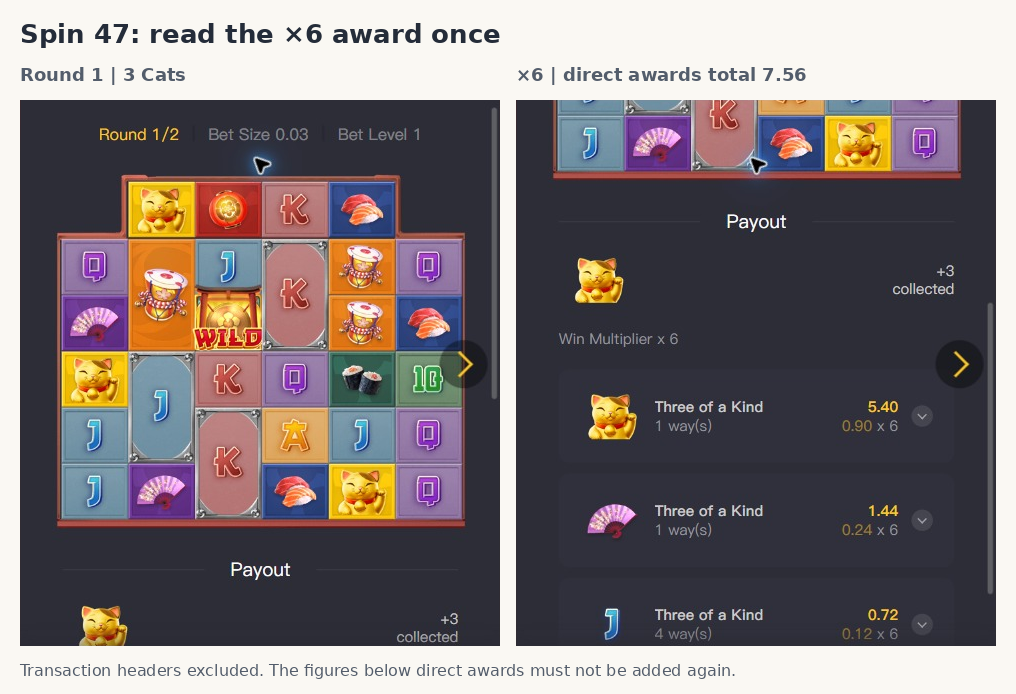
The displayed 0.90 × 6, 0.24 × 6 and 0.12 × 6 explain those same final awards. Adding both the final values and their formulas would double-count the result.
The cat example also connects the paytable to actual money units: a three-reel Cat value of 30 at Size 0.03 and Level 1 gives 0.90 for one Way; the visible ×6 makes that component 5.40. The whole paid parent returned 7.56 against 0.60, leaving +6.96.
Longer cascades are still one parent. Spin 9 had four rounds and the largest parent payout in this sample, 8.88. Spin 36 lasted seven rounds and paid 3.69. More rounds did not automatically produce the larger reward.
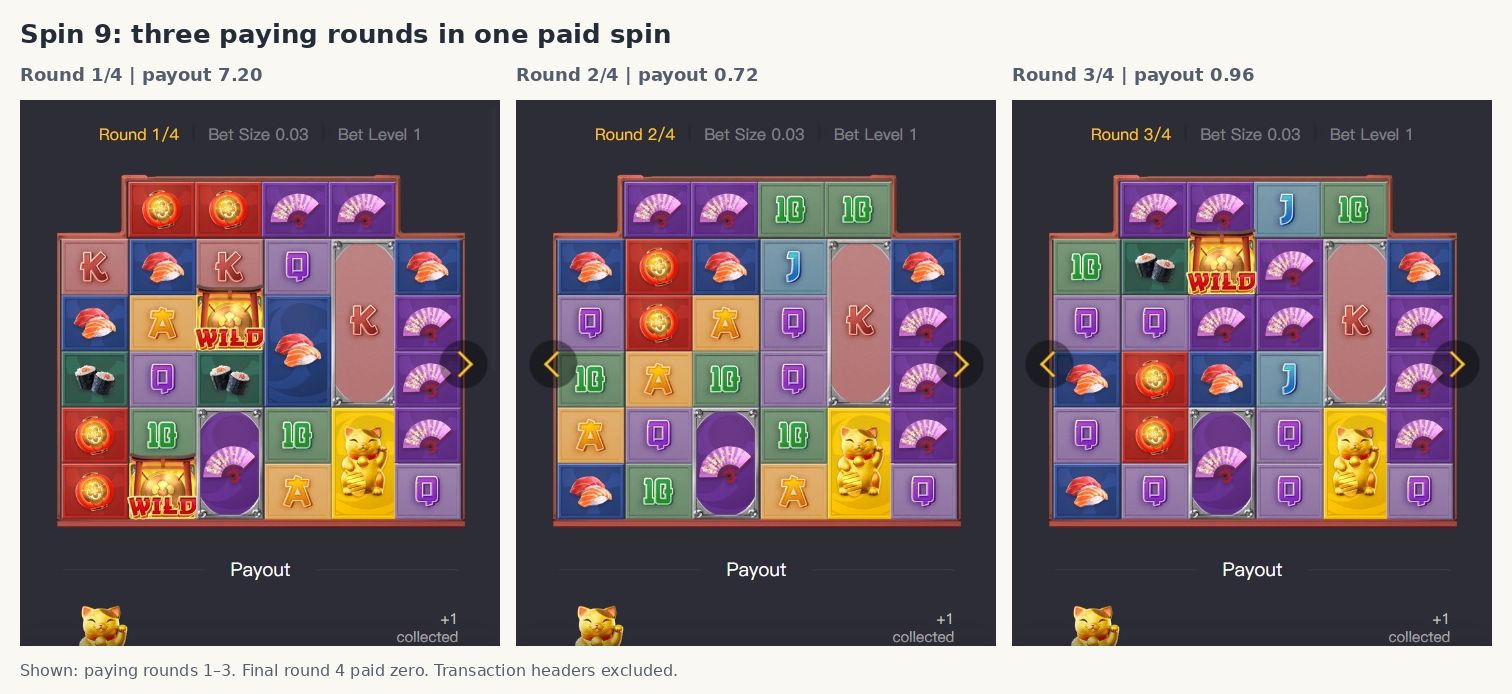
Shown: spin 9’s paying rounds 1–3, returning 7.20, 0.72 and 0.96. The unshown final round 4 paid 0.00. Total cost stayed 0.60; total payout was 8.88 and net change +8.28.
Recorded parent | Round payouts | Cost | Parent payout | Net |
|---|---|---|---|---|
14 | 0.06 + 0.48 + 0 | 0.60 | 0.54 | −0.06 |
9 | 7.20 + 0.72 + 0.96 + 0 | 0.60 | 8.88 | +8.28 |
36 | 0.36 + 0.18 + 0.03 + 1.20 + 0.36 + 1.56 + 0 | 0.60 | 3.69 | +3.09 |
Free Spins rules and the untested Buy option
Four Scatter coins anywhere trigger 10 Free Spins, and each additional Scatter adds two. The current Help says the feature starts at ×2, with each Cat adding another two, and Free Spins can retrigger. None of the 50 completed paid parents entered that mode, so there is no first-hand feature-session result here.
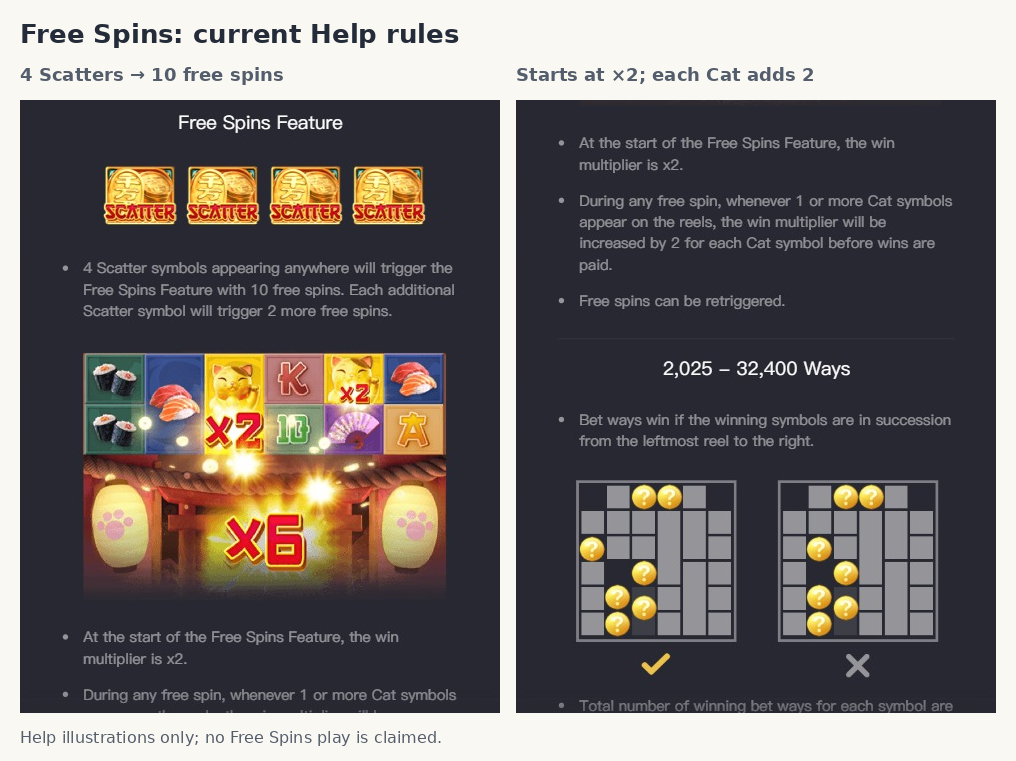
Current Help rules for Free Spins, rather than a feature trigger from the reviewed sample.
PG SOFT’s Game Information PDF includes Feature Buy. The inspected public demo’s main screen, wallet menu, Bet Options, Auto panel and complete Help did not show an actionable purchase entry. I would not treat the PDF illustration as proof that the same button is available in this page’s current game module. No Buy cost or purchase outcome was tested.
5. Stake, RTP and limits
The recorded configuration offered Bet Sizes 0.03, 0.10, 0.30 and 0.90 with Bet Levels 1–10. At the 20-unit base factor, that describes a 0.60–180.00 stake range. The maximum is a panel-derived limit, not a wager that was placed. All 50 completed paid parents used the minimum combination.
Item | Recorded current demo | How to read it |
|---|---|---|
Paid ordinary parent | 0.03 × 1 × 20 = 0.60 | The actual sample cost per parent. |
Ordinary cascade child | 0 additional cost | Part of its original parent, not another paid spin or a Free Spins feature. |
Maximum selectable combination | 0.90 × 10 × 20 = 180.00 | Shown by panel options; not executed. |
Turbo | Same verified 0.60 stake | A speed setting; 49 sample parents used it. |
Auto | Panel inspected; not started | No claim about executing or stopping a batch. |
Buy or EX | No actionable entry found in this inspected configuration | Do not infer a price, outcome or product-wide absence. |
These are demo units, not confirmed Philippine pesos. The official PDF describes a different set of Bet Sizes and an EUR 0.20–20 range. An operator’s currency or configuration can therefore differ from the recorded public demo; check the displayed total before relying on a minimum quoted elsewhere.
PG SOFT’s PDF states 96.73% theoretical RTP and Medium volatility. The captured current Help does not display RTP, so that value is supplier documentation rather than independently confirmed configuration data for the loaded game. The file labels itself Version 1.0 r945 and prints “08/07/2025” as its update date; that is not the verified runtime build or a release date.
The same PDF distinguishes an advertised maximum win of 100,000× from a maximum exposure of 5,527× observed in a billion-spin simulation. Those figures have different meanings. The simulated exposure is not a hard limit, and neither value was reached or independently tested here. The current Help did not state a clear maximum-win termination rule.
For a practical explanation of cost and sample returns, the slot simulator can help compare assumptions about bankroll and variance. It does not reproduce Lucky Neko’s undisclosed mathematics, predict the next result or validate its theoretical RTP.
6. What the 50 completed paid spins showed
The recorded session took place on 6 October 2026 in PG SOFT’s public demo. There were 50 completed paid parents at 0.60 each: one Normal and 49 Turbo. History’s visible direct awards or No Winning Combination supplied the payouts, with independently opened Wallet balances used to cross-check the result. Thirty-six zero-cost cascade children stayed attached to their parents.
Measure | Observed result |
|---|---|
Completed paid parents | 50 |
Cost | 30.00 demo units |
Payout | 47.28 |
Net change | +17.28 |
Sample return | 157.60% |
Parents with payout / zero payout | 16 / 34 |
Net-winning / net-losing / break-even parents | 11 / 39 / 0 |
Largest parent payout | Spin 9: 8.88; net +8.28 |
Longest zero-payout run within one session | Six parents, spins 29–34 |
Longest ordinary cascade | Spin 36: seven rounds |
Free Spins feature triggers | 0 |
The sample split into 23 and 27 completed parents across two sessions. After the first 23, one attempted spin showed Transaction Failed and never supplied a known final settlement. It is excluded instead of being filled in as a zero payout. The last verified wallet was 99,997.63 and the new session baseline was 100,000.00, a difference of +2.37 across that unsettled attempt. This difference cannot be separated into the unknown attempt’s result and a pure balance-reset amount. Neither unknown cost nor payout is filled in as zero or inferred from the gap. The +17.28 net below describes only the 50 verified completed parents, not the entire visit.
Session | Paid parents | Start → end wallet | Cost | Payout | Net |
|---|---|---|---|---|---|
First | 23 | 100,000.00 → 99,997.63 | 13.80 | 11.43 | −2.37 |
Second | 27 | 100,000.00 → 100,019.65 | 16.20 | 35.85 | +19.65 |
Combined | 50 | Two separately checked baselines | 30.00 | 47.28 | +17.28 |
Balance shows the two session paths. The break marks the interval with an unknown settlement between the two verified session baselines. Subtracting the first starting wallet from the final wallet would incorrectly call the result +19.65.
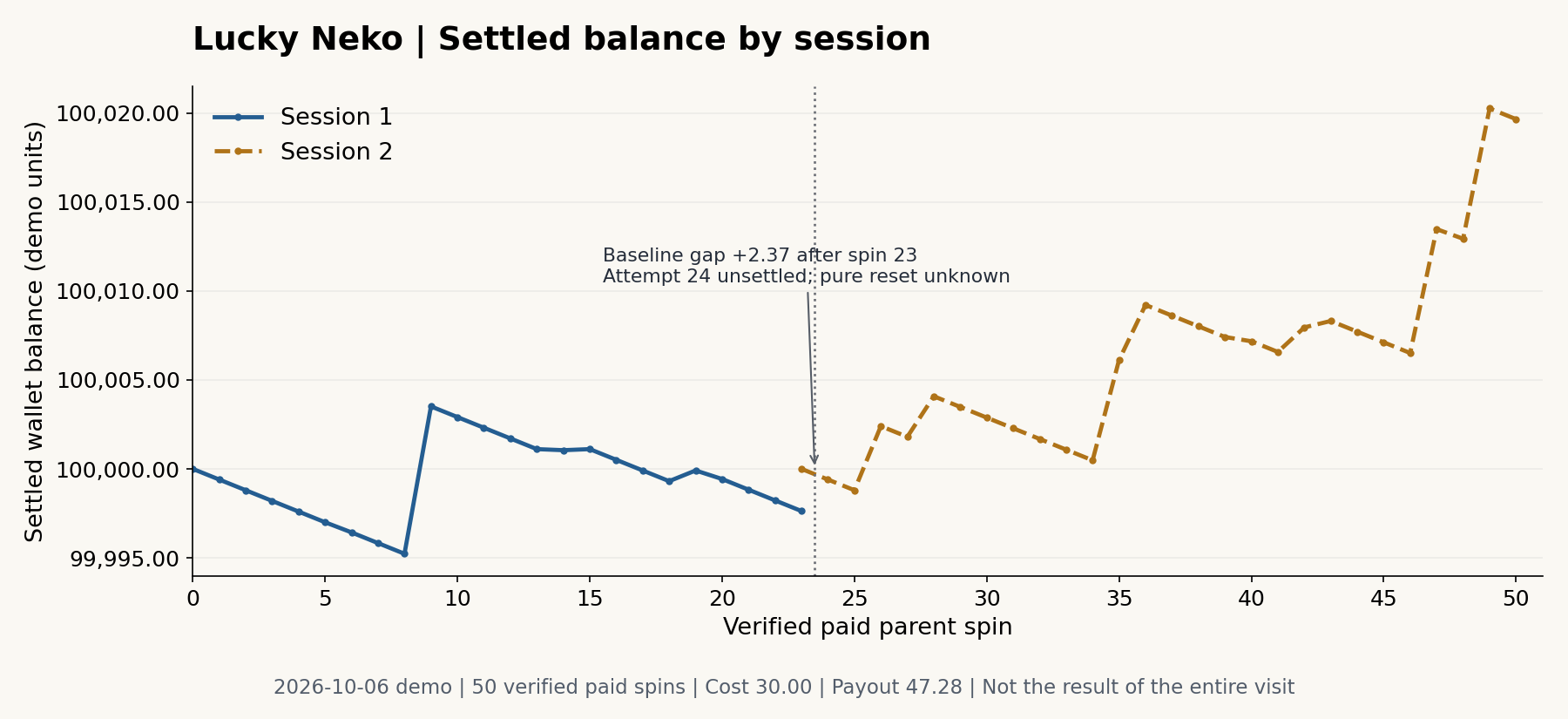
Ledger-based balances for 50 verified paid parents. The +2.37 difference is new baseline minus last verified wallet across unknown attempt24; a pure reset amount is not established. Verified-sample net remains +17.28.
Cumulative sample return uses cumulative payout divided by cumulative paid cost. The calculation continues across the two sets of verified completed parents. The baseline difference and the unknown attempt contribute neither an inferred cost nor an inferred payout. The 100% line is a break-even reference, not the game’s theoretical RTP.
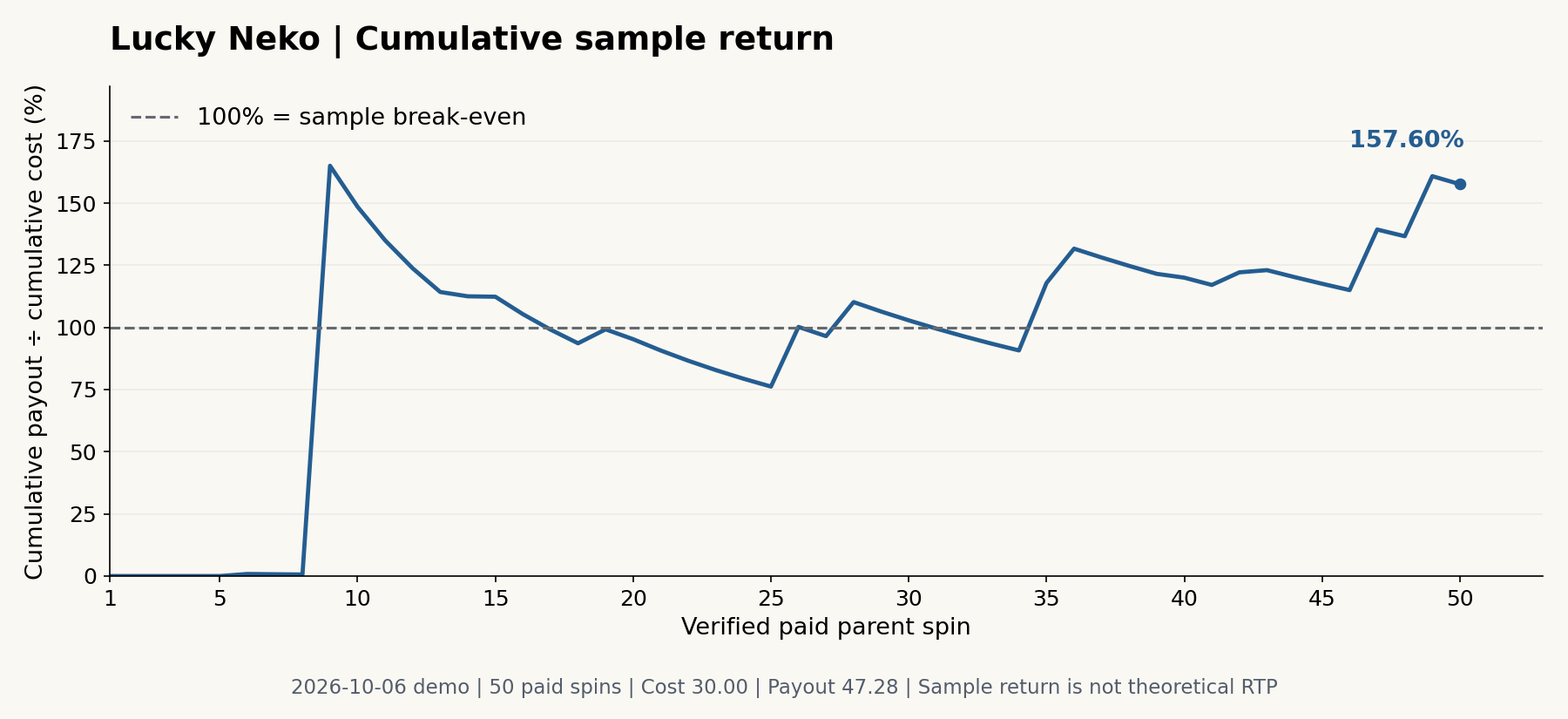
47.28 ÷ 30.00 = 157.60% for this sample only. This does not validate the supplier’s 96.73% theoretical RTP.
Net change is the parent’s full payout minus 0.60. The chart includes all its ordinary cascade rounds once. Five of the 16 parents with a payout still lost money, which is why a hit count is less useful on its own than the payout and net columns.
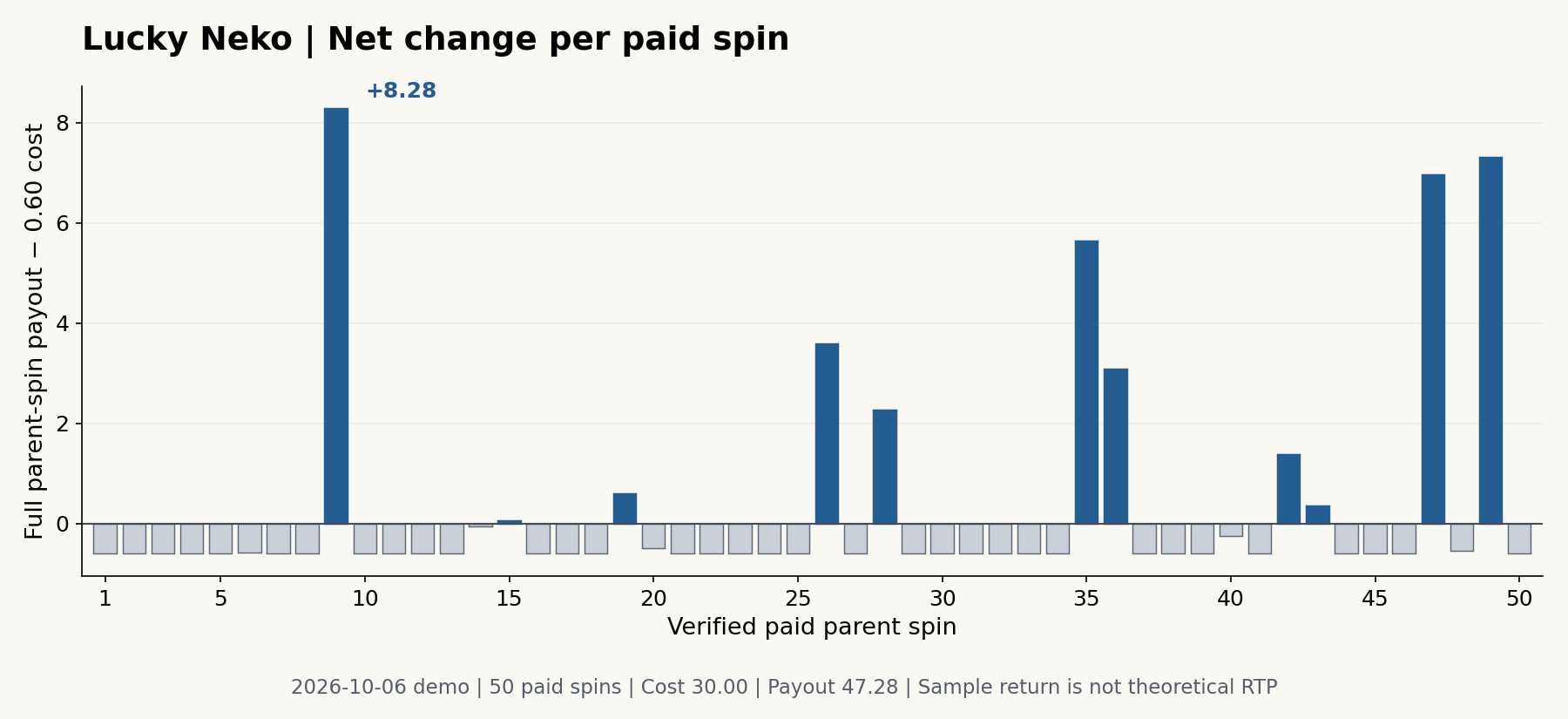
11 net-positive and 39 net-negative parents; no break-even parent. The largest net increase was +8.28 on spin 9.
Several larger returns drove the positive total, while 34 parents paid nothing. That combination makes the sample useful for reading results, not for choosing a supposedly profitable rhythm. The next spin cannot be predicted from the six-spin dry run, the last cat multiplier or the final upward balance.
7. Who I would recommend it to
I would give this recorded ordinary-game experience 7.5/10. The reason is the traceable interaction between frames, Wilds and Cat multipliers, alongside a History view that makes the arithmetic unusually inspectable. The score also reflects the crowded presentation, weaker landscape readability and the observed interruption. It is not a rating of expected winnings or a claim to have tested the Free Spins and Buy experience.
A useful comparison is Wild Bandito by PG SOFT. Both games connect cascading wins with special-symbol changes, but their layouts and multiplier progressions are different. The choice is about which sequence you enjoy reading.
Reading choice | Lucky Neko | Wild Bandito |
|---|---|---|
Board | Six reels, large symbols and an additional upper reel; 2,025–32,400 Ways | Five reels × four rows; 1,024 Ways |
Transformation | A winning silver-framed symbol becomes gold; a winning gold-framed symbol then becomes Wild | Winning gold-framed symbols become Wild |
Multiplier focus | Cats add to the displayed multiplier | The cascade sequence increases its round multiplier |
Best reason to compare | You want changing symbol sizes and Cat collection to matter | You prefer a fixed 1,024-Way layout while following gold-frame changes |
My preference would be to learn Lucky Neko in portrait and use History after a small win before trying to interpret its busiest cascades. Spin 6 explains why a payout can still lose money; spin 14 explains why a Wild is not a guaranteed win; spin 47 shows how to read the final multiplied awards. Together, those examples are more useful than treating the best sample win as a promise.
The resulting review is strongest on the ordinary game: its rules, controls, silver/gold transformations and real settlement examples. The Free Spins feature remains a rules-based explanation, and Buy availability depends on the actual configuration. If you use the same-page demo when available, check the stake again after any reload and treat virtual results as practice.
Sources: current recorded PG SOFT demo Help and History, plus PG SOFT’s Lucky Neko Game Information PDF. The PDF and inspected demo differ on stake configuration and visible Buy availability.
Lucky Neko by PG SOFT FAQs
Answers to common questions about Lucky Neko by PG SOFT.
Lucky Neko by PG SOFT Reviews
 No Player Reviews Yet
Played Lucky Neko by PG SOFT? Share your experience with other players.
 Write A Review