
Mahjong Ways by PG SOFT
Play Mahjong Ways by PG SOFT In Demo Mode
by PG SOFT




 ScatterMahjong Ways - Scatter
- 3: 12 Free Spins
- Extra: +2 Free Spins
- Anywhere
- Can retrigger
 WildMahjong Ways - Wild
- Not Scatter
- No listed payout
- Substitutes tiles
- Gold ingot
 Paying SymbolMahjong Ways - Two Bamboo
- 3 reels: 2
- 4 reels: 5
- 5 reels: 10
- Gold on reels 2–4
 Paying SymbolMahjong Ways - Two Dots
- 3 reels: 2
- 4 reels: 5
- 5 reels: 10
- Gold on reels 2–4
 Paying SymbolMahjong Ways - Five Bamboo
- 3 reels: 4
- 4 reels: 10
- 5 reels: 20
- Gold on reels 2–4
 Paying SymbolMahjong Ways - Five Dots
- 3 reels: 4
- 4 reels: 10
- 5 reels: 20
- Gold on reels 2–4
 Paying SymbolMahjong Ways - Eight Characters
- 3 reels: 6
- 4 reels: 15
- 5 reels: 40
- Gold on reels 2–4
 Paying SymbolMahjong Ways - White Dragon Tile
- 3 reels: 8
- 4 reels: 20
- 5 reels: 60
- Gold on reels 2–4
 Paying SymbolMahjong Ways - Red Zhong Tile
- 3 reels: 10
- 4 reels: 40
- 5 reels: 80
- Gold on reels 2–4
 Paying SymbolMahjong Ways - Green Fa Tile
- 3 reels: 15
- 4 reels: 60
- 5 reels: 100
- Gold on reels 2–4
Game Themes

 ThemeMahjong Games
 11 Games

Mahjong Ways by PG SOFT Expert Review


Updated:
Here you can find detailed review information about Mahjong Ways by PG SOFT.
A closer look at the original Mahjong Ways
Mahjong Ways is most interesting after the reels first stop. Winning tiles disappear, the multiplier steps up, and a winning gold-plated tile can leave a Wild for the next drop. Those three parts work well together: you have a reason to watch how the board changes, rather than looking only at the first win message.
This review covers the original Mahjong Ways by PG SOFT, with five reels, four rows and 1,024 fixed ways. You do not need to know traditional mahjong hands. The tiles supply the theme; the slot’s own matching rules determine the result. Mahjong Ways 2 is a separate game, and its specifications are not used here.
What I liked
✅ I would choose this game for the way winning gold-plated tiles carry interest into the next cascade.
✅ The multiplier ladder and per-round History make the maths easier to follow.
✅ The portrait layout keeps the complete grid and key controls together.
✅ Free Spins keep familiar rules while raising the cascade multipliers.
✅ Bet Options separate Size, Level and total cost clearly.
What I didn’t like
❌ A gold tile must win before it transforms, and the resulting Wild may still produce no award.
❌ Several awards can belong to one spin; early win messages are not the final net result, and an animated win can still be smaller than the stake.
❌ Landscape stays narrow, and smaller wallet/help text needs more attention.
❌ Most sample spins lost net, and two feature entries accounted for most of its payout.
❌ Reloading restored different bet and speed settings; this demo also needed recovery after interruptions.
❌ There is more to follow than on a simple five-line slot.
Our 100 completed demo rounds make both points clear.

Use the demo panel on this page when it is available, and check that the loaded title says Mahjong Ways. The short clip below shows an ordinary spin at Normal speed, followed by the settled board. It preserves the recorded sequence and is silent.
A 14.37-second recording from demo round 2. The reels move in the opening portion; the later portion shows the stopped reels and background animation.
Philippine search interest. Ahrefs estimated 250 monthly Philippine searches for “mahjong ways” and 150 for “mahjong ways demo” when checked on 5 October 2026. Searches for Mahjong Ways 2 were tracked separately. These are search estimates, not player counts or a measure of the game’s payout chances.
The screen and your first spin
The cream tiles stand out against a warm red-and-gold background. Character tiles, dots and bamboo are easy to distinguish once you have seen the paytable. The important reading order is the grid, the active multiplier, then the final win and wallet. A large win message alone does not tell you whether the round covered its cost.
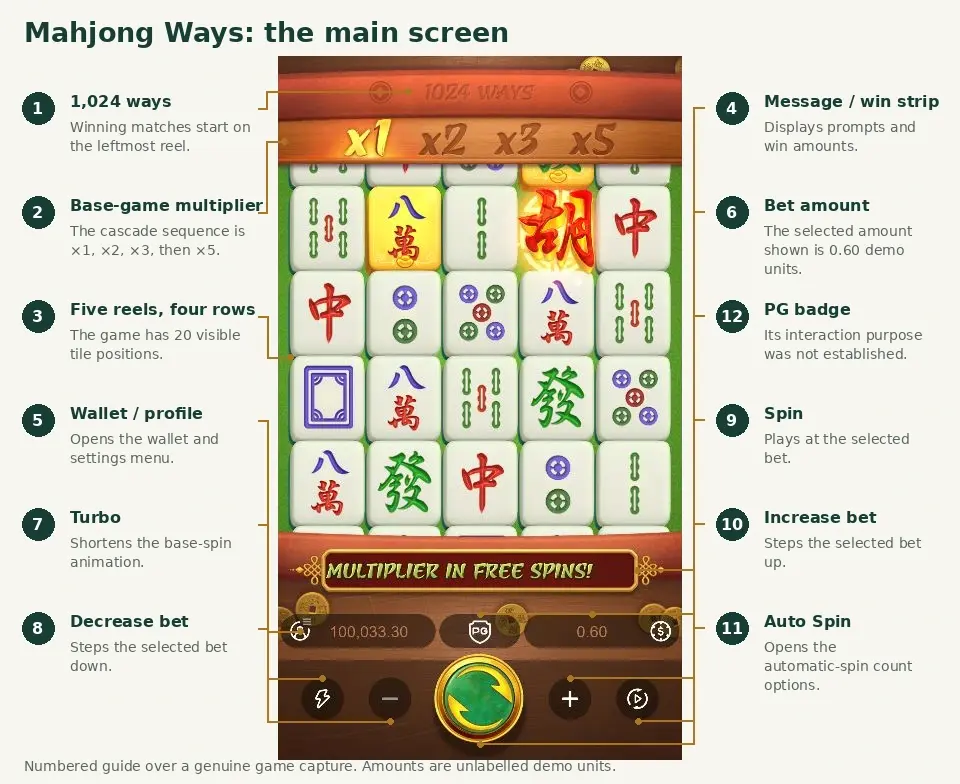
1,024 ways. Winning matches start on the leftmost reel.
Base-game multiplier. The cascade sequence is ×1, ×2, ×3, then ×5.
Five reels, four rows. The game has 20 visible tile positions.
Message / win strip. Displays prompts and win amounts.
Wallet / profile. Opens the wallet and settings menu.
Bet amount. The selected amount shown is 0.60 demo units.
Turbo. Shortens the base-spin animation.
Decrease bet. Steps the selected bet down.
Spin. Plays at the selected bet.
Increase bet. Steps the selected bet up.
Auto Spin. Opens the automatic-spin count options.
PG badge. Its interaction purpose was not established.
Set the amount and confirm it
Open Bet Options by selecting the displayed bet. The panel separates Bet Size, Bet Level and Bet Amount. Our setting was 0.03 Bet Size × Level 1 × Base Bet 20 = 0.60 demo units per base spin. Base Bet 20 is part of that calculation. It does not mean the game has 20 paylines.
Choose the setting, press Confirm, then check the amount on the main screen before pressing Spin. A selected value inside the panel can differ from the still-visible background amount until you confirm. The plus and minus buttons also change the amount, while Max Bet selects the highest Size and Level. These are stake controls, so give them a quick check before playing.
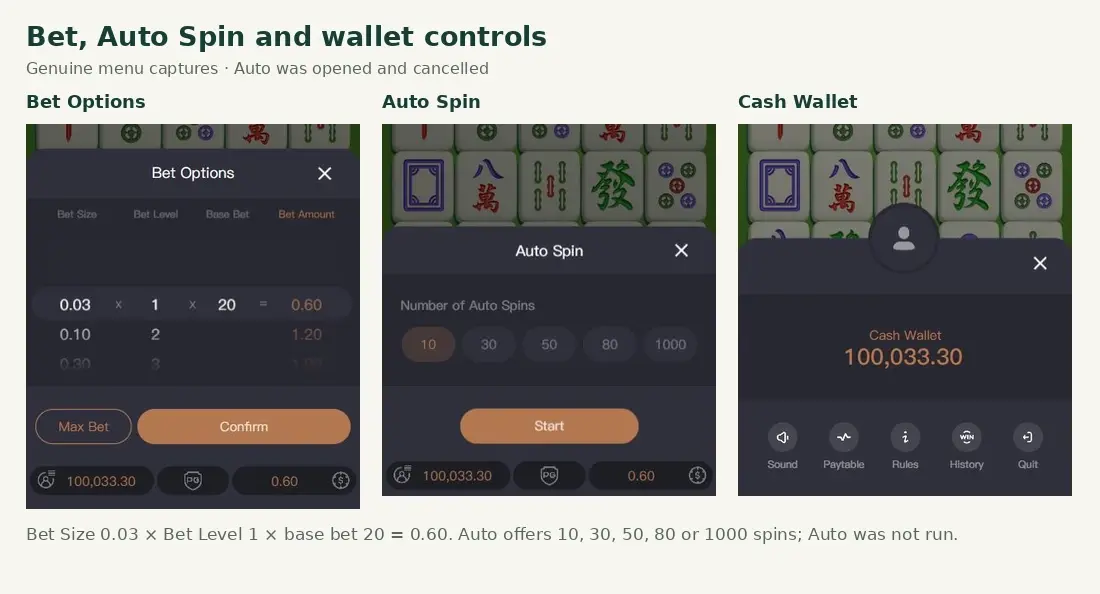
Turbo shortens the base reel animation. We tested its on/off control; we did not find a separate Super Turbo setting. The History label “Normal Spin” describes the base-game mode, so it should not be read as proof that Turbo is off. The clip above uses Normal speed; most of the recorded sample used Turbo.
The wallet menu opens Sound, Paytable, Rules and History, as well as Quit. History is especially useful here because it separates a base spin into its individual cascade rounds and shows the actual awards. The sound switch worked when toggled off and back on, but we did not listen to or rate the audio.
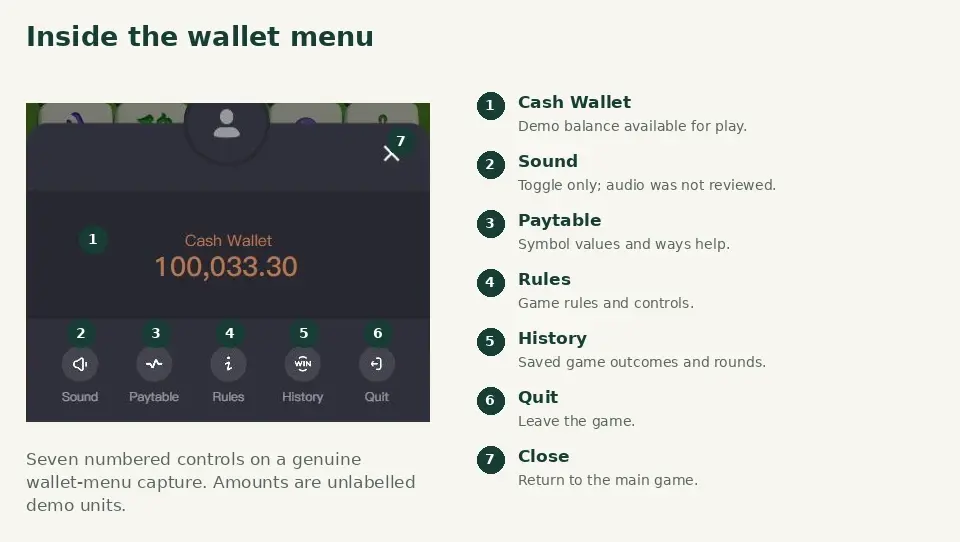
Cash Wallet. Shows the demo balance available for play.
Sound. Toggles the sound setting. We restored it after checking the control; audio quality was not reviewed.
Paytable. Opens the symbol values and ways explanation.
Rules. Opens the game rules and control instructions.
History. Opens saved outcomes and the cascade rounds within each spin.
Quit. The menu’s exit control.
Close. Returns to the main game screen.
Portrait gives the tiles more room
At a simulated 390×844 portrait size, all five reels and the main controls remained visible. The bet panel was readable and Rules could be opened and scrolled, although the wallet text was small. At 844×390 landscape, the game kept a narrow 220×390 portrait strip in the centre, with a lot of background at the sides. The tiles and amounts became noticeably harder to read.
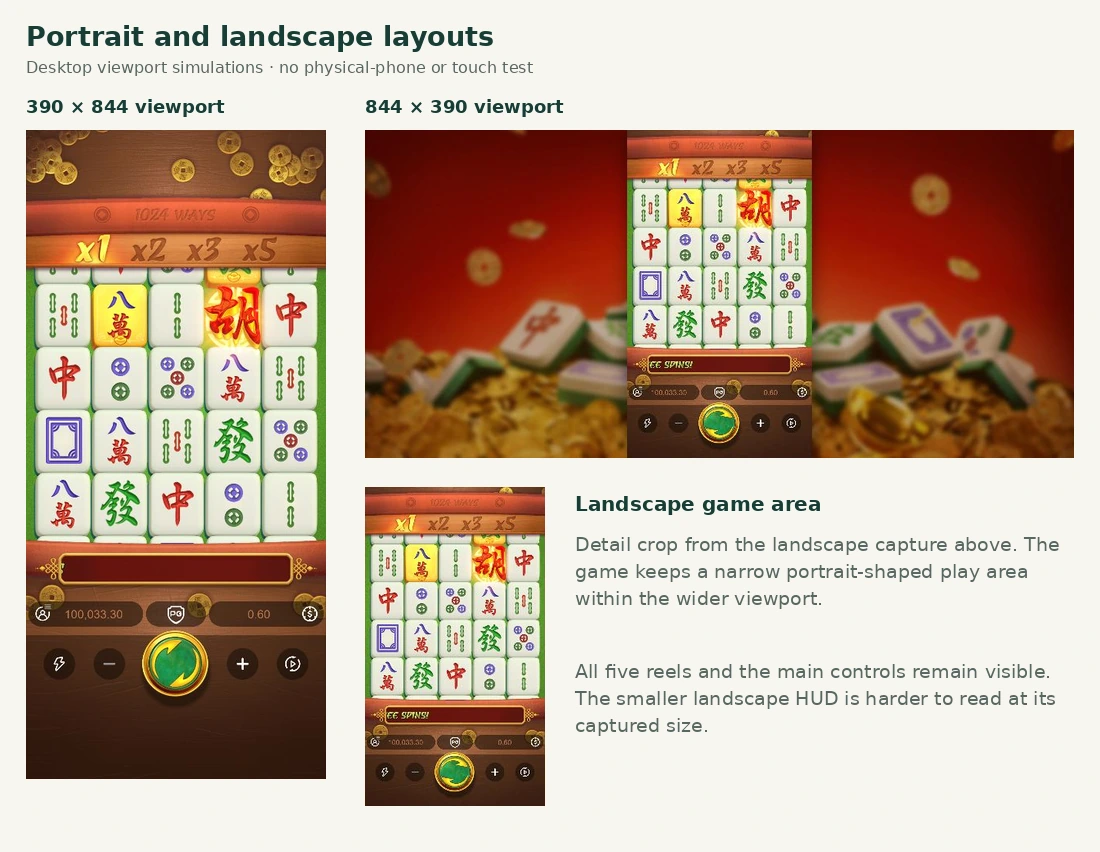
I prefer portrait for this layout. These were mouse-operated desktop simulations, not physical-phone, touch or Philippine mobile-network tests. On reloads and fresh sessions, the demo also returned to a 12.00 bet and Normal speed. Check both settings again after reopening it instead of assuming your previous choices were retained.
How the 1,024 ways calculate a win
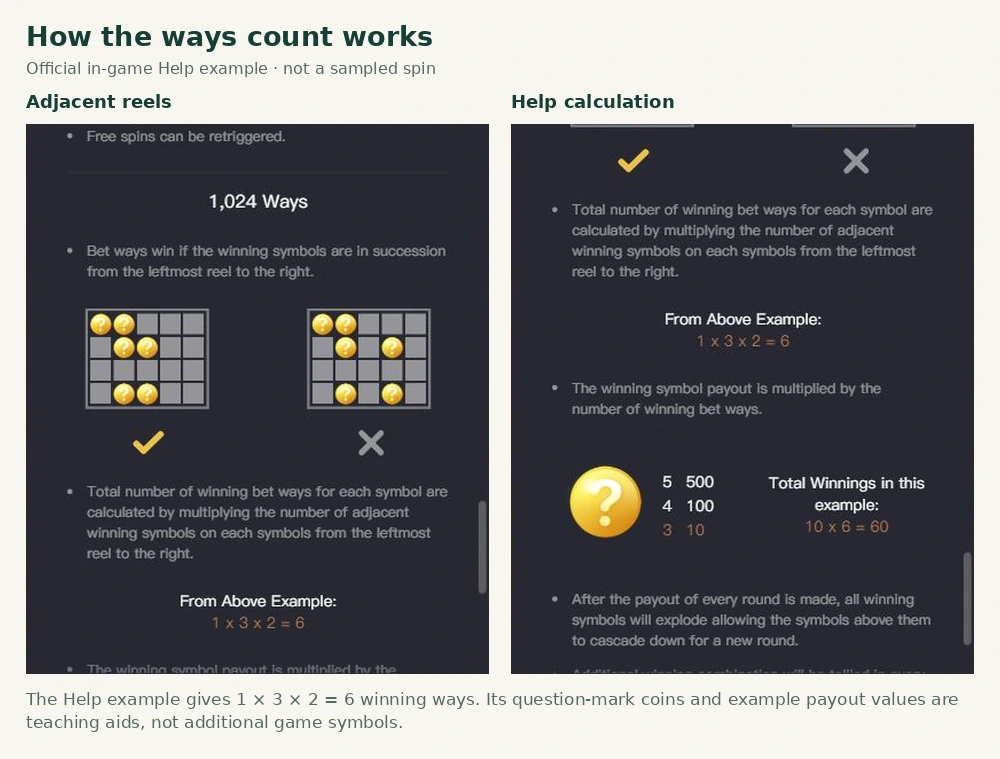
A regular tile wins when it appears on at least three consecutive reels starting from the leftmost reel. Its row can change from reel to reel. Count the matching symbols on each participating reel, then multiply those counts to find the winning ways. A Wild can fill in for any regular tile, but cannot replace a Scatter.
The full five-reel layout offers 4 × 4 × 4 × 4 × 4 = 1,024 possible ways. A particular result usually pays on only a subset of them. You do not multiply every award by 1,024.
Base paytable values. This compact comparison lets you check the eight regular tiles without opening each symbol card. Use the value for the number of matched consecutive reels, then apply Bet Size, Bet Level, the winning ways and the current multiplier. The numbers below are not multiples of the total stake.
Regular tile | 3 reels | 4 reels | 5 reels |
|---|---|---|---|
Green Fa | 15 | 60 | 100 |
Red Zhong | 10 | 40 | 80 |
White Dragon | 8 | 20 | 60 |
Eight Characters | 6 | 15 | 40 |
Five Dots / Five Bamboo | 4 | 10 | 20 |
Two Dots / Two Bamboo | 2 | 5 | 10 |
The names describe the visible tiles; the English paytable does not give each ordinary tile a formal name. Wild and Scatter have separate functions and no standalone cash value listed in this paytable. Gold plating is a state of a regular tile, rather than an eleventh pay symbol.
A real two-way award
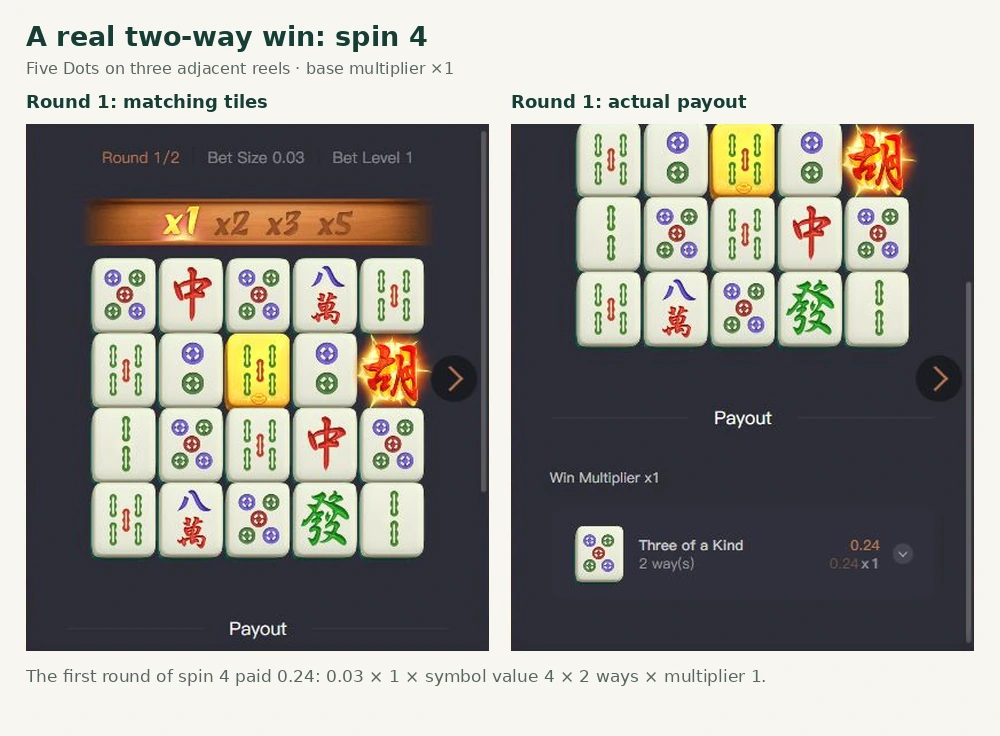
Round 4 produced two three-reel ways of Five Dots. At our settings, its value of 4 gave:
4 × 0.03 × Level 1 × 2 ways × 1 = 0.24 demo units.
Round 3 is another useful example. Two Dots paid 0.06 and Two Bamboo paid 0.06 at the same time. The awards were added, giving 0.12 for the complete spin. After subtracting the 0.60 stake, the wallet fell by 0.48. A payout and a profitable spin are different measures.
After a winning round, the game removes winning tiles and drops new tiles into the gaps. It checks the changed board again and continues until no more winning combinations remain. Those extra cascade rounds belong to the original spin; they do not each charge another base stake.
Cascades, gold-plated tiles and Free Spins
The multiplier applies to its own cascade
The multiplier ladder is easy to follow because it sits above the reels throughout play. Each winning cascade advances the next round by one step. Reaching a higher step still requires a winning combination before there is anything to multiply.
Cascade round within a spin | Base game | Free Spins |
|---|---|---|
First round | 1× | 2× |
Second round | 2× | 4× |
Third round | 3× | 6× |
Fourth and later rounds | 5× | 10× |
Each new base spin starts at 1×; each free spin starts at 2×. Add the already-multiplied awards from that spin to get its total. Do not add the ladder values together or multiply the complete total again at the end.
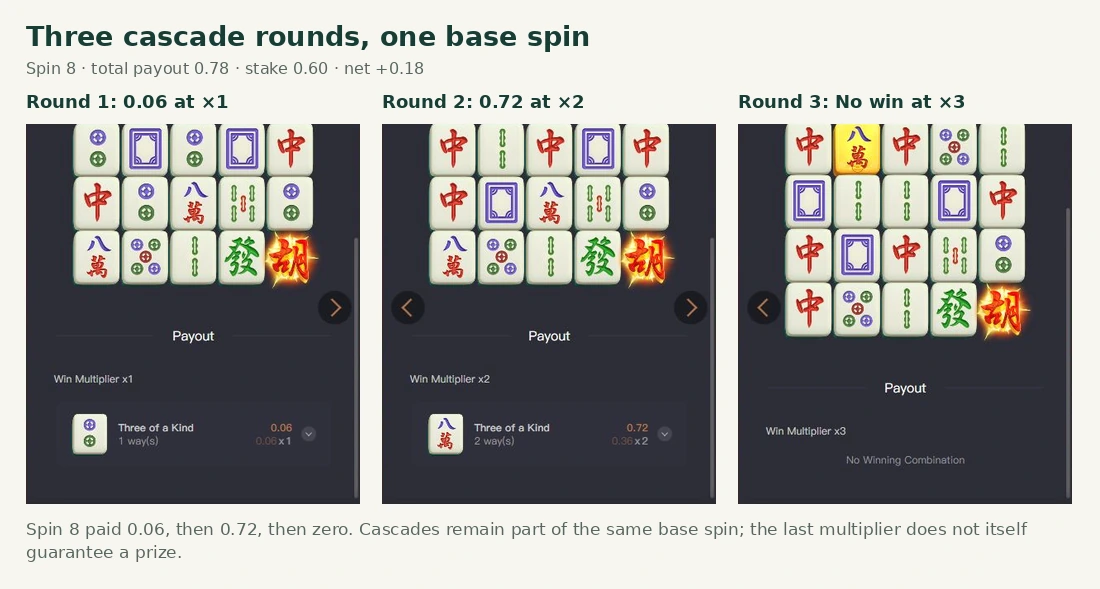
Round 8 makes the timing clear. Its first round paid 0.06 at 1×. The next round had two three-reel Eight Characters ways: 6 × 0.03 × 1 × 2 = 0.36, then the active 2× multiplier made that award 0.72. The third round reached 3× but had no winning combination. The complete payout was 0.06 + 0.72 + 0 = 0.78, a net increase of 0.18.
We also recorded a base-game 5× cash award in round 90: four three-reel Five Dots ways paid 4 × 0.03 × 1 × 4 × 5 = 2.40. The following round stayed at 5× and paid no ordinary award. The multiplier tells you the scale of a winning result, not whether a win will happen.
A winning gold tile can support the next drop
Regular tiles on reels 2, 3 and 4 can appear gold-plated. If a gold-plated tile takes part in a win, it becomes a Wild in the next round after new tiles have dropped. Simply seeing a gold tile is not enough: it must have won in the previous round.
In round 27, a gold-plated Five Bamboo helped form a 0.12 win. The next History board showed a Wild in that part of reel 2. It then supported a Five Dots award of 0.24 and a Two Bamboo award of 0.24 at 2×. The following cascade had no win. The complete spin paid 0.60 and exactly covered the stake.
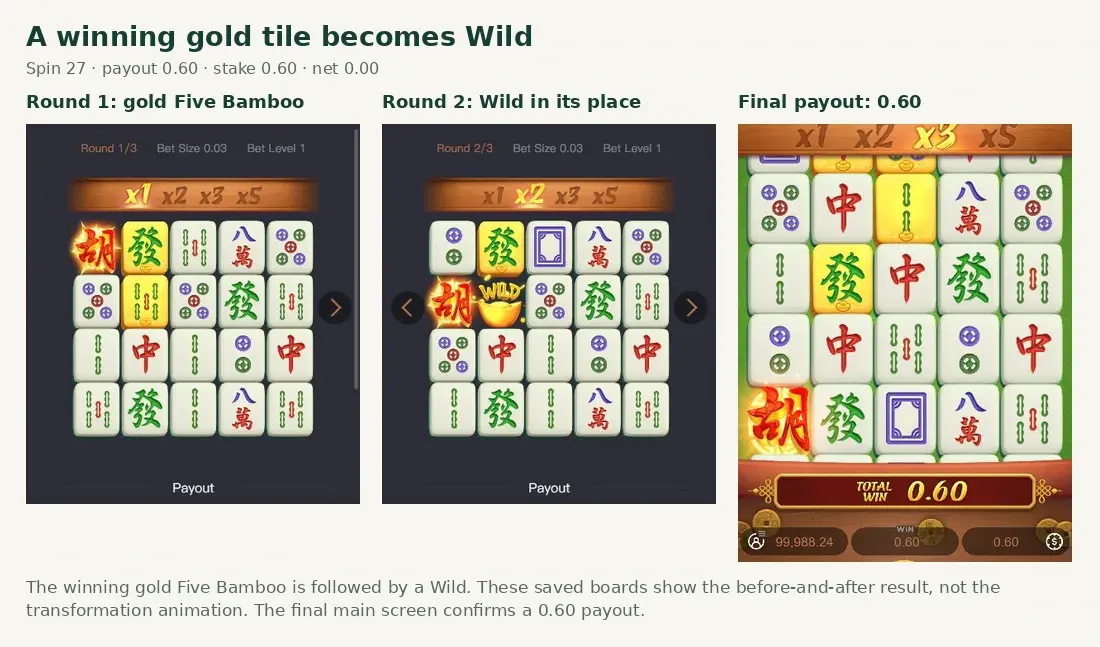
This is the part of Mahjong Ways I find most engaging. A tile’s value comes from both its present combination and the opportunity its Wild may leave behind. That opportunity can also end immediately: round 32 produced a Wild after a 1.20 award, but the next round paid nothing. Gold plating does not guarantee a longer winning chain.
Three Scatters start 12 Free Spins
Three Scatters anywhere trigger 12 Free Spins. Each extra Scatter adds two, so four Scatters give 14. The feature keeps the triggering Bet Size and Bet Level and uses the higher 2×, 4×, 6× and 10× cascade ladder. The rules allow retriggers.
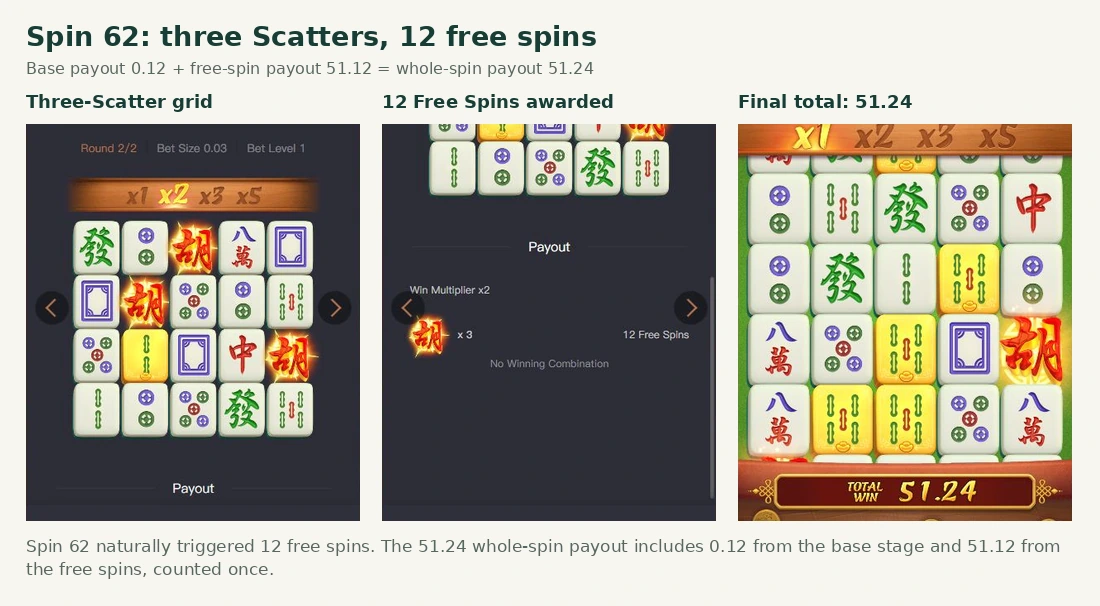
Our first natural feature arrived in round 62. The base game paid 0.12 before three Scatters awarded 12 free spins. Those free spins paid 51.12, bringing the complete spin payout to 51.24. The fourth free spin contributed 39.84, illustrating how one strong sequence can dominate a feature result.
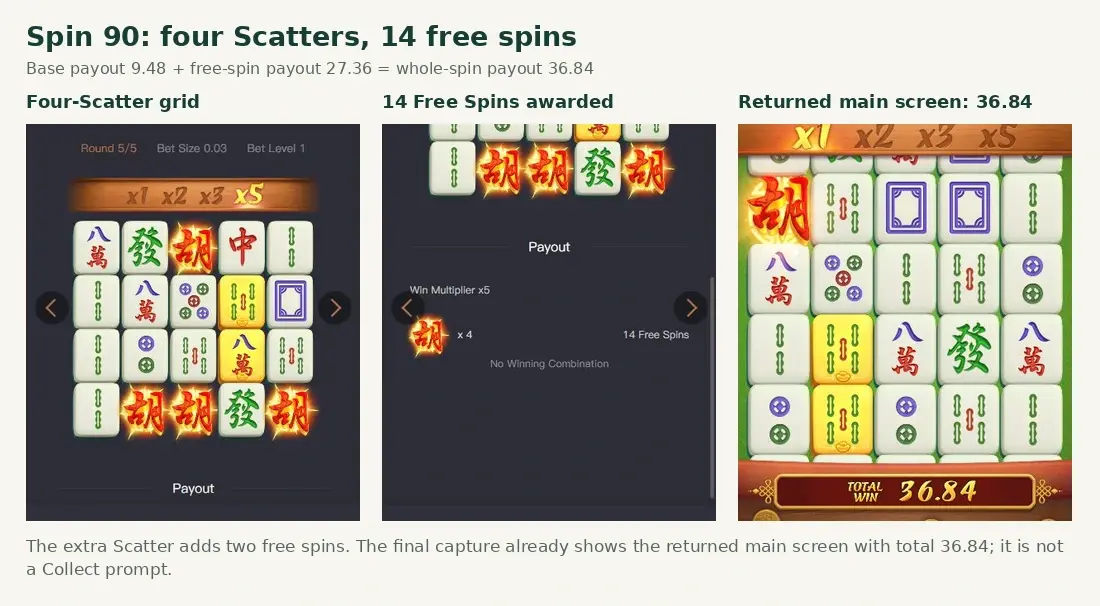
Round 90 followed a different path. Five base-game cascade rounds paid 9.48, then four Scatters awarded 14 Free Spins. The free spins contributed 27.36, making the complete payout 36.84. Keeping those parts separate avoids counting the feature twice.
Across the two features, we saw 26 free spins and no retrigger. A free-spin sequence in round 62 reached the 10× step, but that step had no winning combination. We did not record a 10× cash award or the advertised maximum win.
No usable EX or bonus-buy control appeared in the main screen, betting panel, Auto panel, wallet menu, Rules or Paytable that we inspected. The features above were triggered through ordinary demo play. That finding describes this demo and the checked controls; it does not establish that every future or operator-specific version is identical.
Bet sizes, RTP and the cost of a session
The inspected bet selectors offered Size 0.03–0.90 and Level 1–10 with Base Bet 20. That produces a displayed total range of 0.60–180.00 demo units. We used 0.60 for every completed base spin; we did not test spins at the maximum. No currency name was shown, so these amounts should not be read as Philippine pesos, dollars or euros.
Item | What it means here |
|---|---|
Cost of one sampled base spin | 0.03 × Level 1 × 20 = 0.60 demo units |
Cash value of one winning way | Paytable value × Bet Size × Bet Level, before the cascade multiplier |
Cascades and awarded free spins | No extra base stake; awards stay with the spin that triggered them |
Supplier theoretical RTP | 96.92%, according to PG SOFT’s information sheet |
Supplier volatility label | Medium session volatility |
Advertised theoretical maximum | 25,000× the total bet; not achieved in our sample |
PG SOFT’s game-information sheet lists those theoretical figures. It also gives a default EUR 0.20–50 range, which is a different configuration from the unlabelled demo amounts we observed. Its document version and update date do not identify the running game build.
96.92% is a long-run theoretical return, not a promise for your session. Our 100-round return was much higher, but it is far too small a sample to confirm the supplier figure or estimate its volatility reliably. The loaded demo’s exact build and RTP configuration were not independently identified. The information sheet also lists a 2,893× maximum exposure from a simulation; that is not the same claim as its advertised 25,000× theoretical maximum.
The practical cost is easier to understand than any headline percentage: each ordinary spin at our setting committed 0.60, even if it returned a smaller amount. Use the slot simulator to explore how a short session can vary under different assumptions. It is a general learning tool, not a reproduction of PG SOFT’s undisclosed game maths or a predictor of the next result.
What happened in 100 completed demo rounds
We recorded 100 completed base spins on 5 October 2026 UTC, each costing 0.60 demo units. All cascades and the 26 awarded free spins were included in the base spins that triggered them. The final sample used four sessions; it was not one uninterrupted wallet history. Two spins used Normal speed and 98 used Turbo.
Measure | Recorded result |
|---|---|
Completed base spins | 100 |
Total cost | 60.00 demo units |
Total payout | 115.80 demo units |
Net change | +55.80 demo units |
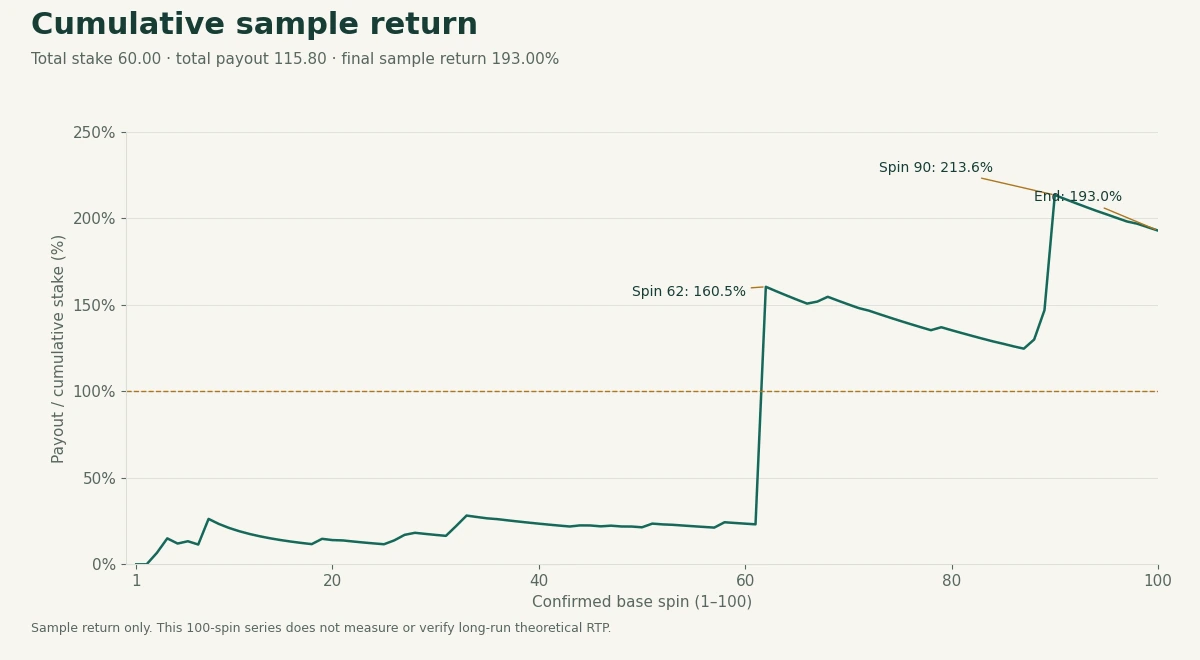
Sample return | 193.00% of the total cost |
Spins with a payout / no payout | 31 / 69 |
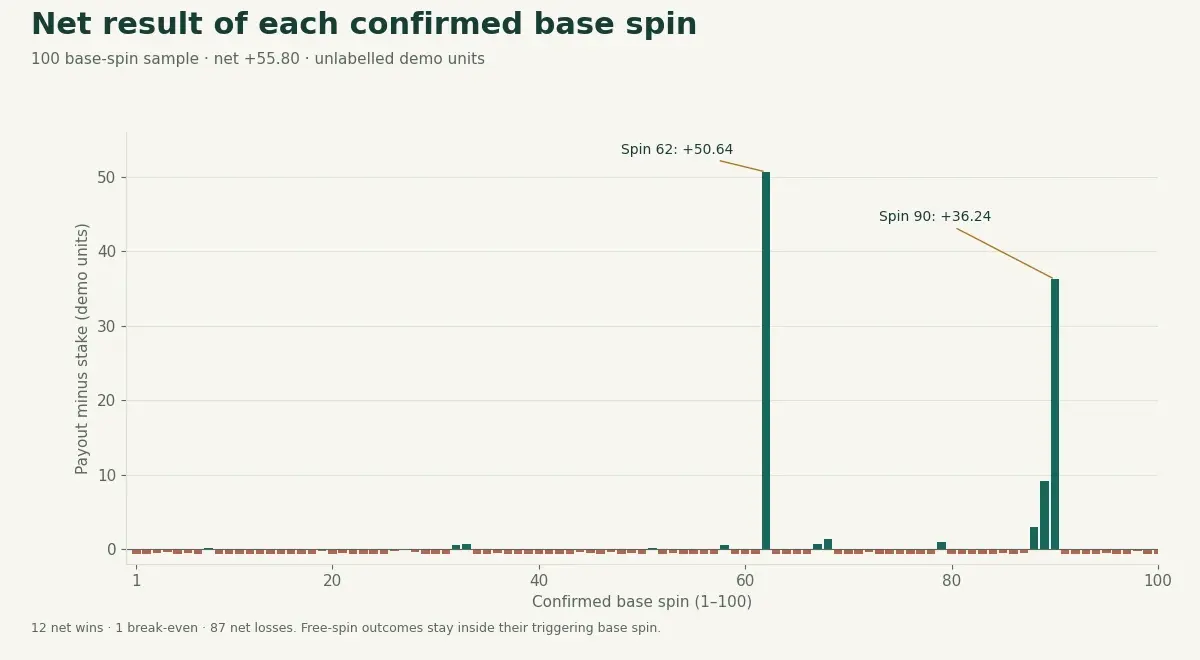
Net-winning / break-even / net-losing spins | 12 / 1 / 87 |
Largest complete-spin payout | 51.24 on round 62 |
Longest recorded no-payout run | 10 spins, rounds 9–18 within one session |
Natural Free Spins entries | 2, awarding 12 and 14 free spins |
The strongest finding is the concentration of the payout. The two spins containing Free Spins paid 88.08 together, about 76.06% of the sample’s entire payout. The remaining 98 spins paid 27.72 against 58.80 in stakes. That split explains why a positive overall result can coexist with 87 net-losing spins. It does not tell us how often either feature will appear in another session.
The wallet chart keeps the resets visible
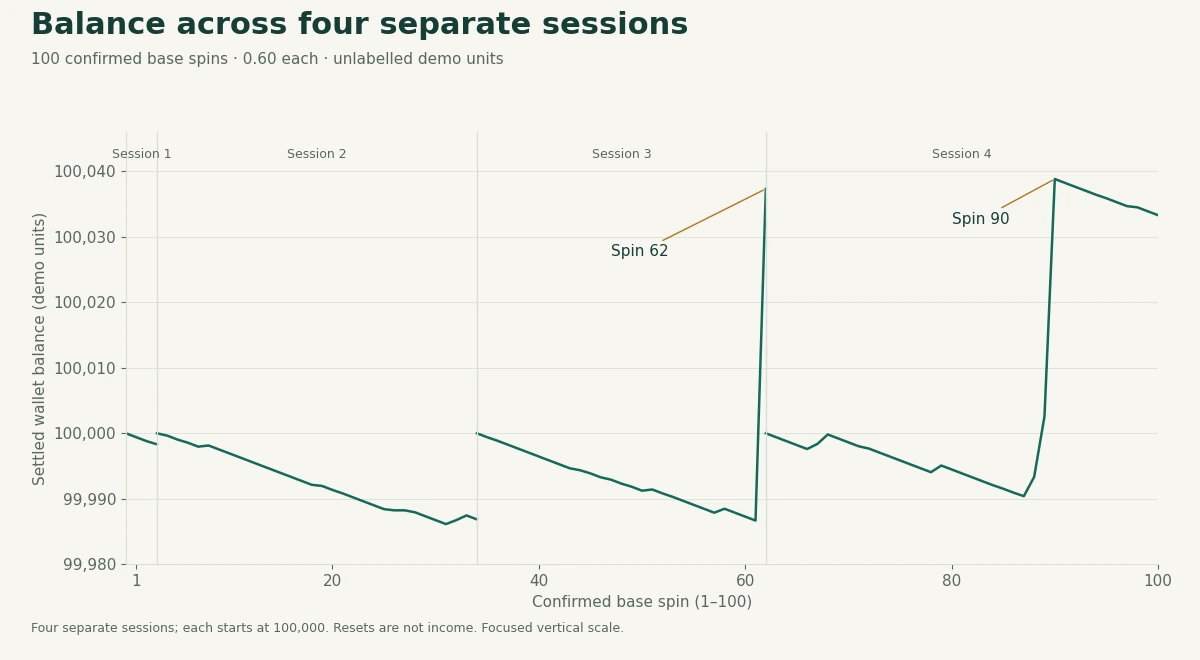
Sessions covered rounds 1–3, 4–34, 35–62 and 63–100. Fresh demo sessions reset the wallet to 100,000. The chart therefore breaks before rounds 4, 35 and 63 instead of drawing those resets as winnings.
The cumulative return includes every sampled stake
This chart divides all payouts to that point by all costs from round 1 onwards. The 100% line means the sample has returned its stakes. It is not the supplier’s theoretical RTP line. The large features at rounds 62 and 90 explain the most obvious changes.
Award size and net change tell different stories
The final chart subtracts 0.60 from each complete spin’s payout. This makes small paying losses visible below zero, alongside no-payout spins. Round 62 adds 50.64 net; round 90 adds 36.24. Their free-spin awards are already included and must not be added again.
Three additional requests lacked a confirmed final result and were excluded: two showed a transaction error and one was affected by a display/capture problem. Their eventual remote outcomes remain unknown. We also separated a new ordinary spin after round 90 from the completed feature; it became round 91, cost 0.60 and paid nothing. These boundaries matter more than a neat uninterrupted curve.
My verdict and comparable PG games
Editorial rating: 8.0/10. I like the way Mahjong Ways links winning tiles, Wild transformation and a visible multiplier ladder. The detailed History makes even a multi-stage result understandable. It loses some polish through the cramped landscape layout and the need to recheck settings after restarting the demo. The rating reflects those design and usability trade-offs, not the sample’s profit.
The interruptions are a limitation of this recorded demo session, with no established common cause. They do not establish how reliably every casino’s implementation performs. For everyday reading of the game, the more useful habit is to check the final History entry and the current stake after any reload.
Two other PG titles offer useful comparisons. Fortune Tiger keeps the layout smaller, while Piñata Wins also uses cascading gold-framed symbols but handles multipliers differently.
Dimension | Mahjong Ways | Fortune Tiger | Piñata Wins |
|---|---|---|---|
Board and winning system | 5×4; 1,024 ways | 3×3; 5 fixed lines | 5×3; 20 fixed lines |
What develops during play | Cascades, winning gold-plated tiles and the next-round multiplier | A randomly triggered respin feature retains qualifying symbols | Cascades and multiplier-bearing gold frames |
Multiplier timing | Applied to each winning cascade; base ladder 1×/2×/3×/5× | 10× when all symbols on the reels are involved in a win | In the base game, collected values apply at the end of the spin |
Extra feature | 3 Scatters start 12 Free Spins | Fortune Tiger respin feature | 3 Scatters start 15 Free Spins |
Best fit for the reader | Following a changing ways-based board | Learning a compact five-line layout | Following line wins and collected multipliers |
Fortune Tiger is the simpler starting point if you want fewer positions and only five line paths to check. Mahjong Ways is my choice of these layouts when I want to follow the next drop and calculate how several ways combine. Piñata Wins suits someone who likes that cascading structure but wants multiplier collection rather than a fixed per-cascade ladder. None of those preferences is a forecast of which game will return more money.
Start with an ordinary demo spin and follow one complete result from the first board to its last cascade. If that is enjoyable to watch, Mahjong Ways has a coherent set of features worth learning. Keep any real-money budget affordable, and do not treat the two strong bonus results in this review as an expected session.
Sources: PG SOFT’s Mahjong Ways product page and game-information sheet, the original game’s loaded Rules and Paytable, our recorded demo results, and the reviewed in-game rules for Fortune Tiger and Piñata Wins. All recorded play amounts are free-demo units.
Mahjong Ways by PG SOFT FAQs
Answers to common questions about Mahjong Ways by PG SOFT.
Mahjong Ways by PG SOFT Reviews
 No Player Reviews Yet
Played Mahjong Ways by PG SOFT? Share your experience with other players.
 Write A Review