
Sugar Rush Xmas by Pragmatic Play
Play Sugar Rush Xmas by Pragmatic Play In Demo Mode




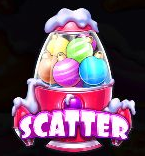 ScatterSnow-topped rocket Scatter
- Anywhere on the grid
- 3–7 Scatter trigger
- 10–30 free spins
- Same-schedule retrigger
 Paying SymbolSnow-topped gold gummy bear
- 5+ matching symbols
- Horizontal/vertical adjacency
- Winning-symbol tumbles
- 20× at 15+ symbols
 Paying SymbolSnow-topped purple gummy bear
- 5+ matching symbols
- Horizontal/vertical adjacency
- Winning-symbol tumbles
- 25× at 15+ symbols
 Paying SymbolSnow-topped red gummy bear
- 5+ matching symbols
- Horizontal/vertical adjacency
- Winning-symbol tumbles
- 30× at 15+ symbols
 Paying SymbolSnow-topped green star candy
- 5+ matching symbols
- Horizontal/vertical adjacency
- Winning-symbol tumbles
- 40× at 15+ symbols
 Paying SymbolSnow-topped pink-purple curved candy
- 5+ matching symbols
- Horizontal/vertical adjacency
- Winning-symbol tumbles
- 60× at 15+ symbols
 Paying SymbolSnow-topped orange heart candy
- 5+ matching symbols
- Horizontal/vertical adjacency
- Winning-symbol tumbles
- 100× at 15+ symbols
 Paying SymbolSnow-topped pink round candy
- 5+ matching symbols
- Horizontal/vertical adjacency
- Winning-symbol tumbles
- 150× at 15+ symbols
Game Themes

 ThemeCandy Games
 34 Games

Sugar Rush Xmas by Pragmatic Play Expert Review


Updated:
Here you can find detailed review information about Sugar Rush Xmas by Pragmatic Play.
What I liked
✅ Distinct seasonal visuals.
✅ Readable position-building mechanics.
✅ Separate balance, stake and payout fields.
What I didn’t like
❌ Symbols can cover the developed position values you are trying to follow.
❌ A position multiplier and the side-panel cluster total mean different things, so the readout needs a second look.
❌ Portrait left large unused areas and made stake and Help text small in the desktop layout checks.
1. Where Sugar Rush Xmas fits
Sugar Rush Xmas keeps the appeal of the original Sugar Rush easy to recognise: a 7×7 candy grid, winning clusters that tumble away, and multipliers tied to positions on the board. The winter artwork gives it a distinct mood, while the inspected rules retain a 128× single-position multiplier ceiling and a 5,000× maximum total win. It is a useful version to understand before moving to the series’ more complicated special-bet menus.
Our completed demo sample comprised 50 ordinary spins at a displayed USD 0.20 stake and one USD 20 Free Spins purchase. Ordinary spins returned USD 4.08; the purchased feature returned USD 2.09. These non-redeemable demo results explain what happened in this session. They do not establish the game’s long-term return or whether a future purchase will cover its cost.
For Philippine readers, the useful starting point is AskSpinner’s demo entry where available, followed by the Help panel in the version you actually open. The amounts below remain in USD because that is the denomination recorded in the sample; they are not a peso price quote. A playable demo also does not establish a particular operator’s account, payment or withdrawal conditions.
Pragmatic Play’s Sugar Rush Xmas product page confirms the 7×7 cluster format, position multipliers and persistent spots during Free Spins. The detailed costs and RTP below come from the Help pages captured with this tested version.
Philippine search interest
Ahrefs reported an estimated 40 monthly searches in the Philippines for “sugar rush xmas” when checked on 7 October 2026. This is its latest-known 12-month average search-demand estimate, not a count of players, visits or game quality.
2. Reading the winter-themed screen
Snow-topped sweets and gummy bears sit inside a blue frame, with a snowman and festive decorations around the grid. The colour and shapes help distinguish the symbols, but the more important information lies around the edges: BUY FREE SPINS and the win breakdown on the left, with CREDIT, BET and WIN along the bottom.
CREDIT is the remaining demo balance. BET is the ordinary spin stake. WIN is the payout from the completed spin or feature, so a positive WIN does not necessarily mean a profit. Before starting again, compare it with the amount actually charged. The information control opens Help; the speed controls include Normal, Quick and Turbo. Autoplay and sound controls are described in Help, but neither an autoplay run nor a listening test formed part of this review.
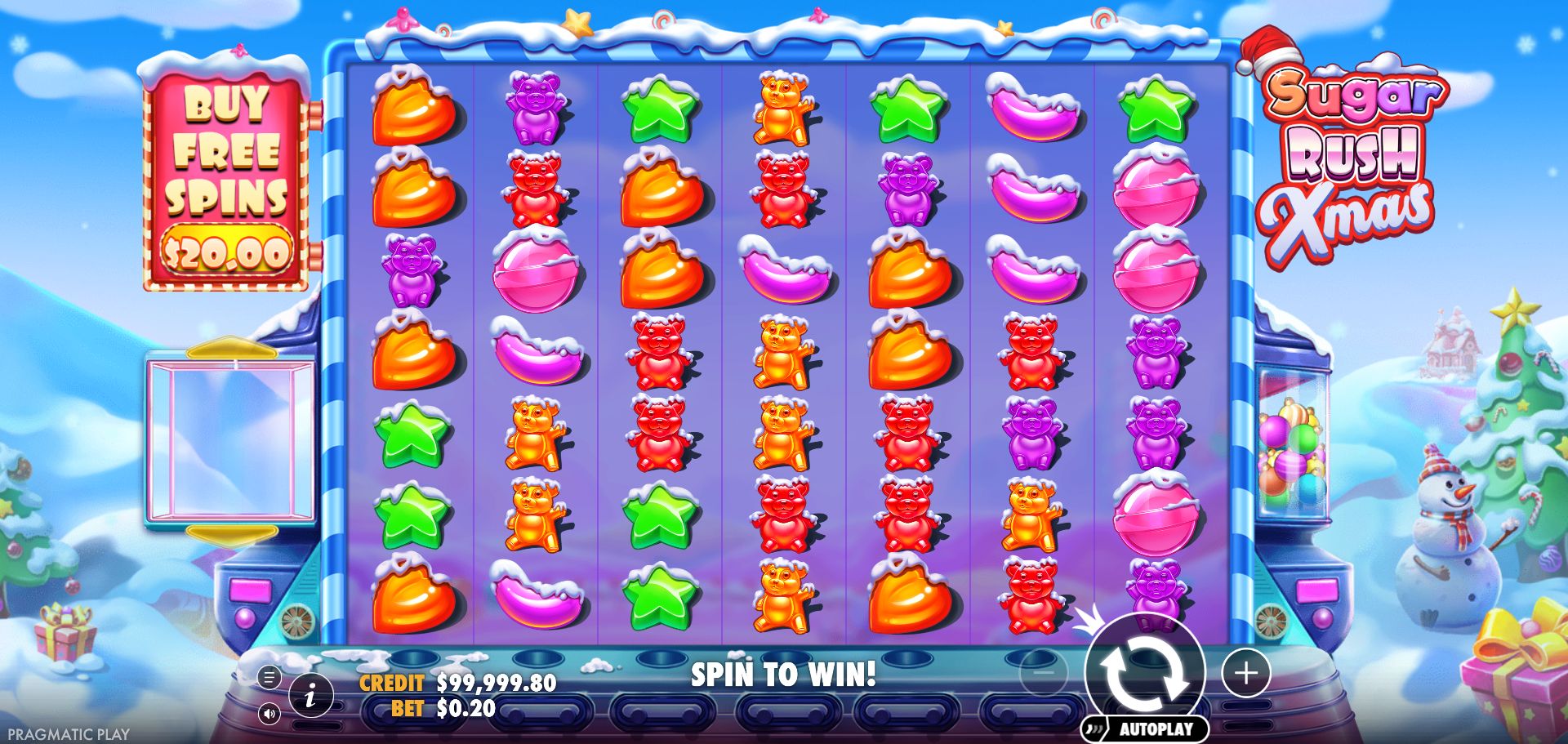
In desktop simulations of 390×844 portrait and 844×390 landscape layouts, portrait left large black areas above and below the game and made the stake and Help text small. Landscape used the space more effectively and was easier to read. Help was successfully opened and closed during these checks. This supports a layout observation, not a claim about real-phone touch accuracy or mobile performance.
3. How an ordinary spin works
A win requires at least five matching symbols connected horizontally or vertically. Diagonal contact alone does not connect a cluster. Winning symbols disappear, the remaining symbols fall, and new ones enter from above. If another winning cluster forms, the tumble sequence continues within the same paid spin.
That last distinction matters when reading the screen. Several cluster awards can appear during one sequence, but the final WIN is the settled payout for that spin. Adding the final WIN to the individual awards would count the same money twice. The symbol values and Scatter illustrations are covered in the symbol module on this page.
The captured Help lists seven ordinary paying symbols plus Scatter and does not list a Wild. Ordinary symbol awards are base cluster payouts before any applicable position multipliers. In the sample’s USD 0.20 setting, a six-red-bear cluster had a USD 0.08 base award. Where its qualifying positions supplied a combined 4× multiplier, that cluster paid USD 0.32. The multiplier mechanics explain how those numbers connect.
4. Position multipliers and Free Spins
Follow the position, then the cluster total
The first winning removal marks the affected positions. A second winning removal at the same position creates a 2× multiplier; subsequent qualifying removals double it, up to the stated 128× limit. When a winning cluster covers more than one multiplier position, the relevant values are added together. They are not all multiplied by one another.
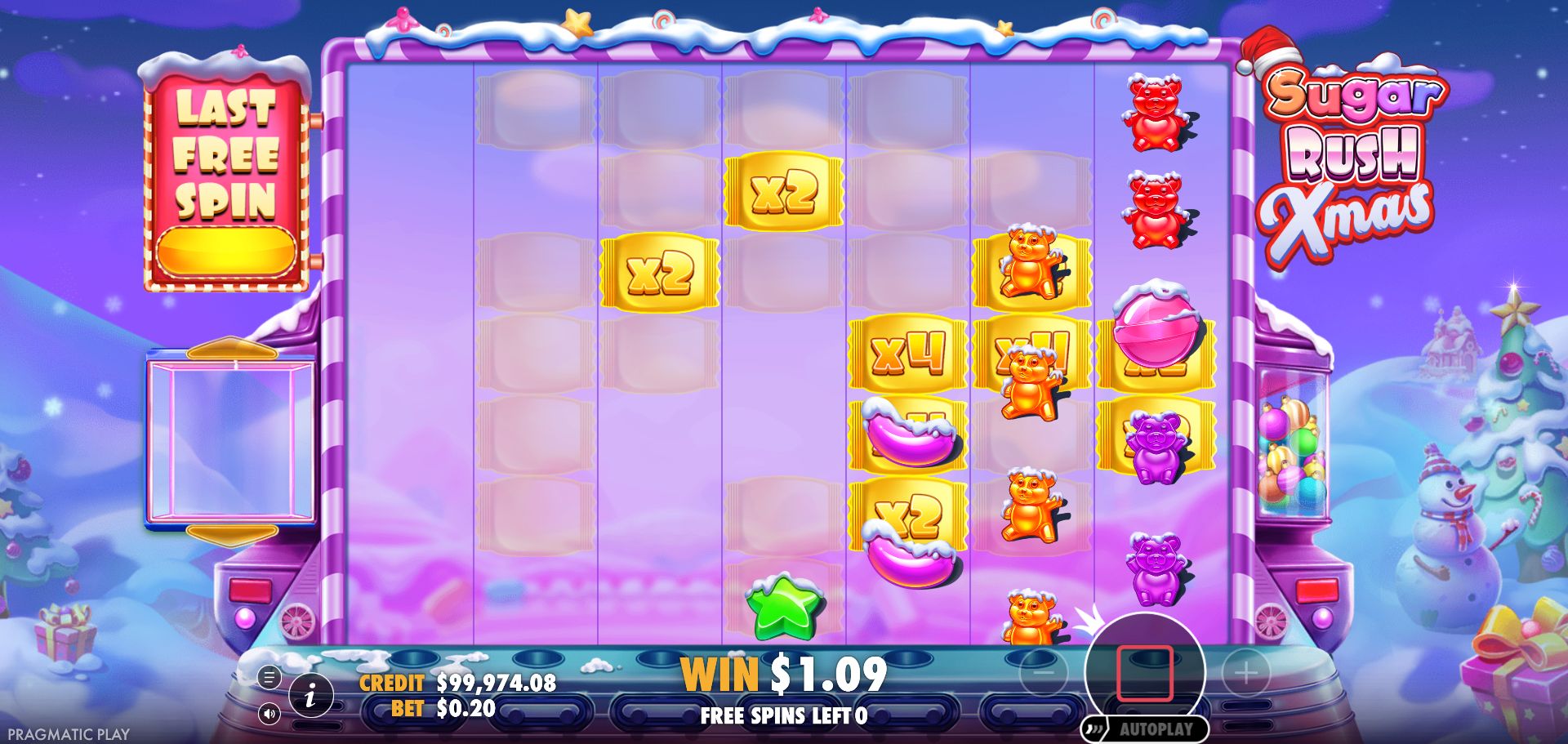
A captured Free Spins sequence shows why the distinction is useful. Two positions that previously displayed 2× contributed a combined 4× to a six-red-bear award: USD 0.08 × 4 = USD 0.32. A later frame clearly shows one of those positions at 4×. The final win panel also shows a different cluster with a combined 6× multiplier, but the contributing positions are not visible in the retained sequence. It would be incorrect to describe that panel as a single 6× square.
Ordinary-game marks clear after that spin’s tumble sequence. During Free Spins, marks and multipliers persist across the feature. The selected screenshots show the same marked positions surviving successive free-spin counters and show readable 2× and 4× positions near the end. The highest clear single-position value in the 16 reviewed representative images was 4×; the capture gaps prevent treating it as the maximum across every moment of the feature.
What triggered and what finished
The rules award 10, 12, 15, 20 or 30 Free Spins for three, four, five, six or seven Scatters respectively. The same quantities can add the corresponding number during Free Spins. The purchase rules allow a random three to seven Scatters, so buying does not mean every feature must start with ten spins.
Our one purchase produced three Scatters and started with ten Free Spins. The completed feature also reported ten, with a final payout of USD 2.09. No retrigger was observed. The 50 ordinary-spin records contain no natural Free Spins trigger. Neither the 128× single-position cap nor the 5,000× maximum total win was reached in the observed evidence.
5. RTP, volatility and the cost of a feature
The inspected Help states 96.50% theoretical RTP for both ordinary play and the Free Spins purchase, and labels the game high volatility. Its displayed stake range is USD 0.20 to USD 240. These are the rules of the captured version; check the Help in your own available version rather than assuming every deployment has identical settings.
Theoretical RTP describes a game’s long-run mathematical return, not an amount a short session should pay back. The ordinary sample returned 40.80%, and the purchased feature returned 10.45%. Those results neither validate nor disprove 96.50%.
Completed sample | Paid events | Cost (USD) | Payout (USD) | Net (USD) | Sample return |
|---|---|---|---|---|---|
Ordinary | 50 | 10.00 | 4.08 | −5.92 | 40.80% |
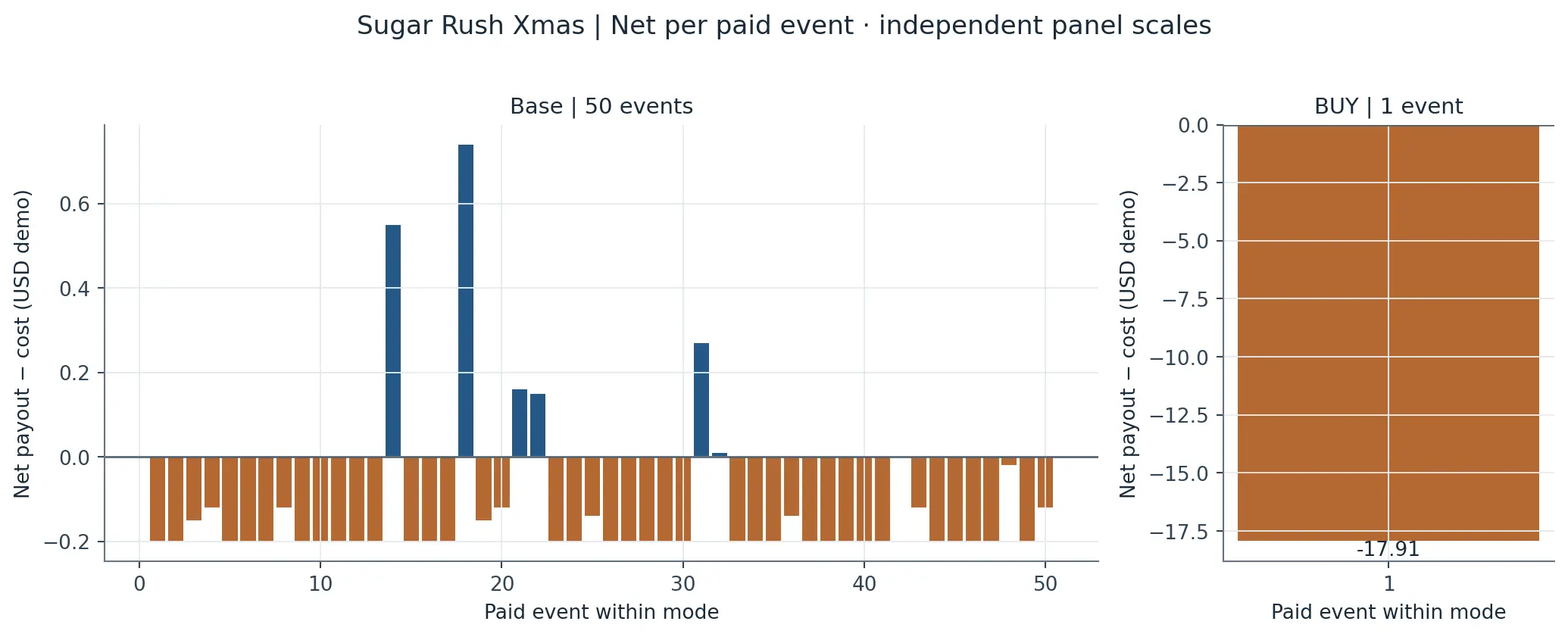
Free Spins purchase | 1 | 20.00 | 2.09 | −17.91 | 10.45% |
Combined | 51 | 30.00 | 6.17 | −23.83 | 20.57% |
BUY costs 100 times the current ordinary stake. At USD 0.20, the confirmation showed USD 20 and the balance actually decreased by USD 20. That is the cost of 100 ordinary spins concentrated into one feature purchase. Its ten free subspins are included in the USD 2.09 final payout; they are not ten extra paid events.
The combined return is USD 6.17 divided by USD 30, rounded to 20.57%. Averaging 40.80% and 10.45% would ignore their different costs. No Ante or EX option was found in the inspected interface and seven Help pages; this observation is limited to that version.
The AskSpinner slot simulator can help illustrate how stake size and variable returns affect a hypothetical balance. Its output is separate from these actual demo records and does not reproduce Sugar Rush Xmas’s undisclosed mathematics. Treat a budget as a limit on entertainment spending, never as money a feature must return.
6. What the 51 completed events show
Testing was completed on 7 October 2026. Each ordinary spin was started individually: one at Normal speed and 49 at Turbo, followed by the Turbo feature purchase. Every financial row refers to one settled paid event, with the final payout recorded once. All amounts are non-redeemable USD demo credits.
Of the 50 ordinary spins, 17 paid something and 33 paid zero. Only six returned more than their USD 0.20 cost; one broke even and 43 reduced the balance. The longest run of zero-payout ordinary spins was five. Spin 18 produced the largest ordinary payout, USD 0.94. These are descriptions of this sample, not estimates of enduring hit rates or volatility.
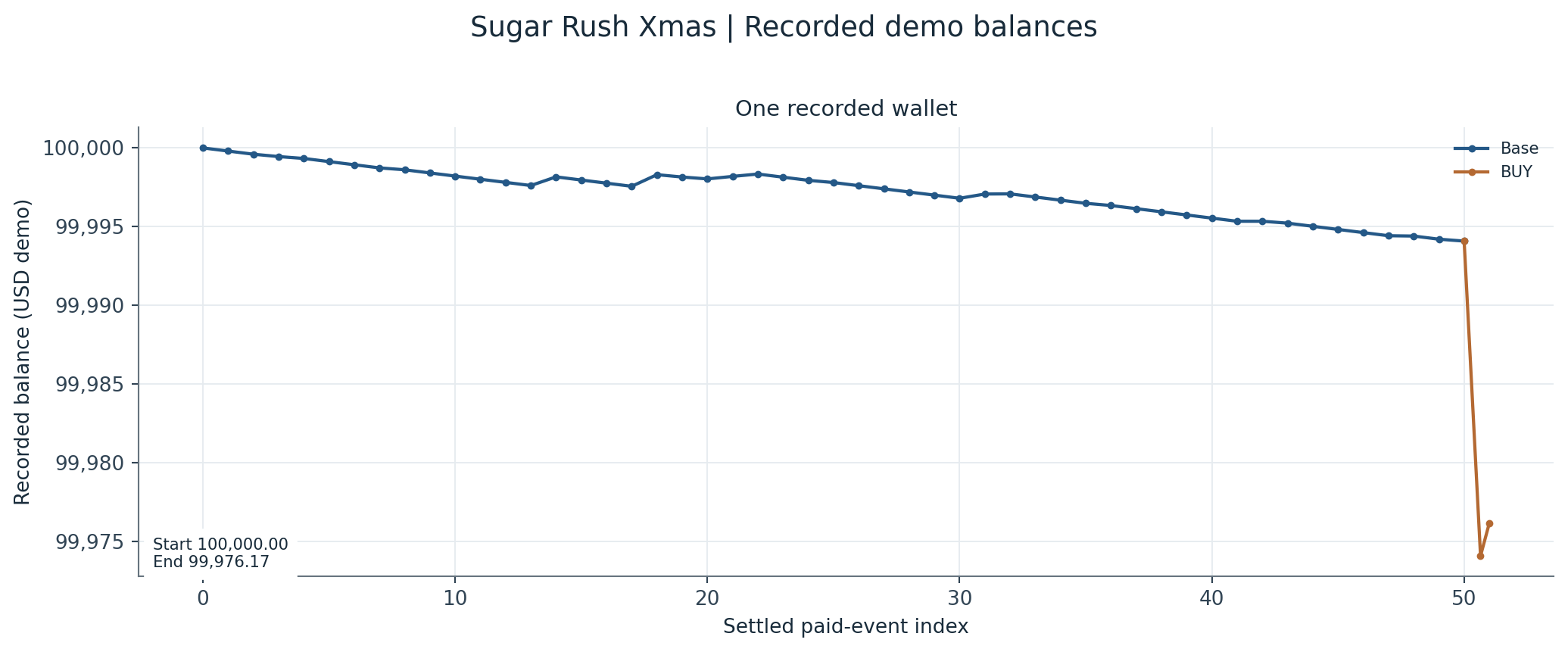
The balance fell from USD 100,000 to USD 99,994.08 after ordinary play. The purchase then reduced it to USD 99,974.08 before its USD 2.09 return brought it to USD 99,976.17. The purchase alone accounts for USD 17.91 of the total USD 23.83 decrease. This is why the modest-looking final WIN needs to be read against the full purchase price.
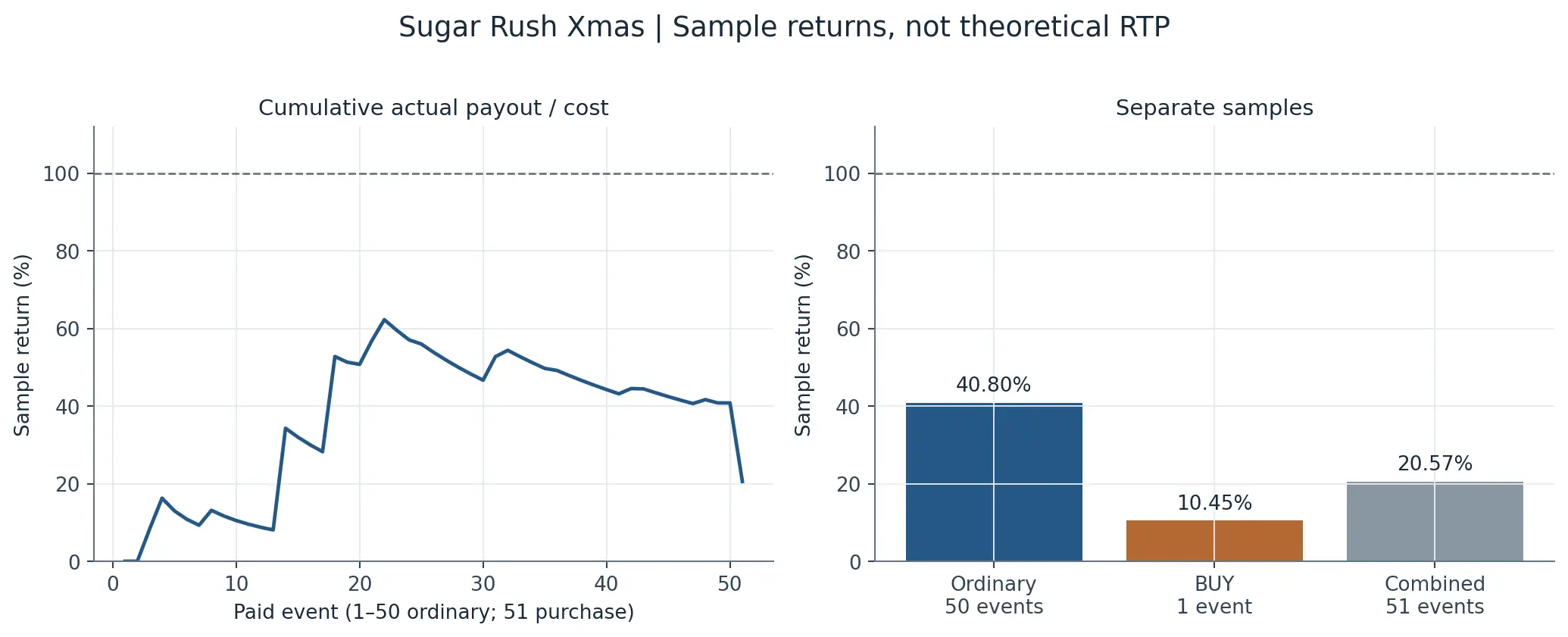
The ordinary and purchase percentages answer different questions. One describes 50 USD 0.20 spins; the other describes one USD 20 purchase. The combined curve uses all actual costs and payouts, so the purchase has much more influence than a single ordinary spin.
A 13-second Normal-speed illustration was assembled from 97 timestamped screenshots. It repeats real captured frames, includes the idle period after the spin and has no audio; it is not continuous native screen recording or a complete feature video. Other mechanism sequences have capture gaps, so missing upgrades or animations have not been reconstructed. Real-phone operation, sound quality and recovery of an interrupted game were not tested. Availability and loading performance on Philippine networks have not been verified.
7. Strengths, drawbacks and the series comparison
Within the four standard versions reviewed here, the original Sugar Rush and Xmas share the inspected 128× position ceiling and 5,000× maximum win. Sugar Rush 1000 raises those rules to 1,024× and 25,000×; Super Scatter uses 1,024× and 50,000× and adds further feature choices in supported markets. Those different rules are useful comparison points. The four ordinary 50-spin returns are not a reliable ranking of which version is more profitable.
Readers familiar with Sweet Bonanza should also notice the matching rule: that game counts matching symbols across the board, whereas Sugar Rush Xmas requires side-connected clusters. Similar candy artwork does not make the win calculation interchangeable.
We rate Sugar Rush Xmas 7.8/10 for the playing experience, level with the original. The winter artwork gives the familiar board a coherent seasonal identity, and the single purchase choice keeps the cluster-and-position progression approachable. Its main friction is visual: symbols obscure some position values, the side-panel cluster total needs a separate reading, and portrait text was small in our desktop simulations. The artwork changes the mood without giving us a reason to separate two closely related core experiences by a tenth. This is an experience score, independent of the sample’s financial outcome.
Sugar Rush Xmas by Pragmatic Play FAQs
Answers to common questions about Sugar Rush Xmas by Pragmatic Play.
Sugar Rush Xmas by Pragmatic Play Reviews
 No Player Reviews Yet
Played Sugar Rush Xmas by Pragmatic Play? Share your experience with other players.
 Write A Review