
Super Ace 2 by JILI
Play Super Ace 2 by JILI In Demo Mode
by JILI Games



 ScatterSuper Ace 2 - Scatter
- 3 trigger 10 Free
- 3 add 5 in Free
- Not replaced by Wild
- Free ladder ×2–×10
 WildSuper Ace 2 - Big Joker
- Wild substitute
- Adds 1–4 Jokers
- Reels 2–5
- No Scatter match
 WildSuper Ace 2 - Triple Joker Stack
- Three layers
- One layer per win
- Adds 1–4 Jokers
- Copies: ≤3 layers
 WildSuper Ace 2 - Double Joker Stack
- Two layers
- One layer per win
- Adds 1–4 Jokers
- Copies: ≤2 layers
 WildSuper Ace 2 - Little Joker
- Wild substitute
- Keeps its position
- No extra copies
- No Scatter match
 Paying SymbolSuper Ace 2 - Clubs (♣ card suit)
- Paying symbol
- 3–5 reels
- Starts on reel 1
- Paytable at Bet 2
 Paying SymbolSuper Ace 2 - Golden Clubs (♣ card suit)
- Equal symbol pay
- Reels 2–4
- Golden card → Joker
- Left-to-right
 Paying SymbolSuper Ace 2 - Diamonds
- Paying symbol
- 3–5 reels
- Starts on reel 1
- Paytable at Bet 2
 Paying SymbolSuper Ace 2 - Golden Diamonds
- Equal symbol pay
- Reels 2–4
- Golden card → Joker
- Left-to-right
 Paying SymbolSuper Ace 2 - Hearts
- Paying symbol
- 3–5 reels
- Starts on reel 1
- Paytable at Bet 2
 Paying SymbolSuper Ace 2 - Golden Hearts
- Equal symbol pay
- Reels 2–4
- Golden card → Joker
- Left-to-right
 Paying SymbolSuper Ace 2 - Spades (♠ card suit)
- Paying symbol
- 3–5 reels
- Starts on reel 1
- Paytable at Bet 2
 Paying SymbolSuper Ace 2 - Golden Spades (♠ card suit)
- Equal symbol pay
- Reels 2–4
- Golden card → Joker
- Left-to-right
 Paying SymbolSuper Ace 2 - Jack
- Paying symbol
- 3–5 reels
- Starts on reel 1
- Paytable at Bet 2
 Paying SymbolSuper Ace 2 - Golden Jack
- Equal symbol pay
- Reels 2–4
- Golden card → Joker
- Left-to-right
 Paying SymbolSuper Ace 2 - Queen
- Paying symbol
- 3–5 reels
- Starts on reel 1
- Paytable at Bet 2
 Paying SymbolSuper Ace 2 - Golden Queen
- Equal symbol pay
- Reels 2–4
- Golden card → Joker
- Left-to-right
 Paying SymbolSuper Ace 2 - King
- Paying symbol
- 3–5 reels
- Starts on reel 1
- Paytable at Bet 2
 Paying SymbolSuper Ace 2 - Golden King
- Equal symbol pay
- Reels 2–4
- Golden card → Joker
- Left-to-right
 Paying SymbolSuper Ace 2 - Ace
- Paying symbol
- 3–5 reels
- Starts on reel 1
- Paytable at Bet 2
 Paying SymbolSuper Ace 2 - Golden Ace
- Reels 2–4
- Left-to-right
- Equal symbol pay
- Golden card → Joker
Super Ace 2 by JILI Expert Review


Updated:
Here you can find detailed review information about Super Ace 2 by JILI.
Where Super Ace 2 fits
Super Ace 2 is worth a look if you enjoy following a win as the cards change, rather than just waiting for a final number.
What I liked
✅ Golden-to-Joker changes give one win a clear connection to the next board and its rising cascade multiplier.
✅ The ordinary and Free multiplier strips are easy to locate.
✅ The tall portrait layout suits the card grid and lower controls.
✅ Buy Bonus displays its selected Bet, quantity and total price.
✅ Bet 0.5 was selectable and stayed selected for the next round in the same session.
What I didn’t like
❌ Stack layers, cascade multipliers and running WIN are different quantities to learn.
❌ Bright win effects can partly cover a multiplier during the animation.
❌ Landscape keeps a small centered game with much smaller labels.
❌ At 44× Bet, one purchase is a meaningful step up from an ordinary round.
❌ A new session reset Bet; Auto could start play immediately when tapped.
My overall rating is 8/10. The card changes are easy to follow in portrait, and the 44× Bonus Buy price is clear. A cramped landscape view and an Auto control that can start play immediately deserve more care. I would learn the ordinary game first and use the demo to understand the sequence before considering the feature purchase.
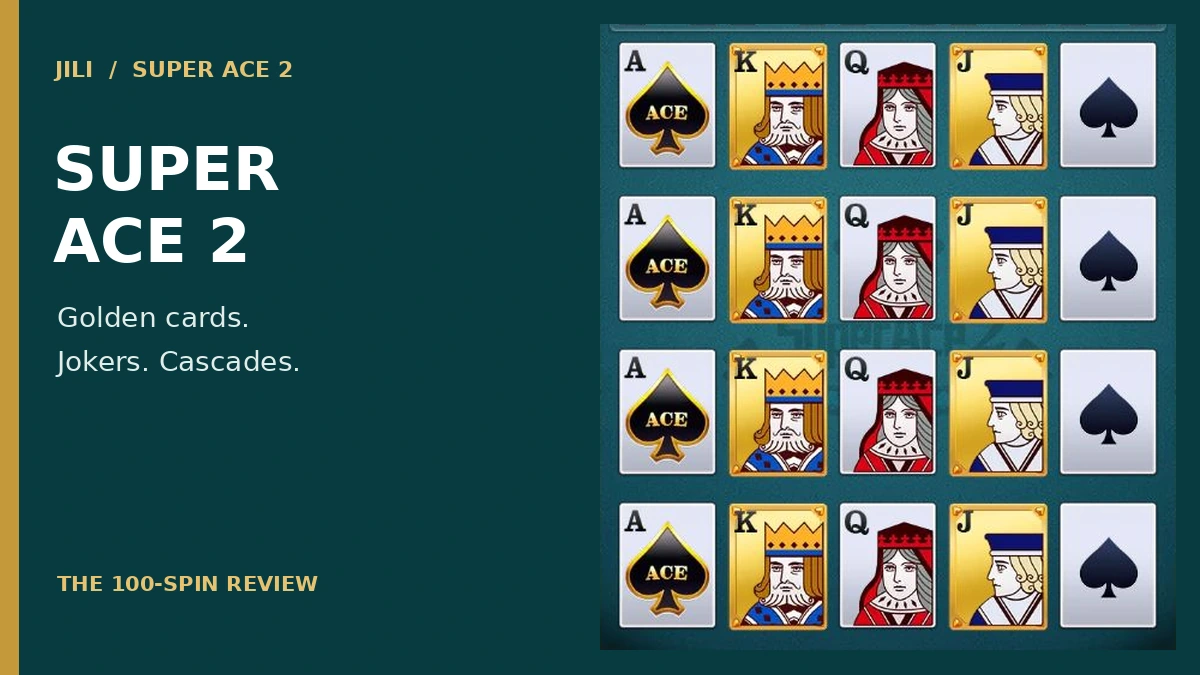
This is JILI game 542, shown as Super Ace 2 Stack in the reviewed interface. The Help also uses “Super Ace II.” JILI’s official Super Ace 2 listing gives a July 2025 publication month, 1,024 ways and a MED volatility label. It is a separate game from Classic Super Ace, Deluxe, Joker and similarly named titles from other providers.
Watch the short Free Games excerpt below to see a Golden card change and the multiplier advance. Then use the demo on this page, when available, to explore the controls at your own pace.
A 12.4-second excerpt from the separate Bonus Buy, assembled from real screenshots at their original timing. It has no audio. The clip ends at a running WIN of 11.900; the completed feature later paid 19.2.
Philippine search interest
Ahrefs estimated the following average monthly searches in the Philippines when checked on 4 October 2026 (UTC). These are estimates of search activity over its latest known 12-month period, not player counts or visits to this review.
Search term | PH monthly estimate | What readers are looking for |
|---|---|---|
super ace 2 | 5,000 | The game and its identity |
super ace 2 demo | 600 | A way to try it |
super ace 2 jili | 90 | The JILI version specifically |
super ace 2 stack demo | 60 | The Stack version shown here |
The average smooths out changes over time. Ahrefs’ dated September 2026 history was lower: 2,359 searches for “super ace 2” and 150 for “super ace 2 demo.” Similar spellings can overlap, so their estimates should not be added together. The useful takeaway is the clear demand for a correctly identified game, a demo and readable rules.
Google Trends for the Philippines over the past 12 months was sparse when checked on the same date. The main term appeared intermittently; the demo term had only one non-zero week, and “super ace2” had insufficient data. Trends normalizes each query, so these results do not establish exact demand, a seasonal pattern or steady growth.
The screen, controls and layout
The wooden frame, green table and familiar card suits make the basic board approachable. Gold backgrounds mark special cards without changing their rank. The blue-green Little Joker and red-gold Big Joker are visually distinct. During wins, the multiplier strip and central effects become more prominent; I find it easier to check the settled WIN after the animation than to treat each flashing amount as a separate return.
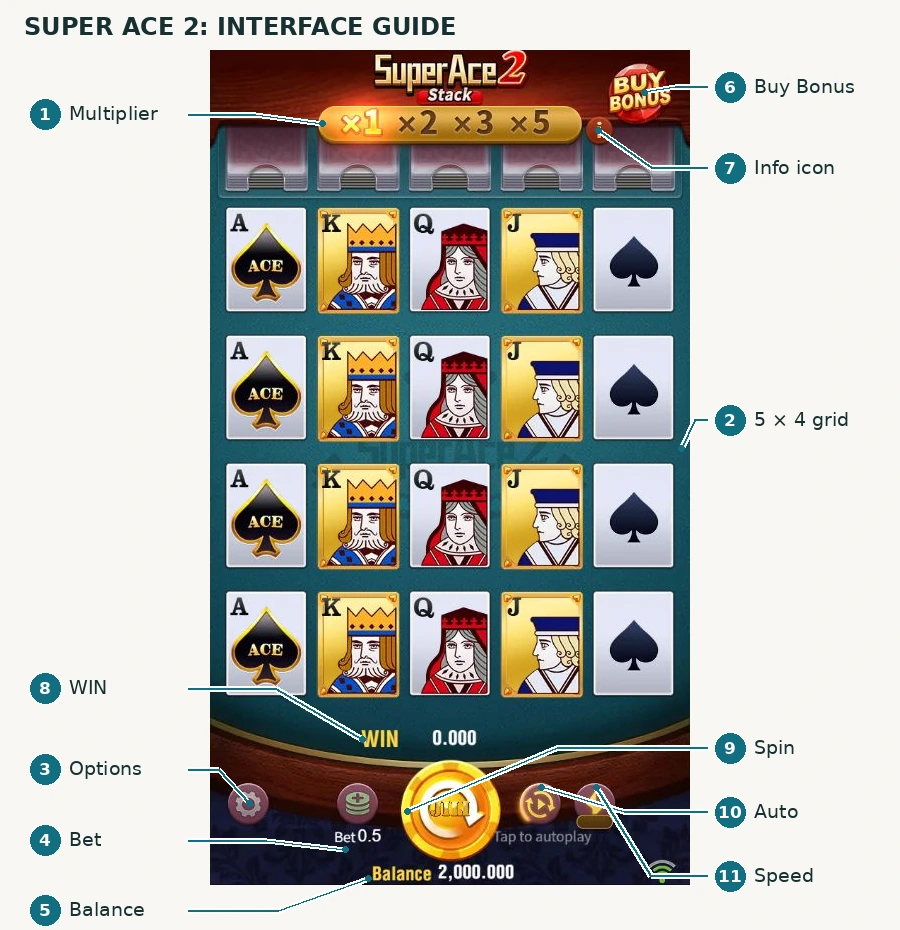
Multiplier strip: ordinary cascades progress through ×1, ×2, ×3 and ×5.
Reel grid: five reels and four visible rows form the 1,024-ways board.
Options: the gear opens access to History, rules and sound.
Bet: the chip control changes the stake; the current value appears below it.
Balance: the remaining game-credit balance.
Buy Bonus: opens the feature-purchase menu, with its own selected Bet and quantity.
Information icon: sits beside the multiplier strip.
WIN: shows winnings, including running amounts during a feature. It is not profit after deducting the stake.
Spin: starts an ordinary paid round at the selected Bet.
Auto: can start automatic play. Do not assume a tap only opens settings.
Speed: the lightning control changes the animation speed.
Changing Bet and opening the menus
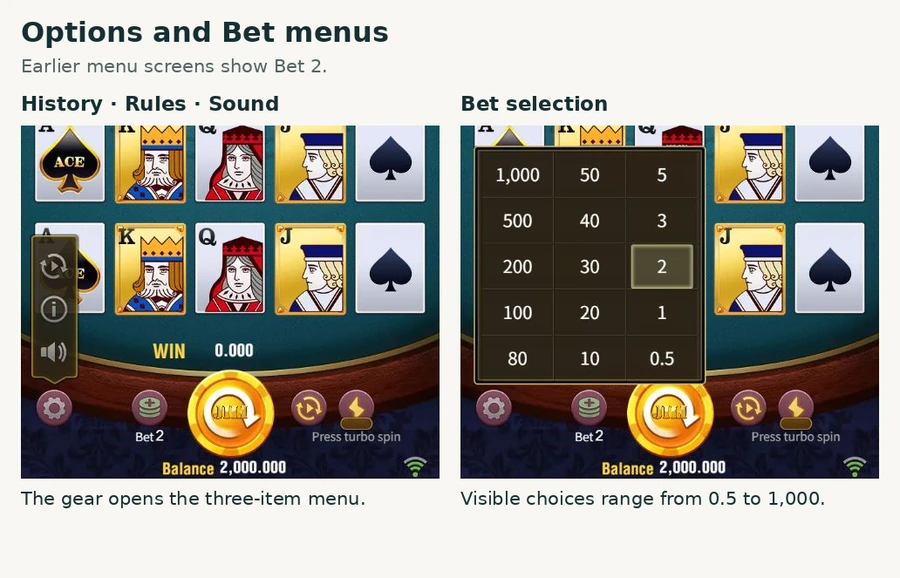
Open Bet, choose the amount and check the value on the main screen before Spin. The displayed range here was 0.5–1,000. Bet stayed at 0.5 between rounds 99 and 100 in the same session. Re-entering the demo after a session reset initially returned it to 2, so I would recheck rather than assume it carries across sessions.
Normal and Super Turbo were used in the captured session; the ordinary 100-round sample used Super Turbo. Help also describes Turbo and says a double press of its control enables Super Turbo. Speed changes presentation. It should not be treated as a way to improve the mathematical return.
Auto deserves a deliberate first look. A tap during our later inspection immediately started additional play. Help describes settings for round count, a single-win threshold, upper and lower balance limits, and stopping when Free Games begin. Those settings are documented options, not tested guarantees that every stop condition worked. No EX control appeared in the screens and Help checked for this review.
Portrait is the clearer layout
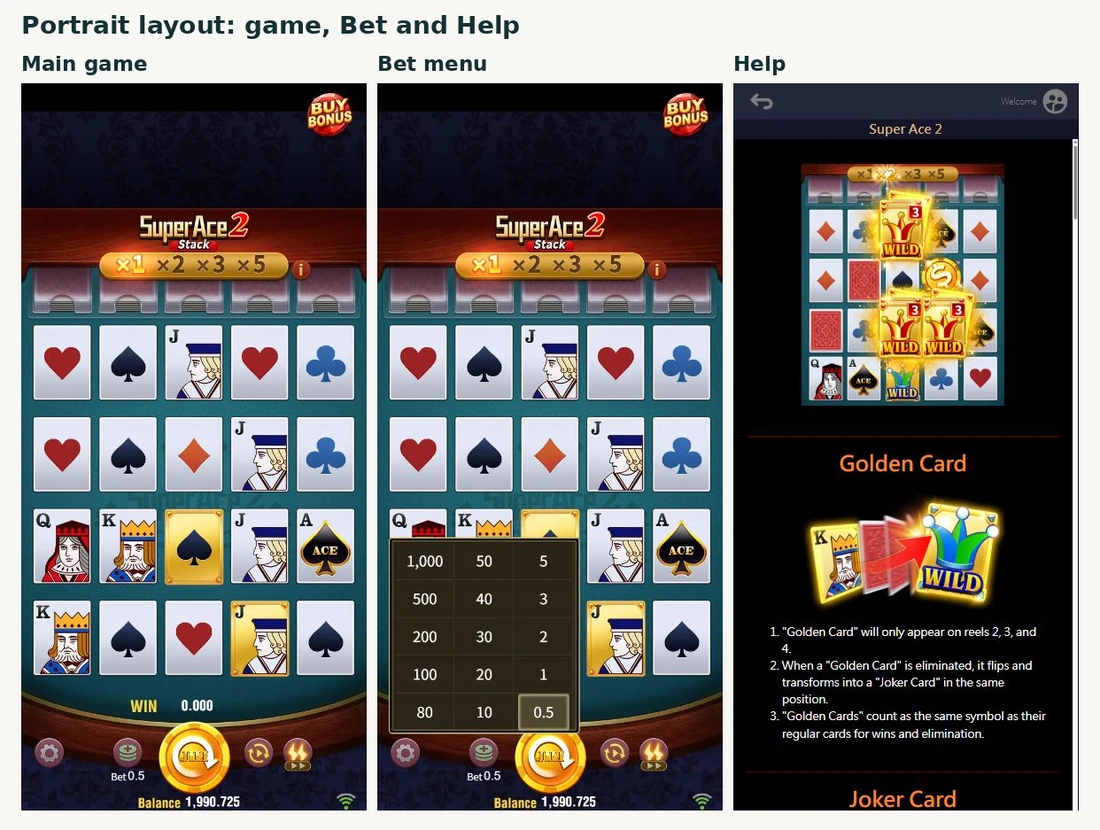
At 390×844, the tall board fits the shape well. Card ranks, Bet and Balance are easy to locate, and the Help can be opened and scrolled. This is the orientation I prefer for learning the game.
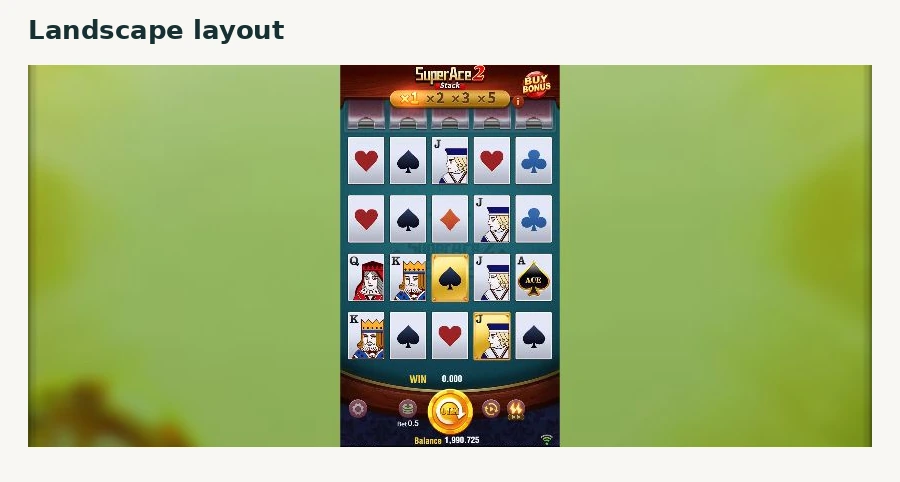
At 844×390, the game remains a small centered column. The rules and lower labels become much smaller, so the extra width provides little benefit. These layout checks used resized desktop views, not a physical phone or a touch-performance test. They support a readability comparison, not a claim about mobile speed or sound quality.
How the 1,024 ways and payouts work
Super Ace 2 uses a 5×4 grid with 1,024 ways. A regular symbol win must start on the leftmost reel and continue across at least three adjacent reels. The matching symbols can occupy different rows. You do not choose individual paylines.
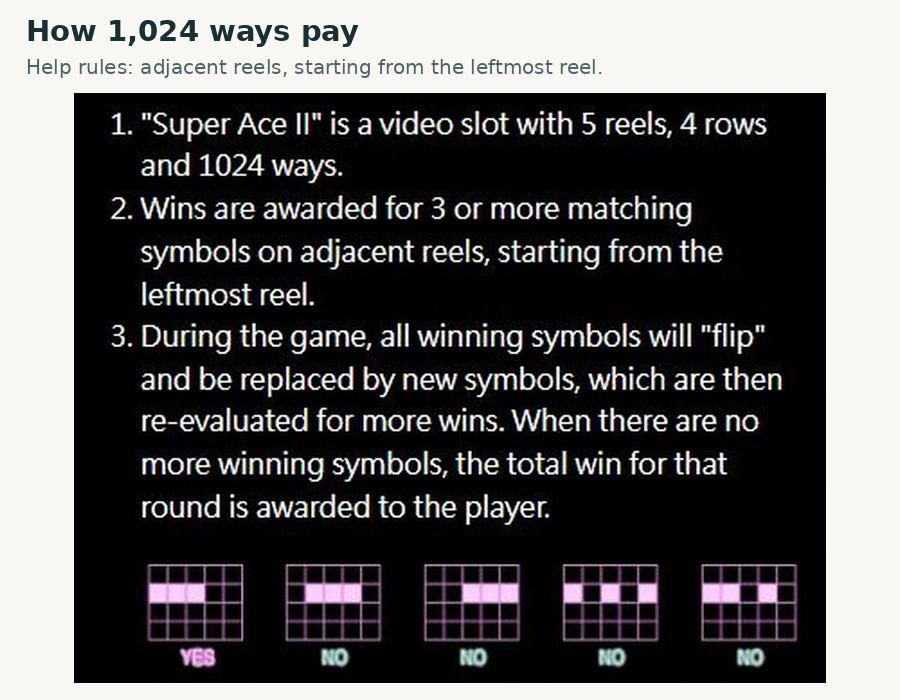
To understand several ways at once, imagine two matching Aces on reel 1, one on reel 2 and three on reel 3, with no continuation on reel 4. That gives 2 × 1 × 3 = 6 three-reel ways. At the Help’s total Bet of 2, one three-reel Ace way pays 1 before the cascade multiplier, so those six ways would pay 6 at ×1. This is an arithmetic example, not a claimed captured spin.
Winning symbols flip and are replaced, then the game checks the new board again. Any further wins belong to that same paid round. The round ends when no more wins remain, subject to the payout cap. Cascades do not each require another ordinary stake.
Read the paytable’s unit before its number
The reviewed paytable displays payout amounts at total Bet 2. Its 5 beside five Aces means 5 credits at that stake before other applicable factors; it does not mean 5× total Bet. Golden and regular versions of the same rank share the same symbol value.
Aces, Kings, Queens and Jacks are the higher-paying card ranks. The four suit symbols complete the regular set. The separate symbol guide contains all eight regular cards, their eight Golden versions, Big Joker, Little Joker, double and triple Joker stacks, and Scatter. It keeps the complete pay values out of the way of the main explanation.
Jokers act as Wilds for ordinary paying symbols. They cannot replace Scatter. There is no separate Joker or Scatter cash-pay table in the reviewed Help; their value comes from their stated substitution or feature role.
Golden cards, Joker stacks and Free Games
Golden cards turn a completed win into the next opportunity
Golden cards appear on reels 2–4. When one takes part in a winning elimination, it turns into a Joker at that position. The Golden card first pays as its ordinary rank; its transformation then changes the board used for the next evaluation.
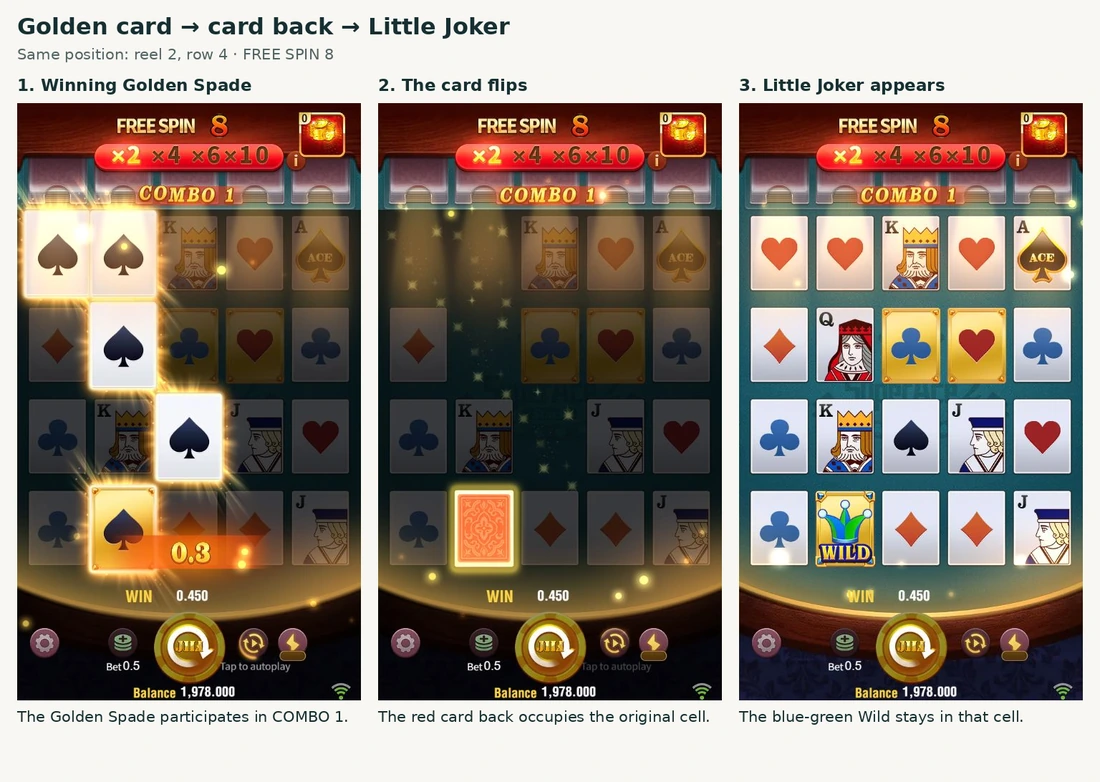
This sequence shows why the mechanic works visually. The original card, its red back and the new Little Joker are easy to connect. Little Joker remains in the original Golden card position and does not create the extra copies described for Big Joker.
What Big Joker and the stack numbers mean
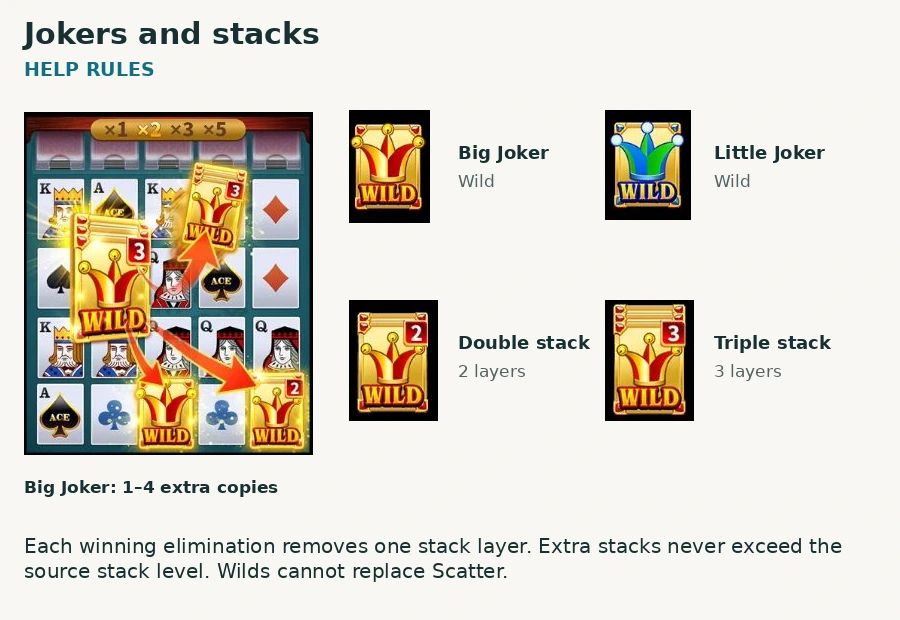
Under the Help rules, a Big Joker creates 1–4 additional Big Jokers on reels 2–5. The replacements exclude Scatters and existing Jokers. A Big Joker formed from a Golden card can also become a double or triple stack.
The corner 2 or 3 on a stack counts layers, not payout multipliers. Each winning elimination involving that stack removes one layer. Its additional Big Jokers cannot have more layers than the source: a double stack can create ordinary or double Big Jokers; a triple can create ordinary, double or triple ones. That makes stacks a way for Wild positions to persist through winning evaluations.
The added rule gives this version a stronger reason to exist alongside the earlier games. It also raises the reading burden. A pair of Little Jokers on the board is not a double stack, and “BIG WIN” is an award message, not proof of a Big Joker.
Two multiplier ladders
Winning cascade in a round | Ordinary game | Free Games |
|---|---|---|
First | ×1 | ×2 |
Second | ×2 | ×4 |
Third | ×3 | ×6 |
Fourth and later | ×5 | ×10 |
The multiplier applies to the current win. It does not multiply the entire running WIN again every time the strip advances. The next ordinary round begins back at ×1; a new Free Game starts its own doubled ladder.
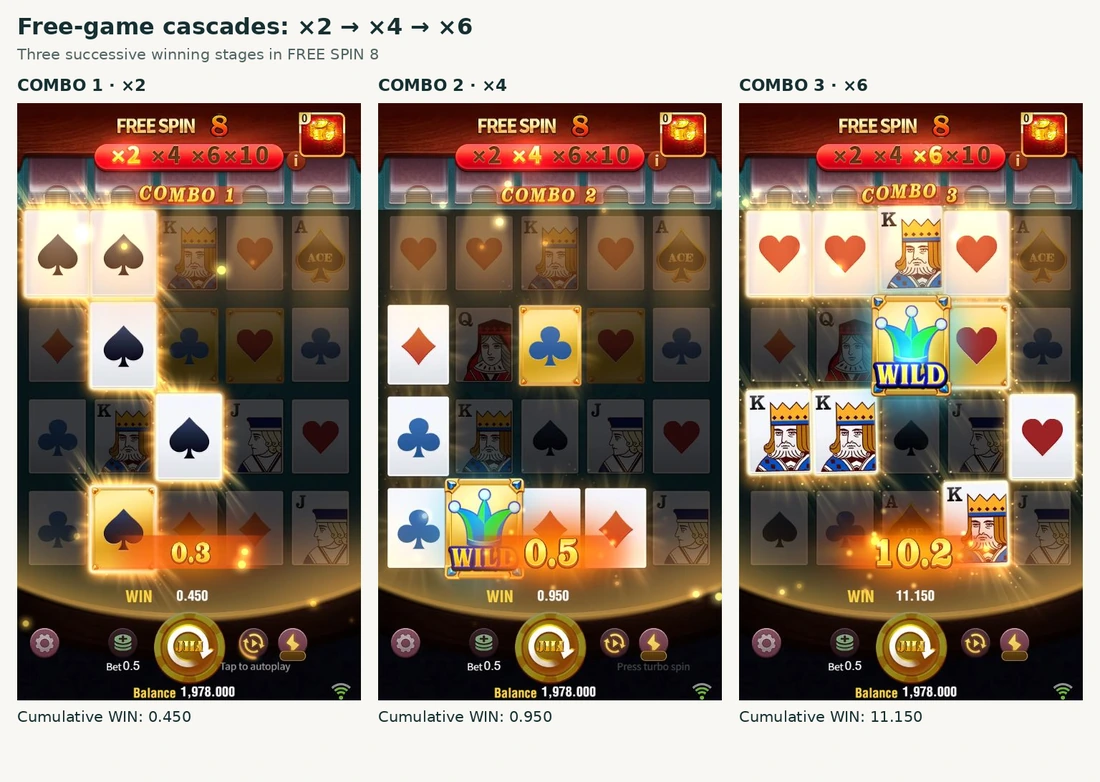
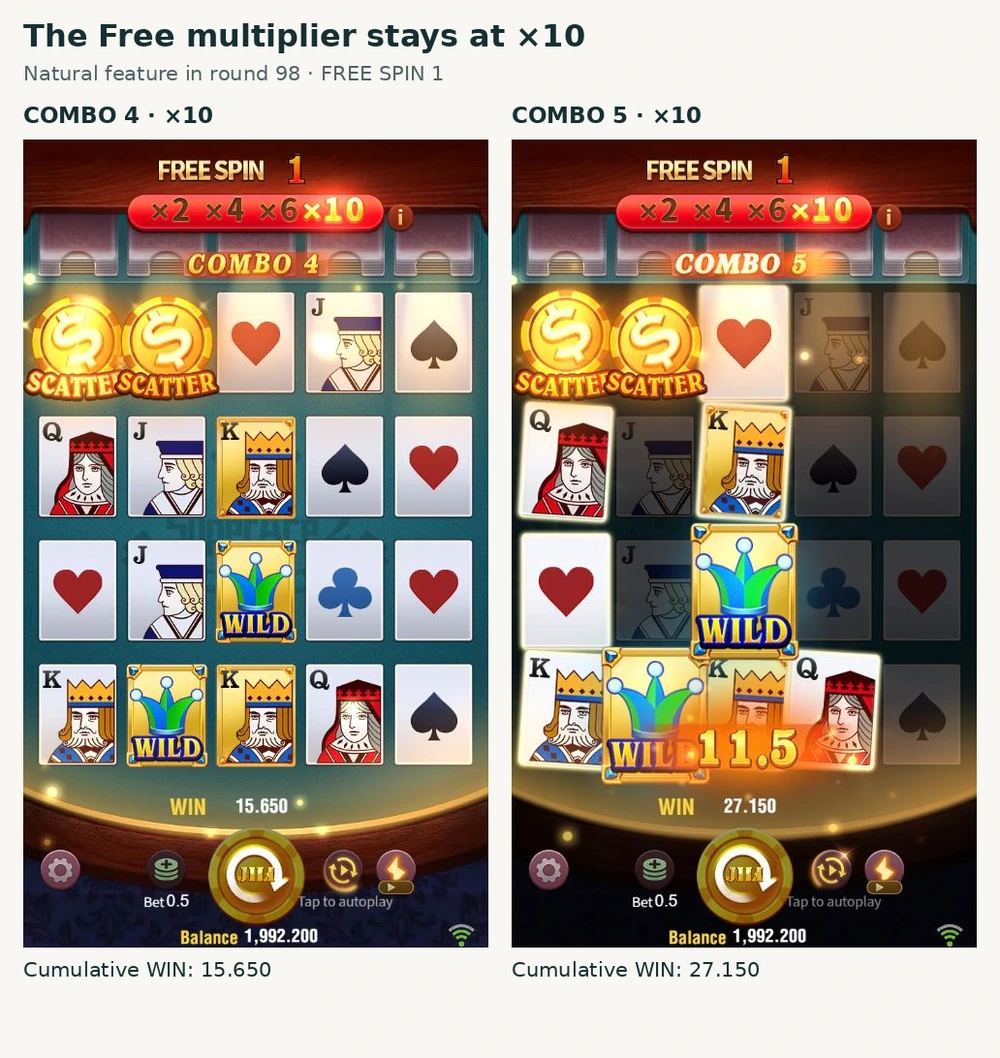
Three Scatters start Free Games
Three Scatters award 10 Free Games. During the feature, three Scatters add five more under the Help rules. The doubled multiplier ladder is the main change; the ordinary matching and Joker rules continue to apply.
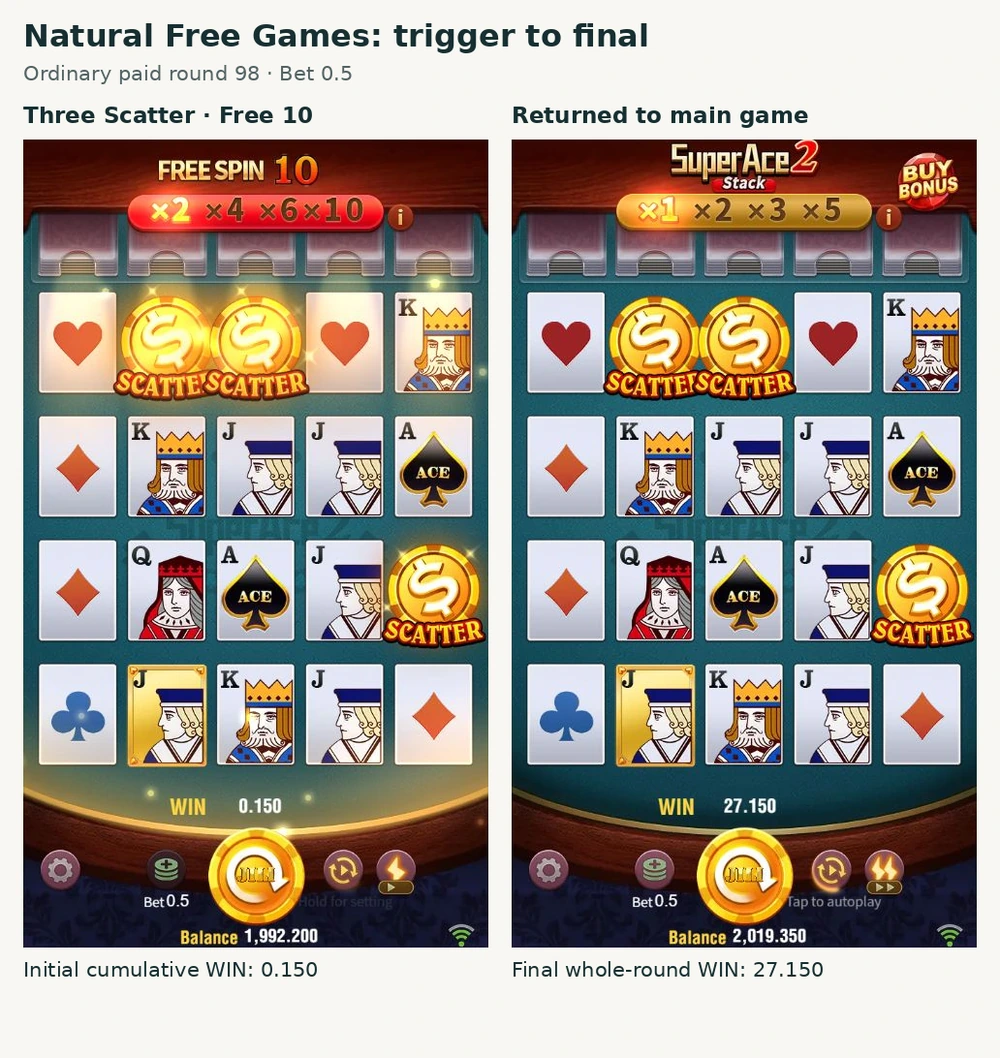
Round 98 is the clearest complete result in this review. Balance began at 1,992.700, fell to 1,992.200 after the 0.5 stake, and finished at 2,019.350. Its total payout was 27.15, giving a net gain of 26.65. The initial 0.150 shown at the trigger was already included in that final payout.
The initial award of ten was captured, but the Free Games sequence has a recording gap. We therefore do not assign an exact total of child spins or claim a verified retrigger. The feature and final result are established without filling in that missing interval.
Buying the feature is a separate purchase
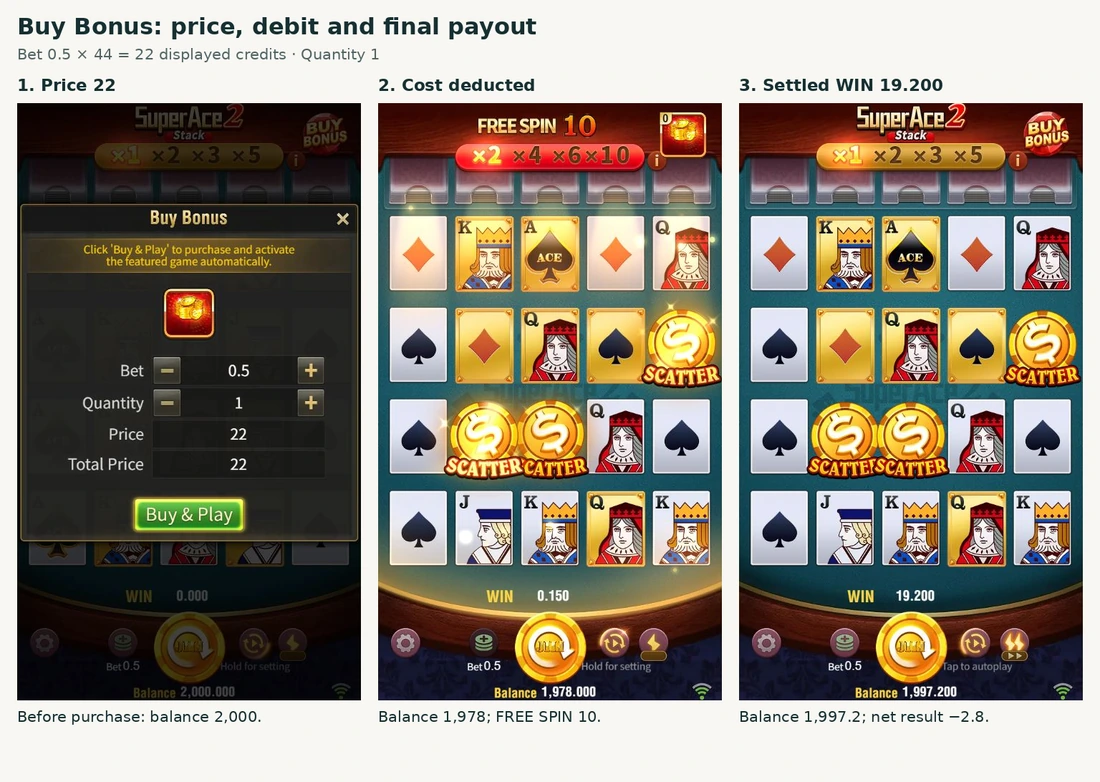
Buy Bonus costs 44 times the Bet selected inside its menu. At 0.5, that is 22 credits. Our separate purchase began with 2,000, deducted 22 and paid back 19.2. The running 11.900 at the end of the short video was part of that 19.2, not an extra award.
The menu also supports a quantity. Help sets its maximum at 99 and explains that Total Price equals Price × Quantity. We bought one. For multiple purchases, the rules describe starting later purchases with Spin or Auto and restrict Bet changes until the sequence finishes. Check both quantity and Total Price before confirming; one feature purchase already costs as much as 44 ordinary rounds at the same Bet.
Costs, RTP and the limits that matter
Value or mode | Meaning in this version |
|---|---|
Ordinary Bet range | 0.5–1,000 displayed credits |
Our ordinary round | 0.5 once, including all cascades and any naturally triggered Free Games |
Buy Bonus | 44× the Bet selected in its menu; 22 at Bet 0.5 for quantity 1 |
Paytable basis | Payout amounts shown at total Bet 2, before the current cascade multiplier |
Maximum round multiplier | 10,000×; Help says further win evaluation stops when the cap is reached |
Maximum payout | 10,000,000 displayed credits |
Provider volatility label | MED on JILI’s official product page |
Numerical theoretical RTP | Not independently verified from the current official listing or reviewed Help |
The maximums are rule limits, not outcomes reached in our session. The demo’s amounts carry no verified peso symbol, so this review calls them credits. Do not read a displayed 0.5 as ₱0.50 without checking the operator’s currency and configuration.
A payout is not the same as profit
At a cost of 0.5, a final WIN of 0.2 leaves a 0.3 net loss. Round 49 did exactly that. Its positive WIN display is real, but calling the round profitable would be wrong. Of the 25 ordinary rounds that paid something in our sample, only nine returned more than their cost.
The ordinary sample’s 105.45% is simply total payout divided by total stake. It does not establish the game’s official RTP, nor does the single Buy result establish the purchase mode’s RTP. JILI’s MED label is a provider classification; the short session cannot verify or replace it.
For a general demonstration of why short sessions vary, use our slot simulator. It is an educational tool, not a reproduction of Super Ace 2’s unpublished mathematical model.
My practical recommendation is to set a credit budget before selecting a faster speed or Auto. For example, 20 new ordinary rounds at Bet 0.5 cost 10 before payouts. A single Buy at the same Bet costs 22. The feature shortcut changes the cost of entry; it does not promise to recover that cost.
What happened in 100 ordinary paid rounds
We reviewed 100 settled ordinary paid rounds from JILI’s official free demo on 4 October 2026 (UTC), build v_190_0005. Each used Bet 0.5 and Super Turbo. One paid round includes its entire cascade sequence and any natural Free Games, so round 98 counts once. The earlier 22-credit Bonus Buy is excluded. All amounts below are demo credits.
Measure | Observed result |
|---|---|
Ordinary paid rounds | 100 |
Total stake / total payout | 50 / 52.725 |
Net result | +2.725 |
Sample payout-to-cost return | 105.45% |
Rounds with any payout | 25 |
Net-profitable / net-losing rounds | 9 / 91 |
Zero-payout / break-even rounds | 75 / 0 |
Largest payout | 27.15 on round 98; 54.3× its 0.5 stake |
Longest zero-payout run | 8 rounds, numbers 50–57 |
Longest net-loss run | 24 rounds, numbers 45–68 |
The session finished slightly ahead, but 91 of its 100 paid rounds lost money after their stake. That combination is possible because payouts are uneven. Round 98 alone supplied approximately 51.5% of all ordinary-sample payouts.
Balance: the break is a reset, not a win
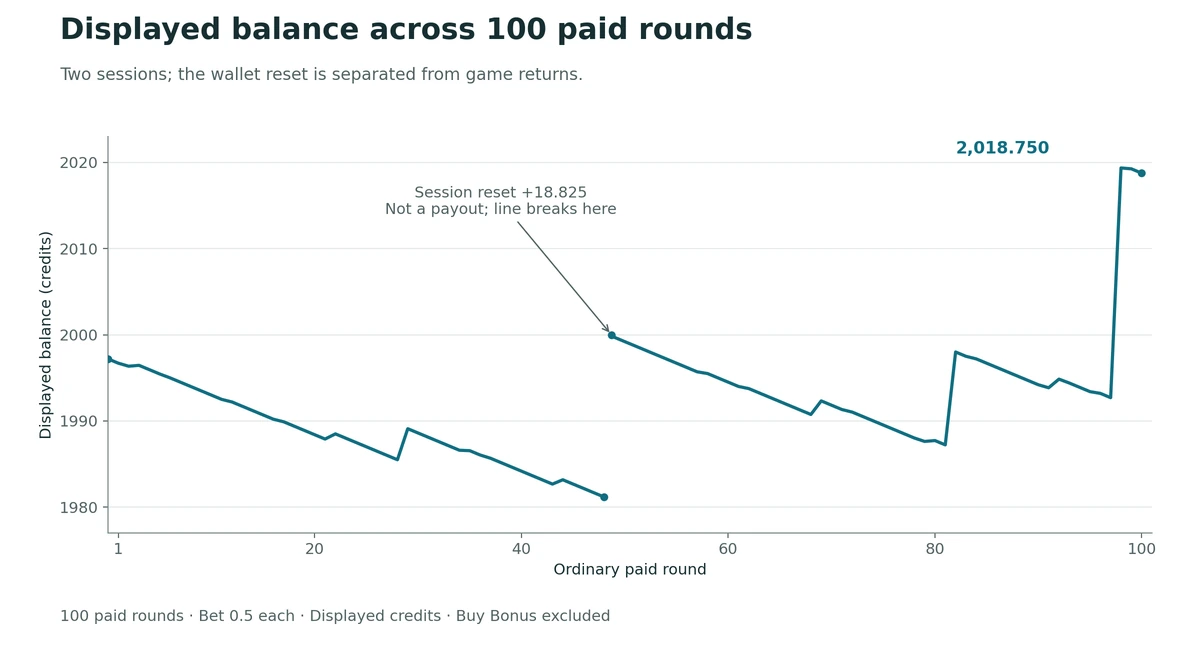
After round 48 settled at 1,981.175, a rest message led to re-entry into a fresh demo session at 2,000. The balance line is deliberately broken there. That 18.825 increase was a wallet reset, not a payout.
Subtracting the opening balance from the closing balance would produce 21.55. Removing the non-playing adjustment gives the correct ordinary net: 21.55 − 18.825 = 2.725. The actual stake-and-payout calculation gives the same answer: 52.725 − 50.
Cumulative return: one late feature changed the result
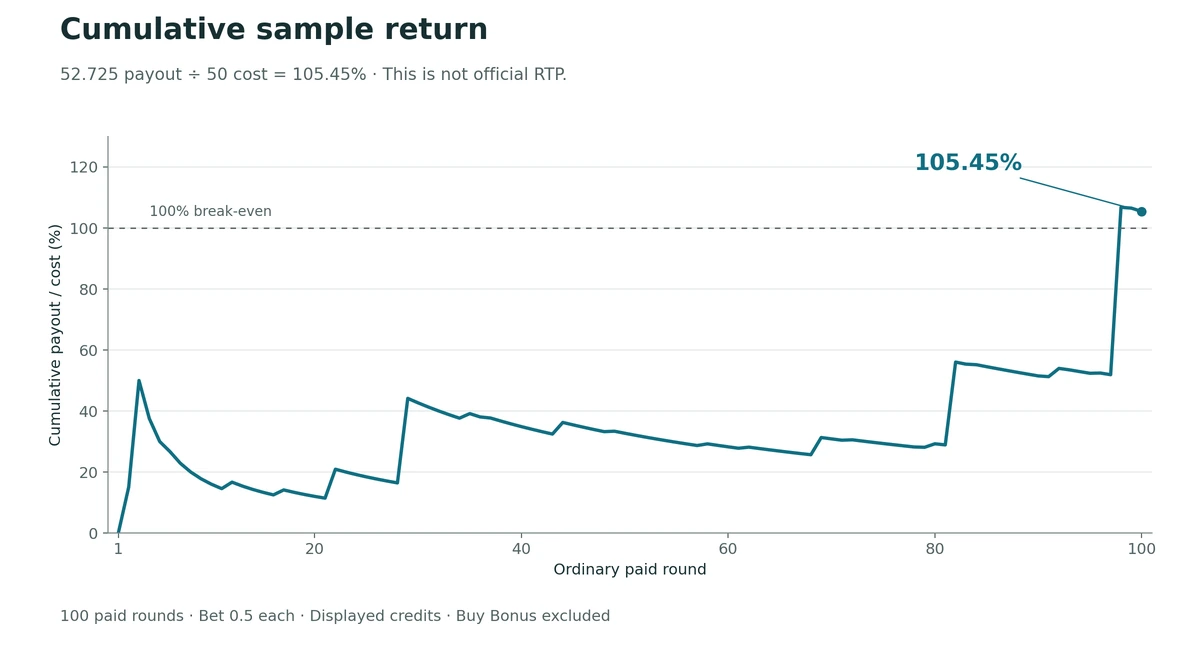
After 97 rounds, cumulative payout was 25.175 against 48.5 staked, or about 51.91%. Round 98’s 27.15 then lifted the ratio above 100%. It ended at 105.45% after round 100. The late change shows why neither an early losing stretch nor the final positive total is a dependable forecast.
Net per round: count the full cost once
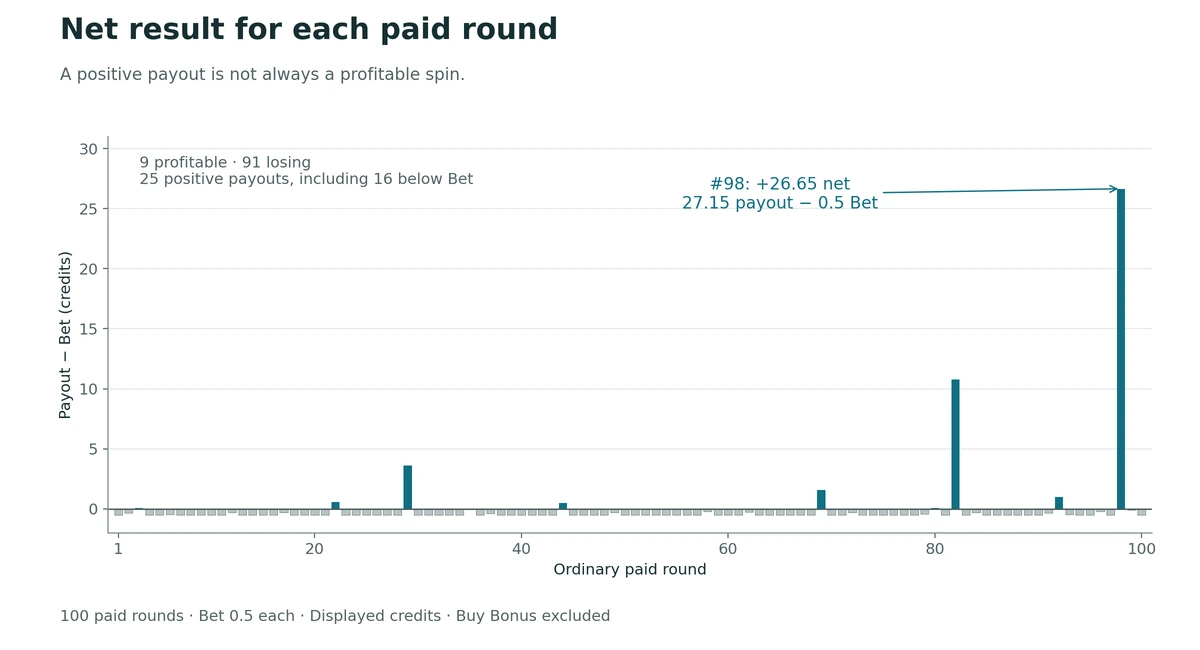
The 24-round net-loss stretch from 45 through 68 ran across the session reset and included some small payouts. The eight-round zero-payout stretch from 50 through 57 is a different measure. Separating the two makes the session more understandable than calling every animated win a success.
The sample ends at the settled result of round 100. Later Auto inspection started extra play without a complete round-by-round record, so those later events are excluded from this table and all three charts. No later interface balance replaces the sample’s 2,018.750 endpoint.
The verdict and the series comparison
The main design success is continuity: the winning card becomes a useful new symbol, and the next cascade can use a higher multiplier. The extra stack rule is a worthwhile variation for people who already enjoy that loop. For a first-time slot reader, I would slow the presentation and learn Little Joker before trying to follow several Wild layers at once.
Which Super Ace fits your preference?
Game | Board | Distinctive feature | Best reason to choose it |
|---|---|---|---|
Super Ace 2 | 5×4; 1,024 ways | Double/triple Joker stacks; four-step multipliers; 44× Buy | You want more persistence rules within the card-cascade format. |
5×4; 1,024 ways | Golden cards, Jokers and rising cascade multipliers | You want to learn the earlier reel-based format. | |
5×4; 1,024 ways | Star Card adds Golden cards; five-step base ladder; 42× Buy | You prefer extra Golden-card creation and a longer base multiplier ladder. | |
2,000 ways | Golden symbols, Wild transformations and Mystery symbols | You want a different arrangement of symbol interactions. |
The linked reviews cover each game’s own rules and screenshots. Their sample returns do not rank long-term value, and a higher Ways count does not by itself mean better odds. For Super Ace 2, the meaningful choice is whether the added stack behavior makes the familiar cascade loop more enjoyable.
Final verdict: 8/10. I like the readable transformations, clear feature price and well-matched portrait layout. The denser rules and smaller landscape view keep it from being an effortless recommendation for everyone. Start with the on-page demo when available, check Bet before each new session, and judge the game by whether you enjoy reading its sequences. The small sample profit is not a reason to expect another.
Super Ace 2 by JILI FAQs
Answers to common questions about Super Ace 2 by JILI.
Super Ace 2 by JILI Reviews
 No Player Reviews Yet
Played Super Ace 2 by JILI? Share your experience with other players.
 Write A Review