
Treasures of Aztec by PG SOFT
Play Treasures of Aztec by PG SOFT In Demo Mode
by PG SOFT




 ScatterScatter
- 4 trigger 10 spins
- +2 per extra Scatter
- Anywhere on reels
- Retriggers possible
 WildWild
- Reels 2–5 only
- Replaces paying symbols
- Never replaces Scatter
- Gold-frame conversion
 Paying Symbol10
- 3–6 consecutive reels
- Left-to-right Ways
- Wild can substitute
- Size × Level basis
 Paying SymbolJ
- 3–6 consecutive reels
- Left-to-right Ways
- Wild can substitute
- Size × Level basis
 Paying SymbolQ
- 3–6 consecutive reels
- Left-to-right Ways
- Wild can substitute
- Size × Level basis
 Paying SymbolK
- 3–6 consecutive reels
- Left-to-right Ways
- Wild can substitute
- Size × Level basis
 Paying SymbolA
- 3–6 consecutive reels
- Left-to-right Ways
- Wild can substitute
- Size × Level basis
 Paying SymbolGreen Mask
- 3–6 consecutive reels
- Left-to-right Ways
- Wild can substitute
- Size × Level basis
 Paying SymbolBlue Flower
- 3–6 consecutive reels
- Left-to-right Ways
- Wild can substitute
- Size × Level basis
 Paying SymbolPurple Animal Head
- 3–6 consecutive reels
- Left-to-right Ways
- Wild can substitute
- Size × Level basis
 Paying SymbolPink Animal Head
- 3–6 consecutive reels
- Left-to-right Ways
- Wild can substitute
- Size × Level basis
 Paying SymbolRed Mask
- 3–6 consecutive reels
- Left-to-right Ways
- Wild can substitute
- Size × Level basis
 Paying SymbolGold Mask
- 3–6 consecutive reels
- Left-to-right Ways
- Wild can substitute
- Size × Level basis
Treasures of Aztec by PG SOFT Expert Review


Updated:
Here you can find detailed review information about Treasures of Aztec by PG SOFT.
Treasures of Aztec rewards paying attention to what survives a win. Its tall symbols can change from silver to gold and then into Wilds, while each successful cascade raises the next round’s multiplier. That makes the board more interesting to follow than a simple stop-and-pay slot. It also creates its main source of confusion: a bigger symbol or a higher multiplier is not, by itself, a bigger settled payout.
What I liked
✅ Frame changes give successive cascades a clear sense of progression.
✅ History separates each cascade’s payout from the paid spin’s total.
✅ Portrait keeps the board, stake and main controls easy to follow.
What I didn’t like
❌ Tall symbols look more valuable than their one-symbol counting rule suggests.
❌ The landscape layout makes the important numbers noticeably smaller.
❌ The published Feature Buy description did not match the available demo controls.
1. What Treasures of Aztec offers
Treasures of Aztec is PG SOFT’s six-reel cascading slot with a temple setting, coloured masks and a variable Ways layout. An extra horizontal reel sits above reels 2–5. Some symbols occupy several spaces, so the board’s shape changes from one result to the next; the captured rules give a range of 2,025–32,400 Ways. The important feature is Wilds-on-the-Way: a winning framed symbol can influence the next board instead of simply disappearing.
This suits a player who enjoys following a developing result. A modest first win can lead to another combination, a higher multiplier and a different role for a framed symbol. It is less immediately readable than a small fixed-payline game. Learning the difference between a paid spin, a cascade and a Free Spin makes the experience much easier to understand.
Start with the demo module on this page to explore the layout and inspect the selected bet. The review below uses records collected on 6 October 2026 from the PG demo reached through AskSpinner, with 50 settled ordinary paid spins. The amounts are demo units; they should not be read as Philippine pesos or as a cash-play minimum at a particular casino.
Philippine search interest. Ahrefs’ Philippines estimates retrieved on 8 October 2026 put both “treasures of aztec” and “treasures of aztec demo” at 100 average monthly searches. The “slot” and “rtp” variations each returned 10. These figures estimate searches over Ahrefs’ latest known 12 months, whose exact endpoints were not returned. They describe keyword interest rather than unique players, and the overlapping phrases should not be added together.
The first Normal spin and its resulting board in a 10-second clip. Reel movement occupies only part of the clip.
2. Reading the screen and setting the stake
The stone surround and bright mask colours make the game’s theme clear without obscuring the reel area. The main grid and upper reel take most of the available height. Current Ways appears above the board; the result strip, multiplier, balance and stake sit below it. The lowest row contains Turbo, the minus and plus controls, the central Spin button and Auto.
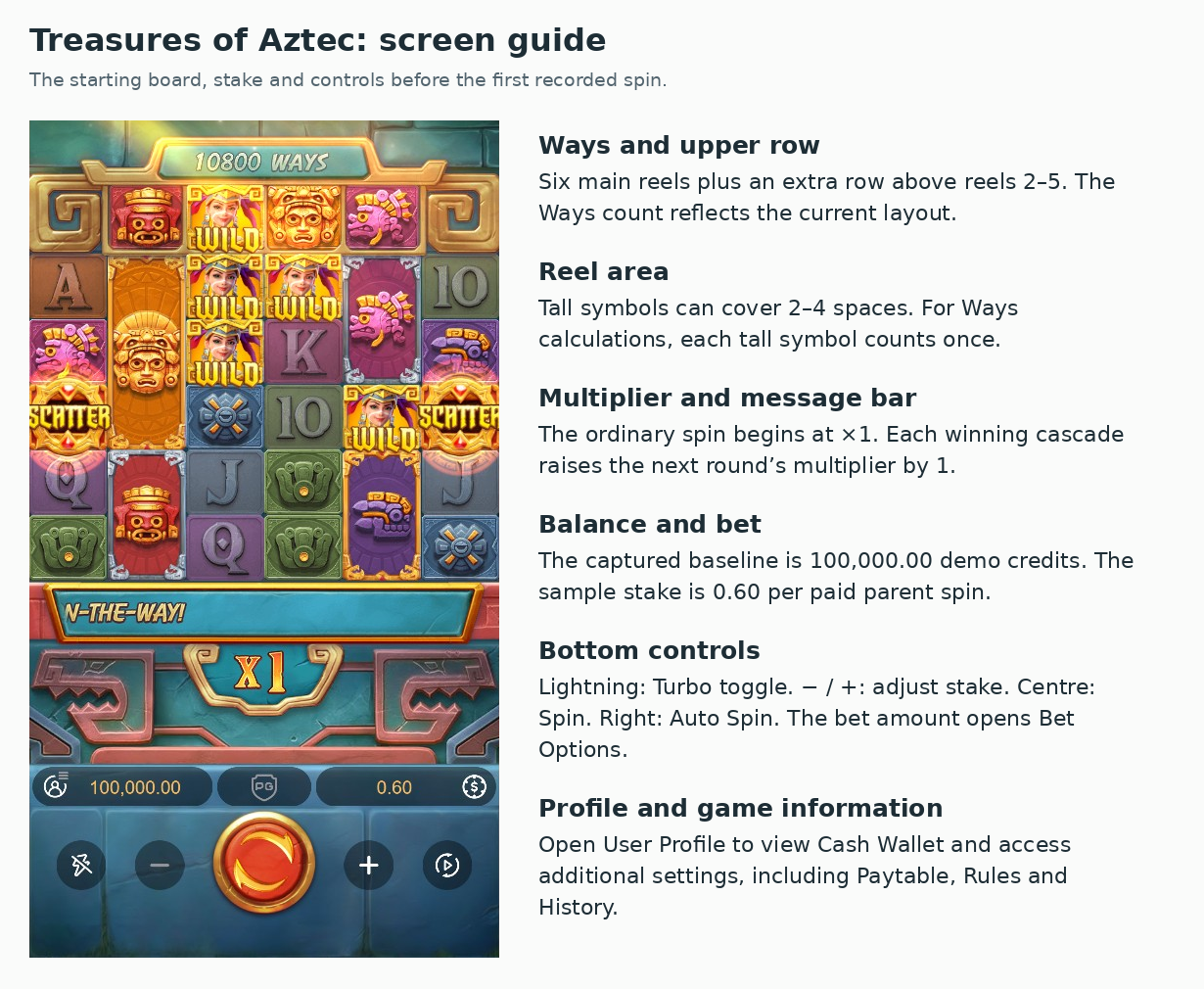
The actual game interface. The result strip can return to the PG logo when no win amount is being shown.
The wallet/profile control provides access to Cash Wallet, Paytable, Rules and History. History is particularly useful here because a paid spin may contain several rounds. It lets you inspect the round’s bet and payout instead of trying to remember every number that appeared during the animation. The initial introductory board contains several Wilds; that display is not evidence that a bonus or large win has already occurred.
Bet Options separates Bet Size, Bet Level and the resulting total Bet Amount. The captured default was 0.30 × 2 × base bet 20, giving 12.00. The reviewed sample used 0.03 × 1 × 20 = 0.60 throughout. This distinction matters: the small Size value is a component of the stake, not the total cost of pressing Spin.
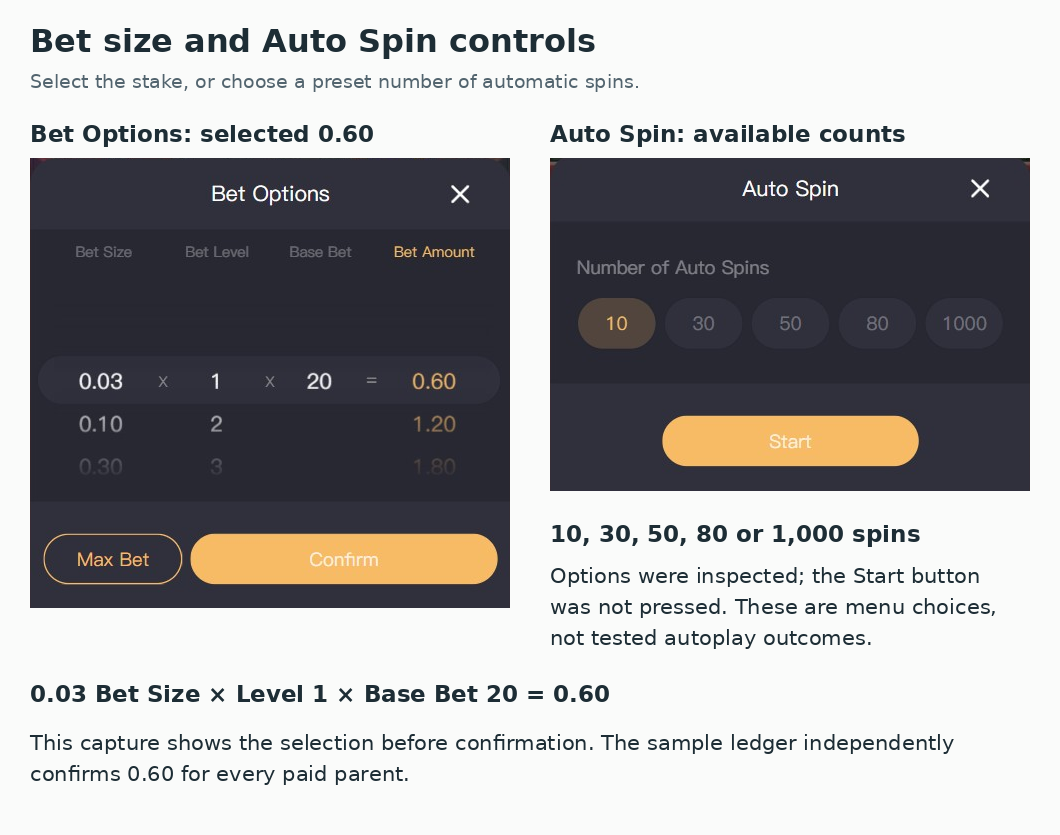
Bet Options shows how the stake is assembled. The captured Auto panel offers spin counts; no Auto batch forms part of the sample.
Auto offered 10, 30, 50, 80 and 1,000 spins in the inspected panel. Turbo was also available: the sample contains one Normal spin followed by 49 Turbo spins, with the same 0.60 paid-parent stake. These are pace controls. Nothing in the recorded results shows that selecting a faster speed changes the payout rules.
Portrait is the more comfortable presentation for learning this game. In the recorded 390 × 844 desktop viewport check, the board, balance, stake and main buttons remained visible, and the Bet panel opened successfully. The 844 × 390 landscape view kept a narrow, approximately 220-pixel-wide portrait game area with scenery on either side. That left the useful figures much smaller. These are viewport observations, not a physical-phone or touch-performance test.
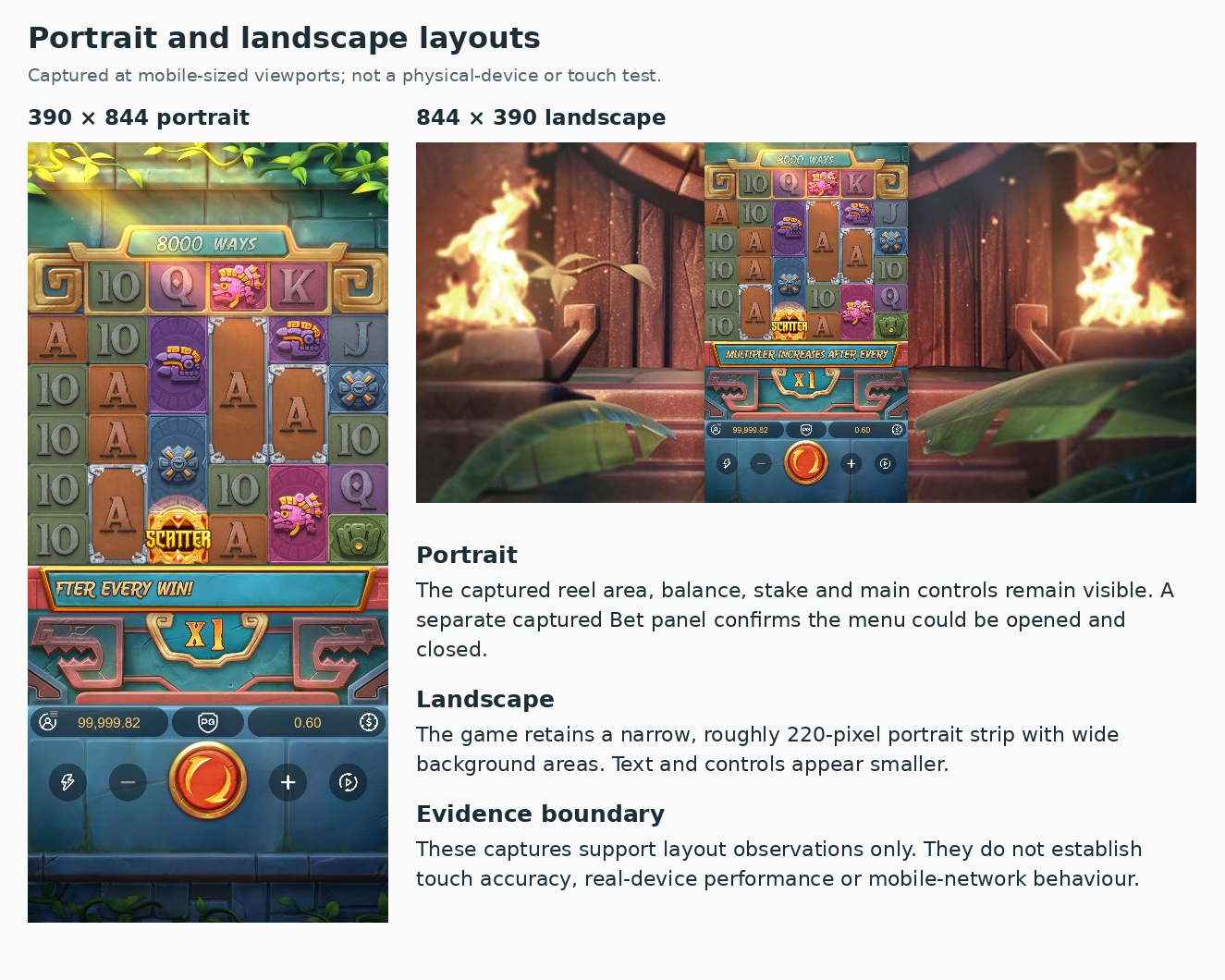
The portrait and landscape checks show the same tall game layout at different available heights.
3. How Ways wins and symbol payouts work
Winning combinations run from the leftmost reel across consecutive reels. Instead of tracing a fixed line through particular positions, count the matching symbols on each participating reel and multiply those counts to obtain the number of winning Ways. Different qualifying combinations can contribute to the same round’s payout.
A simple rules example shows the difference. Suppose a qualifying three-reel symbol appears twice on reel 1, once on reel 2 and three times on reel 3. That makes 2 × 1 × 3 = six Ways. This is an illustration of the calculation, not an additional recorded spin. The symbol’s paytable coefficient, Bet Size, Bet Level and applicable round multiplier determine the money paid for those Ways.
The large symbols need extra care. A symbol occupying two, three or four spaces still counts as one symbol in the payout calculation. Counting each occupied cell separately would overstate the win. The changing reel presentation makes this easy to misread, particularly when a long framed symbol dominates the centre of the screen.
The native symbol cards on this page contain the full payout catalogue. For orientation, the gold mask’s three-reel coefficient is 30. At Size 0.03, Level 1, one winning Way and a ×1 round multiplier, that coefficient produces 0.90. It does not mean 30 times the total 0.60 stake. The distinction between the paytable’s coefficient and a total-bet multiple is essential when comparing the cards with a settled result.
Wild substitutes for paying symbols but not Scatter, and appears on reels 2–5. Scatter has the separate Free Spins trigger role. A Wild therefore helps extend a qualifying symbol combination; it does not replace a missing Scatter to meet the bonus requirement.
The largest settled paid spin in the sample illustrates how several awards combine. Spin 3’s first round paid 1.20, 6.00, 0.24, 0.09 and 0.18, for a total of 7.71. Its next round displayed ×2 but had no winning combination. The final payout remained 7.71, or 12.85 times the 0.60 total stake, with a net gain of 7.11. The later multiplier did not multiply the already-paid first round again.
4. Cascades, framed symbols and Free Spins
After a winning round, the game removes the winning symbols, brings new ones into the available spaces and checks the board again. These follow-on rounds belong to the same paid spin. The next paid stake is charged when a new paid spin begins, rather than each time a successful board produces another cascade.
Wilds-on-the-Way adds a transformation step. Some ordinary symbols on reels 2–5 occupy two to four spaces and carry a silver frame. When one participates in a win, the next round transforms it into a randomly selected ordinary symbol with a gold frame. If that gold-framed symbol subsequently participates in a win, it becomes a Wild in the next round. Wild and Scatter are excluded from the random ordinary-symbol selection.
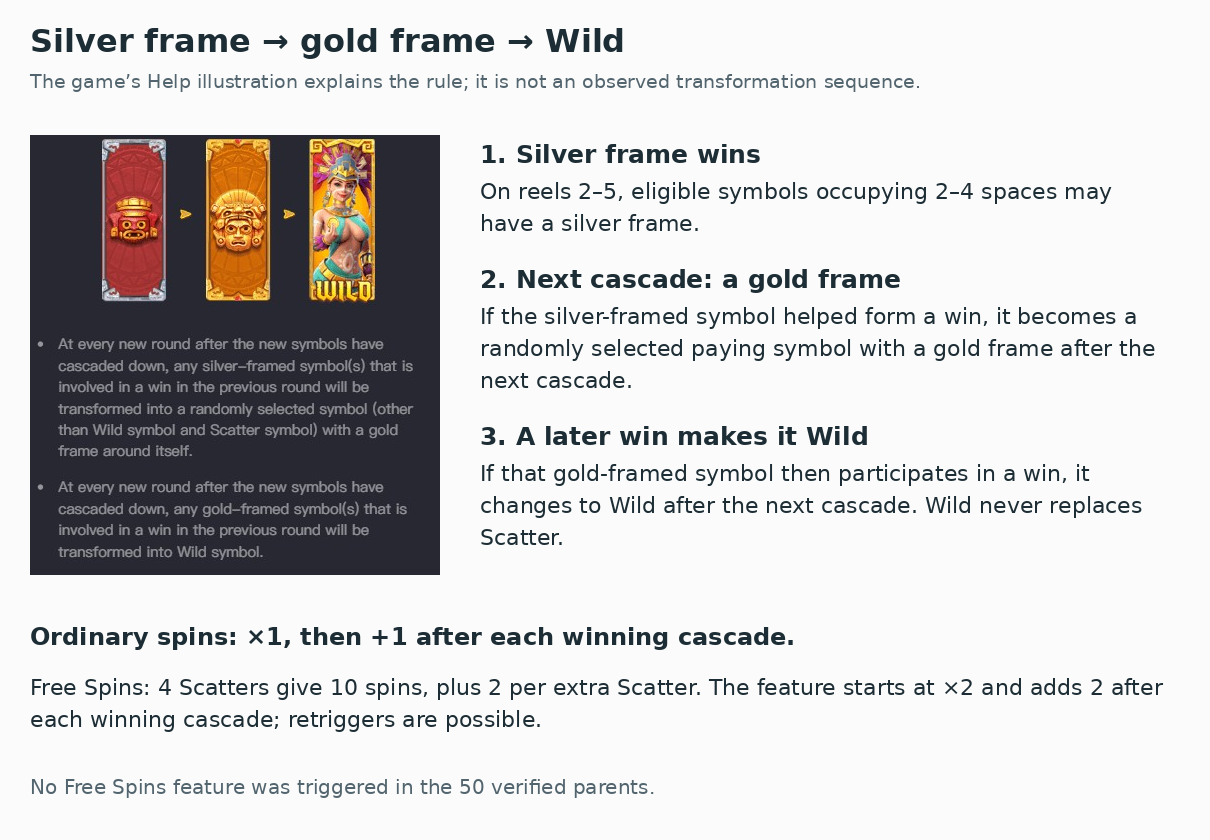
The game’s Help illustrates the silver-to-gold-to-Wild rule. This is a rules example, not a claim that every transformation was continuously recorded during the sample.
The ordinary-game multiplier begins at ×1 for each new paid spin. A winning cascade increases the multiplier for the next round by one. Spin 6 makes the timing clear: its rounds paid 0.36 at ×1, 0.72 at ×2, 1.08 at ×3, then zero at ×4. The paid spin returned 2.16 in total. A multiplier describes what applies if that round wins; it is not an award on its own.
Spin 47 continued even further. The five rounds paid 0.60, 1.20, 0.36, 0.96 and zero, with multipliers ×1 through ×5. Only the first round carried the 0.60 bet. The four later transaction records each showed zero additional bet, and the paid spin finished at 3.12 returned, or +2.52 net.
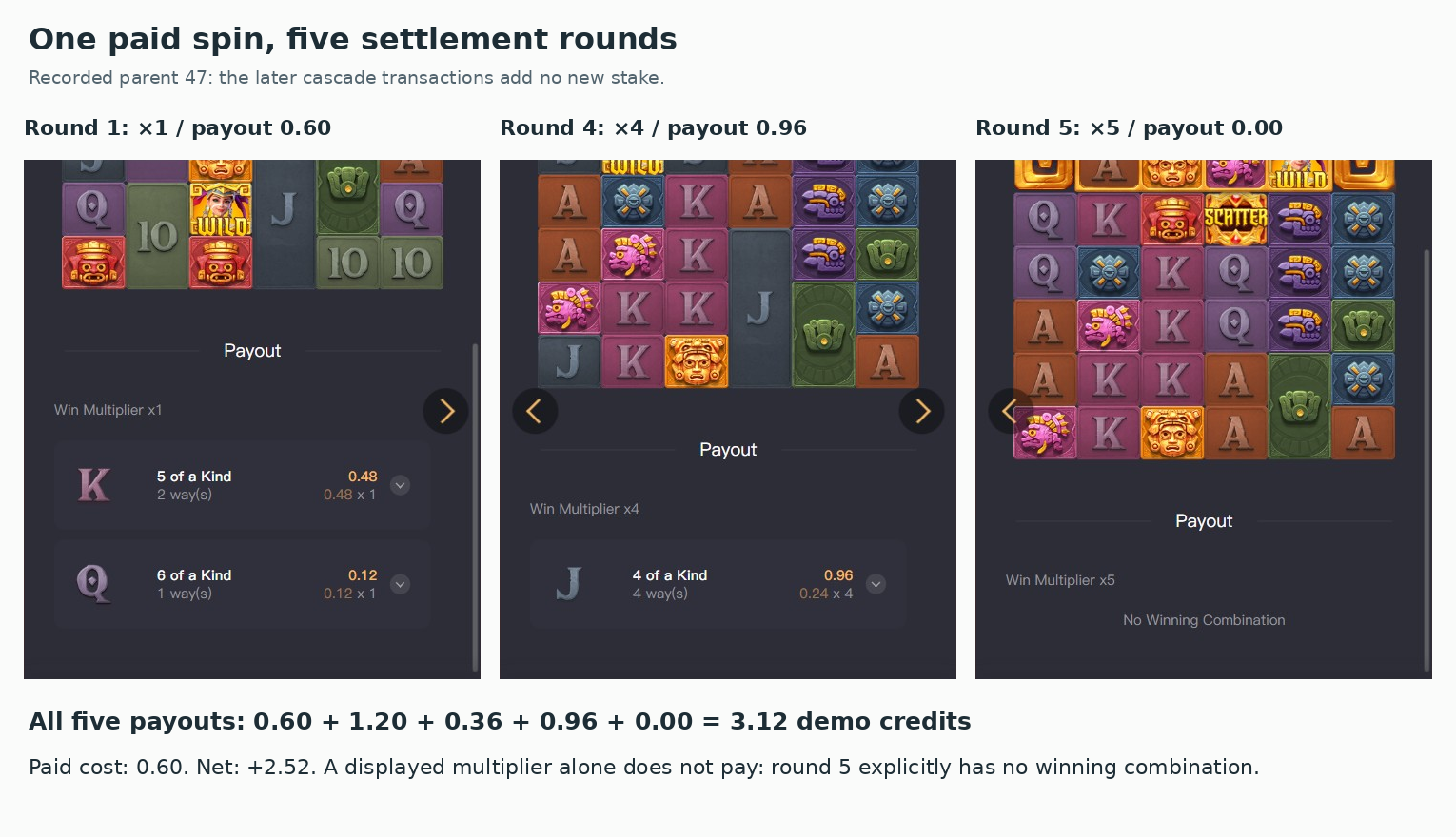
One 0.60 paid spin, five recorded rounds and 3.12 total payout. The final ×5 round did not win.
Free Spins use a different trigger and multiplier pace. Four Scatters anywhere trigger 10 Free Spins, with two more spins for each additional Scatter. The feature starts with a ×2 multiplier, and a winning cascade raises the next round’s multiplier by two. The feature can retrigger. No Free Spins feature occurred in the 50 settled ordinary spins, so these feature details come from the captured rules and official game information.
The official PDF also describes a Feature Buy menu. The inspected demo’s main controls, menu and complete Help did not expose a usable Buy entry. That is a difference between the documented feature and this demo configuration, rather than proof that every Treasures of Aztec version lacks it. There is no verified purchase price or purchased-feature result to recommend from this sample.
5. RTP, volatility and the cost of a spin
PG SOFT’s Treasures of Aztec game information, Version 1.0 r945, lists an overall theoretical RTP of 96.71% and Session Volatility of Medium. Its summary attributes 69.59 percentage points to the main game and 27.12 to the Free Spins feature. Those components describe the published overall model; they are not two alternative return settings or a prediction for a short visit.
The PDF’s bet settings differ from the inspected demo. It lists Bet Size choices 0.01, 0.05 and 0.10 and default euro-denominated limits of 0.20–20. The demo instead showed Size choices 0.03, 0.10, 0.30 and 0.90; the completed sample used its lowest displayed Size with Level 1 for a 0.60 total stake. This is why a copied euro minimum would be a poor description of the actual demo reviewed here.
Figure | Supported reading |
|---|---|
96.71% RTP | Long-term overall model in the official PDF; not established by 50 spins |
Medium volatility | Supplier classification for the documented game model |
0.60 per paid spin | Observed demo stake: 0.03 Size × Level 1 × base bet 20 |
100,000× | Official advertised maximum-win figure, not a sample result |
9,071× | Separately reported maximum exposure in the PDF’s one-billion-spin simulation |
The last two figures have different definitions. A simulated maximum exposure is not a replacement label for the advertised maximum, and neither says how likely a particular player is to see a very large win. The current demo Help did not itself display RTP or maximum-win figures, so the official PDF is the attribution for those numbers.
Cost is simpler to measure than volatility. Fifty settled paid spins at 0.60 cost 30.00, regardless of whether a paid spin contains one round or five. The 25 zero-cost cascade children in History add detail to those outcomes but add no new stake to that sample. If you want to explore how repeated wagers affect a hypothetical budget, the AskSpinner slot simulator can illustrate a chosen model. It does not reproduce PG SOFT’s undisclosed reel mathematics or forecast this game’s next result.
6. What the 50 settled spins actually showed
The 50 settled ordinary spins returned 33.69 from 30.00 in paid stakes, a net gain of 3.69 and a sample return of 112.30%. Seventeen paid spins returned something, but only 11 returned more than their 0.60 cost. The other six paying spins still lost money overall. Thirty-three spins returned zero, leaving 39 net-losing spins and no break-even results.
Settled sample | Result |
|---|---|
Paid spins / extra cascade rounds | 50 / 25 |
Stake / total payout / net | 30.00 / 33.69 / +3.69 demo units |
Paying / net-winning spins | 17 / 11 |
Largest paid-spin payout | 7.71 on spin 3, equivalent to 12.85× total stake |
Natural Free Spins triggers | 0 within these 50 completed spins |
One result made a substantial difference. Spin 3 supplied 7.71, approximately 22.9% of the sample’s total payout. The other 49 settled paid spins cost 29.40 and returned 25.98. This is a useful description of this particular sequence: a positive final total coexisted with many small losing results. It is not evidence that the next session will depend on an equally large early win.
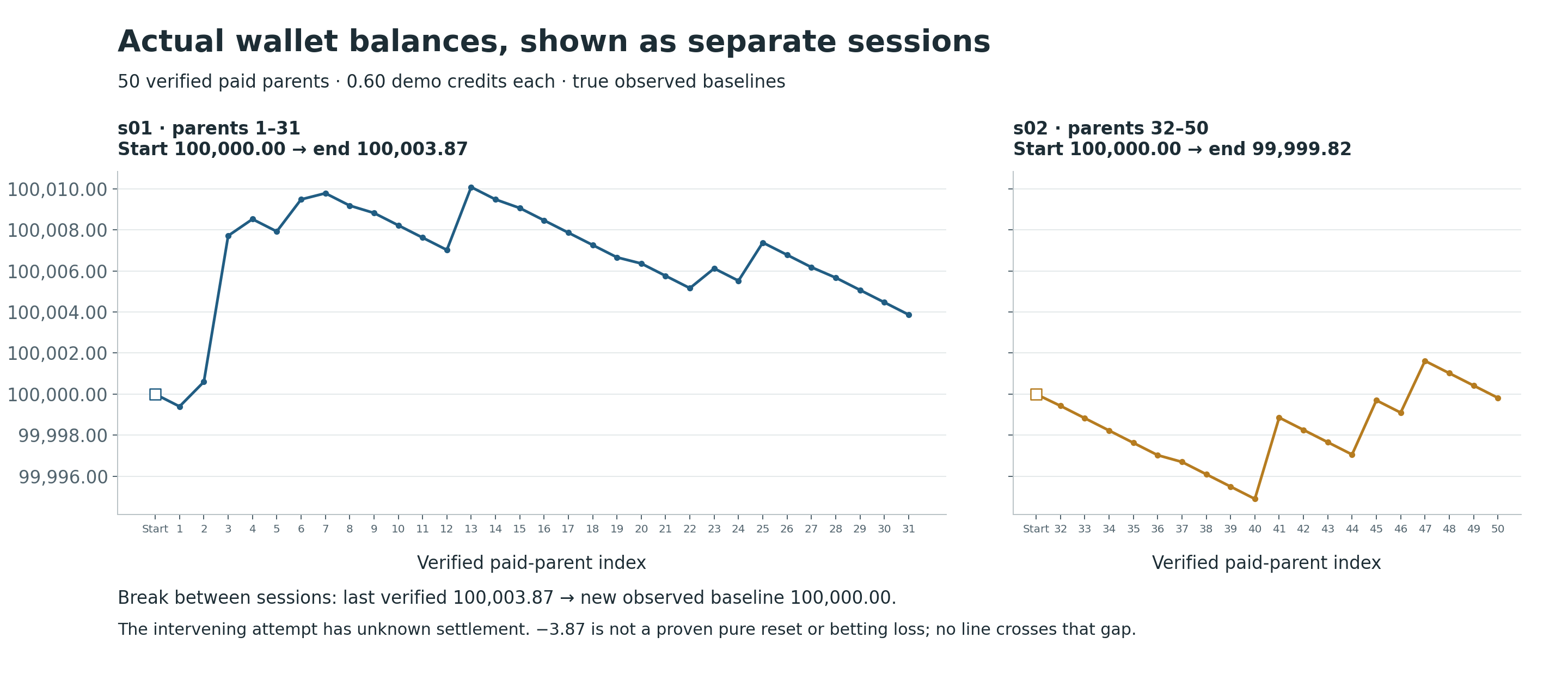
Actual recorded wallet balances. The line stops at the session boundary rather than treating the intervening wallet change as a settled win or loss.
The sample spans two sessions. Spins 1–31 cost 18.60 and returned 22.47, finishing at 100,003.87 from a 100,000 baseline. Spins 32–50 began from a newly read baseline of 100,000, cost 11.40 and returned 11.22, finishing at 99,999.82. A failed attempt between those sessions never yielded a confirmed final settlement. Its unknown cost and payout are excluded, not filled in as zero.
The difference of −3.87 between the last verified wallet and the next baseline cannot be separated into the unknown attempt’s outcome and a pure reset amount. Consequently, +3.69 describes only the 50 verified spins, not the entire visit including that unknown attempt. Subtracting the very first wallet from the very last wallet would answer a different and unsupported question.
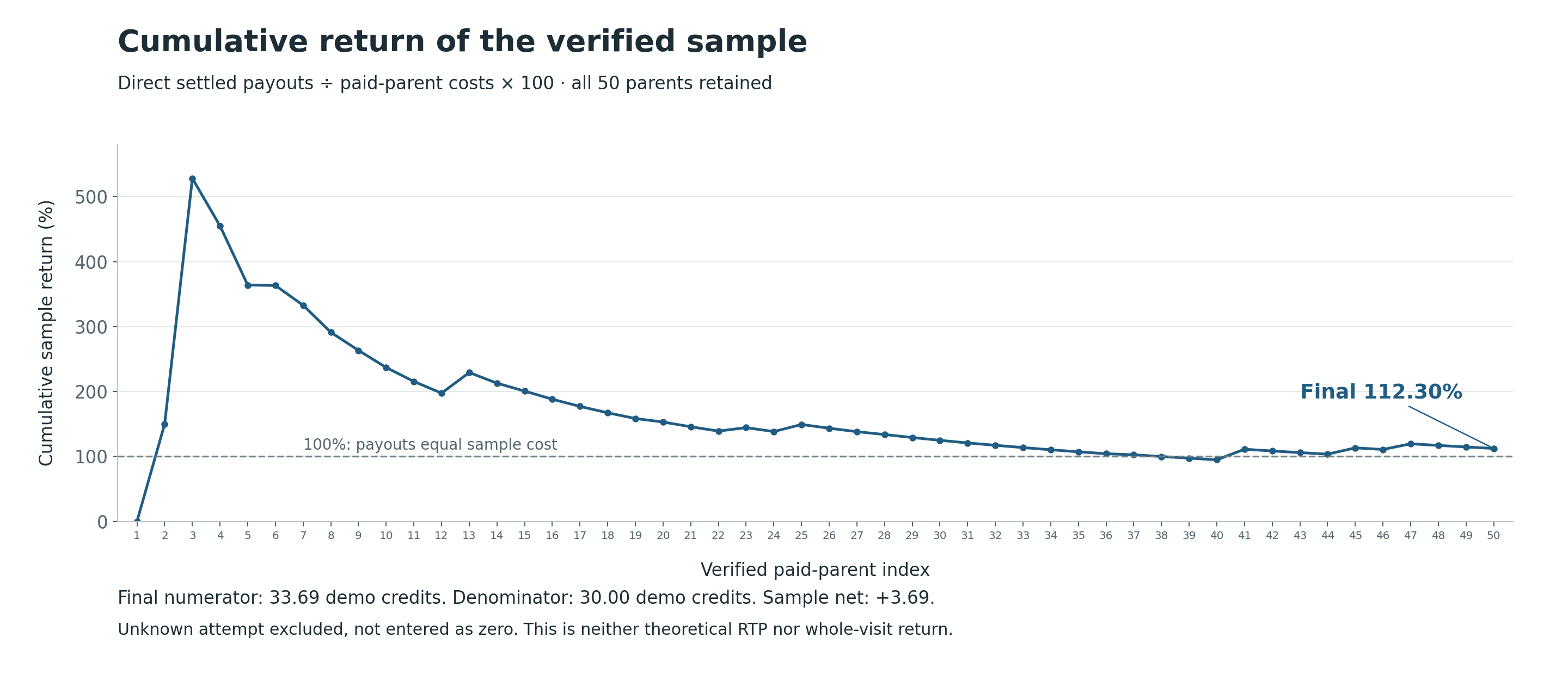
Cumulative sample return, using only the verified paid spins. The final 112.30% is a sample calculation, not a new theoretical RTP.
The return chart uses cumulative settled payout divided by cumulative settled cost. Early results move this ratio sharply because little has been staked. As the denominator grows, later losing spins gradually change the picture. It is more informative to read that path alongside the individual net results than to judge the game only by its positive endpoint.
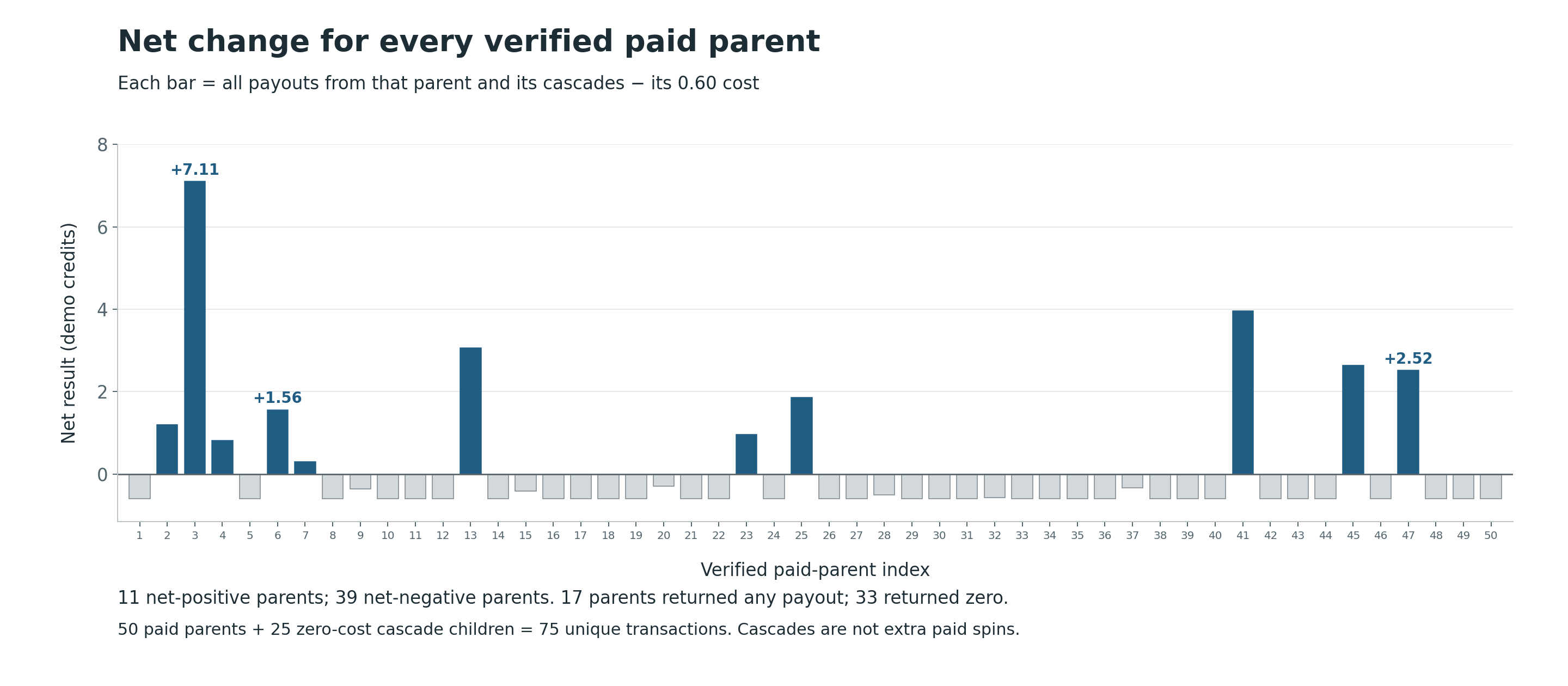
Each bar is one paid spin’s full payout minus its 0.60 cost. Cascade children stay inside the parent result.
These records show what the ordinary mechanics produced in this sample, including small partial returns, a larger early payout and a five-round cascade. They do not measure a reliable long-run hit rate, bonus frequency or theoretical volatility. The absent Free Spins trigger is a sample observation rather than a probability estimate.
7. Who will enjoy it, and where it becomes demanding
My strongest reason to choose Treasures of Aztec is the way a successful board changes the next one. Silver and gold frames give the cascade a visual story, and the stepwise multiplier makes a continuing result easy to explain once you understand when it applies. History is a genuinely useful companion because it separates the successive payouts that the main animation presents quickly.
The corresponding drawback is reading load. You have to distinguish spaces from symbols, the paytable coefficient from total stake, and the current round’s multiplier from the paid spin’s cumulative payout. None of those distinctions is difficult alone, but they arrive together. For a first look, Normal speed and the portrait layout make the mechanics easier to follow; Turbo is more comfortable after those relationships are familiar.
Lucky Neko by PG SOFT is a useful comparison if you enjoy this style. It also combines a six-reel variable-Ways layout with framed-symbol transformations, then adds Cat-related multiplier behaviour. Treasures of Aztec puts more of the reader’s attention on the ordinary cascade multiplier and the progression toward Wilds. That is a mechanics preference, not evidence that either game gives a better short-session return.
I would choose Treasures of Aztec for someone who wants a visually rich cascade slot and is willing to learn how its result is assembled. I would choose a simpler fixed-line game for someone who wants to glance at one payout and move on. The recorded demo provides a clear way to learn the ordinary mechanics, while the published Free Spins rules explain the bonus structure. The 50-spin profit is useful evidence about the recorded sequence; the design, clarity and available controls are the better basis for deciding whether the game suits you.
Treasures of Aztec by PG SOFT FAQs
Answers to common questions about Treasures of Aztec by PG SOFT.
Treasures of Aztec by PG SOFT Reviews
 No Player Reviews Yet
Played Treasures of Aztec by PG SOFT? Share your experience with other players.
 Write A Review