
Wild Ape #3258 by PG SOFT
Play Wild Ape #3258 by PG SOFT In Demo Mode
by PG SOFT



 Other SymbolActive ape ×2
- Central Wild
- Starts at ×2
- Adds 2 per win
- Free Spins active
 Other SymbolLocked ape
- Central reels 3–4
- Two padlocks
- Two winning rounds
- Inactive state
 ScatterScatter
- 4+ anywhere
- 10 free spins
- +2 per extra
- Retriggers
 WildWild
- Reels 2–5
- Substitution
- Excludes Scatter
- No own coefficient
 Paying Symbol10
- 3–6 left-start reels
- Coeffs 1/2/3/4
- Gold frames → Wild
- Large symbol counts 1
 Paying SymbolJ
- 3–6 left-start reels
- Coeffs 1/2/3/4
- Gold frames → Wild
- Large symbol counts 1
 Paying SymbolQ
- 3–6 left-start reels
- Coeffs 1/2/3/4
- Gold frames → Wild
- Large symbol counts 1
 Paying SymbolK
- 3–6 left-start reels
- Coeffs 1/2/3/4
- Gold frames → Wild
- Large symbol counts 1
 Paying SymbolA
- 3–6 left-start reels
- Coeffs 1/2/3/4
- Gold frames → Wild
- Large symbol counts 1
 Paying SymbolPeeled banana
- 3–6 left-start reels
- Coeffs 5/8/10/15
- Gold frames → Wild
- Large symbol counts 1
 Paying SymbolPizza slice
- 3–6 left-start reels
- Coeffs 5/8/10/15
- Gold frames → Wild
- Large symbol counts 1
 Paying SymbolShort glass with lime
- 3–6 left-start reels
- Coeffs 8/10/15/20
- Gold frames → Wild
- Large symbol counts 1
 Paying SymbolColourful bottle
- 3–6 left-start reels
- Coeffs 10/15/20/30
- Gold frames → Wild
- Large symbol counts 1
 Paying SymbolGold wristwatch
- 3–6 left-start reels
- Coeffs 20/25/40/50
- Gold frames → Wild
- Large symbol counts 1
 Paying SymbolJewelled crown
- 3–6 left-start reels
- Coeffs 40/50/80/150
- Gold frames → Wild
- Large symbol counts 1
Wild Ape #3258 by PG SOFT Expert Review


Updated:
Here you can find detailed review information about Wild Ape #3258 by PG SOFT.
Who Wild Ape #3258 suits
Wild Ape #3258 by PG SOFT suits players who enjoy following cascades through a changing six-reel board.
What I liked
✅ The chained ape and its two locks give a paid spin a clear progression: successive wins earn the central Wild’s help.
✅ Gold-frame Wild conversions, a multiplier that rises by two and Free Spins with the ape already awake make the cascade system feel connected.
✅ Portrait keeps the important controls and opened menus readable.
✅ Current Help explains symbol size, ways, conversion and the overall cap.
What I didn’t like
❌ A visible ape can still be inactive, and later multipliers are easy to misread as doubling.
❌ Results take close reading: intermediate counters and whole-spin totals differ, and a bright win banner can hide a payout that leaves the paid spin in the red.
❌ Landscape shrinks the stage to about 220 pixels, making fine labels and controls uncomfortable to inspect.
❌ Supplier-document RTP and Feature Buy information need configuration context.
In our 100-spin Turbo sample, 31 spins paid something, but only 12 returned more than their cost.
The figures below come from a free demo, using 0.60 demo units per paid spin. They are a record of this run, not a profit forecast. The game identity is Wild Ape #3258 by PG SOFT; its current Help describes 256–32,400 ways and a maximum whole-spin payout of 10,000 times the bet.
A 13-second sequence from supplemental Normal-speed spin 103. The opening still shows spin 102’s 0.03; the clip ends during an unfinished cascade at ×4 and cumulative 7.80. Spin 103 later settled at 8.28. This clip is outside the 100-spin Turbo sample.
Philippine search interest. Ahrefs, checked on 5 October 2026 for the Philippines, returned estimated monthly searches of 2,600 for “wild ape demo”, 700 for “wild ape” and 100 for “wild ape 3258”. These are separate keyword estimates, not player counts, and should not be added together.
Find your way around the screen
The neon city backdrop, brightly coloured objects and oversized ape give the game a strong identity. More importantly, the two padlocks and the central multiplier make the main feature’s state visible. The screen remains a tall, narrow stage even on a wide desktop. Empty background on either side does little to help when you are trying to read a small amount.
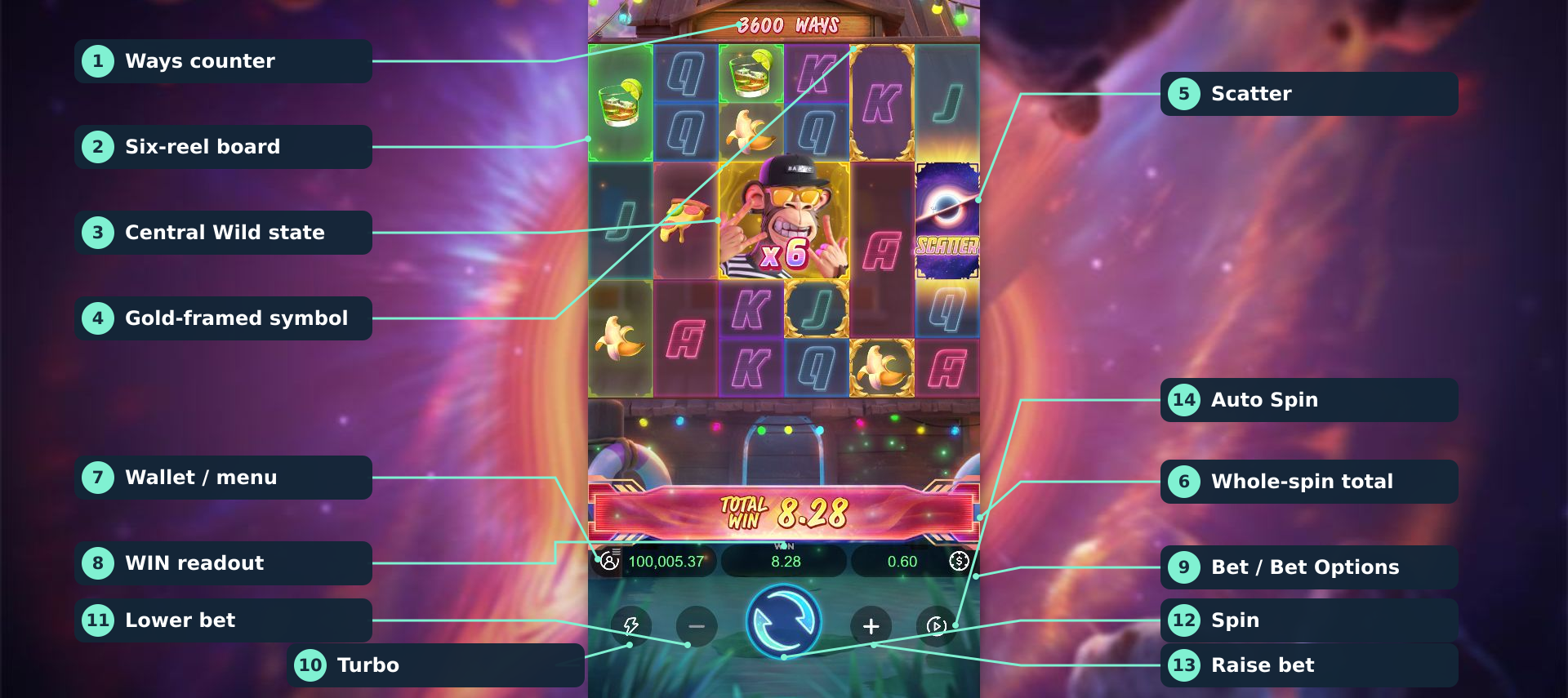
The controls and game areas after supplemental spin 103. The displayed ×6 is its retained result state, not the starting multiplier of a new paid spin.
Ways counter: the current board’s ways count. It is not a count of winning ways or fixed paylines.
Six-reel board: read matching ordinary symbols from the leftmost reel across successive reels.
Central Wild state: two locks at a new base spin; an active multiplier after the required wins, or from the start of each free spin.
Gold-framed symbol: an eligible ordinary symbol can become a Wild after contributing to a win.
Scatter: four anywhere trigger Free Spins. It does not need to form a left-to-right way.
Whole-spin total: the completed paid spin’s payout, including its cascades and any naturally triggered free rounds.
Wallet / menu: shows the available demo balance and opens the menu with Sound, Paytable, Rules, History and Quit.
WIN readout: the win display beneath the stage. A payout is not the same as profit after the bet.
Bet / Bet Options: the displayed total bet and access to Bet Size, Bet Level and Bet Amount selectors.
Turbo: the lightning control shortens reel-spin presentation. The main sample used this visible Turbo setting.
Lower bet: reduces the selected bet before a spin.
Spin: starts a paid spin at the selected amount.
Raise bet: increases the selected bet before a spin.
Auto Spin: opens the selectable spin-count panel; it does not demonstrate a completed Auto session merely by being open.
Bet, wallet and Auto are separate panels
Tap the bet amount to check the actual cost before spinning. In the opened panel, 0.03 Bet Size × Level 1 × Base Bet 20 equals the displayed 0.60. The plus and minus controls were also checked without starting a spin: 0.60 changed to 1.20, then returned to 0.60. That is an interface check, not evidence of a wager at 1.20.
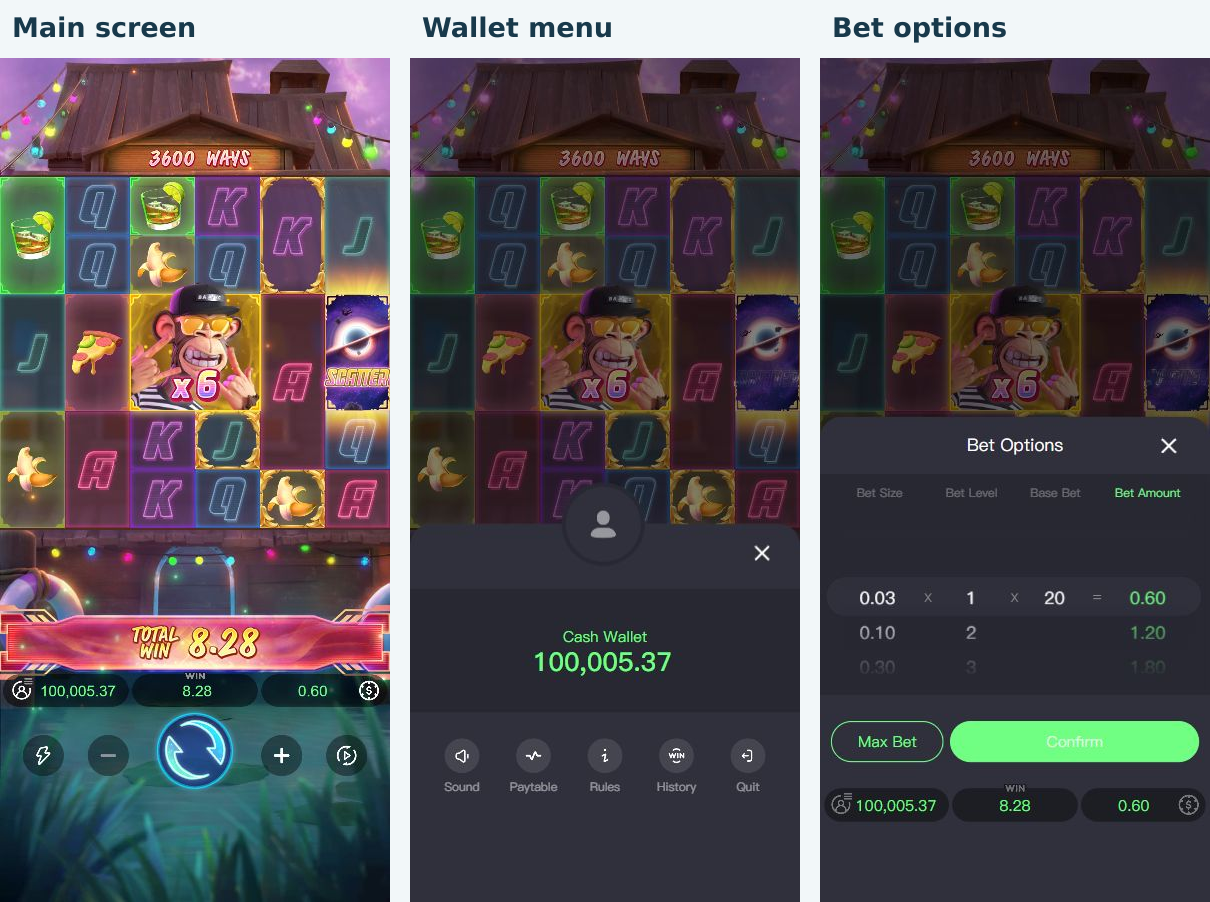
Left: the portrait main screen. Centre: the opened wallet menu. Right: Bet Options, where 0.03 × Level 1 × Base Bet 20 gives a 0.60 total bet. Sound and Max Bet were visible; audio quality and a Max Bet spin were not tested.
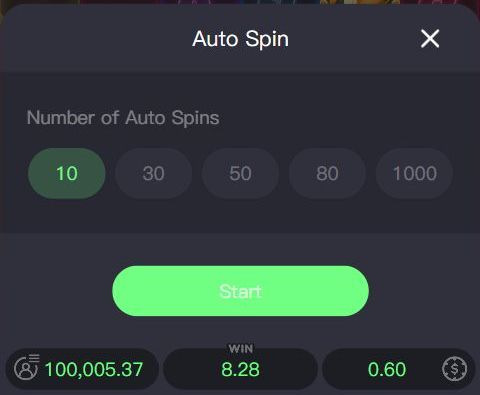
The actual Auto panel offers 10, 30, 50, 80 and 1,000 spins. It was inspected and closed without starting Auto; no automatic-stop behaviour is claimed.
Portrait is the clearer fit
At a simulated 390 × 844 portrait viewport, the wallet, bet and win information were readable and the menus responded. At 844 × 390 landscape, the whole vertical stage shrank to roughly 220 pixels wide. The main controls were not cropped, but the smaller lettering and icons made it a less comfortable way to inspect a result. I would use portrait for reading this game.
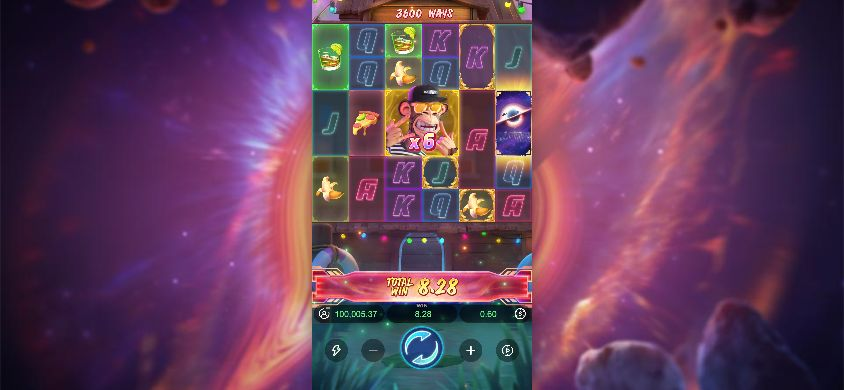
Landscape main screen at its actual 844 × 390 viewport proportions. The design preserves the portrait stage instead of spreading the controls across the available width.
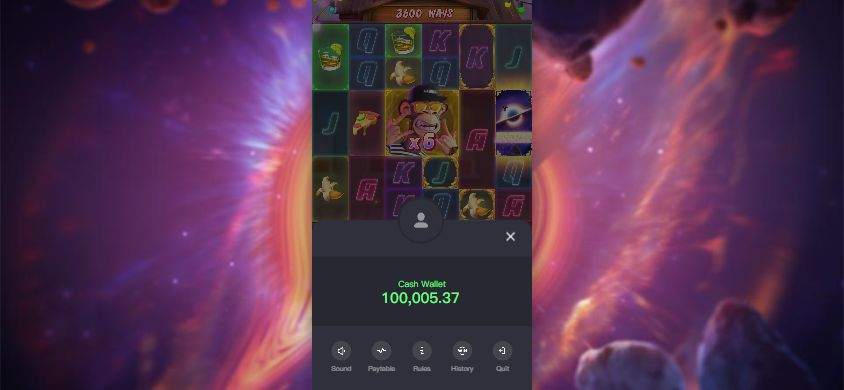
The wallet menu also responded at the same simulated landscape size.
Read the ways, then check the full result
Wild Ape uses six reels and six rows, with 256–32,400 ways. Ordinary symbols pay for matching on at least three successive reels, starting on the left. Their vertical positions can differ. You multiply the number of matching symbols on each participating reel to find the winning ways; you do not trace one of a small set of fixed lines.
A large symbol spanning two or three cells still counts as one symbol. This is the most useful correction to make before calculating a win. Counting occupied cells instead of actual symbols can greatly exaggerate the number of ways. The regular Wild appears only on reels 2–5 and substitutes for ordinary symbols, not Scatter.
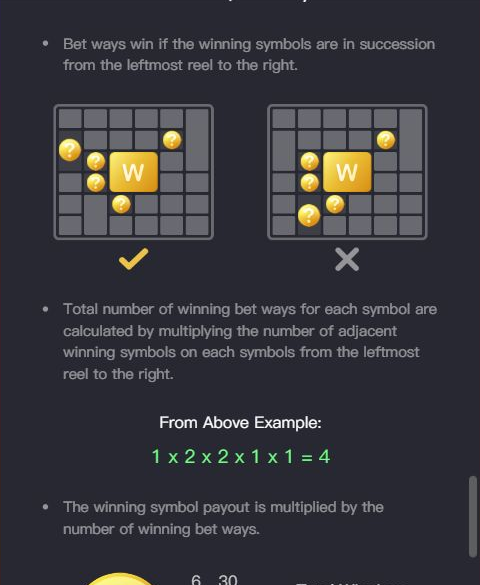
The current Paytable’s own illustrative path diagram. The ticked arrangement starts on the first reel; the crossed arrangement does not. Its displayed symbol-count product is 1 × 2 × 2 × 1 × 1 = 4 ways. This is a Help illustration, not a recorded win from our sample.
A separate calculation at our bet: suppose a qualifying three-reel combination of an A, K, Q, J or 10 has two matching symbols on reel one, one on reel two and one on reel three. That gives 2 × 1 × 1 = 2 ways. The current three-reel coefficient for these symbols is 1, so at Bet Size 0.03 and Level 1, before an active multiplier, the payout is 1 × 0.03 × 1 × 2 = 0.06 demo units. After a 0.60 paid bet, that isolated result would still be a 0.54 loss. This is a worked rules example, not a reconstruction of a sampled board.
Use the symbol atlas’s payout coefficients. The symbol atlas gives the complete reel-count bands for the object symbols and letters. Multiply the coefficient by Bet Size, Bet Level, winning ways and any active multiplier. Do not multiply it directly by the full 0.60 bet.
The symbol atlas uses descriptive names for the artwork. After a winning round, its winning symbols disappear and new symbols cascade into the gaps. Keep reading until the entire paid spin has finished: the award shown during one cascade is not an extra new wager, and an intermediate cumulative counter should not be added again to the final total.
Two locks, gold frames and Free Spins
The central ape rewards a continuing cascade
At the start of a base-game spin, the Wild Bored Ape occupies reels three and four and is held by two chained padlocks. A win in the first round removes one lock. A win in the second removes the other, making the giant Wild active in the third round at ×2. Further winning rounds raise the active multiplier by two: ×2, ×4, ×6 and so on. It does not double to ×8 after ×4.
This gives the cascade a clear purpose beyond adding small awards. Two early wins can open a much more useful centre for the next round. It also makes the game slightly deceptive at a glance: an impressive-looking ape is present even while it is locked and inactive. Check its state before assuming it is helping a combination.
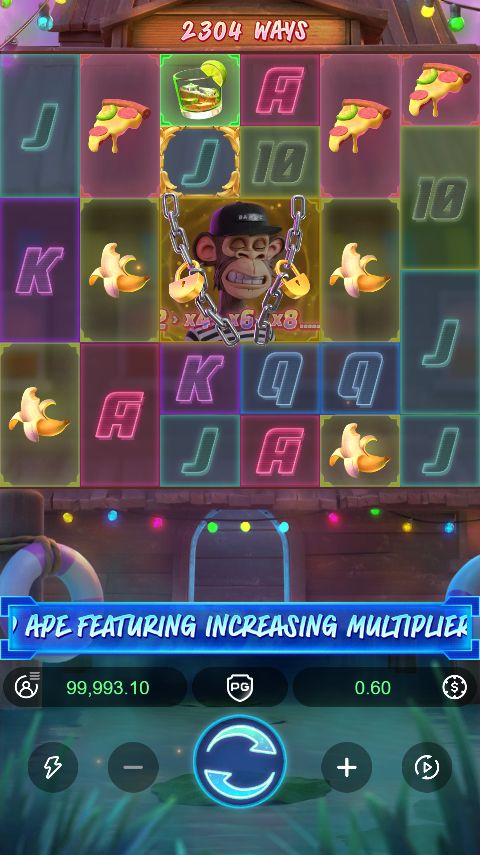
The actual screen before paid spin 49: the central ape is visibly locked. This is a starting-state illustration, not an award or proof that an unlock has already happened.
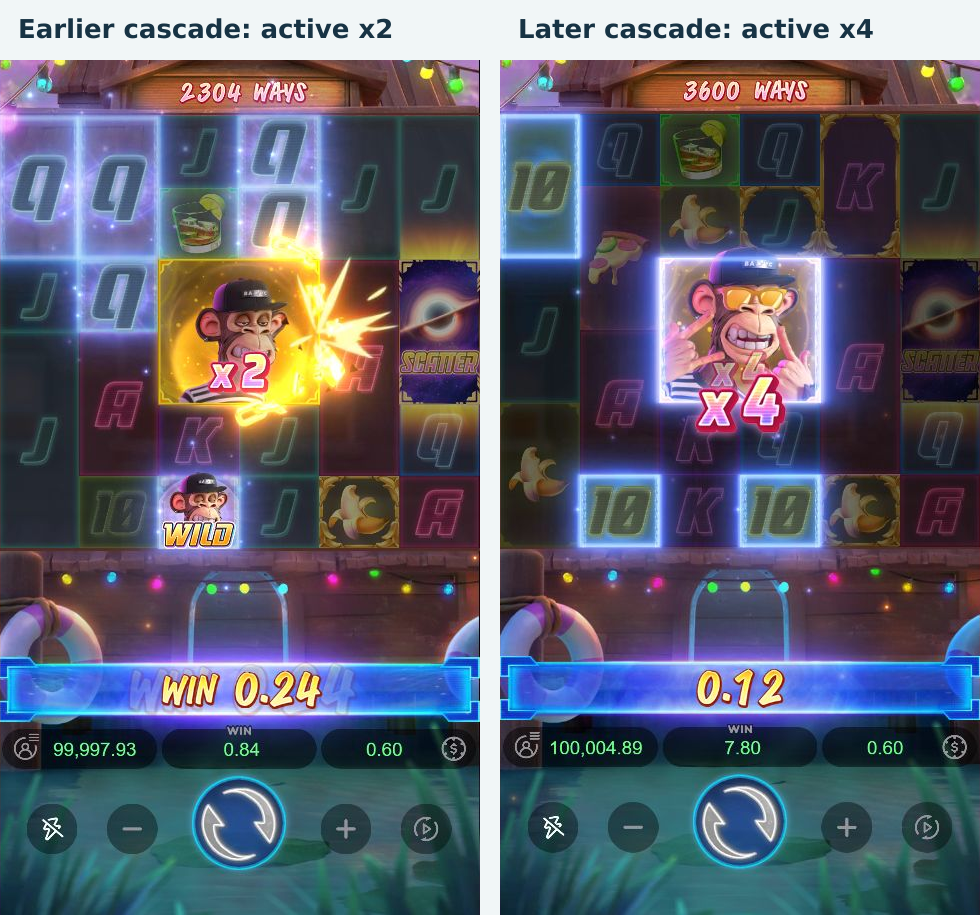
Two observed states from the same Normal-speed paid spin 103. The earlier ×2 state shows a 0.24 round award and cumulative WIN 0.84; the later ×4 state shows a 0.12 round award and cumulative WIN 7.80. These are selected real screenshots, not every intervening frame. The complete spin later settled at 8.28, outside the recorded clip.
Gold frames can make the next round stronger
Some ordinary symbols on reels 2–5 have gold frames and can occupy one to three cells. If one contributes to a win, it transforms into a Wild after the new symbols cascade down for the next round. The conversion applies to eligible ordinary symbols; it does not turn an existing Wild or Scatter into another special award. That delayed transformation is why it is worth following a gold-framed winner into the next board rather than judging only the first payout.
A natural Free Spins sequence, counted once
Four Scatters anywhere award ten free spins. Each extra Scatter adds two more, and the feature can retrigger. Each free spin begins with the central Wild active at ×2, then adds two to its multiplier after each further win in that spin. The triggering Bet Size and Bet Level carry into the free rounds.
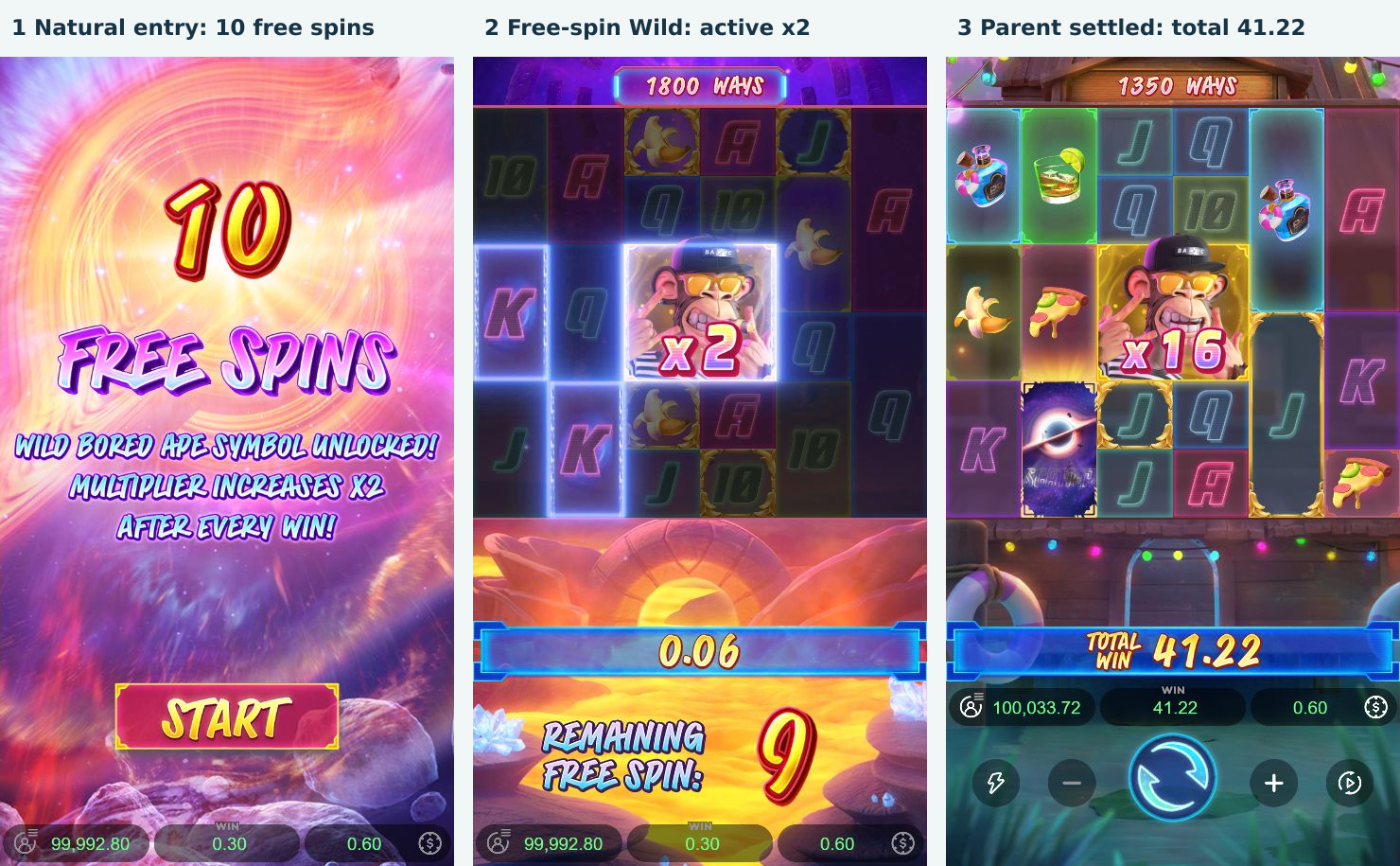
Chronological images from physical spin 49, which is spin 48 in the primary Turbo sample. Left: ten Free Spins entry. Middle: an active ×2 Wild during a free round, with nine free spins remaining. Right: the complete paid parent settles at TOTAL WIN 41.22. The 0.30 and 0.06 visible during the feature are intermediate displays, not extra amounts to add to 41.22.
This was the largest whole-spin payout in the main sample. The original paid spin cost 0.60; all its cascades and naturally triggered free rounds together returned 41.22, giving a net gain of 40.62. Its payout was 68.70 times the paid bet. The free rounds were not charged as separate paid spins or counted again in the 100-spin total.
That sequence is also the best argument for the game’s design. The feature makes immediate use of the central Wild, while the gold-frame rule and the increasing multiplier keep individual free spins interesting. It is much more rewarding to understand the changing board than simply to watch the final celebration.
Bet size, RTP and the real limits
Item | What the evidence establishes |
|---|---|
Actual paid bet | 0.60 demo units in all 100 primary spins and all three Normal supplements |
Bet formula | Base Bet 20 × Bet Size × Bet Level; at 0.03 and Level 1, the total is 0.60 |
Current Help range | Bet Size 0.03–0.90 and Level 1–10 imply 0.60–180.00 total; only 0.60 was wagered |
Theoretical RTP | 96.73% in PG SOFT’s game-information PDF; the current demo Help does not state an RTP |
Volatility | High, as labelled in that supplier PDF |
Maximum whole-spin win | 10,000× the bet amount in current Help; this is not the giant Wild’s multiplier ceiling |
BUY / EX in this demo | No operable entry found in the inspected main screen or opened panels; no purchase was made |
“Base Bet 20” is a calculation factor, not a charge of 20 units. Likewise, the paytable coefficient uses Bet Size × Bet Level before ways and multipliers, while the total wager also includes Base Bet 20. Keeping those two amounts separate prevents the most common overstatement of this game’s awards.
The PG SOFT game-information PDF, marked version 1.0.r4 and updated 22 July 2025, gives an overall theoretical RTP of 96.73% and High session volatility. RTP describes a long-run mathematical expectation, not the return a particular player or short session should receive. The sample’s 256.20% return below cannot confirm or disprove it. The PDF’s separate euro-denominated bet example is also not the currency or range of this demo.
The supplier PDF includes a Feature Buy section, but the current demo’s inspected controls and complete Help did not offer an operable BUY or EX entry. I would not quote a purchase price for this configuration. A search result or another version’s feature description is not enough to establish a button you can actually use here.
The 10,000× limit applies to the total win of the main game or Free Spins feature, at which point the spin ends. The current Help does not separately state a maximum for the giant Wild’s own multiplier. Those are different limits, and the ×16 left on our largest result screen is just an observed state.
For a general demonstration of how cost, hit frequency and payout size interact, use the slot simulator. It is an educational tool, not a replica of Wild Ape’s undisclosed probabilities or a way to predict the next result. Decide on a spending limit before playing for money; a larger wager changes your exposure, not a losing run’s obligation to turn around.
What our 100 Turbo spins actually returned
The main sample contains exactly 100 completed Turbo paid spins recorded on 5 October 2026 UTC, or 6 October in the Philippines. Each cost 0.60 demo units. A paid spin’s final result includes every cascade and any natural Free Spins it triggered. Three completed Normal-speed spins were kept separately: one after a session recovery and two for slower process capture.
Scope | Spins | Cost | Payout | Net | Sample return |
|---|---|---|---|---|---|
Primary Turbo sample | 100 | 60.00 | 153.72 | +93.72 | 256.20% |
Normal, physical spin 23 | 1 | 0.60 | 0.03 | −0.57 | 5.00% |
Normal, physical spin 102 | 1 | 0.60 | 0.03 | −0.57 | 5.00% |
Normal, physical spin 103 | 1 | 0.60 | 8.28 | +7.68 | 1,380.00% |
All completed paid spins | 103 | 61.80 | 162.06 | +100.26 | 262.23% |
All monetary figures are demo units, not verified Philippine pesos. The 31 paying spins in the main sample break down into 12 net winners and 19 payouts below the 0.60 cost. The other 69 spins paid zero. There were no break-even spins, so 88 of the 100 ended at a net loss. The longest consecutive run of net-losing spins was 14.
The positive overall result therefore coexisted with frequent losses. The biggest parent alone returned 41.22, around 26.8% of all main-sample payouts. I would pay more attention to that uneven distribution than to the headline 256.20%: this run shows why a lively win display and a profitable session are different things.
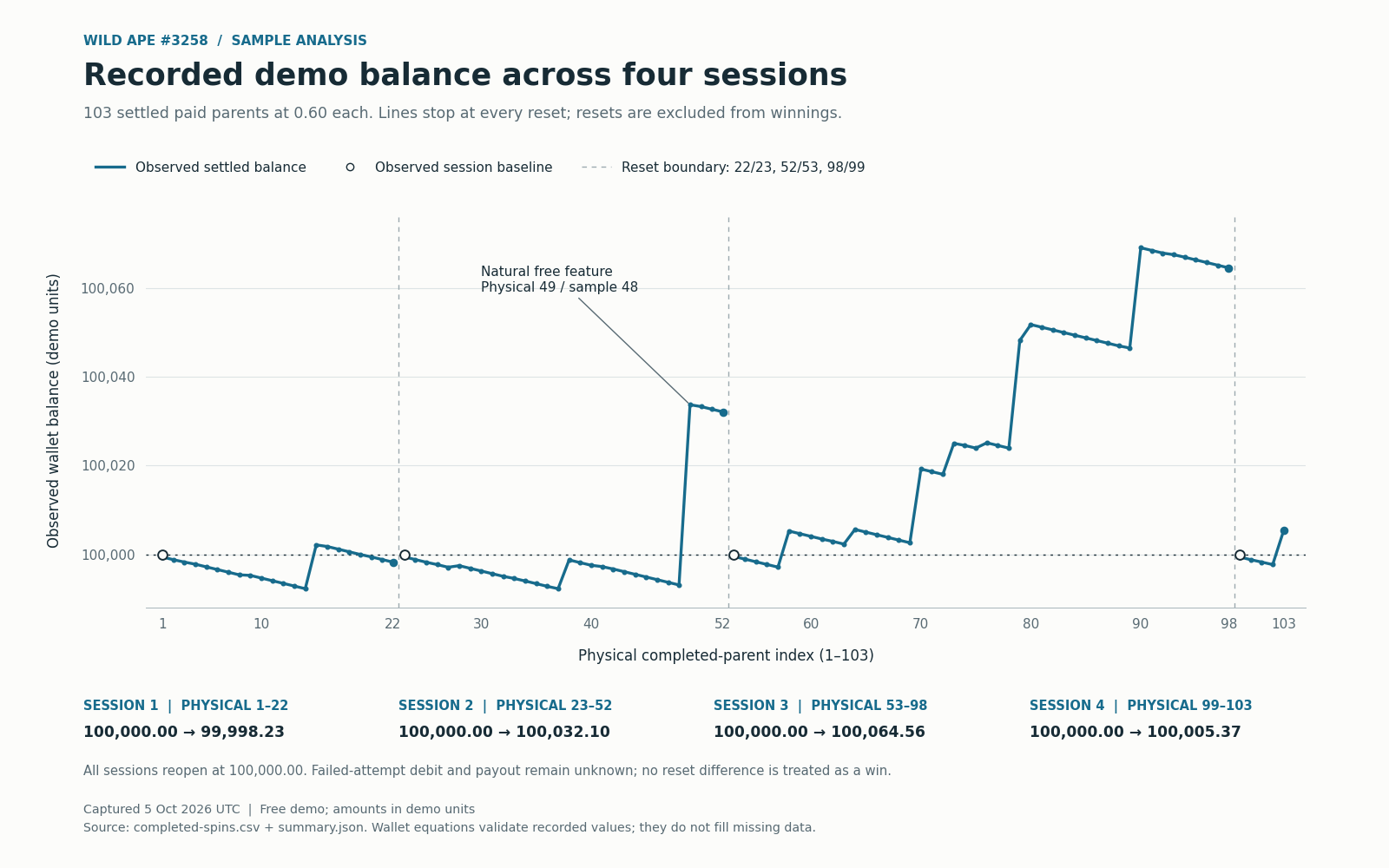
Actual wallet observations for all 103 completed spins. Lines break at the three session changes; the new demo baselines are not counted as game winnings.
There were four demo sessions. The observed changes from the last completed wallet to the next baseline were +1.77, −32.10 and −64.56. Because unresolved server requests occurred between those observations, these differences do not establish the old session’s final wallet or prove a refund. They are excluded from the payout totals.
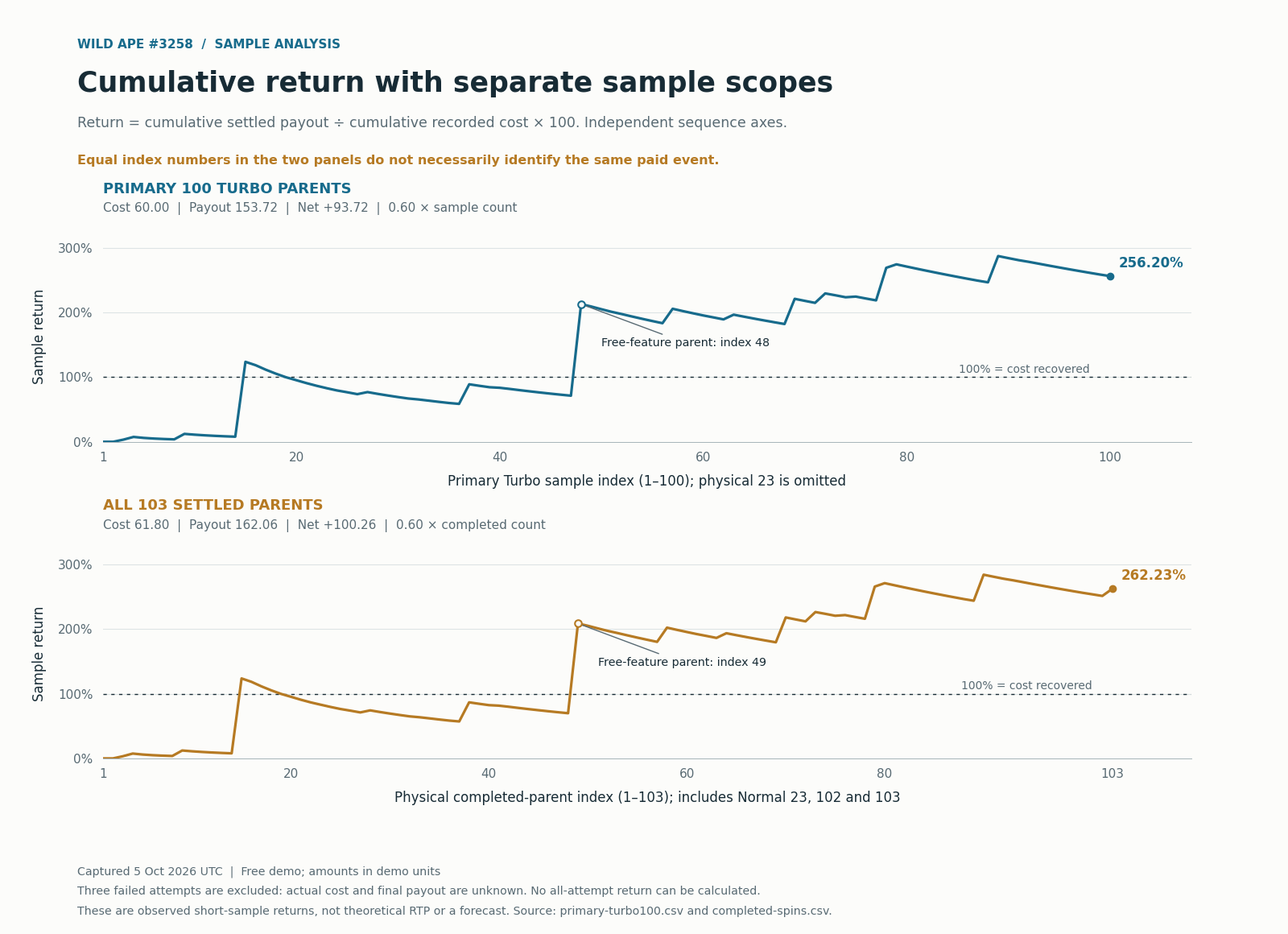
Cumulative sample return starts from the first completed spin in each stated scope: total payout divided by total actual cost. The two panels use different sequence indexes. Their final values are 256.20% for the primary 100 and 262.23% for all 103; neither line is theoretical RTP.
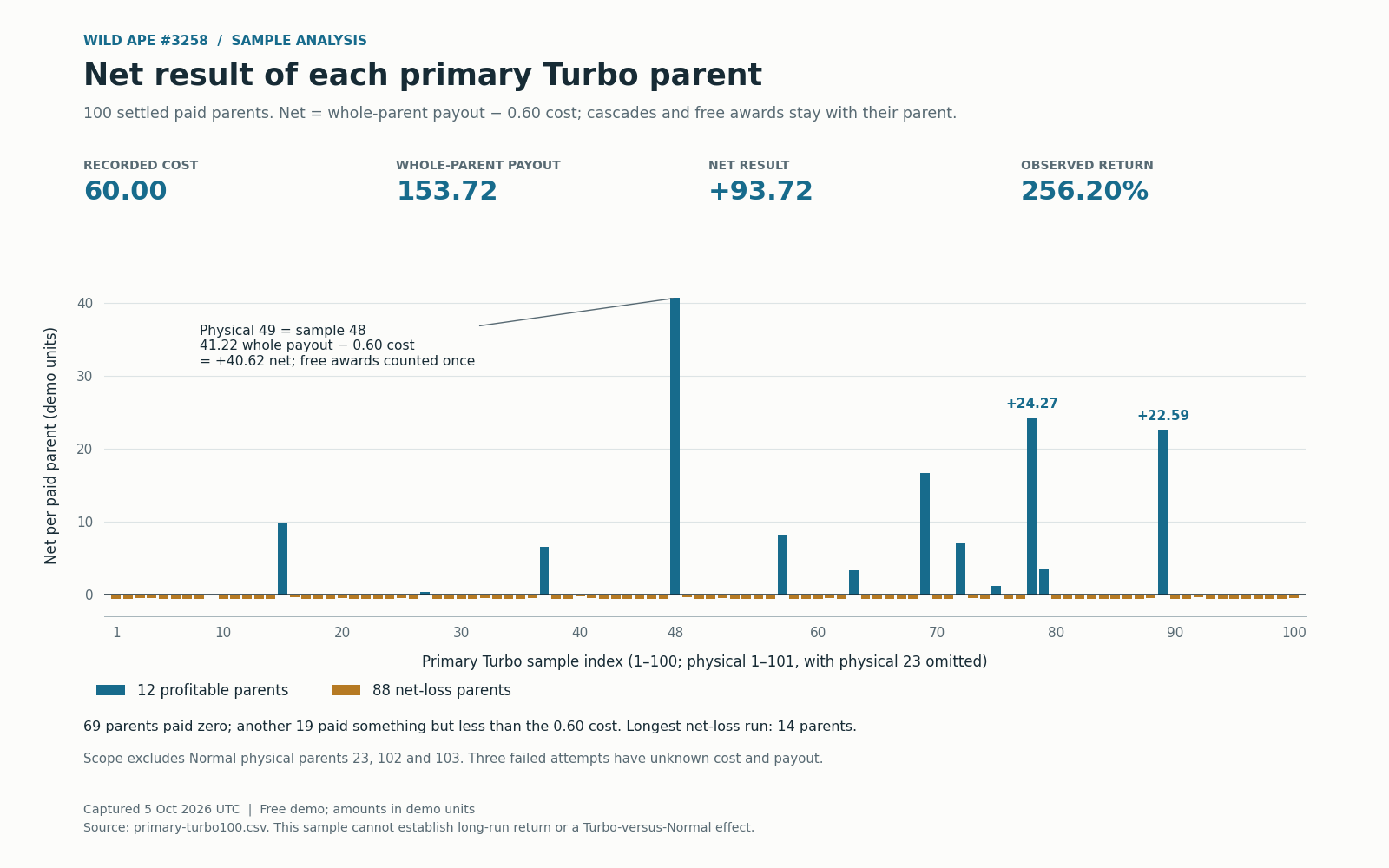
Each bar is a complete primary paid spin’s payout minus its 0.60 cost. The natural-feature parent at primary spin 48, physical spin 49, contributes +40.62 once. Free-spin children are not extra paid events.
Three failed server-request attempts have no independently confirmed debit or final payout and are excluded from these settled-only totals. The total financial result across every attempted request is therefore unknown. This is more precise than assigning each failed request a 0.60 loss or assuming it cost nothing. The failures also do not establish a single cause or a general reliability rate.
Normal and Turbo were not run as a controlled comparison. The three Normal results cannot tell us whether speed changes the chance of winning. Turbo’s documented purpose is to shorten the reel-spin presentation; I prefer Normal when learning the rules because it gives more time to follow gold frames and unlocks.
Verdict: engaging cascades, demanding small-screen reading
Wild Ape or Fortune Tiger?
Fortune Tiger by PG SOFT is the useful contrast if you want a simpler board from the same supplier. The difference is how the result develops, not which game happened to pay more in a short demo.
Decision point | Wild Ape #3258 | Fortune Tiger |
|---|---|---|
Board and reading | 6 × 6, variable ways; large symbols still count once | 3 × 3 with five fixed paylines |
Feature progression | Cascades unlock the central Wild; gold winners can become Wilds | A randomly triggered respin feature holds chosen-symbol and Wild positions while additional symbols arrive |
Multiplier rule | Central Wild activates at ×2, then adds two after further wins | ×10 when every symbol on the reels participates in a win; this does not require every symbol to be identical |
Best reason to choose | You want to follow a changing board and connected features | You prefer a compact fixed-line layout and a more direct board-filling feature |
Editorial score: 7.5/10. The locks and gold frames make Wild Ape’s cascades distinctive, and the natural Free Spins sequence shows how well those rules can work together. I mark it down for dense result-reading and the cramped landscape presentation. The score reflects clarity, feature design and observed usability, not the profitable sample or the supplier’s maximum-win claim.
Start in Normal speed, confirm the total bet and watch how a gold-framed winner changes on the next round. Use the demo on this page to learn those transitions before considering real-money play. Stop at your preset time and spending limits; this game is entertainment, not a reliable source of income.
Wild Ape #3258 by PG SOFT FAQs
Answers to common questions about Wild Ape #3258 by PG SOFT.
Wild Ape #3258 by PG SOFT Reviews
 No Player Reviews Yet
Played Wild Ape #3258 by PG SOFT? Share your experience with other players.
 Write A Review