
3 Super Ace by JILI
Play 3 Super Ace by JILI In Demo Mode
by JILI Games



 Scatter3 Super Ace - Gold Scatter (EX)
- EX mode
- Spin cost: 3× base
- Free trigger required
- All three abilities
 Scatter3 Super Ace - Green Scatter
- Extra Spins
- 15 starting Free Spins
- Free Games ability
- Activation required
 Scatter3 Super Ace - Blue Scatter
- Golden Reel
- Free Games ability
- Golden on reel 3
- Activation required
 Scatter3 Super Ace - Red Scatter
- Bonus Boost
- Free Games ability
- 3× / 6× / 9× / 15×
- Activation required
 Wild3 Super Ace - Little Joker
- Same-position change
- Substitutes paying cards
- Cannot replace Scatter
- Golden-card result
 Wild3 Super Ace - Big Joker
- Copies 1–4 Jokers
- Targets reels 2–5
- Skips Scatter/Joker
- Golden-card result
 Paying Symbol3 Super Ace - Clubs ♣ (card suit)
- 3–5 adjacent reels
- Starts on reel 1
- Paytable: Bet 3
- Cascade multiplier
 Paying Symbol3 Super Ace - Golden Clubs ♣ (card suit)
- Reels 2–4
- Same symbol payout
- Winning card → Joker
- Cascade multiplier
 Paying Symbol3 Super Ace - Diamonds
- 3–5 adjacent reels
- Starts on reel 1
- Paytable: Bet 3
- Cascade multiplier
 Paying Symbol3 Super Ace - Golden Diamonds
- Reels 2–4
- Same symbol payout
- Winning card → Joker
- Cascade multiplier
 Paying Symbol3 Super Ace - Hearts
- 3–5 adjacent reels
- Starts on reel 1
- Paytable: Bet 3
- Cascade multiplier
 Paying Symbol3 Super Ace - Golden Hearts
- Reels 2–4
- Same symbol payout
- Winning card → Joker
- Cascade multiplier
 Paying Symbol3 Super Ace - Spades ♠ (card suit)
- 3–5 adjacent reels
- Starts on reel 1
- Paytable: Bet 3
- Cascade multiplier
 Paying Symbol3 Super Ace - Golden Spades ♠ (card suit)
- Reels 2–4
- Same symbol payout
- Winning card → Joker
- Cascade multiplier
 Paying Symbol3 Super Ace - Jack
- 3–5 adjacent reels
- Starts on reel 1
- Paytable: Bet 3
- Cascade multiplier
 Paying Symbol3 Super Ace - Golden Jack
- Reels 2–4
- Same symbol payout
- Winning card → Joker
- Cascade multiplier
 Paying Symbol3 Super Ace - Queen
- 3–5 adjacent reels
- Starts on reel 1
- Paytable: Bet 3
- Cascade multiplier
 Paying Symbol3 Super Ace - Golden Queen
- Reels 2–4
- Same symbol payout
- Winning card → Joker
- Cascade multiplier
 Paying Symbol3 Super Ace - King
- 3–5 adjacent reels
- Starts on reel 1
- Paytable: Bet 3
- Cascade multiplier
 Paying Symbol3 Super Ace - Golden King
- Reels 2–4
- Same symbol payout
- Winning card → Joker
- Cascade multiplier
 Paying Symbol3 Super Ace - Ace
- 3–5 adjacent reels
- Starts on reel 1
- Paytable: Bet 3
- Cascade multiplier
 Paying Symbol3 Super Ace - Golden Ace
- Same symbol payout
- Cascade multiplier
- Reels 2–4
- Winning card → Joker
3 Super Ace by JILI Expert Review


Updated:
Here you can find detailed review information about 3 Super Ace by JILI.
1. What makes 3 Super Ace different?
3 Super Ace adds three Free Game abilities to JILI’s familiar card-and-cascade format. Red raises the multipliers, blue puts Golden Symbols on the third reel, and green adds starting spins.
What I liked
✅ I like that each coloured ability has a distinct, visible effect.
✅ Golden-to-Joker changes connect one cascade to the next
✅ EX and three buy tiers offer clearly different feature access
✅ Portrait keeps the board and controls together
What I didn’t like
❌ A Scatter appearing is not the same as an ability activating
❌ Big Joker copying adds rules beyond the Little Joker examples
❌ EX triples the debit; BUY uses a separate Bet setting
❌ Landscape leaves a small central board and smaller controls
My verdict is 8.0/10 for its readable feature progression and clear differences between bonus configurations. The extra settings take some learning, and the landscape layout is cramped. It suits players who enjoy following how one winning card creates the next cascade. It is a less comfortable fit if you want a simple, one-cost spin button. The score reflects those design trade-offs, not the result of our demo sample.
The official title is 3 Super Ace, with the number first. “Super Ace 3” is the common search spelling. This review covers JILI game 588, whose official listing gives a March 2026 publication month. It is a separate game from Super Ace 2 and its Stacked Golden Joker.
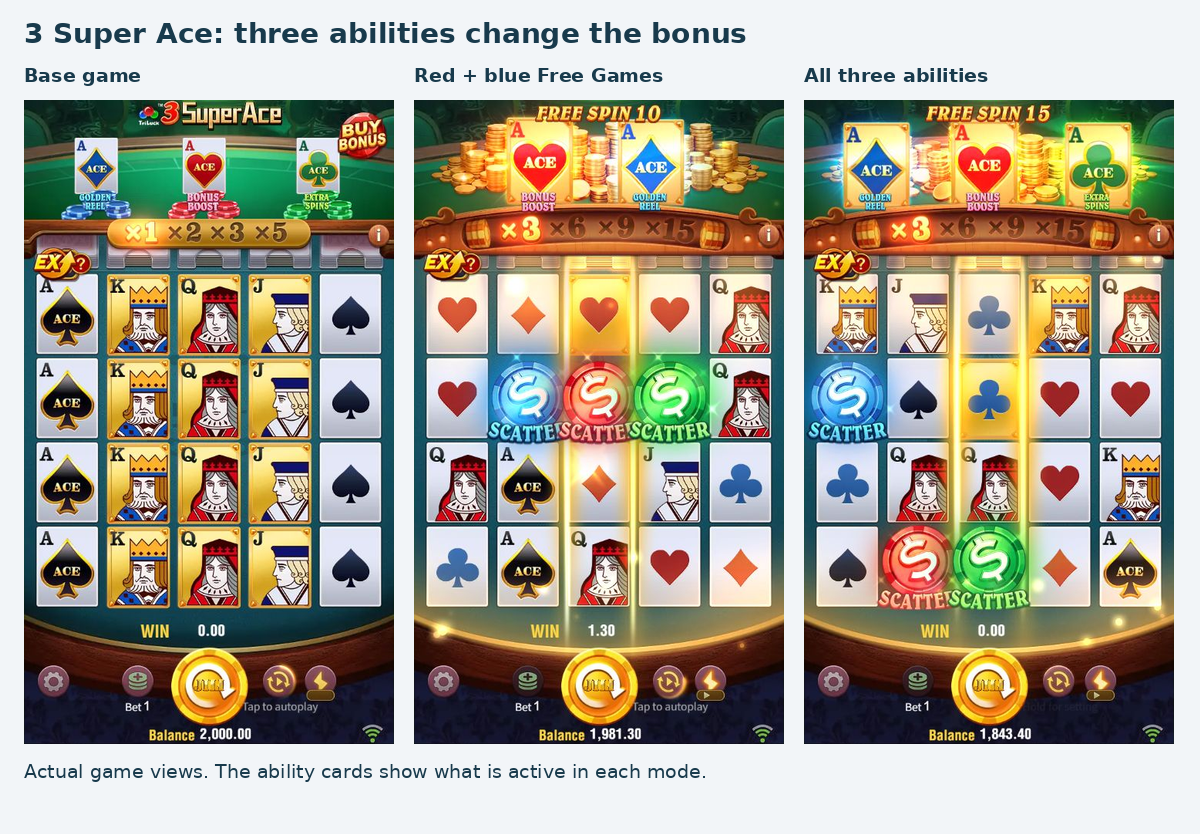
Actual game views. The ability cards show what is active in each mode.
Before starting a demo session, choose normal speed and check both the main Bet and the Buy Bonus Bet. Demo credits have no cash value. All amounts in this review are credits; the game did not identify them as Philippine pesos.
A silent 12.97-second excerpt from the 30-credit buy, assembled from time-ordered gameplay screenshots. It shows part of Free Games, not the final payout. The excerpt closes at WIN 10.00; the full purchase later settled at 23.50.
Philippine search interest: Ahrefs estimated 900 monthly searches for “super ace 3” and 100 for “3 super ace” when checked on 5 October 2026. These spellings can overlap. Some interest in the first spelling predates JILI’s March 2026 listing, so the figures describe searches, not this game’s player count.
A separate Google Trends check for the Philippines over the past 12 months was sparse, with many zero-index weeks and insufficient data for “super ace3” and “super ace 3 demo”. It does not support a reliable growth forecast.
2. Find the controls before your first spin
The three ability cards sit above the multiplier strip, leaving the 5-reel, 4-row board easy to follow. The layout is quite busy, but the most important checks are close to the reels: the active multiplier, EX status and current Bet. WIN is a payout display. To know whether a round made a profit, subtract its actual cost.
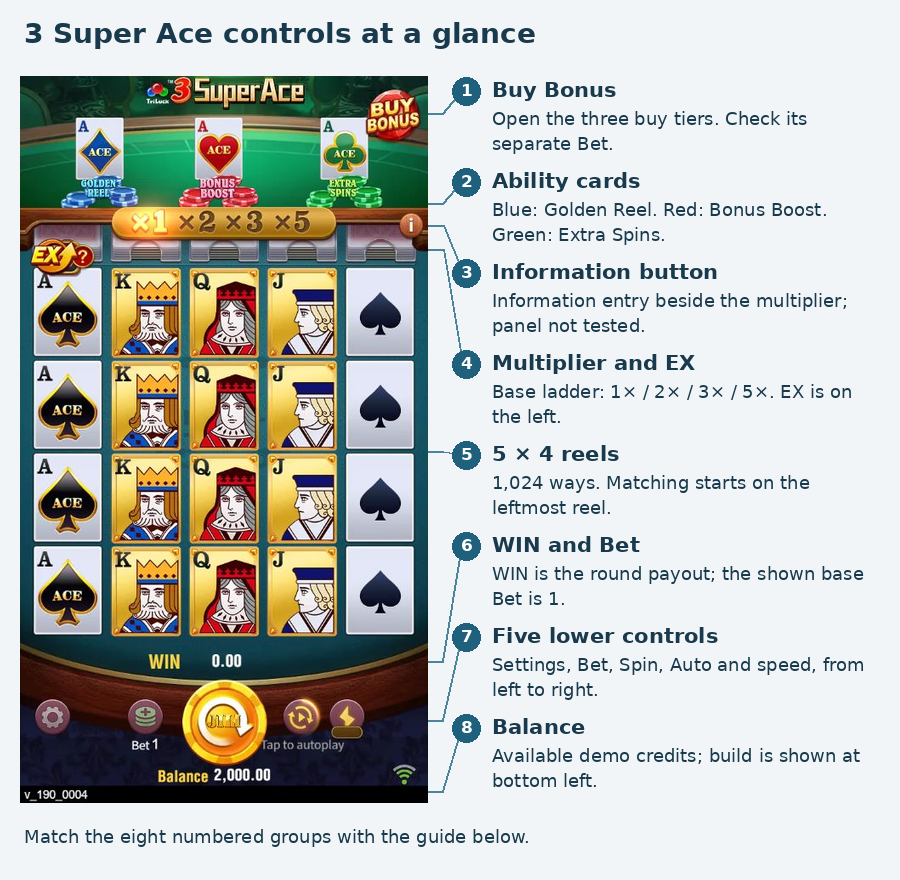
Eight numbered groups locate the controls without covering the game screen.
Buy Bonus: Open the three buy tiers. Check its separate Bet.
Ability cards: Blue: Golden Reel. Red: Bonus Boost. Green: Extra Spins.
Information button: Information entry beside the multiplier; panel not tested.
Multiplier and EX: Base ladder: 1× / 2× / 3× / 5×. EX is on the left.
5 × 4 reels: 1,024 ways. Matching starts on the leftmost reel.
WIN and Bet: WIN is the round payout; the shown base Bet is 1.
Five lower controls: Settings, Bet, Spin, Auto and speed, from left to right.
Balance: Available demo credits; build is shown at bottom left.
Main Bet and BUY Bet are separate checks
The main Bet menu has 15 choices: 1, 2, 3, 5, 8, 10, 20, 50, 100, 200, 300, 400, 500, 700 and 1,000. In ordinary mode, the selected base bet is the spin cost. With EX enabled, the actual cost is three times that base bet.
The more easily missed detail is inside Buy Bonus. Our main game was set to 1, but the buy menu first opened at Bet 3 and quoted 90, 225 and 390. Setting the menu’s own Bet to 1 changed the three prices to 30, 75 and 130. I would check the displayed price every time I open it rather than assume it inherited the main setting.
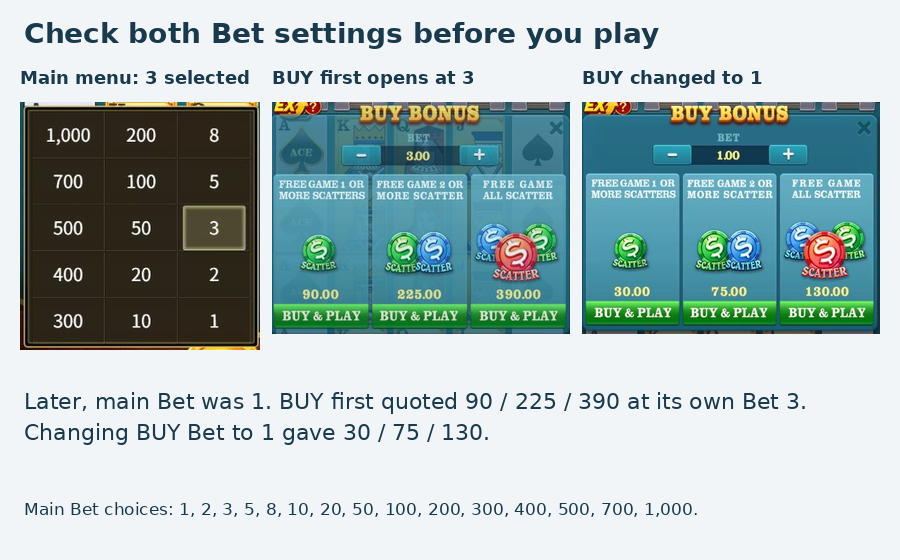
The main-menu image shows an earlier Bet 3 selection. For the two later BUY views, main Bet was 1; BUY kept its own setting.
Speed, Auto and help
Spin starts a round. The Help describes Turbo on the speed button and Super Turbo on a double press. Faster play changes the presentation speed; it does not improve the odds. Normal speed is the better starting point for learning the Golden-card flips and multiplier changes.
Auto has options for a spin count, balance limits, a single-win limit and stopping at a bonus, where available. Review those settings before using it. The options menu also exposes the rules, sound toggle and History. The presence of these controls is not an audio-quality or account-history test. Selected settings carried into later manual spins within a session; I would recheck them after re-entering the game.
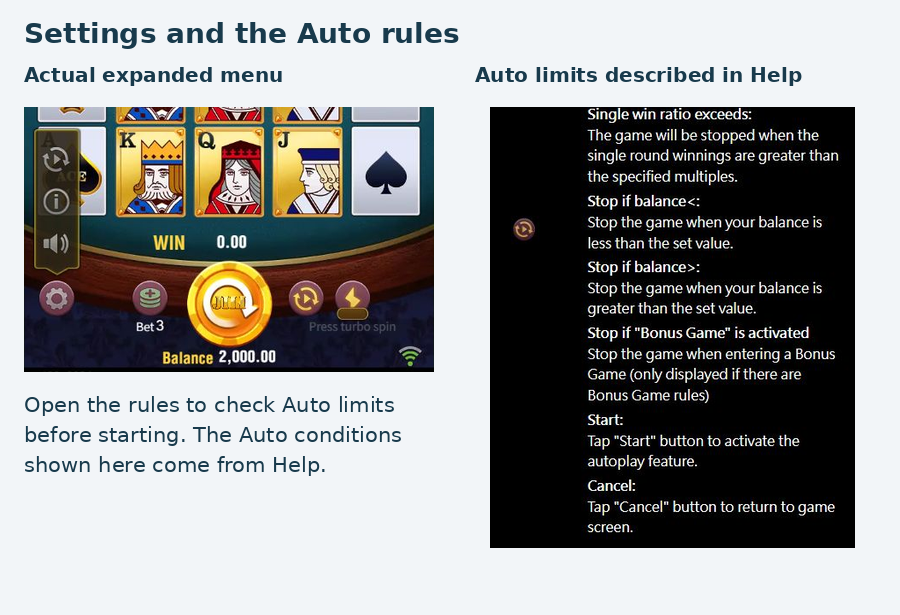
The menu is an observed game view; Auto stopping conditions are Help rules, not tested stop events.
Portrait is the clearer layout
In a 390 × 844 portrait view, the whole board and bottom controls remained together, and the Bet menu and scrolling help were usable. At 844 × 390 in landscape, the game kept a narrow portrait panel in the middle. The surrounding space increased while the amounts and buttons became smaller. I prefer portrait for reading the rules and checking costs.
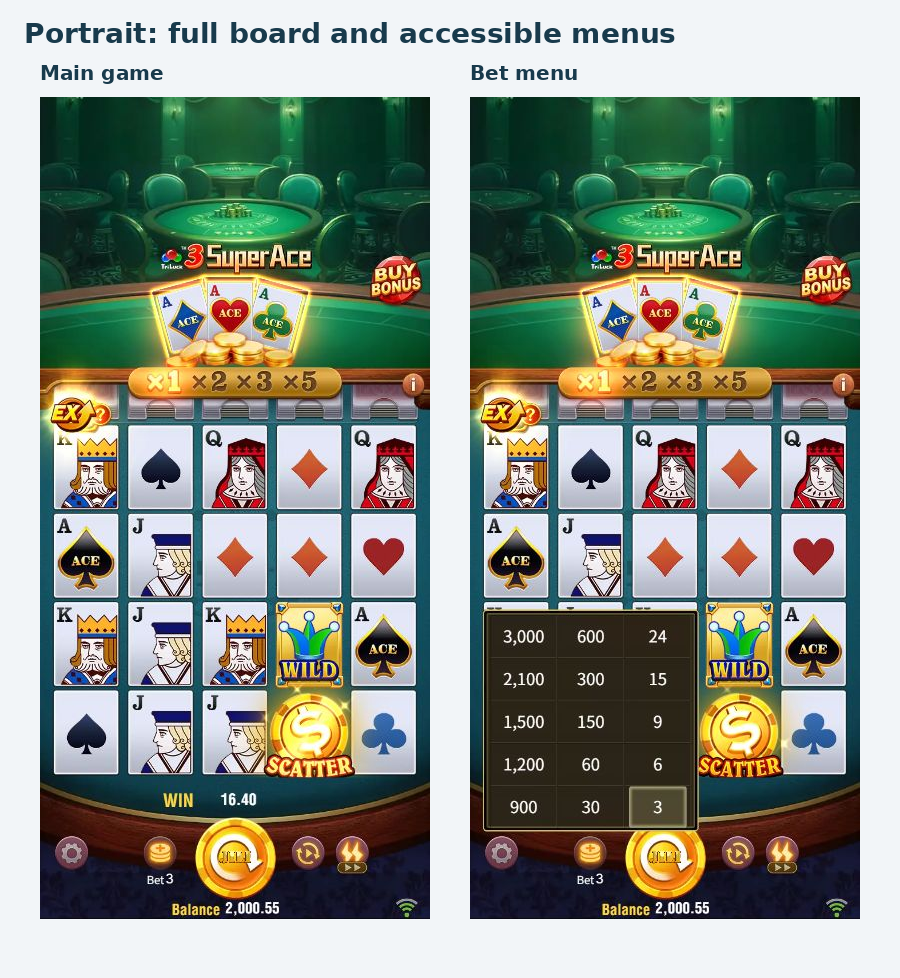
The portrait layout keeps the board, current cost and lower controls together.
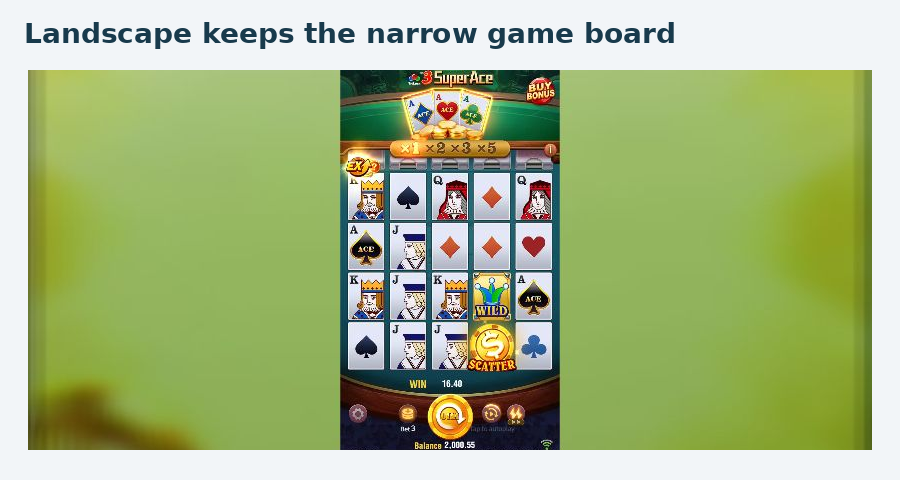
Landscape adds side space rather than a wider control layout.
These narrow-screen checks used resized desktop views. Physical-phone touch controls, sound, Philippine mobile connections and recovery from an interrupted live round were not assessed.
3. How a paid round works
There are 1,024 ways to win. A qualifying match needs at least three adjacent reels, starting on the leftmost reel, but the matching symbols can sit in any row. You do not need a straight line. Winning cards disappear, new cards fill the spaces and the same paid round can produce another win.
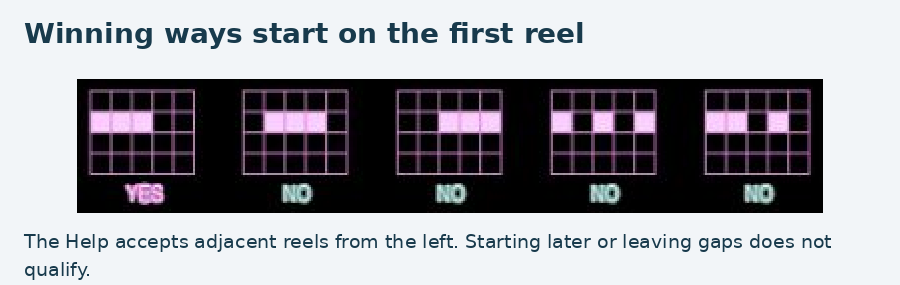
Rule illustration from this game’s Help: start on the leftmost reel and continue without a gap.
For example, two matching cards on reel 1, one on reel 2 and three on reel 3 create 2 × 1 × 3 = 6 matching ways, if that symbol has a qualifying three-reel win. That is an illustration of the ways calculation, not an extra recorded result. The number of matching ways and the current cascade multiplier both affect the payout.
Ordinary cascades use 1×, 2×, 3× and 5×. The first win uses 1×; consecutive winning cascades step through the ladder. The multiplier resets when the sequence stops or a new round begins. A busy animation can therefore contain several wins, yet still count as one paid round.
The card values in brief. The Help paytable below was displayed at Bet 3. These are credit amounts per winning way before the cascade multiplier, not bet multipliers. Golden and ordinary versions of the same card pay equally. The separate symbol cards provide the individual images and details.
Card | 3 adjacent reels | 4 adjacent reels | 5 adjacent reels |
|---|---|---|---|
A | 1.50 | 4.50 | 7.50 |
K | 1.20 | 3.60 | 6.00 |
Q | 0.90 | 2.70 | 4.50 |
J | 0.60 | 1.80 | 3.00 |
Spade or heart | 0.30 | 0.90 | 1.50 |
Diamond or club | 0.15 | 0.45 | 0.75 |
Golden cards appear on reels 2, 3 and 4. When one participates in a winning elimination, it flips into a Joker in the same position. That is their main attraction: the card can help form a win, then leave a useful substitute for the next cascade. Little Jokers stay in that original position. Jokers substitute for regular paying symbols, not the Scatter chips.
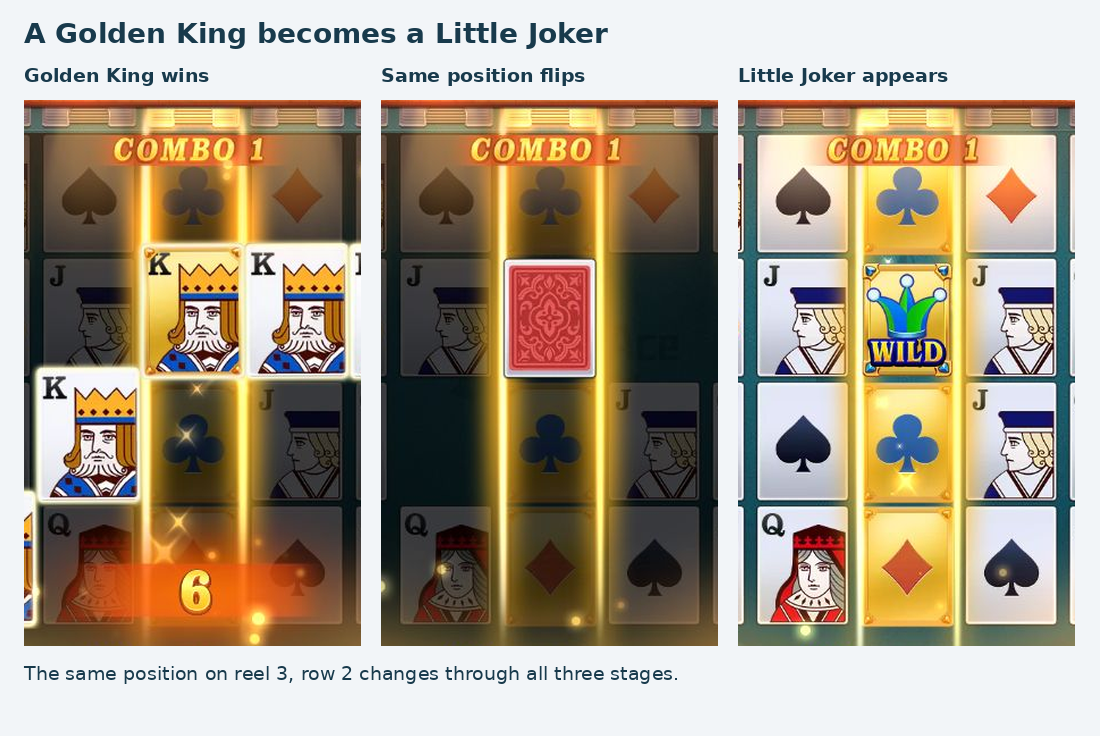
The same position on reel 3, row 2 changes through all three stages.
In our natural Free Game, a Golden King on reel 3, row 2 turned to a red card back and then a Little Joker. The Help also describes a Big Joker that creates 1–4 additional Big Jokers on reels 2–5, excluding Scatter and Joker positions. That complete copying event was not captured in the examples reviewed here. Several Little Jokers, or enlarged Wild artwork in a win celebration, do not establish that the Big Joker copied.
4. Read the three abilities, then choose the mode
The colours are more useful once you separate a Scatter appearing on the board from an ability actually activating. Watch the active cards at the top when Free Games begin. Seeing red, blue and green chips together does not by itself mean all three upgrades are running.
Ability | Effect in Free Games | What to watch |
|---|---|---|
Red: Bonus Boost | Multiplier ladder becomes 3× / 6× / 9× / 15× | The highlighted step above the reels |
Blue: Golden Reel | Guarantees a Golden Symbol on reel 3 | The middle reel and the Golden-card flips |
Green: Extra Spins | Raises the starting Free Spins from 10 to 15 | The opening Free Spin count |
Without the red upgrade, the Free Game multiplier ladder is 2×, 4×, 6× and 10×. Without the green upgrade, the starting allocation is 10 spins. Abilities can activate separately or together. The reviewed Help does not state a fixed three-Scatter trigger threshold, so I would not carry that rule over from an earlier Super Ace title.
What happened in the natural Free Game
Paid round 14 showed all three Scatter colours, but only red and blue were active. It began with 10 Free Spins. The red ability later took one cascade through 3×, 6×, 9× and 15×, giving a clear example of what the upgrade changes.
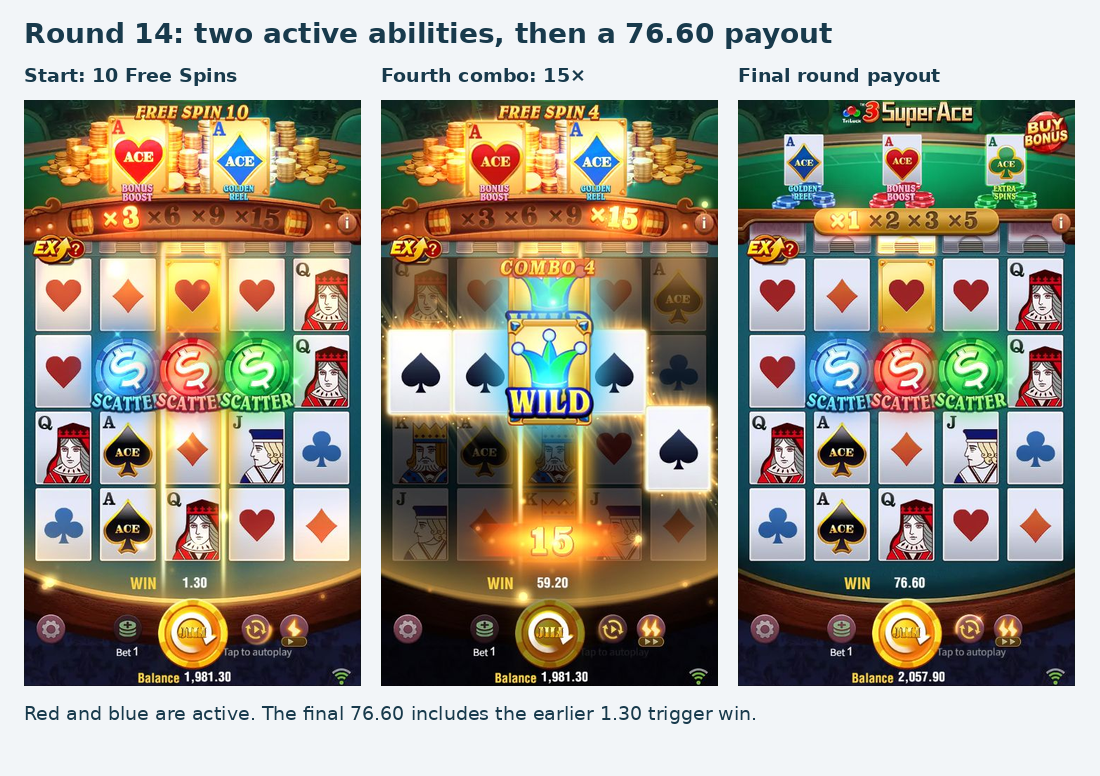
Red and blue are active. The final 76.60 includes the earlier 1.30 trigger win.
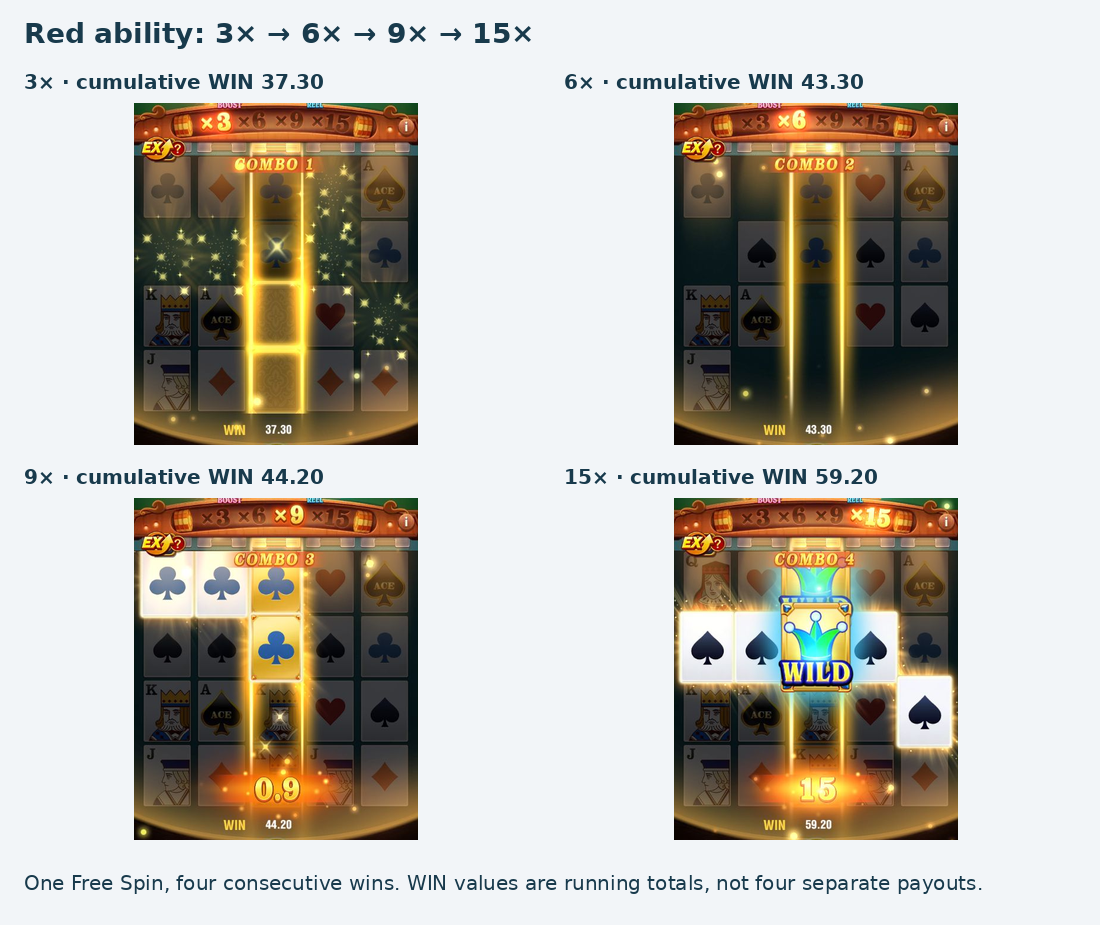
The displayed WIN increases through one Free Spin; do not add the four running totals together.
The complete paid round returned 76.60 on a cost of 1, for a net gain of 75.60. That final payout already includes the 1.30 won before Free Games. Likewise, the process displays of 37.30, 43.30, 44.20 and 59.20 are running WIN totals. Adding them together would count the same winnings repeatedly.
EX costs three times the base bet
EX upgrades the Scatter chips to gold. If a gold Scatter triggers Free Games, all three abilities are included. Enabling EX does not guarantee that the next spin will trigger Free Games. Each EX spin costs three times the base bet: base Bet 1 becomes an actual cost of 3, while the Help says payouts remain based on the base bet and its paytable.
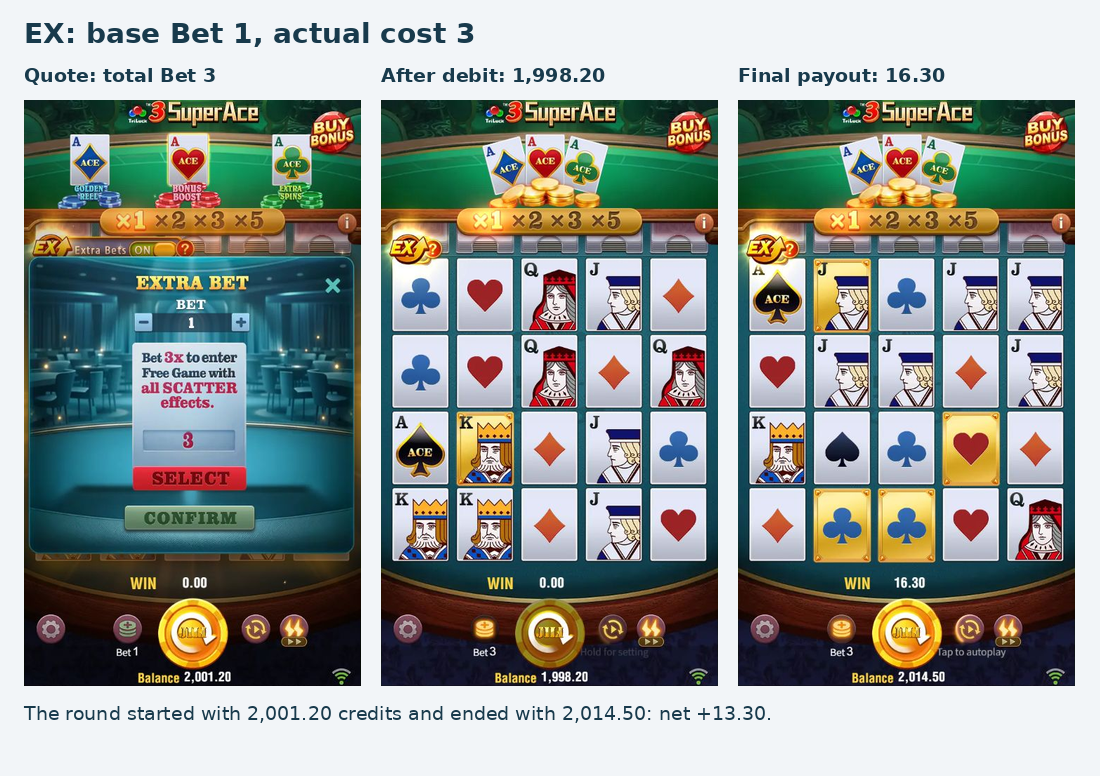
The round started with 2,001.20 credits and ended with 2,014.50: net +13.30.
Our first EX round showed the difference clearly. The balance moved from 2,001.20 to 1,998.20 at the debit, then settled at 2,014.50 after a payout of 16.30. Net profit was 13.30. Subtracting only the base Bet of 1 would overstate it by 2.
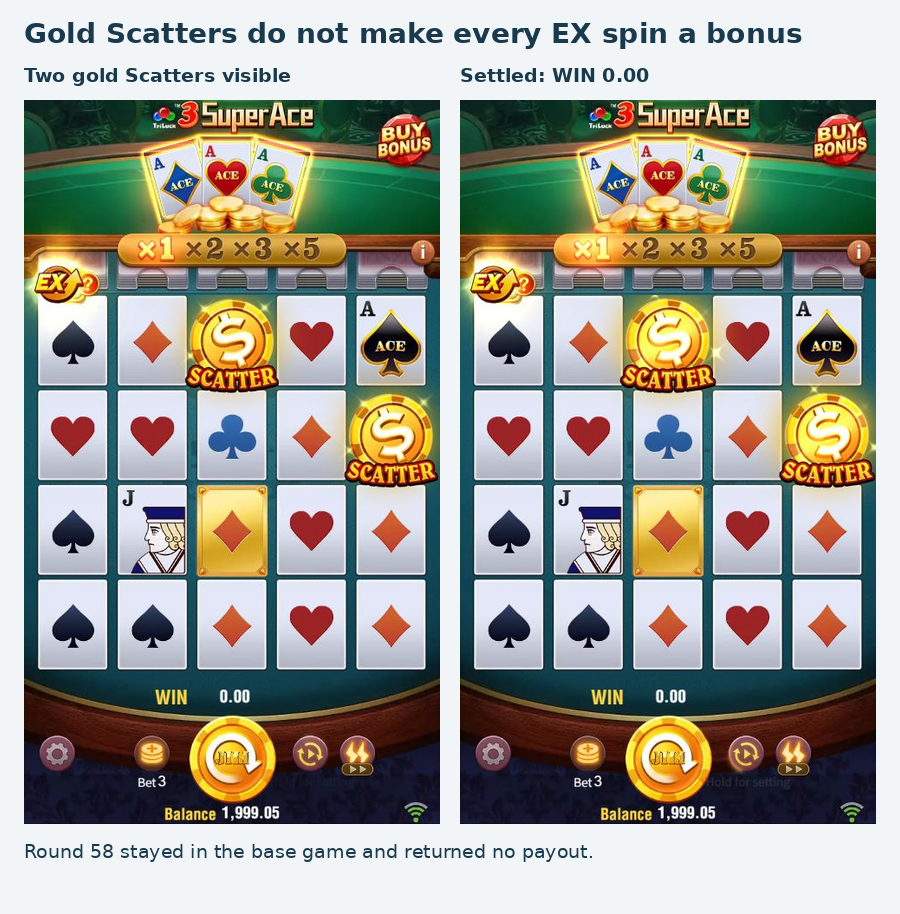
Round 58 stayed in the base game and returned no payout.
Round 58 showed two gold Scatters but stayed in the base game with WIN 0.00. The 50 recorded EX rounds contained no natural Free Game trigger. Those observations demonstrate the cost without an automatic bonus; they do not establish the trigger probability or a required number of chips.
The three Buy Bonus choices
Buy Bonus enters Free Games at a listed price. The lowest tier gives 1–3 random abilities, the middle tier gives 2–3, and the highest tier guarantees all three. Paying for an ability combination does not guarantee a payout above the purchase cost.
Tier at BUY Bet 1 | Ability rule | Observed start | Final payout | Net result |
|---|---|---|---|---|
30 credits | 1–3 random abilities | Green; 15 spins | 23.50 | −6.50 |
75 credits | 2–3 random abilities | Blue + green; 15 spins | 54.90 | −20.10 |
130 credits | All three abilities | Red + blue + green; 15 spins | 132.90 | +2.90 |
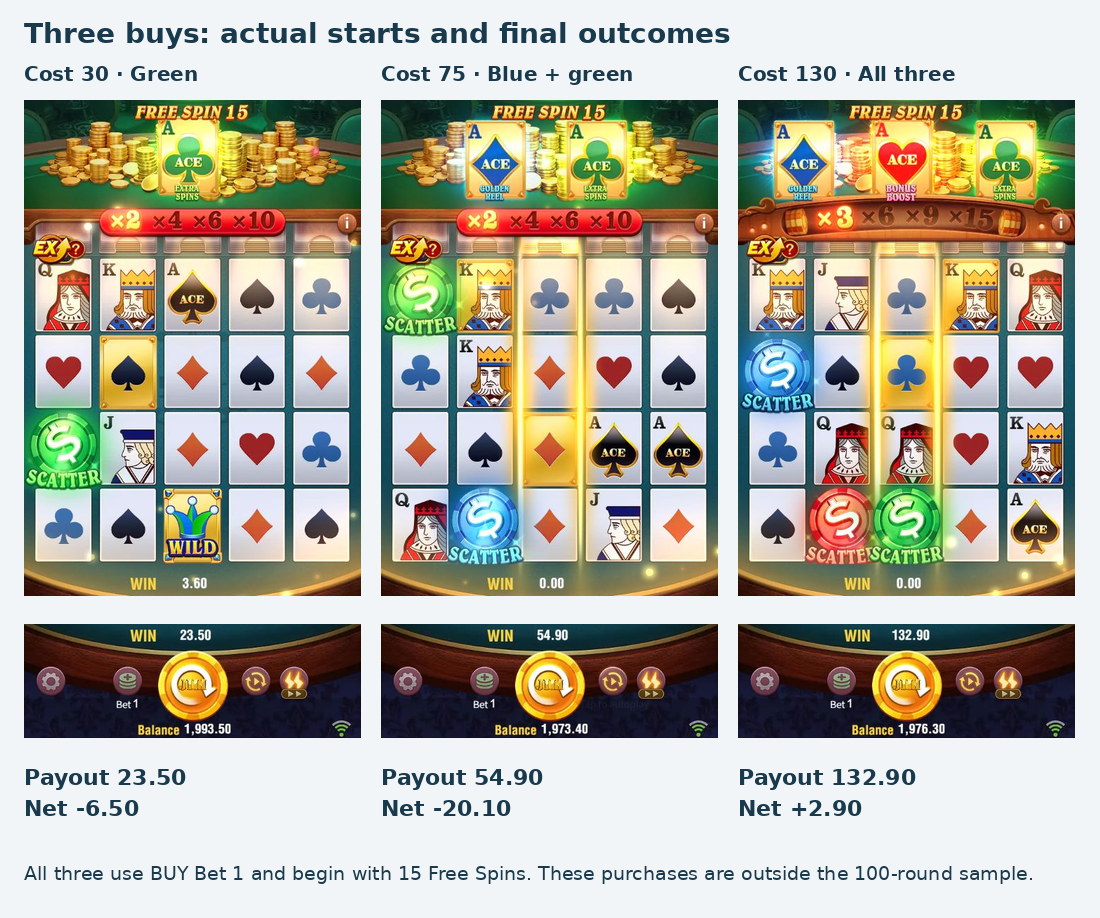
Each buy was tried once at BUY Bet 1. Two returned less than their cost; one returned 2.90 credits more.
We tried each tier once. Together they cost 235 and returned 211.30, a net loss of 23.70. They are separate from the 100-round sample below. The 130-credit result was only 2.90 above its cost, a useful reminder that a large displayed payout and a large profit are different things. One purchase per tier cannot tell us which option has the better long-term return.
5. Costs, RTP and the published limits
For budgeting a session, the actual debit matters more than the number beside the underlying Bet. EX uses three times that base amount. A buy uses 30, 75 or 130 times the Bet selected inside its own menu. Check the cost before committing credits and set a limit you can afford to lose.
Item | Information for this version |
|---|---|
Ordinary bet range | 1–1,000 credits |
EX cost | 3 × base bet; maximum total bet 3,000 |
Buy Bonus cost | 30× / 75× / 130× the BUY-menu Bet |
Maximum multiplier | 10,000×, according to JILI and the reviewed Help |
Maximum payout in the Help | 10,000,000 credits |
Official volatility label | LOW-MED, from JILI’s product listing |
Numeric theoretical RTP | Not verified in the official listing or reviewed Help |
JILI’s 3 Super Ace product page is the source for the March 2026 publication month and LOW-MED label. The maximum is a rule limit, not a target we reached or a promised result. A volatility label also does not make a short session steady.
The theoretical RTP is a long-run mathematical measure. Our sample return is a different calculation: the payouts we recorded divided by the actual credits spent. Neither a positive sample nor a long sequence of small or zero payouts tells you what the next round will do. Our slot simulator illustrates how short sessions can vary; it does not reproduce JILI’s undisclosed 3 Super Ace maths.
6. What the 100-round demo sample showed
The reviewed build was v_190_0004, with captures dated 4 October 2026 UTC. We recorded 50 ordinary paid rounds followed by 50 EX paid rounds, all at base Bet 1. Ordinary rounds cost 1 each and EX rounds cost 3 each. Each result includes all cascades and any Free Games from that paid round. The three separate buys are excluded. This is a short, sequential sample, not a controlled comparison of the two modes.
Recorded group | Paid rounds | Actual cost | Payout | Net result | Sample return |
|---|---|---|---|---|---|
Ordinary | 50 | 50.00 | 106.50 | +56.50 | 213.00% |
EX | 50 | 150.00 | 142.50 | −7.50 | 95.00% |
Combined | 100 | 200.00 | 249.00 | +49.00 | 124.50% |
The combined result was positive, but it was uneven. 26 rounds paid something; only 13 paid more than their actual cost. There were 74 zero-payout rounds, 87 net-loss rounds and no break-even rounds. The largest payout was round 14’s 76.60, which made up about 30.8% of all 249 credits returned.
Across the recorded order, rounds 26–42 formed a run of 17 zero-payout results, while rounds 15–42 formed 28 net losses. Both runs cross a session reset. They describe consecutive records, not one uninterrupted session, and they are not long-run hit-rate estimates.
Balance: distinguish play from wallet resets
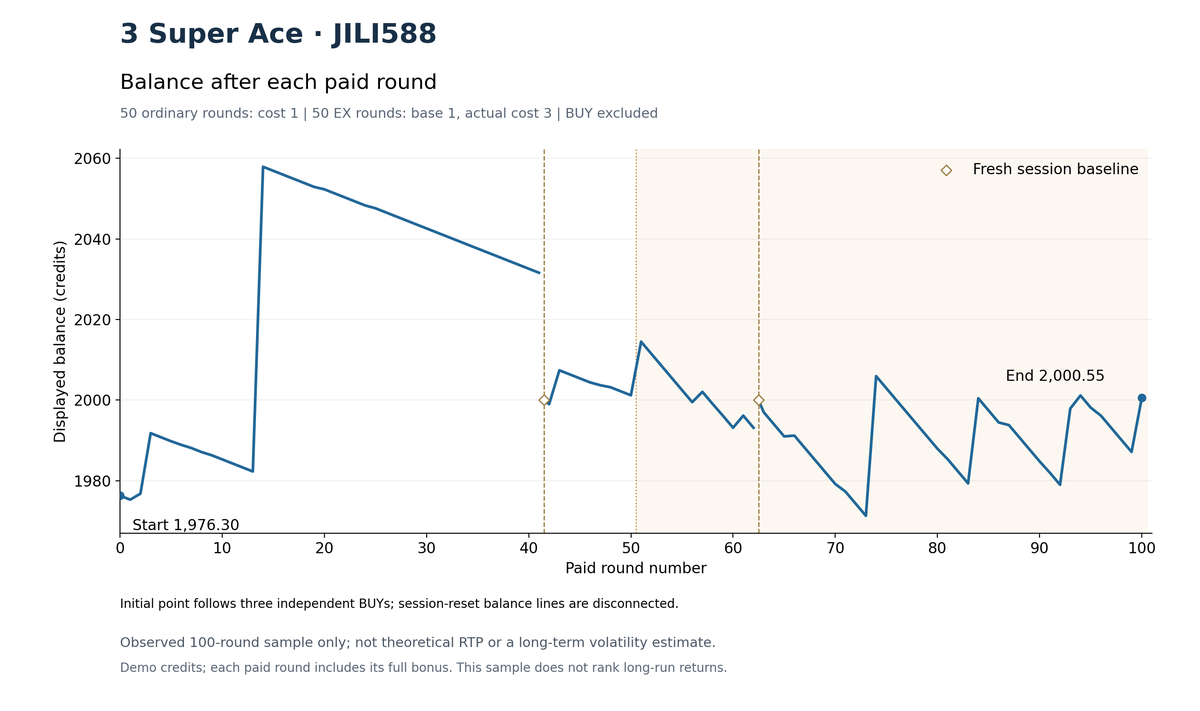
Balance is broken at the two resets. Non-bet wallet changes are not gaming profit or loss.
Two session resets changed the wallet outside play: 2,031.60 became 2,000 before round 42, and 1,993.15 became 2,000 before round 63. Those adjustments totalled −24.75. The sample’s opening and closing balances were 1,976.30 and 2,000.55, a difference of +24.25. Gaming profit was +49.00; the balance chart breaks the line at the resets so they are not mistaken for spin losses or wins.
Cumulative return: 124.50% is this sample only
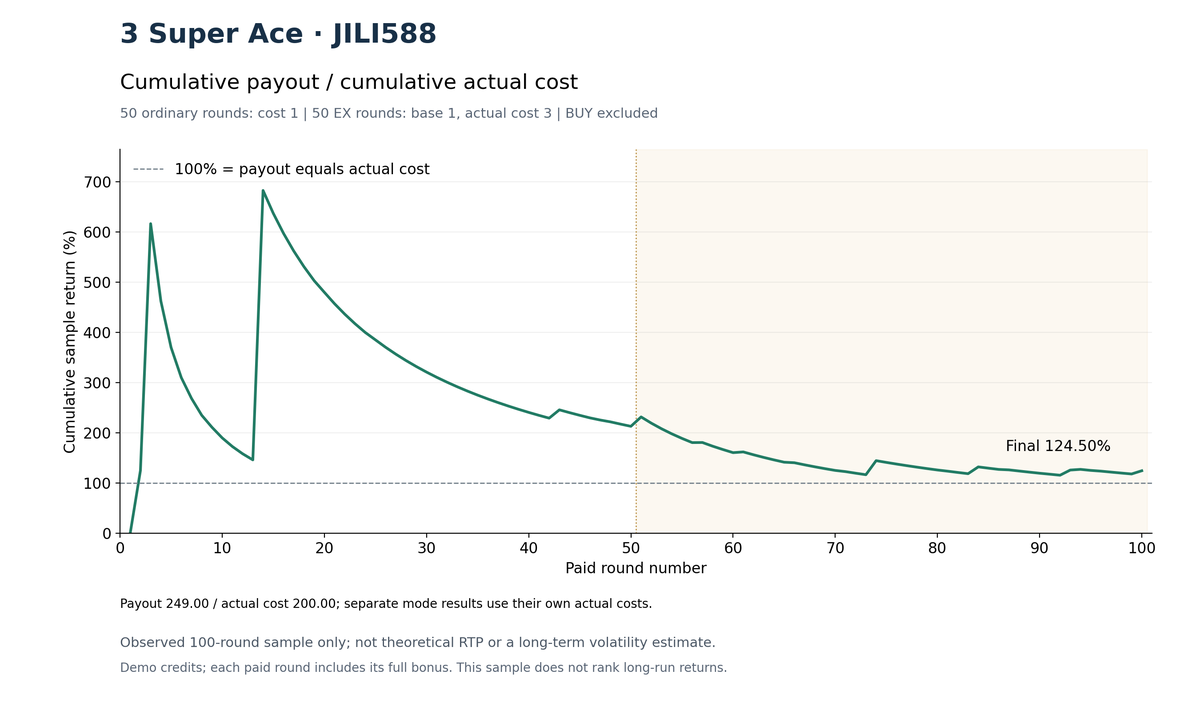
This sample ends at 249 / 200 = 124.50%. The line is not theoretical RTP.
The line divides cumulative payouts by cumulative actual costs. It finishes at 249 / 200 = 124.50%. EX costs must stay at 3 in that denominator. A single natural Free Game helped lift the ordinary section, and later outcomes changed the line again. The final percentage is not an official RTP or a forecast.
Net per round: payout minus the debit
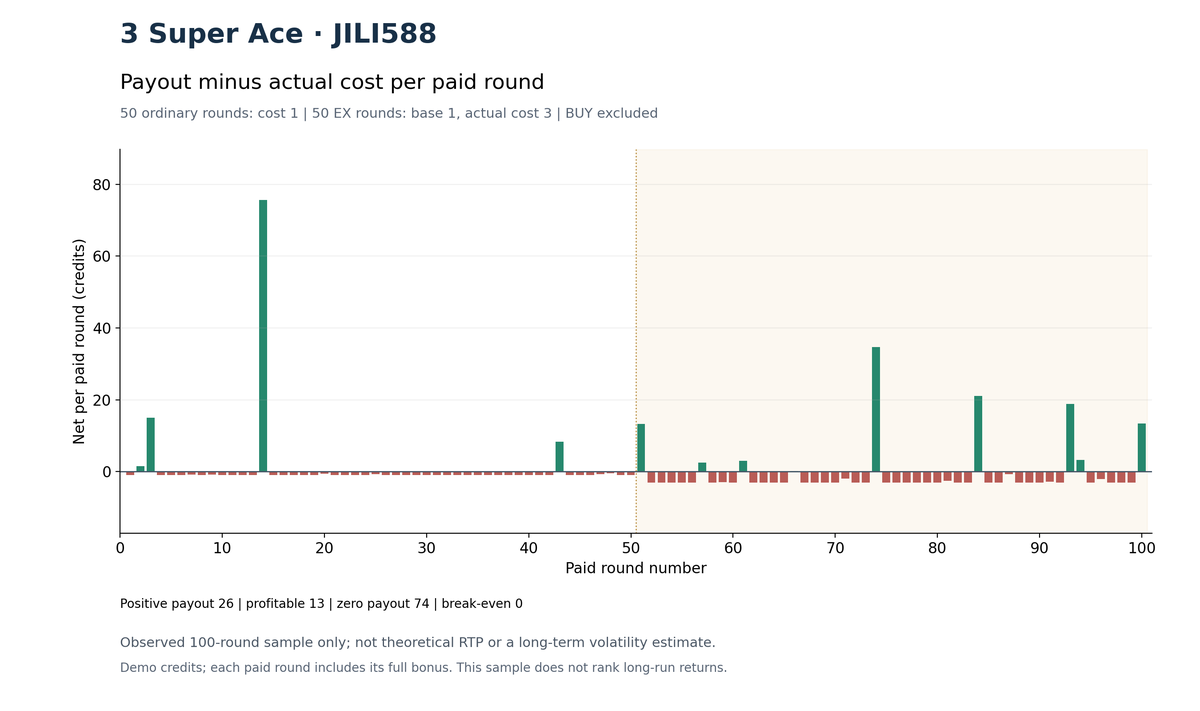
Each bar is one paid round including its cascades and any Free Games. BUY results are excluded.
The last chart treats each paid round as one result. It makes the long runs of losses and the few larger gains easier to see than the closing balance does. Ordinary zero payouts appear as −1; EX zero payouts appear as −3. For example, EX round 74 paid 37.65 on a cost of 3, so its bar is +34.65. The sample does not support choosing one mode as more profitable in the long run.
7. The verdict and the Super Ace alternatives
The strongest reason to try 3 Super Ace is the way the ability cards explain a bonus. Extra starting spins, a guaranteed Golden Symbol on the middle reel and a stronger multiplier ladder feel meaningfully different. I find the game easiest to understand when following one Golden card through its flip and the next cascade.
I would start in ordinary mode at normal speed to learn the display before considering the extra-cost options. That is an interface-learning recommendation, not a way to improve the return. No speed setting, colour sequence or previous loss makes a win due.
The series shares a playing-card look, but the features are not interchangeable. Choose by the mechanism you want to follow rather than by which review happened to finish ahead in a small sample.
Game | Main distinction | Why compare it? |
|---|---|---|
The original Golden-card cascade foundation | A simpler reference for the familiar 5 × 4, 1,024-way format | |
Star Card and a five-step multiplier progression | For players interested in a different route through the cascades | |
Mystery Symbols and a different ways structure | A more distinct variation on the card theme | |
Double and triple Stacked Golden Jokers | For comparing stack behaviour with this game’s three Free Game abilities | |
3 Super Ace | Three coloured abilities, 3×-cost EX and three buy tiers | For comparing bonus configurations within the same game |
3 Super Ace is the one I would pick for understanding how different bonus abilities change the same basic slot. Its learning curve is manageable, provided you check the active cards and actual cost rather than rely on the familiar Super Ace name.
3 Super Ace by JILI FAQs
Answers to common questions about 3 Super Ace by JILI.
3 Super Ace by JILI Reviews
 No Player Reviews Yet
Played 3 Super Ace by JILI? Share your experience with other players.
 Write A Review